
GameBrief · Reviews
Die in the Dungeon Review: Dice-Building With Brains
Die in the dungeon review: 31 dice, 142 relics, 4 frog warriors, and the 1.0 launch ATICO earned across 14 months of Early Access. Worth the $14.99.

Reviewing
Die in the Dungeon
ATICO · HypeTrain Digital, Sidekick Publishing
Score
Reviewed build: 1.0
Pros
- Dice-building with genuine depth: 31 distinct dice and 142 relics create a real build space, not the illusion of one
- Board positioning adds a spatial layer that comparable deckbuilders don't attempt
- Four characters with meaningfully different starting die loadouts extend replayability past the first run
- 1.0 release is the finished product: 14 months of Early Access shows in content volume and polish
Cons
- Early floors are too light: players familiar with the genre coast through the first biome without engaging the build systems
- No explanation of which characters suit which strategies; new players will pick wrong for their playstyle and not know why
Verdict
A well-made dice roguelite that delivers on the concept without overcomplicating it: $14.99 for something that's actually finished.
TL;DR
Die in the dungeon review in one line: 8/10, buy it. ATICO spent 14 months in Early Access building something tighter than the concept suggested. Dice replace cards, spatial positioning matters, and the Very Positive Steam rating (around 91% across 3,100+ reviews as of this update) holds up.
Die in the Dungeon review: Key takeaways
- PC only, $14.99 at 1.0 launch
- 1.0 released May 1, 2026: 14 months after February 2025 Early Access start
- 31 unique dice, 142 relics, 36 potions, 4 playable frog warrior characters
- Dice-building roguelite: customize die faces, stack relic synergies, manage board positioning
Die in the Dungeon review: Overview
Die in the Dungeon is a dice-building roguelite from solo developer ATICO. You play one of four frog warriors descending dungeon floors. The pitch is simple: instead of building a card deck, you build dice: selecting which faces to keep, upgrade, and chain into relic synergies as floors get harder.
ATICO launched into Early Access in February 2025. The gap between that version and the 1.0 shows. Fourteen months left a measurably cleaner game: 59 achievements worth of content, 142 relics with distinct trigger conditions, a board system that isn't decorative. It's the kind of 1.0 that justifies the Early Access model rather than using it as a way to charge for a beta.
The free browser version of Die in the Dungeon has been around for years: if you've played that, the commercial release is a full redesign, not a port. ATICO rebuilt the structure around the paid roguelite format with persistent run mechanics, character selection, and the full relic ecosystem. Familiarity with the browser version won't help or hurt much. The mechanical overlap is superficial.
Gameplay
The dice mechanic does more work than it looks like it should. Pick a character, grab a starting die loadout, and start descending. As floors progress, you collect new dice, reroll faces, and slot relics that change what those faces trigger. A poison die doing two-turn damage plays differently when a relic doubles DOT on odd floors. That layering (face selection plus relic synergy) is where the build depth lives. For a roguelike at this price point, the build space is larger than the genre usually delivers at $14.99.
The 31 dice have genuinely distinct face distributions, not cosmetic variation. Some lean into attack faces with one utility slot. Others carry more reroll faces, which function as probability management: cycle past weak results and land on the faces your relics reward. A die with two reroll faces in a synergy-heavy build is quietly doing offense. Recognizing this takes a run or two, which is where the replayability actually starts.
Board positioning is the element that separates Die in the Dungeon from comparable deckbuilders. Enemies telegraph their movement and attack patterns. Placing your frog on the right tile before committing dice isn't optional theory: it changes fight outcomes, especially from floor 5 onward where enemies start punishing passive positioning hard. The spatial element is modest (this isn't a tactics game) but it adds a layer flat deckbuilders don't replicate.
The four-character roster gives enough starting variation for replayability to feel real rather than padded. Each character approaches the dice economy differently, which changes which relics you prioritize in the early floors. Running all four before hitting meaningful repetition is more than most indie roguelites in this price range offer.
The 142 relics are where long-term build variety lives. The 1.0 content is deep enough that two runs with the same character rarely land at the same relic combination. Most relics have narrow trigger conditions (on poison, on the third attack in a turn, on a specific die face landing) which rewards learning the system rather than memorizing it. The 59 achievements serve a second purpose: they describe build directions the game never explicitly teaches. Scrolling the achievement list before run 3 is worth doing.
One honest criticism: the early floors are light on challenge. Players familiar with the genre will clear the first biome without engaging the build systems at all. The game finds its teeth around floor 5 or 6. That's a design choice toward accessibility, and the game earns the difficulty shift once it arrives, but the first run undersells what's actually here.
 Board positioning changes outcomes from floor 5 onward. Ignoring the tile layer in early floors is fine. Ignoring it in late floors isn't.
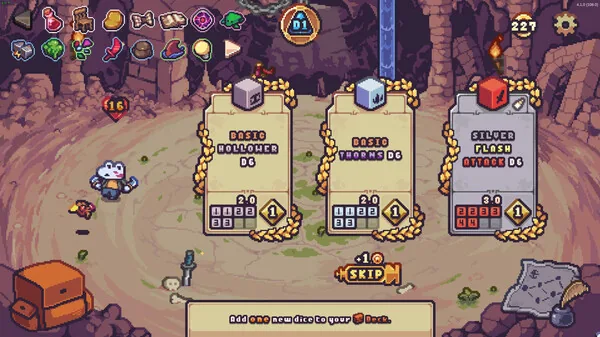 Which die you add here shapes what relic synergies become possible later, more than any single face modification does.
Verdict
This die in the dungeon review lands at 8/10, and that number isn't inflated by goodwill toward an Early Access finish line. The game is well-made. The dice system does something deckbuilders have been circling without landing: the physical die metaphor makes face selection feel like a thing you hold rather than a card you draw.
The game doesn't break new ground for the category. If you've played Slay the Spire, the loop reads as familiar. But the execution is tight, the content depth is real, and the board positioning layer adds a dimension that comparable games don't attempt. Skull Horde was the auto-battler dungeon pick for $9.99 last month. This is the manual-engagement version at $14.99, and it's the better game.
The 59 achievements add structured replay value without demanding completionism. Half of them unlock naturally during normal runs: resource milestones, floor reach counts, character usage. The others hint at specific build strategies or challenge conditions. If you've finished a run and want a reason for the second one, the achievement list gives you about a dozen reasons before you start repeating yourself.
Skip it if the frog warrior aesthetic doesn't land for you on aesthetics alone. ATICO is not trying to convince you the frogs are appealing. They are just the character models.
Buy it if you want a dice-building roguelite where the Early Access to 1.0 transition actually finished something.
Rating: 8.0/10
Related Reading
- Die in the Dungeon Complete Guide 2026: Hub for all Die in the Dungeon guides: builds, relics, dice tier lists, characters, and achievements.
- Die in the Dungeon Tips Guide: Positioning rules, dice management basics, and the relic priority decisions that carry runs past floor 5.
- Die in the Dungeon Best Build Guide 2026: Specific build paths ranked for consistency, including the Warrior stacking build and the Witch chain combo.
- Alabaster Dawn Review: CrossCode's Shadow, Its Own Light: Alabaster dawn review: Radical Fish delivers their first game since CrossCode. Weapon system solid, dungeon redesign works. 8.0/10....
- Mina the Hollower Review: Yacht Club's Gothic New World: Mina the Hollower review: Yacht Club's six-year gothic action-adventure at $19.99. Harder than Shovel Knight, denser than it....
- Luna Abyss Review: Bullet Hell in First-Person Horror: Luna Abyss review: Kwalee's first-person bullet hell on PC. Junji Ito atmosphere, projectile-dense combat, and Fawkes' prison story....
- Die in the Dungeon Achievements: All 59 and Dice Unlocks: Die in the dungeon achievements unlock 31 unique dice that persist across runs.
- Die in the Dungeon Relic Tier List: Best Picks & Synergies: Die in the Dungeon relic tier list: all 142 relics ranked, the categories to prioritize.
- Die in the Dungeon Floor Guide: Floors 1 to 6 Breakdown: Die in the dungeon floor guide: what each floor demands, how floor 5 kills most.
- Die in the Dungeon Relics: All Types, Triggers, and Effects: Die in the Dungeon relics guide: all 5 trigger categories, how each fires, which characters.
References
- Die in the Dungeon on Steam: store page, patch notes, and community hub
- ATICO on Steam: developer page
Frequently asked questions
Q: Is Die in the Dungeon worth buying? A: Yes. Around 91% positive across 3,100+ reviews as of this update, complete 1.0 content, and a dice-building system with real depth past the tutorial floors. At $14.99 it's not a close call.
Q: How many characters does it have? A: Four frog warriors with different starting dice and relic affinities. Each changes how you approach the early die economy.
Q: Is this like Slay the Spire? A: Structurally similar: roguelite runs, build synergies, floor escalation. The key differences are dice instead of cards, and board positioning that actually affects fight outcomes.
Q: How long is a run? A: 30 to 60 minutes. With 4 characters, 31 distinct dice, and 142 relics, the game holds past 10+ hours without significant replication.
Q: Is it still Early Access? A: No. 1.0 launched May 1, 2026, completing a 14-month Early Access period.
Q: What makes the dice different from cards? A: Die faces are physical slots. Upgrade, reroll, or replace specific faces as you descend. Relics modify how those faces trigger. The synergy space is larger than the surface concept suggests.
About the author

Games Critic
Games writer and reluctant optimist who has reviewed over 400 titles across 9 years. Irish, currently in Berlin. Has strong opinions about tutorial design.
- 400+ games reviewed across 9 years
- Platformer and horror specialist
- Narrative design focus
Keep reading



Disclaimer
This article is published for informational and entertainment purposes. It does not constitute professional financial, legal, or technical advice. Game performance, online services, patch schedules, and store listings change. Verify critical details (pricing, system requirements, regional availability) with publishers and storefronts before you buy. Affiliate links, where present, help support our editorial work and are labelled in our affiliate disclosure.
Comments
Loading comments…