
FeatureIndustria 2
INDUSTRIA 2 Out Now: Bleakmill's UE5 Narrative FPS Sequel
INDUSTRIA 2 launched on Steam April 29: Bleakmill's UE5 narrative FPS runs 4-6 hours, sends Nora into a parallel dimension ruled by rogue AI ATLAS.
INDUSTRIA 2 arrived on Steam April 29. Bleakmill's second commercial release is a narrative FPS that makes a structurally similar bet to what Frictional did with SOMA after Amnesia: new world, same protagonist, different rules entirely.
Sponsored

Bleakmill released the original INDUSTRIA in September 2021: a three-to-four hour narrative FPS set during the fall of East Germany, built around an unusual historical atmosphere and handcrafted environments. It accumulated "Mostly Positive" reviews on Steam, 71% positive across 4,000+ ratings, and built a following that cared more about the storytelling than the shooting. INDUSTRIA 2 sends Nora somewhere else. The Cold War setting is gone. What replaces it is a boreal parallel dimension, an artificial intelligence called ATLAS, and Bleakmill's second commercial release running on Unreal Engine 5 with Lumen global illumination.
The developer describes INDUSTRIA 2 on Steam as "a 4-6 hour long filler free journey." That phrase is doing more work than it appears.
TL;DR: INDUSTRIA 2 launched April 29, 2026 on PC at $24.99. Bleakmill's sequel moves Nora from Cold War East Germany into a boreal parallel dimension ruled by a rogue AI called ATLAS: same protagonist, different world logic, UE5 with Lumen lighting. The original held 71% Mostly Positive; INDUSTRIA 2 is currently Mixed at 49% across 431 English reviews. Free demo on Steam is the right entry point for anyone uncertain.
Sponsored

What is INDUSTRIA 2? (quick answer)
INDUSTRIA 2 is Bleakmill's sequel to their 2021 narrative FPS: a 4-6 hour first-person story that sends protagonist Nora into a boreal parallel dimension ruled by a rogue AI called ATLAS. It launched April 29, 2026 on PC via Steam at $24.99, with Unreal Engine 5 lighting, a diegetic inventory, and five upgradable weapons. A free demo has been available since October 2025. The original INDUSTRIA holds 71% Mostly Positive; the sequel launched at Mixed, currently sitting around 49% positive across 431 English reviews.
Current status: September 2026
INDUSTRIA 2 remains available on Steam with its free demo and 28 achievements. The current Steam snapshot is Mixed, 49% positive across 431 English reviews, so the launch score has moved from the earlier 52%/452 snapshot this article originally reported. The official Bleakmill announcement feed and launch trailer confirm that the full release is live; the rest of this feature keeps its launch-scope technical and narrative analysis.
Key takeaways
- INDUSTRIA 2 launched April 29, 2026 on PC, with a free demo available on Steam since October 2025
- Developed by Bleakmill (independent studio, operating since 2017), published by Headup and Beep Japan
- 4-6 hour campaign with full voice acting via Wwise, five upgradable weapons, and a diegetic inventory
- Unreal Engine 5 with Lumen lighting and Wwise audio: an unusual technical investment for a studio this size
- The original INDUSTRIA holds Mostly Positive reviews (71%, 4,000+ ratings): a stable foundation for a sequel
- Setting shifts from Cold War East Germany to a boreal parallel dimension under control of an AI called ATLAS
INDUSTRIA 2 overview
INDUSTRIA (2021) was built around a specific historical idea: the collapse of East Germany as an environment for a narrative FPS. That choice was unusual enough that most coverage at the time spent more words on the setting than the mechanics. The game ran 3-4 hours, ended where it ended, and Bleakmill said very little about what came next.
INDUSTRIA 2 was eventually confirmed, a demo dropped in October 2025, and the full game released April 29, 2026. Headup handles publishing again; Beep Japan covers Asian distribution. The setting is a parallel dimension: a boreal landscape controlled by an artificial intelligence called ATLAS. Nora is back. The historical framing is not.
The technical shift is measurable. Unreal Engine 5 with Lumen global illumination is a different undertaking than the previous game's foundation: not just for visual fidelity but for how light behaves in enclosed spaces, which matters for a game built around environmental atmosphere. Bleakmill has also implemented Wwise for dynamic music, which responds to game state rather than running as fixed tracks. Five weapons are available, all upgradable with attachments. Storage requirement is 20 GB.
A free demo has been on Steam since October 10, 2025. It remains available after the full game's launch. There's no reason to buy blind on a hardware-compatibility question.
GODEEPER: Road to Vostok is a single-developer survival FPS with a similar commitment to handcrafted environments over content volume: the review breaks down where that trade-off works and where it costs. Road to Vostok Review →
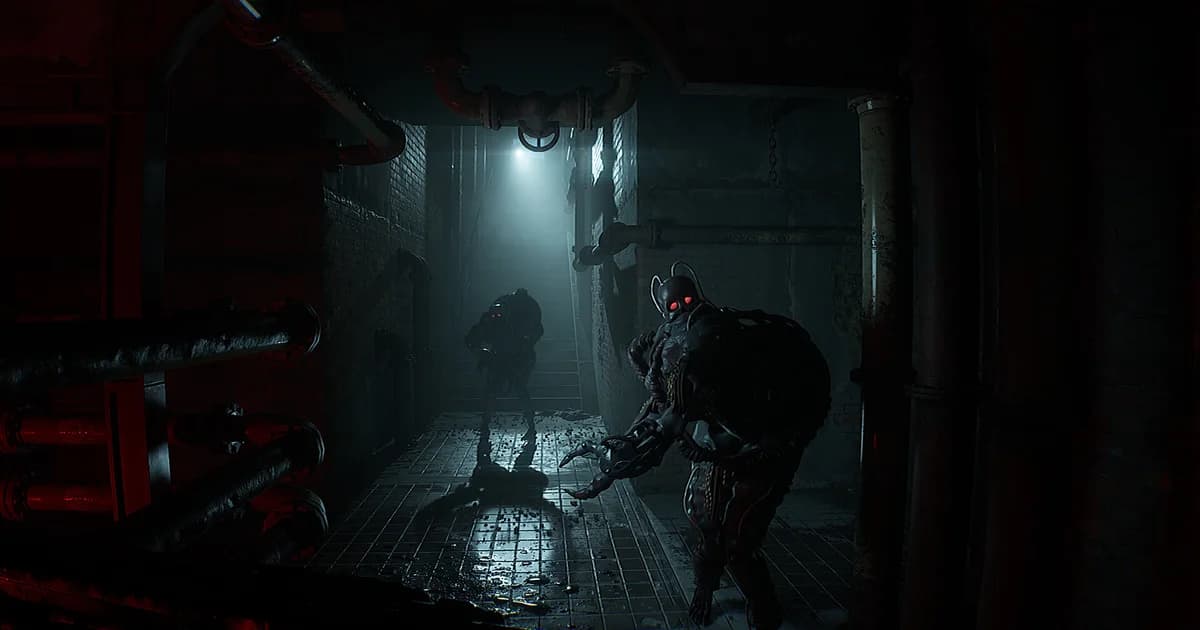
Enemy encounters lean on tight, dark corridors rather than open combat arenas.
What INDUSTRIA 2 adds
The mechanical detail worth examining is the diegetic inventory. INDUSTRIA 2 doesn't use a floating HUD for item management. Players interact with inventory through Nora's physical actions and in-world objects, not a pause-menu overlay. This is a deliberate design position with a genre history. Alien: Isolation, Resident Evil 7, and Hellblade each made versions of this choice, with different results. In games under six hours, diegetic systems can deepen immersion when they work and become a friction generator when they don't.
Whether Bleakmill's implementation falls on the right side of that line is something the Mixed launch reviews already speak to. What is clear from the feature list is that the decision was intentional, not an omission. Physics-based interaction and crafting are also in. Nora can push objects, use the environment, do things the combat alone doesn't require.
Five weapons are upgradable with attachments, which suggests a loadout system rather than a linear arsenal. Full voice acting covers all dialogue. Ten languages are supported at launch, including English, German, French, Japanese, and Korean.
The 20 GB install size is modest for a UE5 title, which suggests either aggressive texture streaming or a game that is genuinely as focused as Bleakmill's description implies.
INDUSTRIA 2 analysis: reading the sequel
The original INDUSTRIA's 71% positive score is an honest read of that game's ambition-to-execution gap. It did what it set out to do. Atmospheric, short, narratively coherent. But not much further than that. The ceiling was visible. A sequel that scores similarly tells you Bleakmill has held its audience. A sequel that scores higher, or more polarized, tells you something changed.
INDUSTRIA 2's premise shift is the more interesting signal. Moving away from the historical Cold War setting that defined the first game's identity is not an obvious commercial decision. That setting was INDUSTRIA's differentiator in a crowded indie FPS market. Replacing it with a parallel dimension and a rogue AI risks looking generic on a store page. But the framing of ATLAS as the antagonist, rather than a political or human conflict, suggests the thematic focus has shifted toward something colder and more systemic.
The Frictional comparison is imperfect but useful. SOMA (2015) followed Amnesia by moving from horror mechanics to philosophical science fiction. The genre shift lost some of the original's audience and gained a different one. INDUSTRIA 2 is making a smaller version of that gamble. The genre stays. The world logic changes. What ATLAS represents thematically, and whether the boreal dimension earns its premise over six hours, is what separates a sequel that justifies itself from one that simply adds content.
Environmental hazards like these spiked structures frame the boreal dimension's ruined architecture.
What this means for players
Players who finished INDUSTRIA in 2021 have a direct continuation available today. The original takes 3-4 hours and is still on Steam. Playing it first is worth the time for anyone planning to go into the sequel. The stories aren't identical, but Nora's situation in INDUSTRIA 2 follows from where the first game ends.
For players new to the series, the free demo on Steam removes the primary barrier to entry. Try it first. The diegetic inventory and physics interaction will either feel correct or they won't, and that's information worth having before spending money.
INDUSTRIA 2 is priced at $24.99 on the INDUSTRIA 2 Steam page, with no discount currently active. For context on what comparable indie games are pricing at right now, the best indie games under $20 in 2026 list provides a useful benchmark.
Reviews are in. INDUSTRIA 2 sits at Mixed on Steam: roughly 49% positive across 431 English reviews, compared to the original's 71% Mostly Positive. The gap between the original's ambition and its execution has widened rather than closed. Players uncertain about the sequel should try the free demo first; the game's length makes the demo a meaningful slice of the full experience before committing.
GODEEPER: Luna Abyss made a similar atmosphere-first bet in a different genre shell, first-person bullet hell instead of walking-sim horror. Luna Abyss Review: Bullet Hell in First-Person Horror →
Frequently Asked Questions
Is INDUSTRIA 2 a direct sequel to the original INDUSTRIA? Yes. INDUSTRIA 2 continues the story of protagonist Nora from the 2021 original. Bleakmill designed it to be accessible to new players, but returning players will get more from the narrative connections.
How long is INDUSTRIA 2? Bleakmill describes INDUSTRIA 2 as "a 4-6 hour long filler free journey." The original INDUSTRIA ran roughly 3-4 hours, so the sequel is longer at its upper end. Both are designed as complete, contained experiences.
What platforms is INDUSTRIA 2 available on? INDUSTRIA 2 launches on PC (Windows 64-bit) on April 29, 2026. Bleakmill has previously supported Xbox and PlayStation alongside PC: check the Steam page for current platform availability.
Does INDUSTRIA 2 have a free demo? Yes. A demo has been available on Steam since October 10, 2025 and remains accessible after the full game's launch. It's a practical way to test performance on your hardware before buying.
What engine does INDUSTRIA 2 run on? INDUSTRIA 2 uses Unreal Engine 5 with Lumen global illumination and the Wwise audio engine for dynamic music. Both are technical commitments you don't often see from an independent studio this size.
Do I need to play INDUSTRIA before INDUSTRIA 2? Not strictly, but it's worth the 3-4 hours. The sequel continues Nora's arc and references the first game's events. Playing the original first gives the ATLAS premise more weight when it lands.
Related Reading
- Road to Vostok Review: single-developer FPS with a similar commitment to handcrafted environments over content volume.
- Mixtape Launch: Annapurna's '90s Memory Adventure: a one-evening narrative game from the same 2026 window.
- Luna Abyss Review: Bullet Hell in First-Person Horror: a comparison on atmosphere versus mechanics.
- Die in the Dungeon Review: a smaller-scope contrast for atmospheric first-person design.
- Scriptorium Review: another narrative-first indie for readers who like slower pacing.
- Tides of Tomorrow Review: a differently structured narrative RPG.
- TetherGeist Review: another atmospheric indie release.
References
- INDUSTRIA 2 on Steam: store page, demo, and full feature list
- INDUSTRIA 2 official announcements: release and developer updates
- INDUSTRIA 2 launch trailer: official Bleakmill launch video
- Bleakmill official site: developer information and studio history
- INDUSTRIA (2021) on Steam: original game page and review history (71% positive, 4,000+ ratings)
About the author

GameBrief's byline for metroidvanias, RPGs, comparisons and design history. Places each game in its genre and argues both sides before picking one.
- Metroidvanias and RPGs
- Comparisons and design history
- Sources listed per article
Keep reading

Away From Life Early Access: Mixed Reviews Explained
General · 7 min
Dungeon Inn 1.0 Is Out: 12 Chapters and Who Should Buy It
General · 8 min
Steam Next Fest October 2026: Dates, Times and 15 Demos
Features · 7 min
Risk of Rain 2 Mithrix Guide: All 4 Phases and Escape
General · 10 min
Risk of Rain 2 Interactables: Shrines, Printers, Scrappers
General · 10 min
Do Steam Next Fest Demos Expire? What Valve's Rules Say
General · 6 min
Sponsored
Disclaimer
This article is published for informational and entertainment purposes. It does not constitute professional financial, legal, or technical advice. Game performance, online services, patch schedules, and store listings change. Verify critical details (pricing, system requirements, regional availability) with publishers and storefronts before you buy. Affiliate links, where present, help support our editorial work and are labelled in our affiliate disclosure.
Comments
Loading comments…