
GameBrief · Guides
LegionBound Ascension Guide: How to Merge Heroes (2026)

LegionBound Ascension is where most early runs fall apart. Two heroes of the same class merge into one stronger unit, which sounds simple. The problem is timing: the game tells you this mechanic exists without telling you when it needs to happen, which classes to merge first, or what you're actually risking when your Ascended hero gets focus-fired in wave 12.
TL;DR: Trigger your first LegionBound Ascension by wave 5. Commit to one class cluster from your first recruit so you have a same-class pair by wave 4. Ascended heroes produce a stat multiplier that stacks with synergy subclass effects: running both on the same class is the intended power loop. When an Ascended hero dies, you lose both component heroes permanently. Protect them with row positioning and item priority.
LegionBound Ascension: quick answer
- First Ascension must happen by wave 5 or you fall behind enemy scaling
- Two heroes of the same class trigger Ascension automatically when the merge condition is met
- Ascension (stat multiplier) and synergy (subclass upgrade) stack on the same hero: this combination is intentional and powerful
- Losing an Ascended hero in combat costs both component heroes permanently
- 800+ Ascension outcomes across 42 classes: specific results vary by item and synergy state
- Skill tree priority: recruitment speed over flat damage, to see more heroes per wave and find same-class pairs faster
Current status: September 2026
LegionBound is live on Steam, and the current store listing describes 42 classes, 50 heroes, and more than 800 Ascension combinations. The Steam review snapshot used for this audit was 563 positive recommendations out of 676 total, or about 83%; review totals move over time. The official July 23 Patch 1.1 added 12 heroes, more than 400 Ascension combinations, 16 items, four item reworks, loadout saving, Android support, and five languages. The September 10 Patch 1.12 focused on crash and hang fixes, including faulty targeting and lingering-zone issues. The merge advice below is still useful, but old May-only balance notes should not be treated as the current patch summary.
What LegionBound Ascension actually does
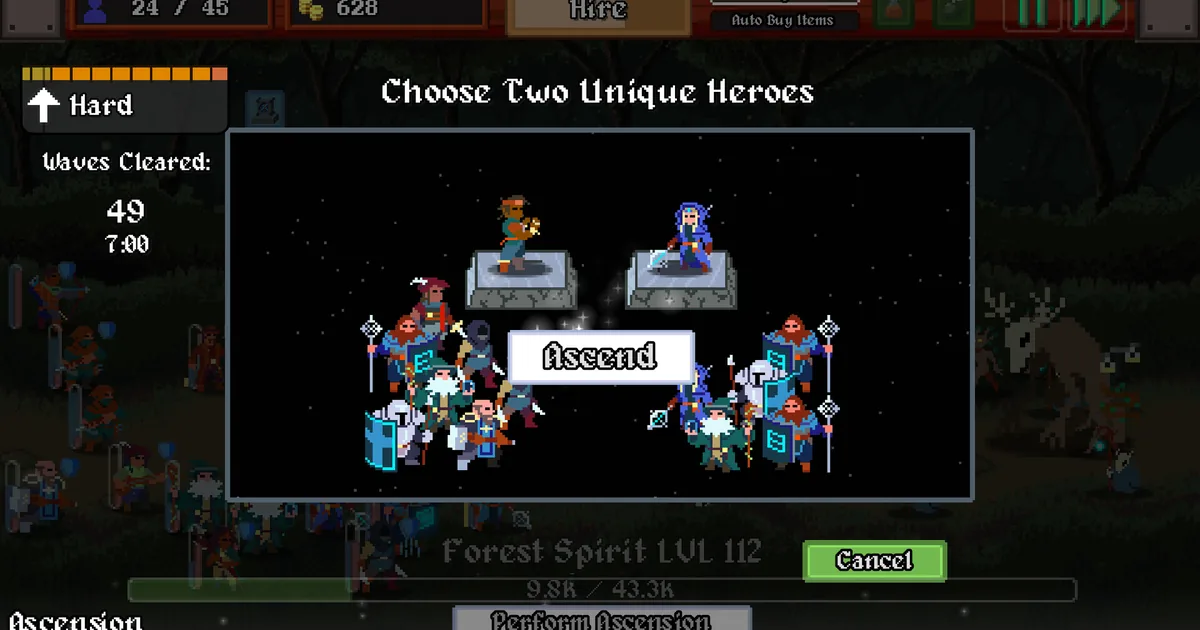
Ascension merges two heroes of the same class into one stronger unit. The merged hero occupies a single party slot, fights as that class, and carries a stat multiplier derived from the merge. Mechanically, it's not a new class: it's the same class at a higher power tier.
The 800+ Ascension outcomes come from how many variable inputs the merge reads: which items each hero carries, how far their stats have been upgraded, what their synergy state is at the moment of merge. Two Warriors merge differently depending on what they've been given across 8 waves of play. The variation is real, which is why Ascensions feel distinct across runs even when you're committing to the same class.
What doesn't change: an Ascended hero still belongs to the same synergy loop. An Ascended Warrior is still a Warrior in the Warrior group, still triggers Sorcerer's Warlock subclass, still benefits from having a Lumberjack in the party. Ascension deepens your class investment; it doesn't reset your synergy positioning.
LegionBound launched on Steam on April 27, 2026 at $9.99 USD, with its first discount arriving roughly two weeks later. For a broader introduction to the game's modes and core loop, the LegionBound launch overview covers what to expect before your first session.
GODEEPER: Before Ascensions click, you need the synergy system working. All 42 classes named, with the original 30 mapped to subclasses and loops. LegionBound Synergy Guide: All 42 Classes & Groups →
Step-by-step: triggering your first Ascension by wave 5
1. Commit to a class on your first pick:
Your starter class choice determines which class you'll be able to merge first. Warrior, Wizard, and Cleric go into the Warrior synergy group. Ranger and Rogue go into Barkeep. None of the starters belong to the Tax Collector group, so if you want that loop you're recruiting both Tax Collector classes from scratch.
For early runs focused on learning Ascension: pick Warrior. It's the easiest to find a second copy of within 4 waves, and it Ascends into a front-line tank that directly reduces pressure on the rest of your party.
2. Recruit toward a pair, not toward variety:
The temptation in early waves is to grab whoever looks strongest in the moment. A Barbarian that appears in wave 2 looks useful, but if you're running Warriors, that Barbarian just pulled a party slot from a potential second Warrior.
Target a second copy of your first class. In the first 4 waves, every recruiting decision should be filtered through "does this give me a same-class pair?" If a second Warrior appears, take it. If nothing matches and you need to add someone, take the class closest to your existing synergy chain.
3. Merge happens automatically, but positioning matters before it does:
Once you have two heroes of the same class, Ascension triggers automatically when the merge condition activates mid-combat. You don't manually execute it.
What you control is row positioning before the merge. If both Warriors are in the front row taking damage, one of them may fall before the merge fires. Position one of the pair in a mid-row slot if possible: they still contribute to combat but take less sustained focus fire. The merge needs both heroes alive when it triggers.
4. Use the new power spike immediately:
An Ascended hero is meaningfully stronger than what came before it. After the first Ascension, use the freed party slot to add the next class in your synergy chain: not another copy of the same class. You've spiked your first class; now you want to activate the synergy subclass on it by adding the adjacent loop class.
If you Ascended Warrior, the next recruit priority is Sorcerer (activates Warrior's synergy chain toward Warlock). That Sorcerer also becomes your second Ascension target: find a second Sorcerer and you'll have two classes both with Ascended and synergy-active states.
 Warrior group partial chain mid-run. The Sorcerer's Warlock subclass is active because a Warrior is in the party: both synergy and Ascension can be running simultaneously on each class.
Stacking LegionBound Ascension with synergy
Synergy gives your heroes their subclass upgrade. Ascension gives them a stat multiplier. These are separate systems that apply simultaneously to the same hero.
A Warrior with Spellblade synergy active is stronger than a plain Warrior. An Ascended Warrior is stronger than one that hasn't merged. Running both on the same hero is what the game is actually designed around.
The practical priority order: establish synergy first, then Ascend within the chain. This is because synergy requires a pair of adjacent-loop heroes (the synergy trigger class must already be present), which takes at least two party slots. Getting your first same-class pair while also maintaining the synergy trigger class means your 3rd and 4th recruits need to be targeted: one to complete the same-class pair, one to maintain or extend the synergy chain.
Tax Collector group makes this coordination easiest. All 4 classes are in a single loop, which means by wave 10 you can be running Ascended Tax Collector heroes with all four synergy subclasses active. The Tax Collector loop is tight enough that the merge targets and the synergy trigger targets are often the same classes.
For the Warrior and Barkeep groups, partial loop synergy works while you build toward Ascension. Two adjacent Warrior group heroes activate subclasses for both: you don't need all 14 classes. Pick the 3-4 closest to your starter and focus Ascensions on those.
Protecting Ascended heroes
This is the part LegionBound Ascension doesn't spell out. An Ascended hero represents two heroes in one slot. When that unit dies, both component heroes are gone permanently. A dead Ascended Warrior isn't one loss. It's two.
Row positioning is the main protection. Ascended heroes shouldn't be absorbing the most sustained damage unless they're tank-specced. An Ascended Warrior is a tank and belongs in front. An Ascended Wizard or Sorcerer goes mid-row or back, where the front row absorbs initial wave pressure before damage reaches them.
Defensive items (HP upgrades, shields, damage reduction) should go to Ascended heroes first when the shop offers them. You're protecting a two-hero investment. An item that adds 20% HP to an un-Ascended hero helps less than the same item on an Ascended one.
The other thing to watch: if your Ascended front-liner is at 30% HP and the next wave hasn't cleared, it's at risk. There's no retreat in LegionBound. Combat runs in real time and you can't pull heroes from their row mid-wave. This is exactly why wave 5 timing matters: an early Ascension means a full-HP merged hero entering mid-game, not a depleted one barely surviving long enough to trigger the merge.
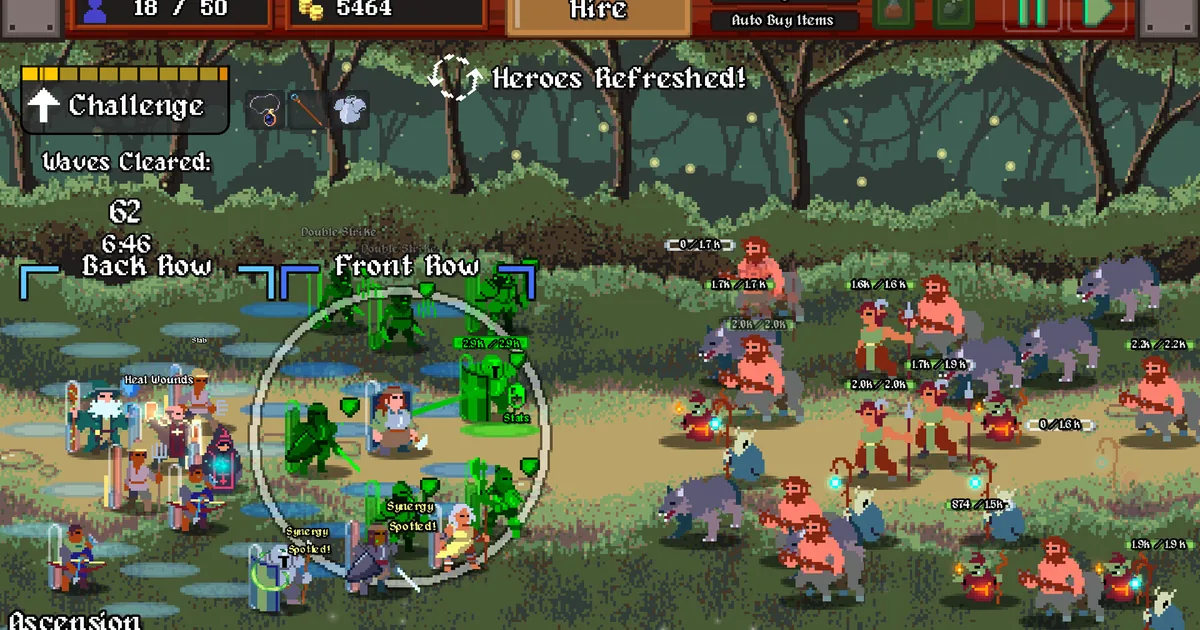
 Caption: A mid-run boss fight at wave 24, the kind of sustained pressure where an unprotected Ascended hero's two-hero investment is genuinely at risk.
GODEEPER: Not sure which starting class fits best with Ascension? The beginner guide covers first-run fundamentals including row positioning and when to commit to a specific synergy group. LegionBound Tips: Best Builds & Synergies for Beginners →
Skill tree priorities for LegionBound Ascension runs
The persistent skill tree carries over between runs. Every run advances it, including short ones. The question is where to spend early points.
Recruitment speed first. More options per wave means higher odds of finding a same-class pair before wave 5. The bottleneck isn't your hero's stats: it's how fast you can find two heroes of the same type. Recruitment speed nodes shorten that gap directly.
Item quality second. The Ascension merge reads each hero's item state at the moment of combination. Better items on both heroes going in means a stronger merged unit coming out. This is one of the few ways to meaningfully shape the outcome of a specific Ascension before it happens.
Flat damage multipliers come later. Once you have Ascension timing working and a reliable synergy chain, damage nodes scale well. Putting first points there doesn't fix anything: the structural problem in early runs is un-Ascended parties running too long, not heroes with too-low damage floors.
The instinct is to buy whatever feels immediately useful. Flat buffs to wave 1 hero stats feel good and do very little. Points spent on recruitment speed feel abstract and solve the actual problem.
Recent LegionBound patches and Ascension
The current official patch history matters more than the launch-era class notes. Patch 1.1 expanded the hero and item pool substantially, so a guide written around the original roster will understate the available merge paths. Patch 1.12 then fixed a faulty-targeting crash, a lingering-zone hang, and a stuck-item problem. In practice, keep the early same-class pair plan, but re-check the in-game roster and item tooltips after updates instead of assuming an old class tier list still applies.
LegionBound Ascension: summary
LegionBound Ascension is the main power mechanism the game is designed around. One Ascension by wave 5, synergy active on that Ascended hero, defensive items prioritizing that unit: that's the core structure every viable run is built on. The 800+ outcome variation comes from which class you're Ascending, what items those heroes carried in, and how far along the synergy chain you got before the merge fired.
The learning curve is the class commitment. New players instinctively diversify: grab strong-looking heroes from multiple classes. The game rewards the opposite: deep same-class investment, controlled synergy loop, and tight item discipline on the units that matter most.
Frequently asked questions
Q: What is Ascension in LegionBound? A: Ascension combines two same-class heroes into one stronger merged unit with a stat multiplier. The merged hero retains its class, continues to benefit from synergy, and occupies one party slot. Losing it in combat costs both component heroes permanently.
Q: When should I first Ascend in LegionBound? A: Wave 5. The enemy scaling makes un-Ascended parties increasingly unable to keep up past that point. To hit wave 5, you need a same-class pair by wave 4: meaning your first recruit should be a deliberate class commitment, not a grab for whatever looks strong.
Q: Does Ascension stack with synergy? A: Yes. Ascension (stat multiplier) and synergy (subclass upgrade) apply to the same hero simultaneously. Running an Ascended hero with its synergy subclass active is the intended power state. Both effects together are noticeably more impactful than either alone.
Q: What class should I Ascend first? A: Your front-row tank first: Warrior or Knight in the Warrior group, Barbarian in the Tax Collector group. A front-liner at risk of dying is the first merge target: Ascending it restores full HP while adding the stat multiplier, and the freed slot goes toward extending your synergy chain.
Q: How many Ascension outcomes does LegionBound have? A: 800+ across 42 classes. The specific outcome depends on item states, synergy state, and which heroes merged. This is why two Ascended Warriors from different runs can perform differently even as the same class.
Related Reading
- LegionBound Synergy Guide: All 42 Classes & Groups: the synergy system that feeds into Ascension: all 42 classes, the original 30 organized into three circular groups, and which subclasses to prioritize.
- LegionBound Tips: Best Builds & Synergies for Beginners: first-run fundamentals including row positioning and which synergy paths to unlock before reaching Ascension.
- LegionBound Endbringer Guide: When to Fight and How to Win: the Ascended builds that perform best against Adventure Mode's final boss at different loop counts.
- LegionBound Gold Farming: Coins, Gems, Economy Guide: Skill Gem farming to fund Ascension path unlocks across runs.
- LegionBound Battle Mode Guide: Endurance Runs: how Ascended builds hold up in endurance scaling past wave 30.
- LegionBound Ascension Chain: Timing, Risk, Recovery 2026: LegionBound ascension chain guide. Second and third merge timing, high-wave hero protection, and how to recover when an....
- LegionBound Adventure Mode Guide: Route, Build, Win: LegionBound Adventure Mode guide: map routing, camp building choices, when to loop vs fight the.
- LegionBound Advanced Builds: Late-Game Class Chains (2026): LegionBound advanced builds: endgame class clusters, stat priorities by Ascension tier, and how to read.
- LegionBound Tier List 2026: Ranking All 30 Classes: LegionBound tier list ranking all 30 classes from S to C: synergy chain value, Ascension.
- LegionBound Builds: Beat the Endbringer on Loop 2+: LegionBound builds for loop 2+ Endbringer: dual Warrior subchains, aura positioning, Mine building priority, and.
References
- Legionbound on Steam: current roster, systems, release information, and review snapshot
- LegionBound Steam announcements: official Patch 1.1 roster and Ascension expansion, plus the September 1.12 fixes
- Spicy Garlic Games: developer page
- LegionBound complete guide hub: all classes, synergies, ascension, and battle/adventure mode guides
Was this guide helpful?
About the author

Senior Critic & Analyst
Former game data analyst turned critic with 11 years covering indie and mid-tier games. Based in Austin. Runs spreadsheets on games most people just play.
- 11 years games criticism
- Former game economy analyst
- Roguelike and strategy specialist
Keep reading

Disclaimer
This article is published for informational and entertainment purposes. It does not constitute professional financial, legal, or technical advice. Game performance, online services, patch schedules, and store listings change. Verify critical details (pricing, system requirements, regional availability) with publishers and storefronts before you buy. Affiliate links, where present, help support our editorial work and are labelled in our affiliate disclosure.
Comments
Loading comments…