
GameBrief · Guides
LegionBound Synergy Guide: Launch 30 Classes (2026)

LegionBound synergy is the system everything else is built around. For the launch roster, field the prerequisite pair and the class being paired-into can promote into its synergy subclass: a second-tier form that changes the hero's role. The official store page confirms that all 42 classes have a synergy subclass, while the launch dependency table below covers the 30-class loop structure.
29 classes across 3 loops, each with its own synergy subclass, plus one odd case (the Peasant) that operates outside the loops entirely: 30 classes total at launch. Patch 1.1 (July 23, 2026) added 12 more heroes on top of that, bringing the full roster to 42. The official patch announcement describes the additions as heroes with their own abilities and passives, but does not publish a named dependency table, so the loop breakdown below stays within the verified launch roster.
TL;DR: The launch roster uses 3 circular groups: Warrior (14 classes), Barkeep (11), and Tax Collector (4), plus the independent Peasant. Each launch class has a documented prerequisite that unlocks its synergy subclass. Start with the Tax Collector group if you want the smallest loop. Three of the five starters (Warrior, Wizard, Cleric) belong to the Warrior group, while Ranger and Rogue enter Barkeep. Patch 1.1 added 12 more heroes in July 2026, bringing the total roster to 42; the official announcement does not name their loop placements.
Legionbound synergy: key takeaways
- Three circular synergy loops: Warrior (14 classes), Barkeep (11 classes), Tax Collector (4 classes)
- Every class has a synergy subclass: unlocked when you field the right pair
- Synergy direction matters: Class A synergizes with the next class listed after it in the loop
- Tax Collector group is easiest: only 4 classes needed to complete the full loop
- 5 starters split across 2 groups: Warrior, Wizard, Cleric in Warrior group; Ranger, Rogue in Barkeep
- Peasant is special: the class guide says it needs 3 other synergy heroes promoted, not the normal loop dependency
- Patch 1.1 (July 23, 2026) added 12 new heroes, growing the roster from 30 to 42 total
How LegionBound synergy works
Each launch class in the three documented loops has one synergy partner: the next class listed in the loop. Field both and meet the activation condition, and the earlier class upgrades into its synergy subclass form. The 12 Patch 1.1 additions are not assigned to the tables here because the official announcement confirms their abilities and passives but does not name a new loop map.
The synergy subclass is not a separate unit you recruit. It's the evolved state of the class itself: same hero slot, different ability set. A Warrior without synergy plays differently from a Warrior who has triggered Spellblade. The subclass changes skills, stat weights, or both.
The circular structure means every class is simultaneously someone's synergy trigger and someone's synergy beneficiary. A Sorcerer in your party not only unlocks its own Warlock subclass when a Witch is present, it also acts as the trigger the Warrior needs for Spellblade. Stacking multiple adjacent classes in one loop is how you create cascading synergy effects across your roster.
Loop structure matters more than individual class strength. A Rogue at base state is weaker than a Rogue running as Assassin. Chasing synergy pairs beats recruiting whoever looks biggest in the moment.
GODEEPER: New to LegionBound? Before the full synergy breakdown, the beginner-focused rundown covers row positioning, Ascension basics, and why your first skill tree points shouldn't go into flat damage. LegionBound Tips: Best Builds & Synergies for Beginners →
 Synergy pairs that work in Battle Mode may not translate to Adventure Mode's resource pressure.
The three synergy groups
Warrior group: 14 classes
The largest loop. Three of the five starter classes (Warrior, Wizard, Cleric) belong here, so most players enter this loop naturally in their first few runs.
| Class | Synergy Subclass | Synergy Trigger (pair with) |
|---|---|---|
| Warrior | Spellblade | Sorcerer |
| Sorcerer | Warlock | Witch |
| Witch | Hexer | Cleric |
| Cleric | Mender | Paladin |
| Paladin | Templar | Priest |
| Priest | Bishop | Knight |
| Knight | Stalwart | Smith |
| Smith | Armorer | Guardian |
| Guardian | Bulwark | Shield Mage |
| Shield Mage | Bastion | Battlemage |
| Battlemage | Enchanter | Wizard |
| Wizard | Magus | Druid |
| Druid | Grovekeeper | Lumberjack |
| Lumberjack | Axeman | Warrior |
The Warrior group is the longest loop to complete, but partial chains still provide synergy value. Running Warrior + Sorcerer activates Spellblade on the Warrior. Add Witch and Sorcerer also unlocks Warlock. You don't need all 14 to start benefiting: any adjacent pair in the table above triggers the earlier class's subclass.
Three starter classes in this group means you're likely to land 2-3 Warrior group heroes in the first few waves without deliberate effort. The decision point is whether to commit to deepening that loop or branch into Barkeep.
Barkeep group: 11 classes
The mid-size loop. Two of the five starters (Ranger, Rogue) are here, and the group has a mix of physical and utility classes that work well together as a focused damage cluster.
| Class | Synergy Subclass | Synergy Trigger (pair with) |
|---|---|---|
| Barkeep | Alchemist | Herbalist |
| Herbalist | Apothecary | Ranger |
| Ranger | Snapshot | Artificer |
| Artificer | Wright | Samurai |
| Samurai | Ninja | Rogue |
| Rogue | Assassin | Duelist |
| Duelist | Fencer | Gunslinger |
| Gunslinger | Trickshot | Swashbuckler |
| Swashbuckler | Trickster | Bard |
| Bard | Poet | Monk |
| Monk | Drunken Fist | Barkeep |
The Rogue → Duelist → Gunslinger stretch is one of the more accessible partial chains in the Barkeep group. Rogue is a starter class, Duelist can be recruited early, and running all three activates Assassin on Rogue and Fencer on Duelist (Gunslinger needs Swashbuckler too before its own Trickshot fires). The Ranger → Artificer pair is similarly efficient if you take Ranger as your starter, unlocking Snapshot on Ranger.
Barkeep group's 11 classes sit between the Warrior group's size and the Tax Collector's speed. You can build meaningful partial loops here faster than in the Warrior group, but not as easily as the Tax Collector's tight 4-class loop.
Tax Collector group: 4 classes
The smallest loop and the easiest complete loop in the game. Four classes, all of them unlockable within a reasonable run length if you prioritize them.
| Class | Synergy Subclass | Synergy Trigger (pair with) |
|---|---|---|
| Tax Collector | Strongarm | Barbarian |
| Barbarian | Berserker | Brawler |
| Brawler | Boxer | Mercenary |
| Mercenary | Bounty Hunter | Tax Collector |
The full Tax Collector loop activates all four synergy subclasses simultaneously. That's Strongarm, Berserker, Boxer, and Bounty Hunter all live in one party configuration: something that takes many more heroes to achieve in either of the larger groups.
None of the five starters belong to the Tax Collector group, so you're recruiting your way in from scratch. That's the tradeoff: the loop is compact enough to complete, but you start with zero natural entries. The Barbarian and Brawler tend to appear mid-run, with Tax Collector and Mercenary being the less common finds depending on the mode.
Peasant: special case
Peasant (listed in-game as Protagonist) doesn't belong to any of the three circular loops. It has a different dependency: the class guide says Peasant synergizes after three other synergy heroes have promoted.
Peasant is a later-run target because of this. Recruiting it early does not itself satisfy the condition; build the other promoted heroes first and let Peasant upgrade when the requirement is met.
Peasant's synergy class is Protagonist. The source material also distinguishes that promoted state from the separate True Legend Ascension, so do not treat Protagonist as a fourth circular-loop class.
Step-by-step: building your first synergy chain
Step 1: Pick a starter that anchors a loop.
Your first run's synergy direction starts with your starter class. Warrior, Wizard, and Cleric all anchor the Warrior group. Ranger and Rogue anchor Barkeep. None anchor Tax Collector, so if you want to run that loop, you're committing to recruiting your first two classes fresh.
For the first run, pick Warrior or Rogue. Warrior puts you in the largest loop with multiple nearby classes likely to appear. Rogue puts you in Barkeep with Duelist and Gunslinger as natural follow-ups.
Step 2: Identify your synergy direction immediately.
When you recruit your second hero, check which synergy group they're in and where they fall in the loop relative to your starter. If your second hero is the next class after your starter in the loop, your starter's synergy is already active. If they're from a different group, you're starting to split attention: which is sometimes correct but needs to be a deliberate choice, not an accident.
The class tables above show every synergy trigger relationship. Bookmark this and check it when you're deciding which recruit to take in the early waves.
Step 3: Extend the chain before branching.
The most common mistake in the first dozen runs: taking a hero from a second synergy group too early because they look individually strong. A Barbarian (Tax Collector group) joining a Warrior group party is doing base-class work (no synergy) while also pulling a party slot away from a Warrior group recruit that would activate a subclass.
Get a few adjacent Warrior-group heroes in a chain before you consider branching, or deliberately pursue the compact Tax Collector loop. The exact wave at which to branch is run-dependent; the source tables establish the dependencies, not a universal wave deadline.
Step 4: Stack Ascensions within the chain.
Ascension is a separate promotion layer. The Steam class guide describes combining synergized heroes into Ascended Units and warns that an Ascended hero does not count as the prerequisite for another synergy. Do not describe Ascension as a same-class merge or assume that an Ascended Warrior can replace the base prerequisite needed for Spellblade.
Promote a unit first when the prerequisite is available, then treat Ascension as a separate choice. The official sources confirm both systems exist, but they do not establish a universal damage multiplier or a guaranteed "stack both" outcome for every class.
Step 5: Reassess loop completion at mid-run.
By mid-run you can estimate how many remaining classes in your primary loop you're likely to see. If you've built 6 classes in the Warrior group and there are 8 more you haven't encountered, completing the full loop isn't happening this run. Shift focus: deepen what you have through Ascensions and look for what the Barkeep or Tax Collector groups can add without fracturing your core synergy chain.
If you're running the Tax Collector group's 4-class loop, mid-run assessment is easier because the dependency chain is short. Whether it completes still depends on the heroes offered in that run.
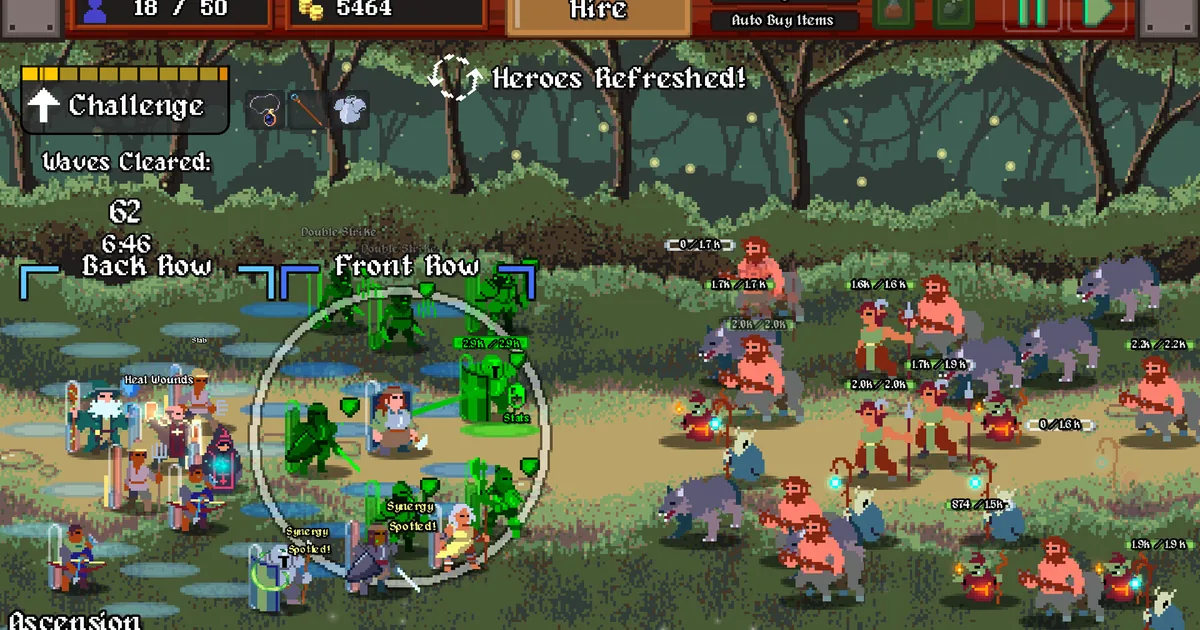
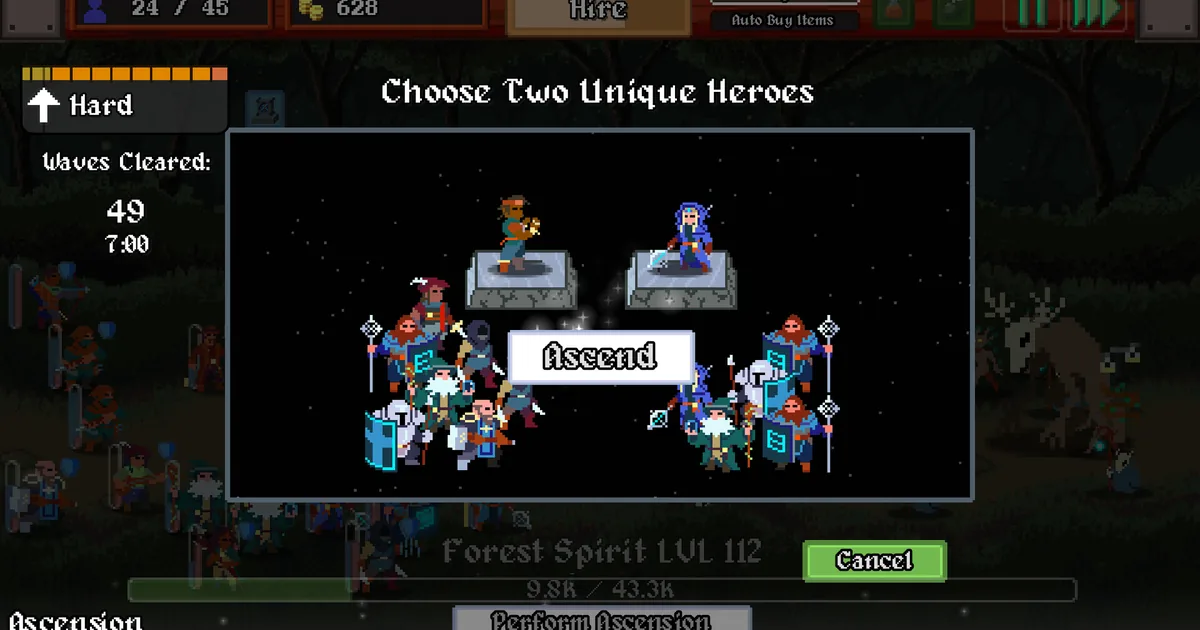
 Ascension choices like this one are where the game's hero-combination system meets the synergy roster; use the preview rather than assuming a same-class outcome.
Tips
Synergy subclass names are the signal. When you see a class displaying its synergy subclass name in the hero info panel, synergy is active for that hero. If the base class name shows instead, synergy is not firing. Use this to verify your pairs are actually triggering, not just coexisting in the party.
Tax Collector loop is your training wheels run. Four classes means you can run the full loop experiment without committing a 20-wave investment. Do one full Tax Collector run to understand what a completed loop feels like (all four subclasses active simultaneously) before scaling up to the longer loops.
Treat Peasant as a later target. Its synergy condition requires three other synergy heroes to have promoted. Recruiting it early does not satisfy that requirement, so make the decision around your available roster rather than a fixed wave number.
Mixed groups are sometimes correct. If you're running the Warrior group and take a Tax Collector-group hero, check the actual dependency table before calling it a synergy. Tax Collector promotes with Barbarian; Barbarian promotes with Brawler or Boxer. A shared group label alone does not activate a subclass.
Partial loops still improve individual heroes. You don't need to complete the loop for synergy to matter. Warrior + Sorcerer = Spellblade on Warrior, full stop. Every adjacent pair in the tables above is a synergy pair, even if you never build the full 14-class Warrior loop.
If you bounce off autobattlers, try the roguelite format first. LegionBound has an Adventure Mode with map choices, buildings, modifiers, rewards, and a final Endbringer decision. The official store page describes the final foe gaining power as you build; it does not frame that system as a fixed boss timer.
GODEEPER: LegionBound's launch week context: what Very Positive reviews are actually saying and whether this is worth your time if you've bounced off autobattlers before. LegionBound Launch Week Analysis →
May 2026 balance patches: what changed
Several classes and charms received nerfs in May. If advice you read before May 7 references Ninja, Bard, or Cleric passive behavior, it may no longer apply.
Patch 1.05 (May 5): Three charms nerfed: Healer's Charm, Hunter's Charm, and Bloodsoaked Charm all had their scaling reduced. These were popular charm picks in Warrior and Barkeep group builds. Synergy subclass strength is unaffected; the nerfs hit supporting charm layers.
Patch 1.053 (May 7):
- Ninja (Samurai's synergy subclass): Ability cost changed from 1/3 of Action Gauge to 25%. A net nerf to Action Gauge efficiency. The Samurai → Ninja chain in the Barkeep group is still strong, but Ninja's burst output per gauge cycle is reduced.
- Bard Passive: Nerfed. Bard sits in the Barkeep group (synergy subclass: Poet, triggered by Monk). The passive reduction affects sustained output in long waves.
- Cleric Passive: Changed (not a pure nerf). Cleric is a Warrior group class (synergy subclass: Mender, triggered by Paladin). The passive change altered the healing cadence. If you were building around Cleric's passive timing, test the current behavior before committing to a build guide written before May 7.
Cleric healing bug (fixed May 11): A bug caused Cleric healing to not apply correctly in certain team compositions. This was live from launch until May 11. Cleric's actual output before the fix may have been higher or lower than intended depending on configuration.
Chain Lightning known bug (as of May 12): Unresolved as of late May. Affects specific Wizard/Magus interactions in the Warrior group. If you're building around Chain Lightning procs, verify behavior in-game rather than relying on pre-patch documentation.
Frequently Asked Questions
How does synergy work in LegionBound? Synergy is circular: each class has one synergy partner (the next class listed in its loop). Field both classes together, meet the activation condition, and the earlier class upgrades to its synergy subclass. The subclass is not a separate recruit; it's the evolved state of the class itself.
What are synergy subclasses in LegionBound? Every class has a synergy subclass (a powered-up form unlocked when its synergy condition is active. Warrior's synergy subclass is Spellblade, Rogue's is Assassin, Ranger's is Snapshot. Subclasses are not separate units) they're the upgraded state of the base class when synergy fires.
Which LegionBound synergy group is easiest to build? Tax Collector group: only 4 classes. You can complete the full loop and activate all four synergy subclasses (Strongarm, Berserker, Boxer, Bounty Hunter) simultaneously. The larger groups require more party slots and run length to approach completion.
What is the Peasant class in LegionBound? Peasant (Protagonist) is outside the three circular loops. The class guide says it promotes after three other synergy heroes have promoted. It is a later-run target, not a normal loop link.
What are the 5 starter classes in LegionBound? Cleric, Ranger, Rogue, Warrior, and Wizard. Warrior, Wizard, and Cleric belong to the Warrior synergy group. Ranger and Rogue belong to the Barkeep group. All five give you immediate entry into at least one major synergy loop.
How many classes are in LegionBound? LegionBound launched with 30 classes: 29 split across three loops (Warrior 14, Barkeep 11, Tax Collector 4) plus Peasant outside the loops. Patch 1.1 added 12 new heroes, bringing the total to 42; the official patch note confirms their abilities and passives but does not provide a named loop table, so this guide limits its table to the launch roster.
What is the Warrior synergy group in LegionBound? The largest loop: Warrior, Sorcerer, Witch, Cleric, Paladin, Priest, Knight, Smith, Guardian, Shield Mage, Battlemage, Wizard, Druid, and Lumberjack. Three starter classes are here, making it the most naturally-entered loop in early runs.
Related Reading
- LegionBound Complete Guide Hub: the source-backed overview of LegionBound's modes, class system, and between-run progression.
- LegionBound Advanced Builds: Late-Game Class Chains: specific class-chain recommendations for players who want to push deeper endurance runs.
- LegionBound Ascension Guide: All Hero Builds: hero-combination advice, the 800+ possible Ascension heroes, and how to use the in-game preview.
- LegionBound Gold Farming: Coins, Gems, Economy Guide: how coins drop, Tax Collector mechanics, and Skill Gem persistence, the economy layer that sits under the synergy loop.
- LegionBound Battle Mode Guide: Endurance Runs: endurance-mode recruiting and editorial build advice without unsupported wave deadlines.
- LegionBound Endbringer Guide: When to Fight and How to Win: synergy timing against Adventure Mode's scaling final boss.
- LegionBound Ascension Chain: Timing, Risk, Recovery 2026: LegionBound Ascension choices, risk, and recovery advice, with exact outcomes treated as run-dependent.
- LegionBound Adventure Mode Guide: Route, Build, Win: LegionBound Adventure Mode guide: map routing, camp building choices, when to loop vs fight the.
- LegionBound Tier List 2026: Ranking 30 of 42 Classes: editorial S-to-C rankings of the original 30 launch classes; Patch 1.1's 12 heroes are kept outside the ranking.
- LegionBound Builds: Beat the Endbringer on Loop 2+: LegionBound build ideas for later Endbringer attempts, with exact outcomes treated as run-dependent.
- LegionBound Warrior Group: All 14 Classes & Synergies: LegionBound Warrior group: all 14 classes in the largest synergy loop, how the circular subclass.
References
- LegionBound on Steam: official store page describing 42 classes, synergy subclasses, Ascension, rows, and between-run progression
- LegionBound 1.1 - Volatile Elements: official patch note confirming 12 new heroes, their abilities/passives, and 400+ additional Ascension combinations
- Hero Class Guide: Steam community reference listing launch/new hero class names and prerequisite pairs
- Hero Synergy Groups: Steam community reference describing the 30 launch heroes and the three dependency loops
- Spicy Garlic Games on Steam: developer page
- r/LegionBound on Reddit: community tips and loop discussion
- LegionBound Tips: Best Builds & Synergies for Beginners
- LegionBound Launch Week Overview
- LegionBound complete guide hub: all classes, synergies, ascension, and battle/adventure mode guides
- LegionBound launch coverage: the related LegionBound guides and updates
Was this guide helpful?
About the author

Senior Critic & Analyst
Former game data analyst turned critic with 11 years covering indie and mid-tier games. Based in Austin. Runs spreadsheets on games most people just play.
- 11 years games criticism
- Former game economy analyst
- Roguelike and strategy specialist
Keep reading

Disclaimer
This article is published for informational and entertainment purposes. It does not constitute professional financial, legal, or technical advice. Game performance, online services, patch schedules, and store listings change. Verify critical details (pricing, system requirements, regional availability) with publishers and storefronts before you buy. Affiliate links, where present, help support our editorial work and are labelled in our affiliate disclosure.
Comments
Loading comments…