
GameBrief · General
Legionbound Tips: 42 Classes, Builds and Synergies

These Legionbound tips cover what the game won't tell you in the first hour. Row positioning matters. Ascensions are automatic but you have to set them up deliberately. The skill tree persists between runs and most players spend their first few points on the wrong nodes.
These tips come from working through the first dozen runs of both Battle Mode and Adventure Mode: the autobattler RPG from Spicy Garlic Games that launched April 27 and has since expanded with the Volatile Elements update.
TL;DR: LegionBound's depth lives in three systems the tutorial skips: row positioning (front row holds, back row stays alive and scales), Ascensions (automatic merges you set up deliberately by fielding pairs of the same class), and the run-persistent skill tree (spend early points on recruitment speed and item quality, not flat damage). With 42 classes total (the original 30 organized across three synergy groups, plus 12 more added in Patch 1.1), your first goal is completing one full synergy loop, not collecting strong individuals. The Tax Collector loop is the easiest to finish early.
Legionbound tips? (quick answer)
Start by protecting the front row, force an early same-class Ascension, and commit to two or three synergy clusters instead of recruiting every attractive outlier. Battle Mode is the cleaner first practice space; Adventure Mode adds routing and the Endbringer timer before you understand the roster.
Current status: September 2026
Patch 1.1, Volatile Elements, went live July 23 and added 12 new heroes, more than 400 additional Ascension combinations, new Brittle/Wet/Oily status effects, loadout saving, interface improvements, and an Android release. That is why this guide treats the roster as 42 classes rather than the launch-era 30. The official Steam page currently shows 645 reviews at 83% positive, with 18 recent reviews at 77% positive when checked; the launch-week review count below is historical context, not the current score.
Legionbound tips: key takeaways
- Ascensions require same-class hero pairs: stack class clusters deliberately, not randomly
- Row placement determines who takes damage first; front row needs your highest-HP heroes
- Battle Mode is the better starting point; Adventure Mode punishes class system ignorance
- Skill tree: spend early points on recruitment speed and item quality, not damage multipliers
- 2-3 synergy clusters outperform a 6-class spread every time
Legionbound tips: overview
Legionbound runs on a core loop that looks simple but has real depth: recruit heroes between waves, position them in rows, let combat play out automatically while you cast spells and buy items. The complexity comes from the class system: 42 classes total, the original 30 each with a known synergy subclass you unlock by stacking heroes of that type (Patch 1.1 added 12 more whose subclasses aren't catalogued here yet), plus Ascensions that merge pairs into stronger units. The new heroes also add hundreds of Ascension combinations, so the cost of a stray recruit is higher now than it was at launch.
The autobattler label is accurate but undersells the decision density. You're making 4-6 meaningful choices per wave even when nothing is happening on screen.
The game runs in real time during combat, but the strategic layer is entirely in the pauses between waves. That's when you recruit, reposition, buy items, and decide which class cluster to double down on. Most players lose their first ten runs because they treat those inter-wave pauses as downtime rather than the actual game. A 30-second recruitment window where you add two heroes to your party and swap a front-liner is more impactful than anything you'll do once the wave starts.
The skill tree is persistent but not obvious about it. Every run advances it, including runs you abandon at wave 3. If you quit out early thinking the run was a loss, you still earned points. Check the tree after every session, not just after a long run.
If you've already seen the Legionbound launch coverage and want specifics on how to actually win runs, this is the guide.
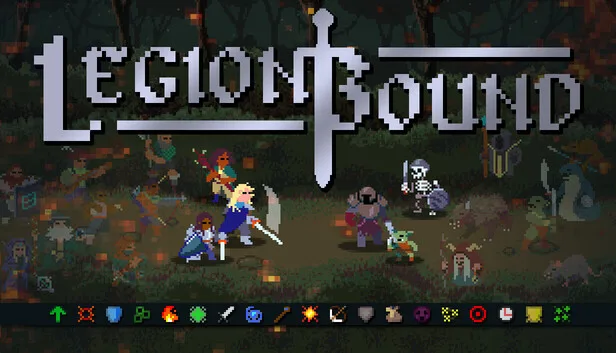 Hero recruitment screen. Classes display their synergy subclass when you hover: understanding which subclasses align with your current party is half the game.
Step-by-step: how to survive your first run
- Put your highest-HP heroes in front, recruit a second copy of a core class, and aim for one Ascension before wave 5.
- Narrow the party to two or three class clusters by wave 3, then buy items that reinforce those synergies.
- Spend early skill-tree points on recruitment speed, item quality, and starting gold before flat damage bonuses.
Understand rows before wave 3
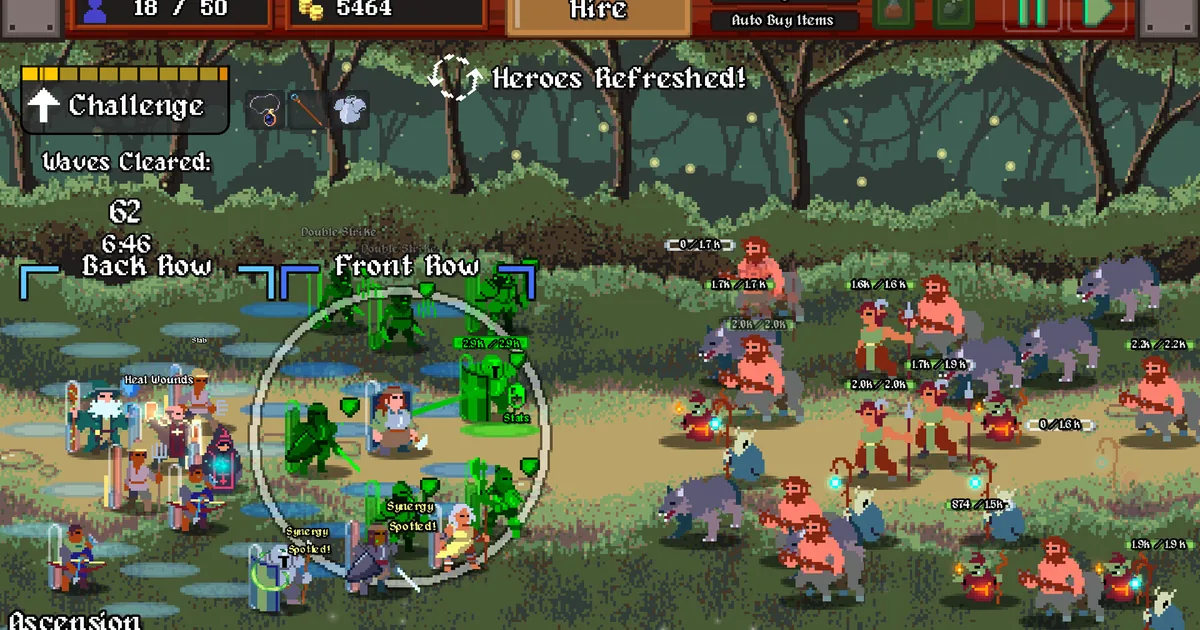
Heroes fight in rows. Front row takes the most damage. Back row stays safer but usually deals less direct damage unless you're running ranged or caster classes. Your job isn't to set up the front row once and forget it: it's to swap heroes between rows as your party grows.
Practical rule: your two highest-HP heroes belong in the front row until you have Ascended tanks. If they die first, the damage spills into your squishier back-row casters and your run ends fast.
Trigger your first Ascension by wave 5
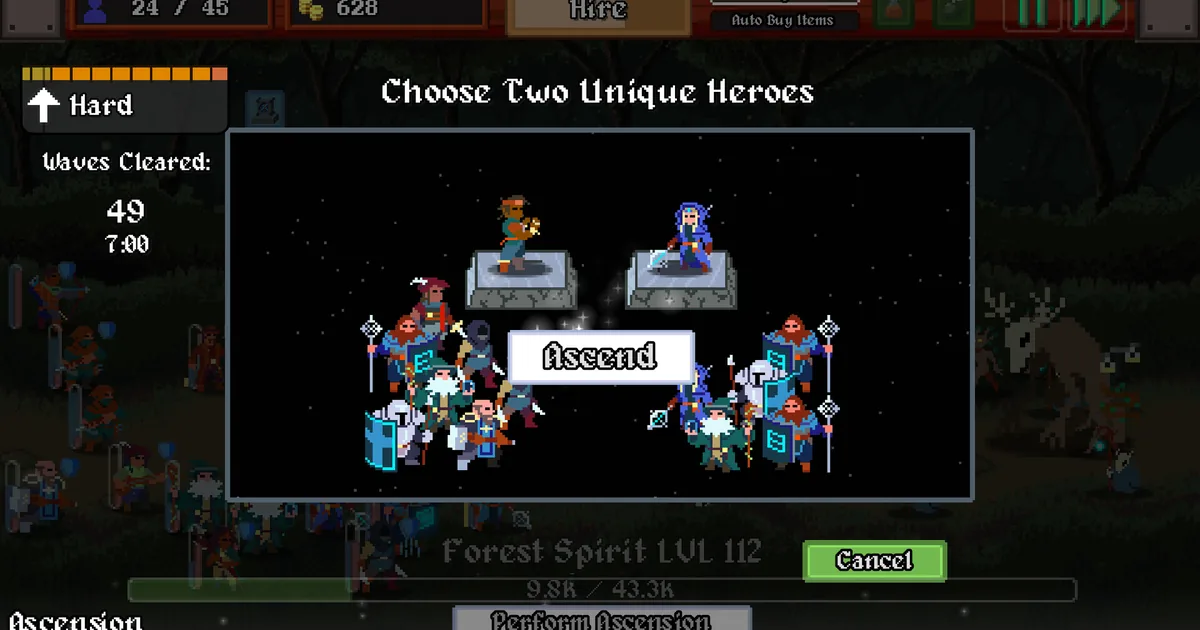
Ascensions are the power spikes that carry runs. To trigger one, you need two heroes of the same class: recruit a second copy of any class you already have and they'll combine into an Ascension unit automatically in battle.
The earlier this happens, the earlier you start pulling ahead of the enemy scaling. Aim for your first Ascension by wave 5. If you hit wave 7 without one, you're probably too spread across classes to recover.
Lock in 2-3 class clusters and ignore tempting outliers
The biggest mistake in Legionbound is opportunistic recruiting. A high-stat hero of a class you don't have looks good. It isn't. Taking it breaks your synergy cluster math.
Choose 2-3 class types by wave 3 and only recruit outside them if the alternative is leaving a slot empty. At 42 classes, the temptation to diversify is constant. Resist it. Synergy subclasses unlock based on how many heroes of a given type you have in the party: spreading thin means never unlocking the deeper bonuses.
GODEEPER: Die in the Dungeon has a similar resource-timing problem: knowing when to hold versus spend changes your survival rate completely. Die in the Dungeon Tips Guide →
Match passive items to your primary synergy
Items bought between waves give passive stat bonuses. The most important thing about them isn't the stat values: it's whether they activate synergy bonuses for your primary class cluster. A mediocre item that triggers warrior synergy on a warrior-heavy party is worth more than a high-stat item from an incompatible class.
When you have a choice between two items, ask: which one lines up with my 2-3 class focus? The other one is a trap.
Tips
Battle Mode unlocks things; do it first
Battle Mode gives you the cleanest look at how class synergies scale without the Endbringer timer pressure of Adventure Mode. When a run ends there, you've lost nothing except time. The skill tree still advances, and you leave knowing which classes you'd actually want to stack next.
Adventure Mode introduces map routing, building placement, and the Endbringer: a boss that grows more powerful with every loop. Playing Adventure Mode as your first mode is like playing the DLC campaign before the base game.
Don't assume your Ascension is safe
Ascended heroes can still die. When an Ascension dies, the two component heroes are gone: and if that pair was your only stack of that class, you've lost your synergy anchor. If you have a second copy of a class hero waiting to Ascend, keep recruiting a third so you have a spare.
This matters most in Adventure Mode around the third or fourth map, when enemy health scales enough that even your front-line Ascended hero takes sustained damage. Backups aren't wasted recruits: they're insurance.
Spell timing changes outcome
You can cast unlockable spells during battle. The default instinct is to cast as soon as a spell is ready. That's usually wrong. High-value spells (AoE damage, group heals) are worth holding 2-3 seconds to hit a moment when enemies cluster or when several of your heroes drop to dangerous HP at the same time.
Spending a spell on two enemies is a waste if six appear 3 seconds later. Patience on spells extends runs more than any single item purchase.
Early skill tree priority
The persistent skill tree is where long-term Legionbound progression lives. Failed runs feel less bad once you understand every run advances it.
Early priorities, in rough order:
- Recruitment speed: faster hero acquisition between waves means more class choices per run
- Item quality tier: higher tiers shift which items appear, so synergy matching gets easier
- Starting gold: extra wave-1 gold lets you recruit toward your cluster target immediately
Flat damage bonuses are lower priority early. You're not trying to brute-force through waves: you're building the infrastructure to construct better parties.
What the current Steam score means at $9.99
Legionbound crossed 382 reviews in its first two weeks at its $9.99 launch price. That launch number is historical; the current Steam page shows 645 reviews at 83% positive. The reviews that mention frustration are mostly about learning the class system without enough upfront explanation, not value for money. Players comfortable with autobattler genre conventions consistently rate the depth well above the price.
One pattern worth knowing: the learning curve levels off sharply after you understand Ascension and class synergy basics. Players who push through the first three or four runs before reading any guides tend to report the game clicking around run six, once the skill tree has enough invested to make synergy construction reliable.
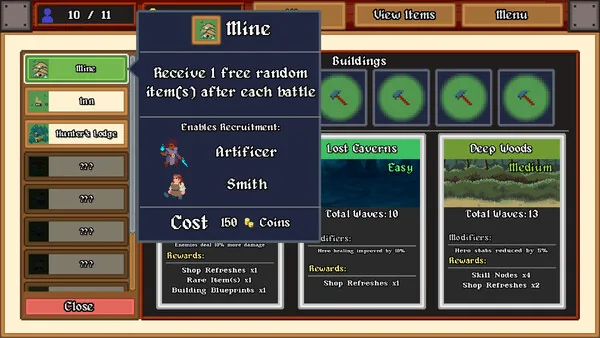 Losses still give skill points: a failed run that teaches you the Endbringer's pattern isn't wasted.
GODEEPER: Gambonanza runs a similar early-optimization logic where what you do in the first few rounds defines your ceiling. Gambonanza Tips Guide →
Frequently Asked Questions
What are Ascensions? Combining two heroes of the same class creates one stronger Ascension hero. With 800+ possible Ascensions, there's more depth here than any single run reveals.
Battle Mode or Adventure Mode first? Battle Mode. It lets you experiment without the Endbringer timer.
How many heroes should I run? The slot limit is 50, but most runs stabilize around 20-30 heroes before the difficulty spike hits. Focus on quality (Ascensions + synergy) over quantity.
Does Legionbound cost anything? Yes: Legionbound is a paid game, priced at $9.99 on Steam. A free standalone demo exists under a separate Steam App ID if you want to try before buying.
How does the skill tree work? Points accumulate across runs. Even failed runs count. Prioritize recruitment speed and item quality before damage nodes.
What classes are easiest to start with? Warrior-type and healer combinations are the most forgiving: high HP, self-sustain, and straightforward synergies. Avoid pure caster builds on your first few runs; they're glass before you understand row positioning.
Related Reading
- LegionBound Synergy Guide: All 42 Classes & Groups: the three circular groups, which classes unlock which synergy subclasses, and build priority order.
- LegionBound Advanced Builds: Late-Game Class Chains: class chain setups for players past wave 20, including the stacking combos the tips guide only touches on.
- LegionBound Ascension Guide: All Hero Builds: every Ascension outcome across all 42 classes and how item state affects which version you get.
- LegionBound Gold Farming: Coins, Gems, Economy Guide: how enemy coin drops and wave depth shape income, plus source-bounded Skill Gem and Tax Collector notes.
- LegionBound Guide 2026: All Modes, Classes and Builds: the $9.99 autobattler RPG's 42 classes, modes, and builds in one hub.
- LegionBound Boss Idol Guide: Patch 1.11 Rework Explained: the Boss Idol rework and how it changes run planning.
- LegionBound Endbringer Guide: When to Fight and How to Win: when to confront Adventure Mode's scaling final boss and which builds counter it.
- LegionBound Tier List 2026: Ranking All 42 Classes: the expanded roster ranked by synergy chain value and Ascension potential.
- LegionBound Ascension Chain: Timing, Risk, Recovery 2026: timing, risk, and recovery for longer Ascension chains.
- LegionBound Builds: Beat the Endbringer on Loop 2+: dual Warrior subchains, aura positioning, and Mine priorities.
References
- Legionbound on Steam
- Legionbound Patch 1.1: Volatile Elements: official update with 12 heroes and 400+ additional Ascension combinations
- Spicy Garlic Games on Steam
- Legionbound demo (standalone)
- LegionBound complete guide hub: all classes, synergies, ascension, and battle/adventure mode guides
Was this guide helpful?
About the author

Senior Critic & Analyst
Former game data analyst turned critic with 11 years covering indie and mid-tier games. Based in Austin. Runs spreadsheets on games most people just play.
- 11 years games criticism
- Former game economy analyst
- Roguelike and strategy specialist
Keep reading


Disclaimer
This article is published for informational and entertainment purposes. It does not constitute professional financial, legal, or technical advice. Game performance, online services, patch schedules, and store listings change. Verify critical details (pricing, system requirements, regional availability) with publishers and storefronts before you buy. Affiliate links, where present, help support our editorial work and are labelled in our affiliate disclosure.
Comments
Loading comments…