
GameBrief · Guides
Die in the Dungeon Achievements: All 59 and Dice Unlocks

Reviewing
Die in the Dungeon
ATICO
Die in the dungeon achievements are doing more than tracking what you've done. Clearing one nets a permanent reward, most often a Relic added to your future-run pool, but sometimes a new die, a new playable character, or an unlock like Endless Mode. Those rewards persist forever once earned, separate from the relics, potions, and board state that reset when a single run ends. This matters: an achievement reward isn't a cosmetic trophy, it changes what's available to you the next time you load in.
Most players discover this backward. They clear a few runs, scroll the die in the dungeon achievements list out of curiosity around run four, and suddenly see a catalogue of build directions and unlocks the game never explicitly pointed at. This guide is that catalogue upfront.
TL;DR: 59 total achievements exist, and 31 unique dice exist in the game overall, most earned from battle rewards and the Forge rather than achievements directly. About half the achievements clear during normal runs (floor progress, boss kills, character usage), while the rest need specific conditions or challenge runs. Three of the four playable characters (Lisver, Mango, and Nera) start locked and must be unlocked through specific achievements. The D1 through D8 achievements track completing a run at each difficulty tier, not dice challenges. Check the list before run 3, it maps out what the game doesn't explicitly teach.
Die in the Dungeon achievements: Key takeaways
- 59 achievements track progress across all of Die in the Dungeon's content layers
- Achievement rewards are mostly permanent Relics, plus a handful of new Dice, 3 unlockable characters, and mode unlocks like Endless Mode
- Only Cinder starts unlocked; Lisver, Mango, and Nera each require a specific achievement to unlock
- About half unlock during normal play: floor clears, boss kills, resource milestones, character usage
- The D1 through D8 achievements are a difficulty ladder ("complete a run in D{n} difficulty"), not a dice-challenge series
- Some achievements are mutually exclusive at branching events: they need separate runs to complete both
- Scroll the list before run 3: it describes build directions and character unlocks the game doesn't teach explicitly
What the achievement system does
Die in the Dungeon is a roguelite where runs reset: relics, potions, and board state wipe between sessions. What persists is whatever an achievement unlocked. Most of the 59 achievements reward a Relic that joins your pool for future runs. A smaller number reward a specific new die, a playable character, or a mode unlock like Endless Mode or the Challenges system.
The Die in the Dungeon review put it this way: "The 59 achievements serve a second purpose: they describe build directions the game never explicitly teaches." That's right, but it understates the practical consequence. Every achievement you haven't cleared is a map to a relic, a die, a character, or a game mechanic you haven't run with yet. The list is a curriculum for a game that doesn't write one.
Reading the achievement list before your third run changes how you approach that run. You'll see targets that hint at relics worth chasing, character loadouts worth trying, floor conditions worth attempting. The game doesn't point you there. It's worth going anyway.
What resets each run: relics you picked up during that run (in-run pool wipes), potions, board state, HP and accumulated damage.
What persists permanently: achievement progress, any relic or die an achievement unlocked (joins the pool for future runs), and character unlocks.
Only Cinder is playable from the start. Lisver, Mango, and Nera are locked by default. Each requires a specific achievement: A Knight's Honor unlocks Lisver, Ribbiting Finale unlocks Mango, and Nera Miss unlocks Nera. That unlock order matters for planning your first several runs, since one of those three (Mango) isn't trivial to earn early.
Dice come in dozens of distinct types rather than a small handful of clean categories: straightforward attack dice, area and splash variants, block and heal dice, poison and other status dice, Mirror dice that key off other dice on the board, and more. Most dice come from battle rewards, upgrading at the Forge, or specific events, not achievements. A few specific dice, like the Offensive Mirror Dice tied to the D2 achievement, are achievement-exclusive rewards.
Achievement categories
The 59 achievements break into five rough groups. Understanding the category determines how to approach targeting each one.
Natural-unlock achievements (approximately half)
These clear during normal play without deliberate targeting: floor reach counts, boss kill milestones, resource accumulation, and character usage across multiple runs. You'll pick them up ("Defeat a floor 4 boss," "Complete a run with each character") without planning to.
Natural-unlock achievements are how most players get their first half of the 31 dice. Running all four characters alone represents four distinct completions. Track which ones you've cleared so you know what's left: the remaining ones are the deliberate targets.
Challenge-run achievements
These require specific conditions during a run: no-damage battle streaks, board-fill conditions, or hitting specific damage thresholds in one hit.
Confirmed examples:
- No-hitter: win 10 battles in a run without taking damage. Tight but achievable once you understand board positioning.
- Critical Roll: deal 99 or more damage in a single hit. FROGGERS, a separate achievement, raises that bar to 999 damage in one hit.
- Speedhopper: complete a run in under 40 minutes.
- I Know the Pieces Fit...: fill every slot on your board with dice.
These achievements don't clear accidentally. They're the targets to plan around once the natural completions slow down.
Boss and enemy-specific achievements
Boss kill achievements track defeating specific area bosses. Ruthless Regicide requires defeating the Queen Bee. Taste of Triumph requires defeating the Croissantpillar Chef. Venomous Vendetta requires defeating the Scorpion Rider. Mantis Massacre and Bloodsucker's Bane work the same way, tied to the Mantis Sisters and the Mosquito Duke. This category is mostly natural-clearing once you're hitting deeper areas.
Proper Burial and The Monarch's New Grave are the exceptions: each requires defeating an area boss specifically with an Ultimate Kill, not just a standard defeat. That's a distinct kill condition on top of the fight itself, so don't expect these to clear the first time you beat that boss normally.
Character and character-unlock achievements
Four characters exist, but only Cinder starts unlocked. The other three are gated behind specific achievements: A Knight's Honor unlocks Lisver, Ribbiting Finale (reach the final battle on D1 difficulty) unlocks Mango, and Nera Miss (win a boss battle without taking damage) unlocks Nera. Once a character is unlocked, a follow-up achievement rewards completing a run with them: Fastest Alive for Lisver, Hammer Time for Mango, The End is Nera for Nera.
This means the "run every character" natural progression isn't available from hour one. Lisver and Nera unlock from conditions achievable fairly early. Mango is the harder gate: reaching the final battle on D1 difficulty is a full clear, not a quick milestone, so expect Mango to be the last of the four you unlock.
D-series achievements (a difficulty ladder, not a dice track)
D1 through D8 are not tied to dice at all. Each one requires completing a run at that specific difficulty tier: D1 is "complete a run in D1 difficulty," D8 is "complete a run in D8 difficulty," and so on up the ladder. Each tier rewards a specific item, mostly Relics, with one exception: D2 rewards the Offensive Mirror Dice specifically. This is the game's difficulty-progression track, not a dice-completion track, and it's worth treating as a separate long-term goal from the rest of the achievement list.
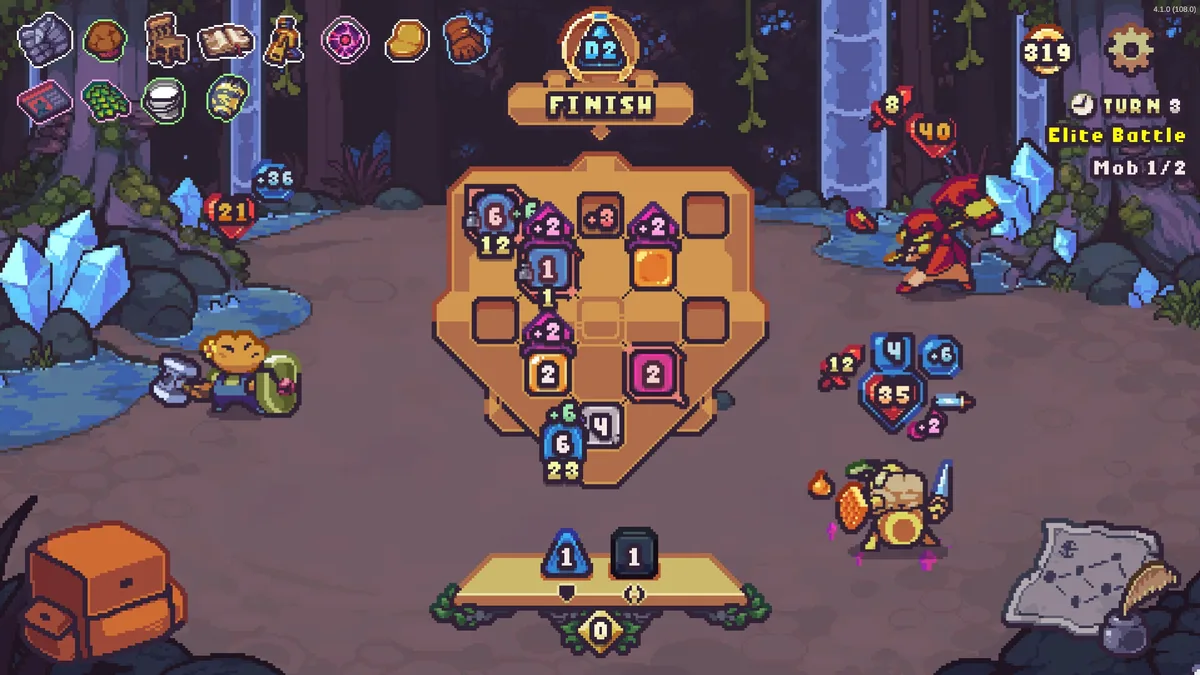 Most natural-unlock achievements, like boss kills and floor totals, clear from battles like this one rather than from deliberately farming the achievement list.
GODEEPER: Which relics to chase on each die type: and why the die you're carrying changes which relics are worth taking. Die in the Dungeon Relics Guide →
Step-by-Step: Working Through the Die in the Dungeon Achievement List
1. Unlock and run all four characters: Only Cinder is available at the start. Unlocking the other three is itself an early achievement goal: earn A Knight's Honor to unlock Lisver, Nera Miss to unlock Nera, and finally Ribbiting Finale (reach the final battle on D1 difficulty) to unlock Mango, which is the hardest of the three to reach. Once a character is unlocked, complete a run with them for their follow-up achievement (Fastest Alive for Lisver, The End is Nera for Nera, Hammer Time for Mango).
Play Cinder first since that's the only option initially. Work toward Lisver and Nera next since their unlock conditions are single-run achievable. Save Mango for later, since reaching the final battle on D1 difficulty is a genuine full clear, not a quick early-game milestone.
2. Scroll the list after run 4: After four character runs, open the achievement list and read the remaining locked entries. Sort by which ones describe conditions you've already approached versus which describe something you haven't tried yet.
The ones describing things you haven't tried are your next targets. Most achievement names in Die in the Dungeon signal the boss or condition they track directly: Venomous Vendetta wants the Scorpion Rider dead, Ruthless Regicide wants the Queen Bee dead. Reading the list before planning your next run is how you convert normal play into structured progression.
3. Target natural completions before challenge runs: Complete the remaining natural-unlock achievements before attempting the challenge runs. Floor reach milestones, cumulative damage and resource achievements, and boss-kill totals all clear without disrupting your build strategy. Challenge-run achievements like No-hitter and Speedhopper require playing differently from your standard approach, so save them for runs specifically designed around the condition.
4. Plan separate runs for mutually exclusive achievements: Some achievements in Die in the Dungeon require specific choices at branching event nodes that lock out the alternative. Two achievements may require opposite decisions at the same event: both are completable, but not in the same run.
Before any run where you're targeting an event-specific achievement, confirm whether there's a conflicting achievement that would require the other choice. Completing both requires at least two visits to that event.
5. Treat D1 through D8 as a separate difficulty ladder: D1 through D8 track clearing a run at increasingly hard difficulty tiers, not dice challenges. Don't hunt for a specific build archetype to satisfy these. Instead, treat them as a long-term goal you climb once your relic and dice pool from natural play is strong enough to handle a harder run. Each tier cleared rewards a new item, mostly relics, and unlocks the ability to select that tier's difficulty going forward.
6. Return to challenge runs last: No-hitter, Speedhopper, and similar challenge completions are for runs where you're not chasing a specific boss or character, you're optimizing for the challenge condition itself. Run these after you've built familiarity with boss phase timing and floor patterns. They're harder to hit blind and cleaner to hit on a dedicated run.
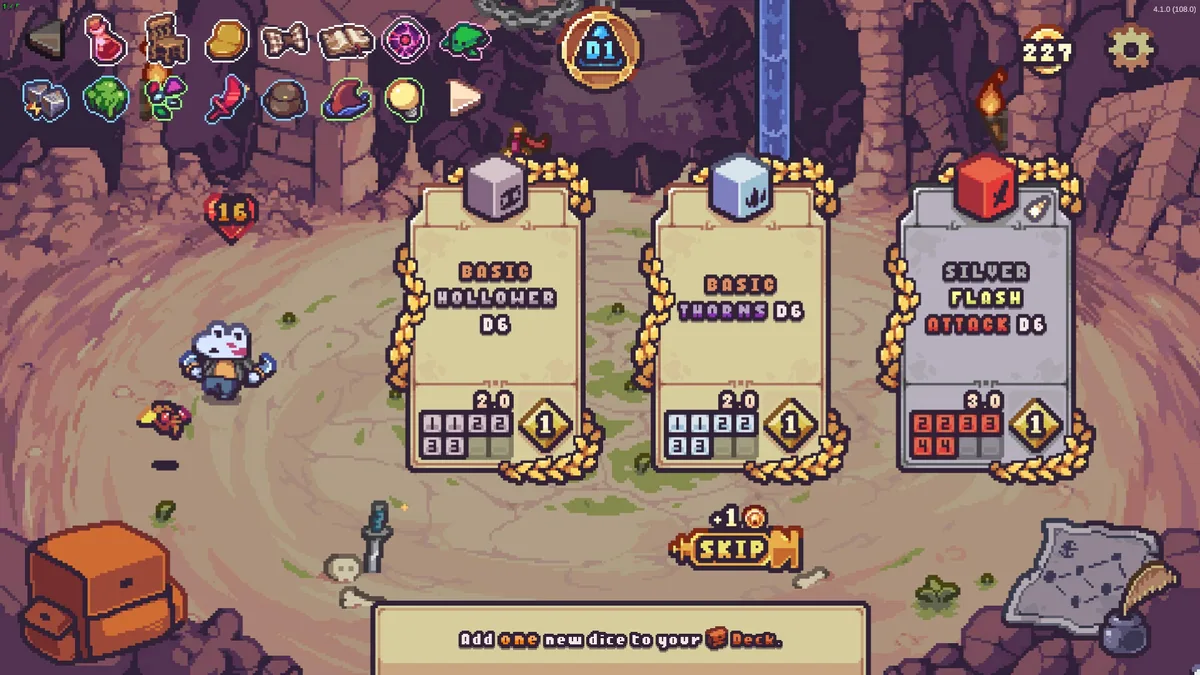 Dice rewards like this, not the achievement list, are where most of the game's 31 dice actually come from.
GODEEPER: The four character starting loadouts: which die faces each carries and which relics to chase by character type. Die in the Dungeon Characters Guide →
Tips
Read the achievement list as a build assignment list. Each achievement describes a game condition, which means it describes a build. Venomous Vendetta wants a poison run. Fastest Alive wants a speed run. If you don't know what to try next, that's where to look: it's actually a better answer than Reddit.
Cumulative-stat achievements complete across failed runs too. If an achievement tracks "deal X total poison damage across all runs," your damage from failed runs still counts. Don't skip poison faces because a run went badly: the total keeps building.
Natural-unlock achievements are usually floor-count and boss-kill milestones. The review confirms roughly half the 59 clear during normal play. This means if you're 30 achievements in after five runs, you're roughly at the halfway mark and the remaining 29 are deliberate targets. This is normal pacing.
Track which achievements require event choices. When you see a branching event in the dungeon, consider whether the achievement you're targeting requires a specific choice: and whether there's a conflicting achievement requiring the other choice. Making the wrong choice on an event you visited specifically for an achievement wastes the run's opportunity.
Critical Roll and FROGGERS are easiest to hit mid-run when a full relic synergy is active. Both require dealing a large damage threshold in a single hit (99+ for Critical Roll, 999+ for FROGGERS), which is much easier once your relics are stacking damage multipliers. Don't try to force them before floor 4 when your relic load is thin.
D1 through D8 track difficulty, not dice or build type. Each is "complete a run in D{n} difficulty," in order, and clearing each one unlocks that tier as a selectable difficulty going forward. Treat this as a long game you climb over many runs, separate from the rest of the achievement list.
Poison build achievements are the most forgiving challenge category. Poison deals damage over time without requiring perfect positioning. This makes achievements tied to poison output (Venomous Vendetta) more achievable on a dedicated run than achievements requiring no-hit clears or time restrictions.
Common mistakes
Treating the achievement list as a trophy shelf rather than a build guide. Most players treating the die in the dungeon achievements as bragging rights don't look at the list until they're bored. Checking it before run 3 changes the next four runs in a way that retroactively feels obvious.
Staying on Cinder after the others unlock. Once Lisver, Mango, and Nera are all unlocked, each has its own follow-up achievement for completing a run with them. Staying on Cinder because it's comfortable delays those achievements and the relics or dice tied to the other three loadouts.
Attempting No-hitter on a run optimized for something else. No-hitter requires a floor clear without taking damage. Running it while also trying to complete a boss-kill condition or build a specific relic stack introduces competing priorities. Give No-hitter a dedicated run with positioning as the primary goal.
Ignoring cumulative-stat achievements. Some achievements track totals across all runs, not single-run performance. Skipping poison damage because your current build isn't poison-focused misses cumulative credit. Keep face types active even when they're not your primary damage source.
Missing the event choice achievements. Branching dungeon events sometimes have achievement targets on both choices. Picking blindly means you might complete one and foreclose the other for the run. Check the achievement list before entering a known event node if you haven't completed both of its associated achievements.
Frequently asked questions
How many achievements are in Die in the Dungeon? 59: the full die in the dungeon achievements count at 1.0 launch. About half clear naturally during normal play; the rest require specific build conditions, challenge runs, or deliberate event targeting.
Do achievements unlock dice in Die in the Dungeon? Mostly no. Most achievements reward a permanent Relic. A handful reward a specific die, three unlock a new playable character, and a few unlock modes like Endless Mode. Most of the game's 31 dice come from battle rewards, the Forge, and events instead.
What are the Die in the Dungeon dice types? 31 unique dice exist, spanning dozens of named types rather than a handful of clean categories: attack, splash and area attacks, block, heal, poison and status effects, Mirror dice that react to other dice on the board, and more.
Which achievements are hardest? No-hitter (win 10 battles without damage), FROGGERS (999+ damage in one hit), and reaching D8 difficulty are the hardest to hit, since they need dedicated runs or a long difficulty climb rather than natural progression.
Do achievements reset between runs? No. Achievement progress and unlocked dice persist permanently across all runs. A failed run still contributes to cumulative-stat achievements.
Can you miss achievements permanently? No. Some achievements require different choices at the same branching event, meaning you need separate runs to complete both: but neither is permanently missable. You can always start a new run and make different decisions.
What is Ruthless Regicide? An achievement for defeating the Queen Bee, one of the game's area bosses. It's a straightforward boss-kill achievement, unlike Proper Burial or The Monarch's New Grave, which require an Ultimate Kill against an area boss specifically.
Related Reading
-
Die in the Dungeon Complete Guide 2026: Hub for all Die in the Dungeon guides: builds, relics, dice tier lists, characters, and achievements.
-
Die in the Dungeon Floor Guide: Floors 1 to 6 Breakdown: Die in the dungeon floor guide: what each floor demands, how floor 5 kills most runs, and what.
-
Die in the Dungeon Tips: Dice, Board, and Build Basics: Die in the dungeon tips: board positioning, dice face priority, and relic synergies.
-
Die in the Dungeon Dice Tier List: Best Dice Ranked: Die in the Dungeon dice tier list: S to D ranking of all dice types,.
-
Die in the Dungeon Relics: All Types, Triggers, and Effects: Die in the Dungeon relics guide: all 5 trigger categories, how each fires, which characters.
-
Die in the Dungeon Best Build: Attack, Poison, and Reroll: Die in the dungeon best build: attack concentration, poison DoT, reroll chains.
References
- Die in the Dungeon on Steam: official store page with achievement list, patch notes, and current reviews
- ATICO on Steam: developer page with game updates and development notes
- Die in the Dungeon Wiki: Achievements: community-maintained wiki listing exact unlock conditions and rewards for all 59 achievements
- Die in the Dungeon Characters Guide: starting dice loadouts for each frog warrior and which relics to target per character
- Die in the Dungeon Relics Guide: how to evaluate the full relic pool and which synergies work by die type
Was this guide helpful?
About the author

Critical game theorist with a background in film criticism. Writing for print and digital outlets since 2015. Specialises in genre analysis and design heritage.
- Background in film criticism
- 10 years games coverage
- Genre theory and design history specialist
Keep reading


Disclaimer
This article is published for informational and entertainment purposes. It does not constitute professional financial, legal, or technical advice. Game performance, online services, patch schedules, and store listings change. Verify critical details (pricing, system requirements, regional availability) with publishers and storefronts before you buy. Affiliate links, where present, help support our editorial work and are labelled in our affiliate disclosure.
Comments
Loading comments…