
GameBrief · General
Frog Sqwad Advanced Guide: Scoring, Combos & Extraction
Reviewing
Frog Sqwad
Panic Stations
The beginner tips stop runs from collapsing. This frog sqwad advanced guide covers what comes after: tongue relay chains that move heavy food at roughly three times single-frog speed, the Megafrog timing window most squads miscalculate, and the quota math that tells you when stopping is smarter than one more grab. The mechanics here aren't hidden behind difficulty. They're behind repetition.
TL;DR: Three-frog tongue relay chains multiply haul speed on heavy items. Trigger Megafrog after the small food cluster clears, not at run start. Extract at 110 to 120 percent of quota value secured. Two Revivers in an 8-player squad, not one. Add a Traffic Controller role on Day 4 and 5 runs. Exact scoring multiplier values are not publicly documented: treat community benchmarks as directional, not authoritative.
Frog Sqwad advanced guide: what changes at high level?
Advanced squads maintain continuous tongue contact with food. Beginners execute one grab, release, reposition, grab again: four separate inputs where the advanced version runs them as one unbroken relay. The other gap is extraction discipline. Most squads extract when they feel they have enough. High-performing squads extract when the food-to-time math says continuing isn't worth it, which is usually 30 to 60 seconds earlier than it feels.
Both habits compound across a full quota cycle and account for most of the Day Score difference between squads at the same experience level.
Key Takeaways
- Three-frog tongue relay chains move heavy food items at roughly triple the single-frog haul speed
- Megafrog transformation timing matters: trigger it during the heavy-item phase, not the opening small-cluster phase
- Bubble Gum delays the Megafrog threshold, giving Haulers precise control over when the transformation fires
- Exact scoring multiplier values are not publicly documented; community testing points to run speed and clean-run components
- Frogspawn incidents cost 20 to 40 seconds of run time and likely reduce Day Score through a clean-run component
- Full 8-player squads benefit from a dedicated Traffic Controller role that the beginner guides do not cover
- Extract at 110 to 120 percent of secured quota value: the math tips against continuing past that buffer
Overview: the extraction ceiling
Frog Sqwad launched June 11, 2026 from Panic Stations at $7.99 base. The extraction loop is quota-driven: your squad raids The Sewers, hauls food back to The Swamp, and feeds the Swamp King enough each day to unlock what comes next. The beginner tips guide covers the eight things that sink most first-session runs. This guide assumes you have internalized those: roles, catapult countdowns, and the core frogspawn recovery mechanic.
The ceiling for most squads isn't mechanical. It's structural. They know the three tongue modes, they spread Megafrog growth across Haulers, they designate a Reviver. What they haven't built is the relay chain technique, the timing discipline around Megafrog transformation, or the Traffic Controller role that appears in high-level runs. Those three gaps explain most of the Day Score difference between a squad that hits quota reliably and one that hits it consistently at surplus.
Tongue combo chains: the relay system
The tips guide describes the tongue in three discrete modes: short lick for swinging, long hold for hauling, and latching onto teammates for catapults. Advanced play removes the pauses between those modes.
The relay chain is the core technique. Frog A latches onto a heavy food item with a long hold and begins pulling. Frog B latches onto Frog A's body using the same input as a teammate latch. The combined tongue tension roughly doubles the effective haul force. Frog C can extend the relay further. Three frogs in relay move heavy items at approximately triple the single-frog speed, though the exact multiplier varies with item weight. The chain breaks if any player releases early. Build in a verbal or text countdown before anyone drops hold.
The grab-hold-redirect sequence removes the pause between swinging and hauling. Instead of swinging to a pipe anchor, releasing fully, dropping to a food item, and then grabbing: swing to the anchor, redirect mid-arc to the food item without a complete release, and begin hauling in the same motion. The momentum carries over. Getting this consistent takes 15 to 20 minutes of deliberate practice in a run where the cluster is not critical, but the route efficiency improvement is immediate once it clicks.
The catapult-catch is the third application. One frog catapults a second to an elevated food cluster. The airborne frog grabs an item at height and tosses it down to a waiting hauler rather than trying to land while carrying it. The toss uses the same long hold input as all grabs. Timing the release before gravity takes the arc too low is the hard part. Practice the angle on runs where the elevated cluster doesn't matter for quota before relying on it when it does.
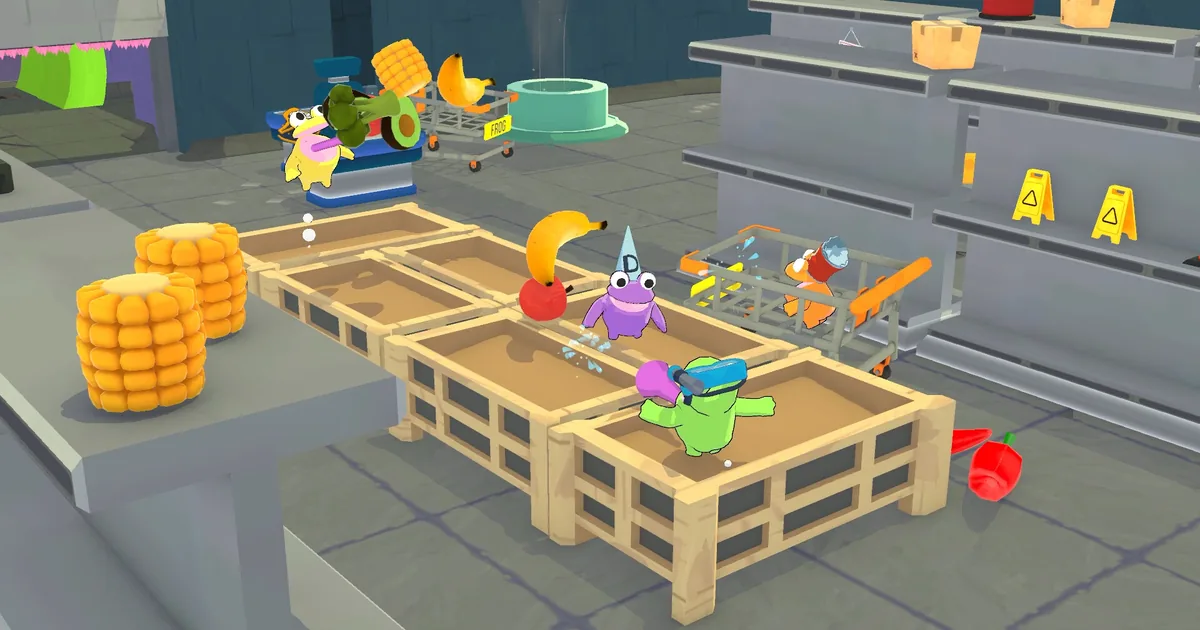
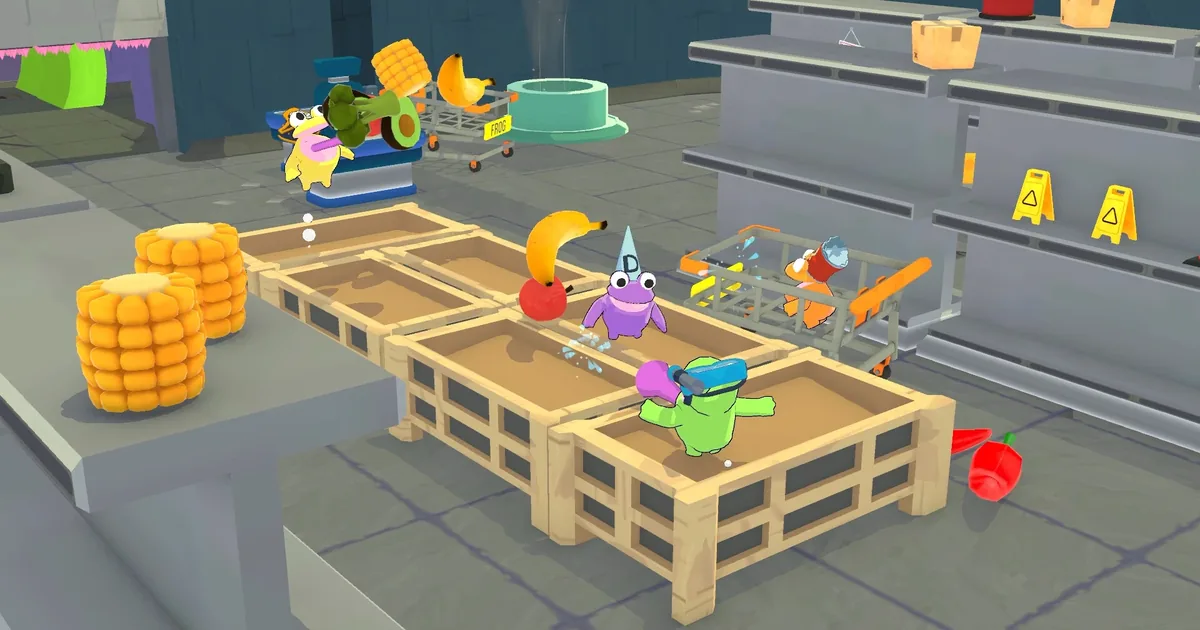
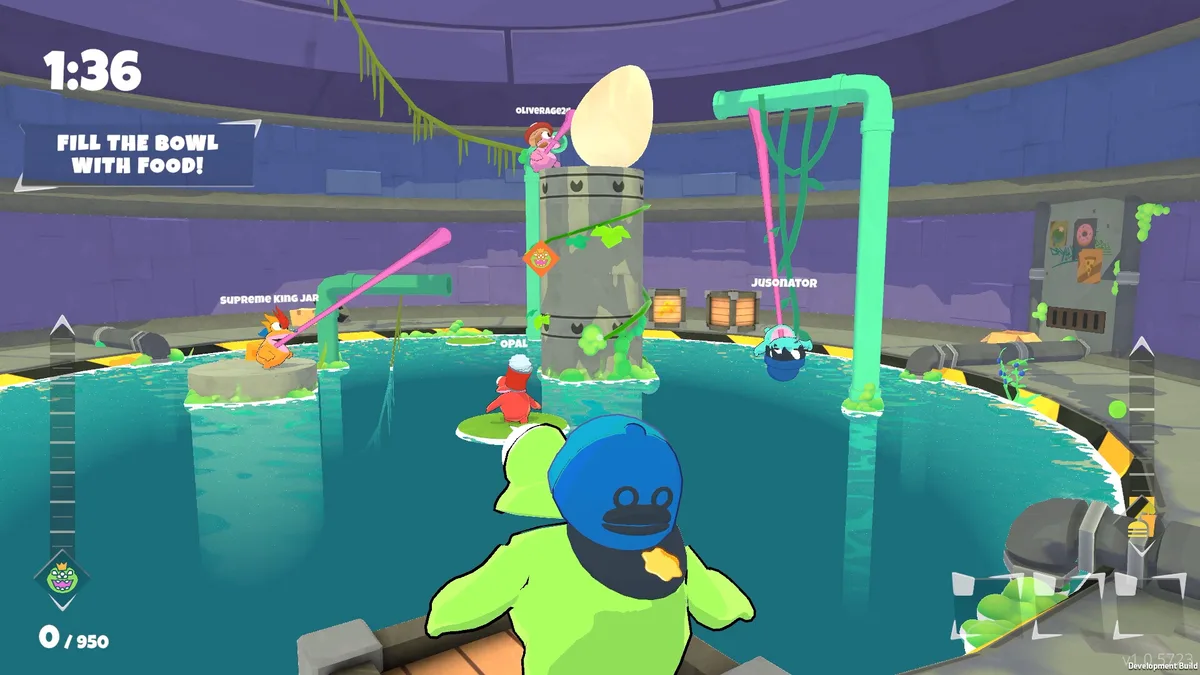 A timed "Fill the Bowl" objective room: each frog's tongue reaches the same central item independently here rather than chaining frog-to-frog, but the underlying tongue-targeting input is identical to what a relay chain uses.
GODEEPER: The Vending Machine items that amplify these tongue techniques, including Bubble Gum and X-LONG Gum, are documented with full descriptions in the frogs and items guide. Frog Sqwad Frogs Guide: Roles, States, and Items 2026 →
Step-by-Step: building an advanced extraction run
Step 1: pre-drop item assignment. Before your squad drops into The Sewers, assign Haulers to carry Bubble Gum and at least one X-LONG Gum between them. Assign Revivers to carry emergency food reserves. No other role needs items in the opening phase; gadgets purchased for novelty value before quota consistency is established waste Gold that could go toward the relay-amplifying items.
Step 2: scout the small cluster, mark the heavy cluster. The Scout moves fast and light through the opening corridors, calling food cluster locations to the squad. The critical output is not the location of small items but the location of the heavy oversized items that need relay chains. Mark those first. Small food is fast and any frog can grab it solo.
Step 3: clear small food with Standard-frog speed. Haulers eat minimally in this phase. The Megafrog transformation hurts in tight corridors when you are moving lightweight items that Standard frogs handle efficiently. Run agile until the small cluster is cleared.
Step 4: trigger Megafrog at the heavy-item transition. Once the squad moves to the oversized food cluster, Haulers begin eating to build toward Megafrog. With Bubble Gum, this transition is controllable: the raised threshold lets Haulers eat through the small-item phase without triggering early, then continue into the heavy-item phase and transform when the mass pays off.
Step 5: form relay chains on oversized items. Two to three frogs in a relay chain move the heaviest items to extraction in a fraction of the time a single Hauler requires. Anchors hold corridor positions to clear the route. Scout calls hazard positions. Revivers stay within two traversal zones of the active hauling group.
Step 6: call extraction at 110 to 120 percent quota. Once the quota caller confirms secured food value is 10 to 20 percent above the daily target, the squad stops hauling and moves to exit. Whatever remains in The Sewers stays. The food-to-distance ratio at that point almost never justifies extending the run.
Megafrog timing: the growth window
The frogs and items guide describes Megafrog as a growth state triggered by eating enough food. The strategic question is when to trigger it.
Triggering Megafrog in the first five minutes of a run creates a friction problem. Opening runs contain small, lightweight food: faster to grab, easier to traverse with, requiring no relay chains. A Megafrog moving through tight opening corridors is slower than two Standard frogs covering the same route, and the mass you gained for heavy items is active during the phase where you do not need it.
The optimal window is the transition point: after the small cluster clears and before the run enters the heavy-item phase. Haulers should eat minimally during opening traversal and begin stacking food intake when the squad locates the oversized cluster.
Bubble Gum raises the Megafrog growth threshold. The framing of "larger stomach capacity" is accurate but incomplete for high-level play. The more useful framing is that Bubble Gum delays the transformation trigger point. A Hauler with Bubble Gum can eat through the opening phase without triggering growth, then continue into the heavy-item phase and transform when size actually pays off.
Running Bubble Gum and X-LONG Gum on the same Hauler creates the dominant late-run loadout: a Megafrog that reaches items from extended range, hauls them with relay chain support, and absorbs more hazard hits before losing food to the vomit mechanic. This combination shows the highest food-per-minute output in community testing, though exact yield numbers vary by level layout and squad configuration.
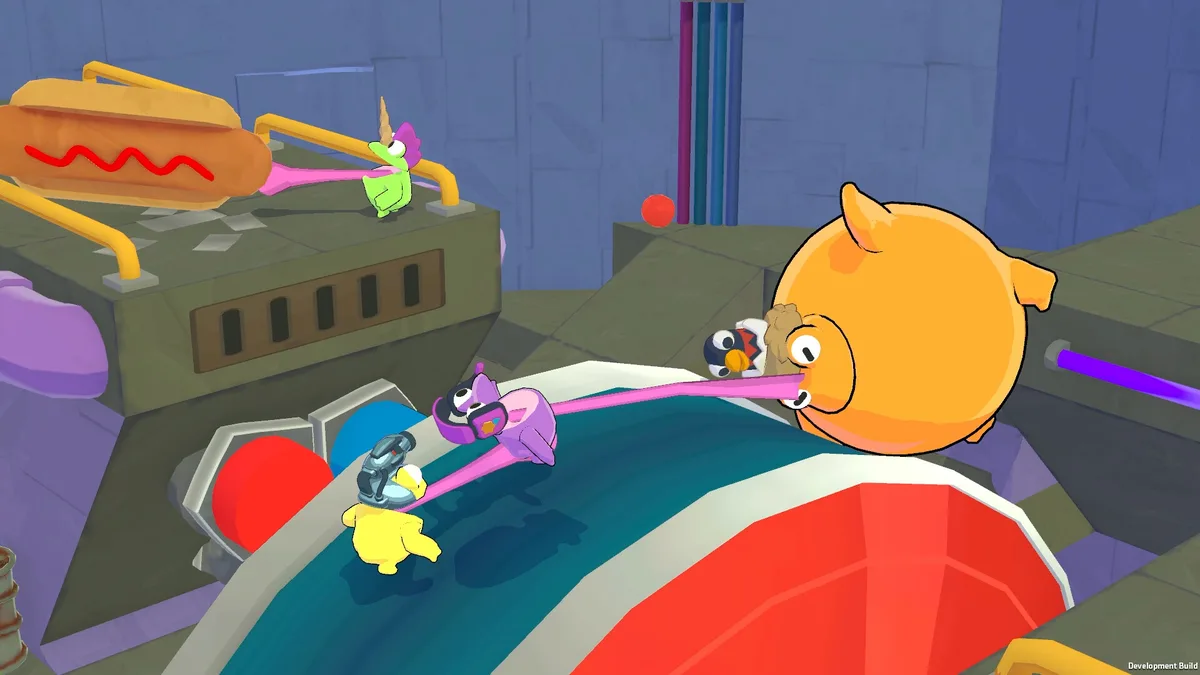 Tongue lines linking multiple frogs to the same large object mid-level. Coordinated tongue use lets a squad move or hold bigger objects than any single frog could manage alone.
Scoring and Day Score
Panic Stations has not published scoring formula details. Community testing since the June 11, 2026 launch points to several contributing factors.
Quota percentage earns a base score with diminishing returns past 100 percent. Going to 150 percent of quota does not appear to yield proportionally more than 120 percent, which is why the extraction buffer holds at 110 to 120 percent rather than pushing further.
Run speed appears to contribute a speed component. Runs that complete the quota window with meaningful time remaining score higher than identical hauls completed in the final stretch of the available window. The community benchmark is hitting quota in the first two-thirds of the run window.
Frogspawn incidents are the most measurable variable. Each incident costs the squad 20 to 40 seconds of effective run time depending on Reviver proximity and emergency food availability. Whether incidents apply a direct score penalty or whether the time cost is the primary mechanism is not confirmed. The practical position is identical either way: clean runs score higher.
Food variety is the murkiest of the four factors. Community testing suggests that collecting multiple food types rather than farming a single high-value item contributes positively to score. No controlled baseline has confirmed it at equivalent total weight, and the game doesn't display enough data to isolate the variable cleanly. Hold this one loosely.
The consistent theme: run time lost to Frogspawn recovery and route inefficiency is more damaging to Day Score than any attempt to push quota percentage past a reasonable buffer.
Frog Sqwad advanced guide: optimal squad roles
The 8-player co-op overview establishes the four behavioral roles: Scout, Hauler, Tongue Anchor, Reviver. Advanced squads at full 8 players add a fifth.
Traffic Controller came out of community frustration with Day 4 and 5 runs where 7 frogs converging on a narrow extraction corridor generate enough physics chaos to slow the squad by 30 to 60 seconds. The Traffic Controller doesn't haul food. They hold position at the corridor bottleneck, call routes to the exit, and keep the rest of the squad moving in sequence rather than tangled in a tongue pile. The role is optional in groups of four or fewer but becomes meaningful at full 8 under late-day hazard density.
The two-Reviver setup is the most common gap in squads that are experienced but not advanced. One Reviver covering 8 players is insufficient when Frogspawn incidents happen in clusters. Two incidents simultaneously, with one Reviver across the map, means both downed frogs sit out while the Reviver makes two sequential trips. Two Revivers with staggered positions eliminate that scenario.
Role distribution for advanced 8-player extraction:
- 2 Haulers: Bubble Gum on at least one, X-LONG Gum on the second
- 2 Tongue Anchors: held positions at the gap crossings the relay chains must pass through
- 1 Scout: eats minimally to stay agile, calls cluster locations and hazard positions throughout
- 2 Revivers: staggered positioning, one near the heavy-item cluster, one within two zones of extraction
- 1 Traffic Controller: extraction corridor only in the final phase; covers Anchor duties in the opening
In a 4-player squad, one player covers Scout and Anchor, one covers Hauler and part-time Reviver, and two remaining players take dedicated Hauler and Reviver roles. The Traffic Controller role compresses into Scout responsibilities because a 4-player squad rarely generates corridor congestion.
GODEEPER: The full co-op extraction structure and how the quota loop connects to the Megafrog system is in the launch overview, worth reading as context for these role assignments. Frog Sqwad: 8-Player Co-op Tongue-Swinging Chaos 2026 →
Tips: Advanced run management
Establish a quota clock, not just a quota caller. The beginner guide recommends appointing a quota caller. The advanced version splits that role in two. The quota caller tracks remaining food value needed. The quota clock tracks elapsed run time against the speed-score window. Knowing you are at 80 percent quota in the final third of the run changes the extraction decision versus being at 80 percent quota in the second third.
Treat Reviver food as locked. The biggest risk to the two-Reviver setup is that Revivers eat their emergency food during the opening phase and transform before any incidents happen. Revivers don't eat. They don't grow. Their food reserve exists only for recovery scenarios and is replaced at the next run from Gold shop purchases.
Hazard positioning beats hazard avoidance. Advanced players know hazard positions well enough to use them as crowd-clearing tools against creatures when the route warrants it. The Grenade item from the Vending Machine, which requires two players to arm and detonate, is effective against creature clusters blocking extraction corridors. Planning the detonation before the extraction window opens removes a variable that otherwise delays the squad at the worst moment.
Smaller squads run faster clocks. With two players, the relay chain mechanic becomes the primary advantage: two frogs chaining a heavy item move it at roughly double speed, which compresses the time needed to hit quota. But the Frogspawn risk is higher per incident because there is no spare coverage. Both players should carry at least a partial food reserve, accepting slower growth in exchange for recovery safety.
Caffeine Gum fits Scout loadouts specifically. Caffeine Gum from the Vending Machine provides a speed boost that extends the effective range of an early scouting run before Haulers need location data. It doesn't pair meaningfully with Megafrog form, making it a poor choice for Haulers and the right one for whoever is running light. Don't buy it first; buy it once your Haulers are already equipped.
Related Reading
- Frog Sqwad Tips: 8 Co-op Rules That Prevent Squad Wipes: The foundational co-op tips covering catapult countdowns, Frogspawn recovery, and extraction timing for new squads.
- Frog Sqwad Frogs Guide: Roles, States, and Items 2026: Full breakdown of the three frog states, all nine Vending Machine items, and the behavioral role framework.
- Frog Sqwad: 8-Player Co-op Tongue-Swinging Chaos 2026: Launch overview covering the quota loop, the Megafrog hook, and how Frog Sqwad fits among 2026 co-op extraction games.
- Best Indie Co-op Games Steam Summer Sale 2026: 6 Picks: Six co-op games tested across 40 or more hours, including extraction and party-game picks alongside Frog Sqwad.
- Pratfall Guide 2026: Max Players, Biomes, Items and Tips: Physics-comedy co-op with similar coordination logic and its own advanced squad mechanics worth comparing.
Frequently Asked Questions
What separates advanced Frog Sqwad play from beginner play? Advanced play is about chaining tongue inputs rather than executing them one at a time. Beginners grab, stop, reposition, then grab again. Advanced squads maintain continuous tongue contact across multiple frogs, moving food in relay chains that never fully pause. The other major gap is extraction timing: knowing precisely when the math stops favoring another haul.
How does a three-frog tongue relay chain work in Frog Sqwad? One frog grabs a heavy food item and pulls. A second frog latches onto the first frog's body, using combined tongue tension to multiply haul force. A third extends the relay further. The chain breaks if any player releases early, so count down before anyone drops. Three-frog chains move heavy items at roughly triple single-frog speed.
Is there a scoring penalty for Frogspawn incidents in Frog Sqwad? Exact scoring values are not publicly documented. Community testing suggests Frogspawn incidents reduce the end-of-day score, likely through a clean-run multiplier component. More importantly, each incident costs 20 to 40 seconds of effective run time, which is usually the real damage rather than any direct score number.
When should a Megafrog player stop eating to avoid being too slow? Stop eating once you have shifted from small food items to the heaviest cluster items. The Megafrog speed penalty matters most in tight corridors during the opening phase. With Bubble Gum equipped, delay the transformation to match when heavy items appear on your route, shrinking the window where size works against you.
What is the best squad setup for the hardest extraction runs in Frog Sqwad? Run two Haulers with Bubble Gum for deferred Megafrog growth, two Anchors at key gap positions, one Scout on hazard and route calls, two Revivers with staggered food reserves, and one Traffic Controller managing extraction corridor flow. The Traffic Controller is optional at four players but critical at full eight on Day 4 and 5 runs.
References
Was this guide helpful?
About the author

Senior Critic & Analyst
Former game data analyst turned critic with 11 years covering indie and mid-tier games. Based in Austin. Runs spreadsheets on games most people just play.
- 11 years games criticism
- Former game economy analyst
- Roguelike and strategy specialist
Keep reading

Disclaimer
This article is published for informational and entertainment purposes. It does not constitute professional financial, legal, or technical advice. Game performance, online services, patch schedules, and store listings change. Verify critical details (pricing, system requirements, regional availability) with publishers and storefronts before you buy. Affiliate links, where present, help support our editorial work and are labelled in our affiliate disclosure.
Comments
Loading comments…