
GameBrief · General
Lootbound Release: Tactical Roguelite Launches August 14
Lootbound release guide: the $14.99 tactical roguelite's adjacency inventory, current Steam reception, closed demo, patches and solo launch status.
Reviewing
Lootbound
ArtDock · Dreland Enterprises
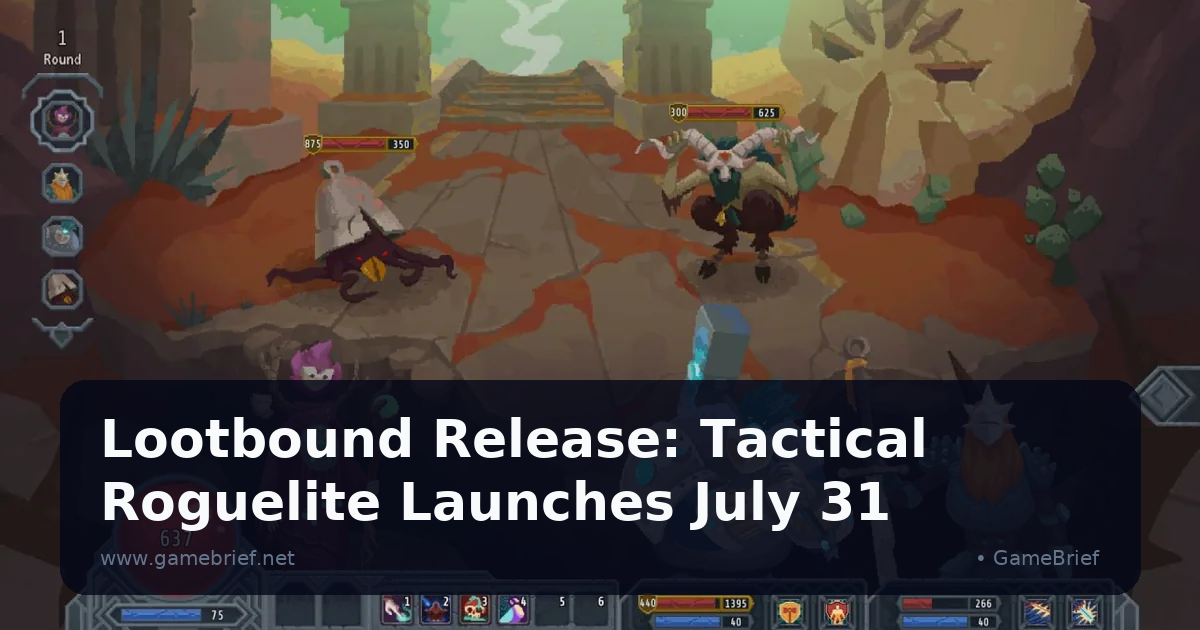
Lootbound released on August 14, 2026, so the launch article now needs to answer a different question from its pre-release version: is the full game worth $14.99, and does the adjacency inventory remain a meaningful hook after the demo? The store currently shows 77% positive across 1,246 reviews, with 75% across 670 recent reviews. The demo that supplied the original pre-launch signal is closed.
TL;DR: Lootbound is a $14.99 single-player tactical roguelite from ArtDock and Dreland Enterprises. Items do not have fixed slots; place them in the shared grid and use adjacency/aura relationships to shape a party build. It released August 14, and the current Steam snapshot is 77% Mostly Positive across 1,246 reviews. The official announcement feed says the demo closed on September 9, while patches 1.1.5 and 1.1.7 changed boss difficulty and reward choices.
What is Lootbound? (quick answer)
A released, single-player tactical roguelite with turn-based combat, D&D-inspired loot management, companion recruitment and an inventory system built around placement rather than fixed equipment slots. The current store description confirms that items can be rotated and placed where space permits. That makes the inventory grid the game's defining decision layer: the item you choose matters, but the cells around it matter too.
Current status: September 2026
Lootbound released August 14, 2026 at $14.99 in the US Steam snapshot. Steam currently shows 77% positive across 1,246 reviews and 75% across 670 recent reviews. The game is listed as single-player rather than Early Access. Official updates 1.1.5 and 1.1.7 adjusted boss/elite power, dice-roll difficulty and the choice between common rewards and riskier rerolls. The September 9 announcement says "The Lootbound Demo Is Closed," so the old demo review count should not be used as current buyer evidence.
Key takeaways
- Lootbound released August 14, 2026 on PC via Steam, developed by ArtDock and published by Dreland Enterprises.
- The core mechanic is an adjacency-based inventory: items carry auras that boost gear in neighboring cells, so placement matters as much as what you pick up.
- Steam currently lists $14.99 in the US snapshot.
- The old demo had 665 reviews, but the official feed says the demo closed on September 9; use the full-release score now.
- Single-player only. You control the hero directly; recruited companions act on their own in combat.
- Updates 1.1.5 and 1.1.7 changed boss/elite difficulty and reward-risk choices.
The inventory system is the real pitch
Loot management in Lootbound isn't the usual "bigger number beats smaller number" roguelite loop. Items don't have fixed equipment slots; instead, you place them into a shared inventory grid alongside your companions' gear, and some items carry auras that strengthen whatever weapon or armor sits in an adjacent cell. The official store supports this non-slotted, placement-based premise without requiring one promotional item, aura percentage or side-specific trigger to become a permanent rules table.
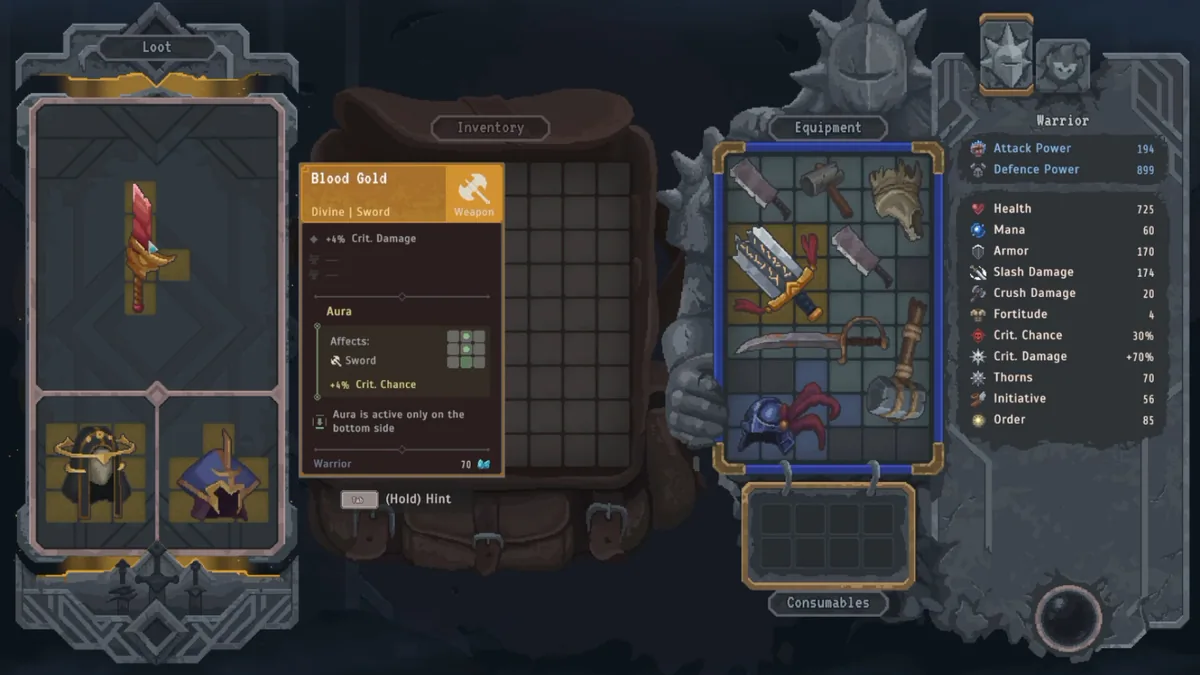 The inventory screen shows why adjacency is the first thing to inspect when evaluating a new item.
That means the value of an item isn't fixed at pickup: a weak-looking item next to the right neighbor can outperform a stronger item sitting alone, and moving a single piece of gear by one cell can be enough to reshape how an entire build performs. It's a grid-adjacency system in the same family as recent inventory-Tetris roguelites, applied here across a full party rather than just one character's backpack.
Combat itself only puts you in direct control of the hero. Recruited companions act on their own once a fight starts, which shifts the strategic layer away from moment-to-moment input and toward deciding who to recruit, how to gear them, and where their aura-boosted items sit relative to everyone else's equipment before the fight even begins.
The demo is closed, so use the full-release signal
The original article leaned on 665 Very Positive demo reviews collected before launch. That was useful pre-release context, but it is not a current demo recommendation because the official feed now says the demo is closed. The full-release Steam snapshot is the relevant signal: 77% across 1,246 reviews overall and 75% across 670 recent reviews in this audit.
That shift is not automatically a verdict against the game. It simply means the buyer question has changed from "does the demo look promising?" to "does the complete $14.99 package appeal to me despite a Mixed-to-Positive reception?" The inventory hook remains specific enough to answer that question for players who enjoy spatial build optimization.
Building the final Guardian
Lootbound's risk-reward systems are patch-sensitive. The pre-launch article described a fixed Guardian-assembly route and special-room dice odds in confident detail, but the current primary-source pass did not establish a complete stable table for those systems. Treat those observations as versioned play notes rather than universal route instructions. Record the boss-part choice, reward type and patch when you write your own route, especially after balance updates.
Pricing and where to find it
Lootbound currently lists at $14.99 in the US Steam snapshot. Regional pricing, discounts and future changes belong to the live store page, not to this launch article's old "no price listed" language. The official Steam page and announcement feed are the right places to check after a patch because both the price and the inventory balance can change without altering the basic release date.
Frequently Asked Questions
When did Lootbound release? Lootbound released August 14, 2026 on PC via Steam. It is a single-player tactical roguelite from ArtDock and Dreland Enterprises.
How much does Lootbound cost? The current US Steam snapshot lists Lootbound at $14.99. Check the live store for your region and any later discount.
Is the Lootbound demo still available? No. The official announcement feed says the demo closed on September 9, 2026. Its 665-review snapshot is historical pre-launch context.
How does Lootbound's inventory system work? Items don't have fixed slots. Some items carry auras that boost weapons or armor placed in adjacent inventory cells, so moving a single item by one space can change how an entire build performs.
Is Lootbound multiplayer? No. Lootbound is single-player only. You directly control the hero while recruited companions act on their own during combat.
Related Reading
- WATERPUNK Release: Day-Night Roguelite Launches July 30: another roguelite from this summer's indie launch window, built around a very different core mechanic.
- Archon Soul Release: Dice-Builder Launches July 29: a build-focused roguelite with its own hook, worth comparing against Lootbound's grid inventory.
- Mistfall Hunter Release: Pricing, Editions Explained: a launch where the monetization structure, not the demo record, was the story worth knowing before buying.
- Rogue Eclipse Launch: Among Us Studio Backs This Roguelike: a spaceflight roguelike from the same stretch of Steam launches, worth comparing against Lootbound's grid-inventory hook.
- Best Indie Roguelites Steam Summer Sale: a wider comparison of current roguelike prices and reception.
- Slayblade Battle Top Roguelite Launch: another launch built around a distinct build-planning hook.
- Best Indie Games Under $20 in 2026: compare Lootbound's current price with other indie releases.
References
- Lootbound on Steam
- Lootbound official Steam news: launch post, patch 1.1.5/1.1.7 and the September 9 demo closure
- Lootbound Official Trailer on YouTube
- Lootbound on X
About the author

Indie & JRPG Critic
Indie game evangelist and lifelong JRPG fan covering small studios since 2017. Mumbai-born, London-based. Writes the way she talks.
- 7 years indie games coverage
- JRPG and visual novel specialist
- Narrative design focus
Keep reading
Disclaimer
This article is published for informational and entertainment purposes. It does not constitute professional financial, legal, or technical advice. Game performance, online services, patch schedules, and store listings change. Verify critical details (pricing, system requirements, regional availability) with publishers and storefronts before you buy. Affiliate links, where present, help support our editorial work and are labelled in our affiliate disclosure.
Comments
Loading comments…