
GameBrief · General
Killer Bean Complete Guide: All 5 Bosses, Weapons, Tips
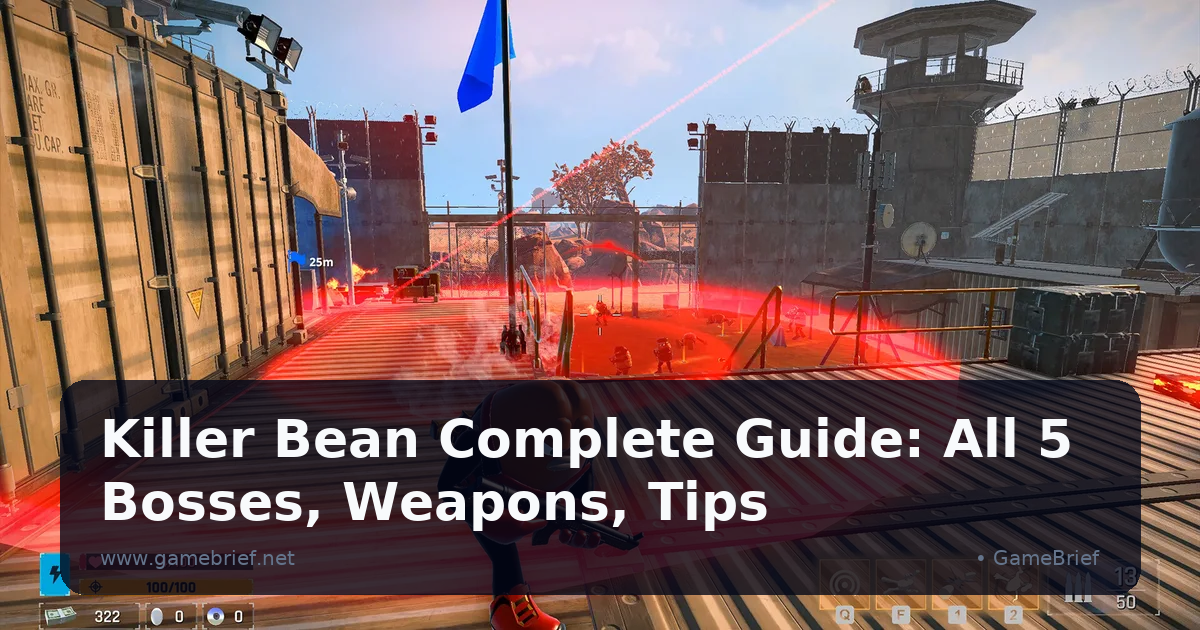
Killer Bean complete guide: hub for all 5 campaign bosses, the weapon tier list, and builds and tips across the 9-mission Steam Early Access roguelite.
Reviewing
Killer Bean
This Killer Bean complete guide pulls together everything GameBrief has published on Jeff Lew's coffee-bean assassin since it hit Steam Early Access on June 8, 2026. One hub for the boss fights, the weapon rankings, the beginner tips, the advanced combat tech, and the review verdict, so you're not hunting across seven separate articles to answer one question.
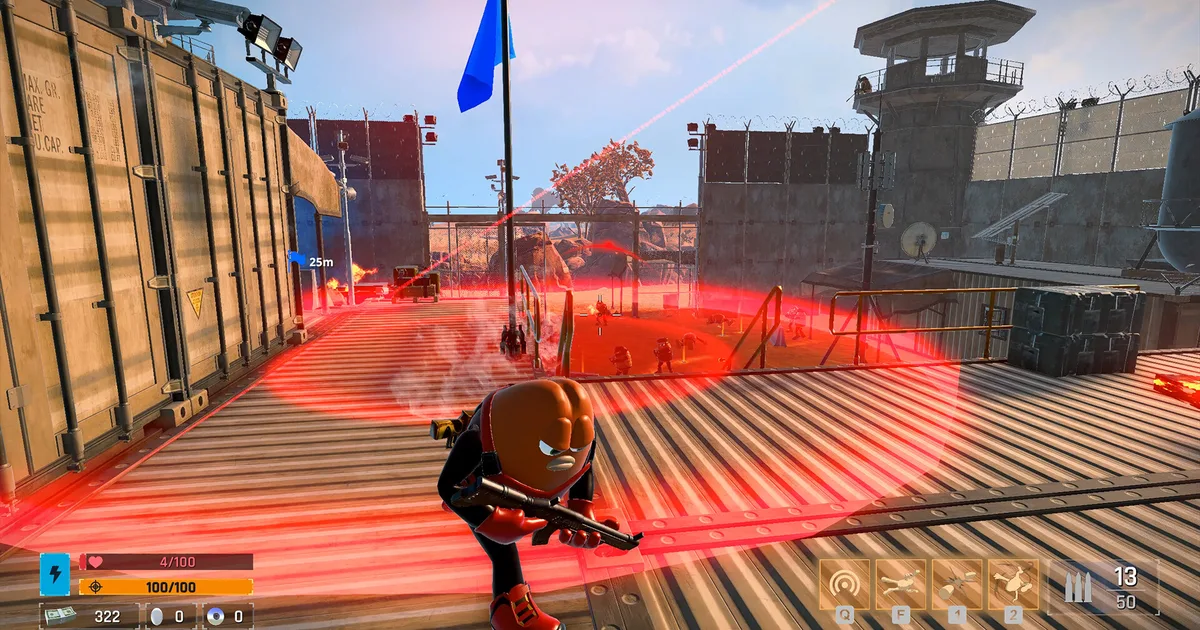
TL;DR: Killer Bean is a $14.99 Steam Early Access action roguelite: 9-mission campaign, 4 game modes, 5 named bosses, and 4 skill trees built around a slow-motion dive mechanic. GameBrief's review lands at 6.5/10: the dive and gunplay carry the game, but Melee is broken at the hitbox level. Dual pistols are the S-tier weapon thanks to infinite ammo. Permadeath was removed three days after launch. This hub links the boss guide, weapon tier list, both tips guides, and the full review.
Key takeaways
- Killer Bean launched into Steam Early Access on June 8, 2026, developed by Killer Bean Studios LLC, priced at $14.99 (it briefly discounted to $11.99 two weeks post-launch)
- Five named campaign bosses across 9 missions: Warlord, Toy Maker, the Overseer, Bullet Eyes, and the Monitor (a three-phase fight)
- Four game modes: Campaign, The Party, Battle Arena, and Conquest (procedurally generated islands, four rival factions)
- Four skill trees: Guns Blazing, Melee, Parkour, and Stealth, but only three of them currently work as intended
- Dual pistols are the S-tier weapon in the site's tier list thanks to infinite ammo and consistent damage across all 9 missions
- Permadeath was removed on June 11, 2026, three days after launch, following community pushback
- GameBrief's full review rates Killer Bean 6.5/10: distinctive dive mechanic, broken melee hitboxes, moderate content depth for the price
What is Killer Bean? (quick answer)
Killer Bean is a first-person and third-person action roguelite starring a rogue assassin coffee bean who left the sinister Shadow Agency and now works to take it apart, faction by faction. It's built on animator Jeff Lew's cult "Killer Bean" Flash cartoons from the early 2000s, and it launched into Steam Early Access on June 8, 2026.
Jeff Lew isn't a random indie name attaching itself to nostalgia. He's a professional animator whose film credits include X-Men, The Matrix Reloaded, Transformers: Revenge of the Fallen, and Tron: Legacy. He made the original Killer Bean shorts in the late 1990s: a dialogue-free, John Woo-inspired action film where a coffee bean shoots his way through a bathroom to a hip-hop soundtrack. It spread through forums and download sites before YouTube existed. His 2009 follow-up, Killer Bean Unleashed, was a 45-minute feature he animated entirely by himself over five years, and it went on to rack up tens of millions of views. That's the pedigree behind the ragdoll physics and slow-motion gunfights in the game.
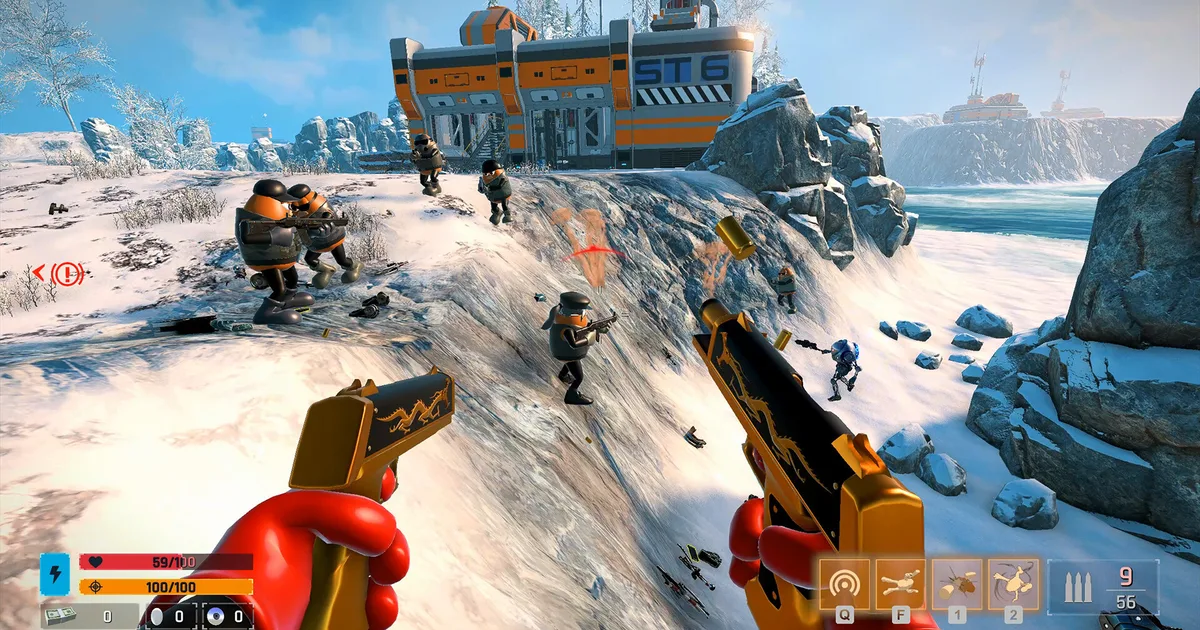
Our Killer Bean Early Access launch coverage covers what actually shipped on day one: four biomes, eight bosses and mini-bosses spread across them, four game modes (Campaign, Battle Arena, Conquest, and the core procedural island system), and ragdoll physics as a real gameplay identity, not just a visual flourish. Co-op and full character customization were both listed as planned, not present at launch.
Two weeks later, our post-launch analysis covered how the actual release went. The first four days were rough: bugs, a punishing permadeath system, and camera issues pushed early reception into mixed territory. Killer Bean Studios responded fast, patching daily and removing permadeath entirely on June 11, 2026, three days after launch. By that point the review score sat at 71% positive from 1,095 reviews, and the price had briefly dropped to $11.99 (20% off the $14.99 launch price). That article also confirmed the four Conquest factions (Bad Beans, Mercenaries, Pirate Commandos, and Shadow Troops) and a roadmap that includes online co-op and a second playable character, Jet Bean.
The game splits its audience into two groups that don't fully overlap: people who grew up on the original shorts and have waited two decades for a Killer Bean game, and players coming in cold who just want a fast, kinetic FPS roguelite. Both groups get the same four modes: Campaign (the main story run against the Shadow Agency, featuring animated-series characters like Jack and Detective Cromwell), The Party (clearing dance venues that "disturb your sleep"), Battle Arena (endless enemy waves), and Conquest (faction warfare on a procedurally generated island). Controller support is partial on Xbox and full on PS5 DualSense as of the current build, and the ragdoll physics that made the original shorts memorable, bodies bouncing off walls and tumbling down stairs, carry over directly into how enemies react to gunfire.
Boss guide: all 5 bosses
The campaign has five named bosses, one per major mission milestone, and they don't all play the same way. Warlord (Mission 3) punishes players who ignore his drone spawns in favor of shooting him directly; the drones track your position independently, and letting them accumulate while focusing on Warlord means getting hit from two angles at once. Toy Maker (Mission 4) is the odd one out: an environmental fight about shooting incoming explosive vehicles at range rather than a dive-and-burst encounter. The Overseer (Mission 5) has surge armor that no standard weapon can damage until you lure him next to one of the arena's three or four fixed power generators and shoot it; scouting those positions before engaging saves several minutes of confusion. Bullet Eyes (Mission 7) is a constant-pressure orb-spam fight where the dive's slow-motion window is close to mandatory, and the mission's vertical platform ascent doubles as a natural dive trigger if you stop treating it as an obstacle. The Monitor (Mission 9) closes out the campaign across three distinct phases: standard guns and a protective shield in Phase 1, shoulder-mounted grenade launchers added in Phase 2, and a flying form with a mace tentacle and a laser-shooting pyramid tentacle in Phase 3. Arena ammo crates sit between each phase transition, and using them is preparation, not luck.
Our Killer Bean boss guide covering all 5 campaign bosses ranks them by difficulty (the Monitor is the hardest, Bullet Eyes and Warlord next, then the Overseer and Toy Maker at the bottom), breaks down every phase and attack window mission by mission, and covers the specific weapon picks that work best against each one. It's also the source for the Overseer's generator trick and the exact I-Frame timing windows the advanced guide below builds on.
Weapon tier list
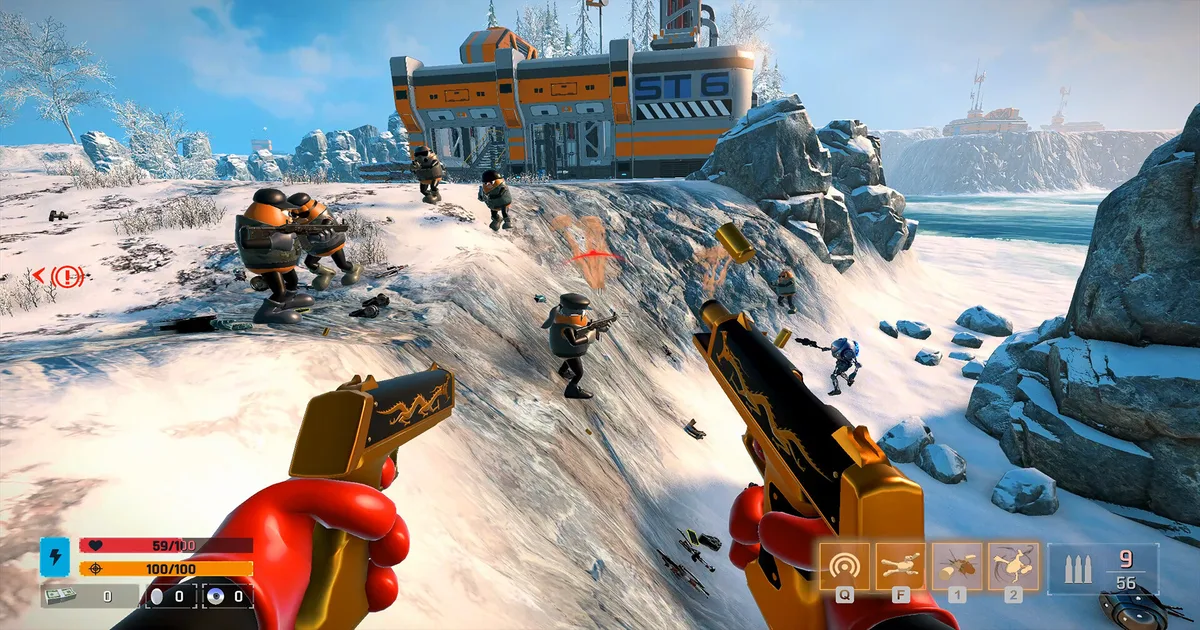
Five weapons are confirmed in the current build, and the ranking isn't close to what most players expect on a first playthrough. Dual pistols sit at S-tier for three reasons: infinite ammo (no resource math before the Monitor fight because you burned rounds on a random Bad Beans patrol), consistent damage that carries the full 9-mission campaign without ever feeling underpowered, and direct scaling from the Guns Blazing skill tree, whose early nodes noticeably improve pistol output before Mission 4. The KRG-25 Assault Rifle is A-tier specifically for boss dive windows, where its higher fire rate turns a three-second slow-motion burst into meaningfully more damage than the pistols manage in the same window, especially against Bullet Eyes and the Monitor's first two phases. The rocket launcher swings between A-tier (Mission 2's enclosed interiors, Warlord's drone clearing phase, the Monitor's Phase 2 grenade segment) and C-tier (open-island encounters against single targets, or enemy helicopters fired at from a distance, where the splash damage goes to waste and projectile drop makes hits unreliable). The shotgun is a situational B-tier for corridor chokepoints and Conquest-mode rushes, and the grenade launcher is the most niche of the five, useful mainly during the Monitor's Phase 2 and otherwise held back as insurance ammo.
The Killer Bean weapon tier list guide covers the full mission-by-mission ammo management plan (when to hold heavy rounds, when to spend them, and which of the nine missions are worth clearing with pistols only) and explains exactly why the starting weapon outperforms almost everything you find later.
Builds and beginner tips
If you're picking Killer Bean up for the first time, the game explains almost none of its own systems. The beginner tips guide covers the nine things new players need to know before their first mission: prioritizing the Guns Blazing skill tree over Melee, Parkour, or Stealth in the opening hours; the two separate energy bars (a regular bar that powers movement including the double jump, and a special move bar that fuels Breakdance, Bullet Time, and Sonar); why the dive ability is the single best tool against every boss; and why firing a weapon inside the between-mission shop locks you out of purchases for that visit.
It also covers the Overseer's generator mechanic (Mission 5) and the counterintuitive rule for enemy helicopters: get close before firing RPGs at them, because projectile drop makes long-range hits unreliable. Killer Bean's four skill trees are Guns Blazing (ranged), Melee (close combat), Parkour (movement, including the double jump), and Stealth (concealment and disguise), and the guide's core advice, lean hard into Guns Blazing before touching the other three, holds up across every later guide on this site.
Two smaller mechanics trip up new players constantly. Sonar, pulled from the special move energy bar, pings nearby enemies through walls without dealing damage, which is useful before entering a room blind but easy to forget exists. And every mission has a two-part structure: completing the retrievable objective (a hard drive, an override key, a target computer) doesn't end the mission, it triggers the boss gate. Checking your ammo before activating that final objective, rather than after, is the single easiest habit that prevents a boss fight from starting already behind.
Advanced tips
Once the basics click, the game rewards a specific habit change: using the dive offensively instead of defensively. The advanced combat and Conquest guide covers the I-Frame Dodge, timing an acrobatic dive to land exactly as a boss's melee attack connects, which grants a brief invincibility window and refunds a chunk of your focus meter. Players who only dive reactively burn through that meter and spend more of every fight at normal speed recovering it. Players who land the timing consistently stay in bullet time for a much larger share of a boss encounter.
The advanced guide also covers what to do with skill points after Guns Blazing's early nodes are covered (Melee for players getting cornered at close range, Parkour for traversal and escape problems, Stealth for a slower avoidance-first approach), and how Conquest mode punishes reactive weapon-switching in favor of a committed weapon pairing tuned to the modifier system's specific encounter timing. It walks through three specific mid-to-late pairings: dual pistols plus shotgun (the highest-use combination, since the gap between the two weapons is small enough that switching feels natural), dual pistols plus RPG (a high ceiling against grouped enemies but dependent on specific positioning), and shotgun plus RPG (maximum burst for players who've internalized the I-Frame Dodge, at the cost of reliability against enemies that demand sustained pressure). If your death pattern in mid-game content doesn't match the beginner tips guide's advice anymore, this is the next stop.
Is Killer Bean worth playing?
GameBrief's full Killer Bean review settles on 6.5/10 and recommends it with caveats. The dive mechanic is the reason to buy in: it turns every firefight into a live decision (dive on approach and take the risk, or hold cover and play safer), and three of the four skill trees noticeably change how that decision feels. The developer's patch cadence backs that up: permadeath, a design the community rejected within the first 24 hours, was gone within 72, and camera bugs got fixed within the first week. As of this freshness pass, the game sits at Mostly Positive across roughly 1,628 Steam reviews, versus the 71% positive score recorded two weeks after launch.
The honest problem is Melee. Hitbox detection is confirmed broken, attacks miss enemies standing directly in front of you, and Killer Bean Studios LLC has acknowledged it's rebuilding the system with raycast collision instead of the current hitbox approach, with no ship date given. The tutorial doesn't warn new players about this, so anyone who invests early points into Melee spends an hour assuming they're doing something wrong. It also skips how the dive interacts with skill-tree damage bonuses and what actually separates Conquest from Campaign, gaps this hub and the guides linked above exist to close. Content depth is also moderate for the price: a first campaign run is 4 to 6 hours, and while the four modes and roguelite structure extend that, you notice the boundary at $14.99.
The review's pros and cons hold up: the dive mechanic sets this apart from other roguelite shooters and creates a real decision point in every firefight; the four skill trees produce builds that actually diverge in feel; the developer patches daily and has already shown it will reverse a bad call (permadeath, gone in 72 hours); and the character has more personality than most shooter protagonists, backed by 20-plus years of Jeff Lew's IP. Against that: Melee's broken hitboxes, a tutorial that skips key mechanics, and moderate content depth at the current price. None of this breaks the experience if you go in expecting it and stick to the trees that function. The verdict: buy it for a John Woo shooter with real personality and a working progression system built around guns; wait if you were planning to build around melee.
All Killer Bean guides
This Killer Bean complete guide only summarizes each article above; the full detail lives in the guides themselves. All seven are listed here in one place:
- Killer Bean Early Access Launches June 8: What's in It: the launch-day breakdown of every mode, biome, and roadmap item confirmed for the June 8 build, plus the Jeff Lew backstory.
- Killer Bean Early Access: What the New Roguelike Gets Right: how the actual first two weeks went, including the permadeath removal, the four Conquest factions, and the post-launch review score.
- Killer Bean Boss Guide: All 5 Campaign Bosses Explained: every boss phase, dive window, and weapon pick, plus a full difficulty ranking from the Monitor down to Toy Maker.
- Killer Bean Weapon Tier List: Best Guns Ranked 2026: the full S-through-C ranking of all five confirmed weapons and a mission-by-mission ammo management plan.
- Killer Bean Tips: 9 Things to Know Before You Play: the essential beginner guide covering skill tree priority, the two energy bars, and the shop rule new players always break.
- Killer Bean Advanced Guide: Combat, Conquest, and Builds: the I-Frame Dodge, secondary skill tree investment, and committed weapon pairings for Conquest mode.
- Killer Bean Review: 9 Missions, 5 Bosses, One Dive: the full 6.5/10 verdict, pros and cons, and what the broken Melee tree actually looks like in practice.
Frequently Asked Questions
What is Killer Bean? Killer Bean is a first-person and third-person action roguelite built on Jeff Lew's 25-year-old animated coffee-bean-assassin character. It launched into Steam Early Access on June 8, 2026 at $14.99, with a 9-mission campaign, four game modes, and five named campaign bosses.
How many bosses does Killer Bean have? Five named bosses across the 9-mission campaign: Warlord (Mission 3), Toy Maker (Mission 4), the Overseer (Mission 5), Bullet Eyes (Mission 7), and the Monitor (Mission 9, three phases). A Mission 1 helicopter fight is a combat gate, not a named boss.
What is the best weapon in Killer Bean? Dual pistols. They have infinite ammo and enough damage to carry the entire 9-mission campaign, which is why the site's weapon tier list ranks them S-tier above the KRG-25 Assault Rifle, rocket launcher, shotgun, and grenade launcher.
Is Killer Bean worth buying in Early Access? Yes, with caveats. GameBrief's review scored it 6.5/10: the dive mechanic and gunplay are genuinely distinctive, but the Melee skill tree is broken at the hitbox level and the developer hasn't shipped the promised raycast rebuild yet. Guns-focused builds are the safer bet right now.
How much does Killer Bean cost? Killer Bean launched into Steam Early Access on June 8, 2026 at $14.99. It briefly discounted to $11.99 (20% off) two weeks after launch. Killer Bean Studios has said the price is expected to rise as content expands over the Early Access period.
Does Killer Bean have co-op multiplayer? Not yet. The current build is single-player only. Online co-op is listed on Killer Bean Studios' Early Access roadmap alongside Jet Bean (a second playable character) and expanded customization, but none of those have a confirmed release date.
How long is the Killer Bean campaign? The Campaign mode runs 9 missions and takes roughly 4 to 6 hours on a first playthrough. The Party, Battle Arena, and Conquest modes extend total playtime well beyond that, especially Conquest's procedurally generated islands.
References
- Killer Bean on Steam: official store page with current price, patch notes, and Early Access roadmap
- Killer Bean on YouTube: official channel from Killer Bean Studios, source of the original animated shorts
- r/KillerBean community: fan discussion, build talk, and community reaction to patches
About the author

Games Critic
Games writer and reluctant optimist who has reviewed over 400 titles across 9 years. Irish, currently in Berlin. Has strong opinions about tutorial design.
- 400+ games reviewed across 9 years
- Platformer and horror specialist
- Narrative design focus
Keep reading

Disclaimer
This article is published for informational and entertainment purposes. It does not constitute professional financial, legal, or technical advice. Game performance, online services, patch schedules, and store listings change. Verify critical details (pricing, system requirements, regional availability) with publishers and storefronts before you buy. Affiliate links, where present, help support our editorial work and are labelled in our affiliate disclosure.
Comments
Loading comments…