
FeatureSlayblade
Slayblade Battle-Top Roguelite Launches With 60+ Parts
Slayblade battle-top roguelite is out now on Steam, not Early Access. 60+ parts to merge and a two-person studio whose pedigree actually checks out.
The Slayblade battle-top roguelite launched on Steam on August 20, 2026, built by a two-person Australian studio that had already spent six years making a card shop simulator and a pet-raising game before this one. That's a strange resume for a game about building spinning tops out of scavenged junk and betting cash on street fights. It's also exactly the kind of resume that tends to produce something more thought-out than it looks at first glance.
TL;DR: Slayblade released August 20, 2026 from Henry's House, not as Early Access. It's a physics roguelite where you build a "battle-top" from 60+ collectible parts, spin it against opponents in a Y2K-styled city, and bet cash on the outcome. Steam's own store copy credits the same developer with Desert Child, and that claim checks out on Desert Child's separate Steam page. Steam hadn't listed a price before launch; it released at $4.99 and the current page shows Mixed with 332 user reviews.
What is the Slayblade battle-top roguelite? (quick answer)
Slayblade is a physics-based roguelite where you assemble a customizable spinning top, called a battle-top, out of collectible parts, then spin it against opponents in short arena matches while betting the cash you've earned. It released August 20, 2026 on Steam for Windows, built by the two-person studio Henry's House.
Slayblade current status: September 2026
The live Steam page snapshot checked on September 18 lists $4.99 and Mixed with 332 user reviews visible; Steam did not expose a separate recent-review percentage block in that snapshot, so no recent percentage is inferred here. The official August 26 Patch 1 and Future Plans post acknowledges launch issues and lists the fixes and follow-up work. Sources: Slayblade on Steam and the official announcements feed.
Key Takeaways
- Slayblade released August 20, 2026 on Steam. It's not tagged Early Access; Steam lists it as a standard launch.
- The core loop: walk a pixel-art Y2K city, trigger battles, win cash, spend it on parts at a shop, and merge parts for better stats.
- 60+ collectible parts are confirmed at launch. The free Slayblade Demo (released June 6, 2026) carries about half that total, and demo progress transfers to the full game.
- Henry's House is a two-person studio, Rob Gross and Oscar Brittain, founded in 2020 and based between Perth and Melbourne, Australia.
- Slayblade's own store page credits its creator with Desert Child (2018). That claim is independently confirmed: Desert Child's separate Steam listing credits Oscar Brittain alone as developer.
- Steam hadn't listed a price for it before launch, which is normal for a game marked "coming soon" right up until release day. It released at $4.99, and the current page shows Mixed with 332 user reviews.
Overview: A Y2K City Built Around Spinning-Top Combat
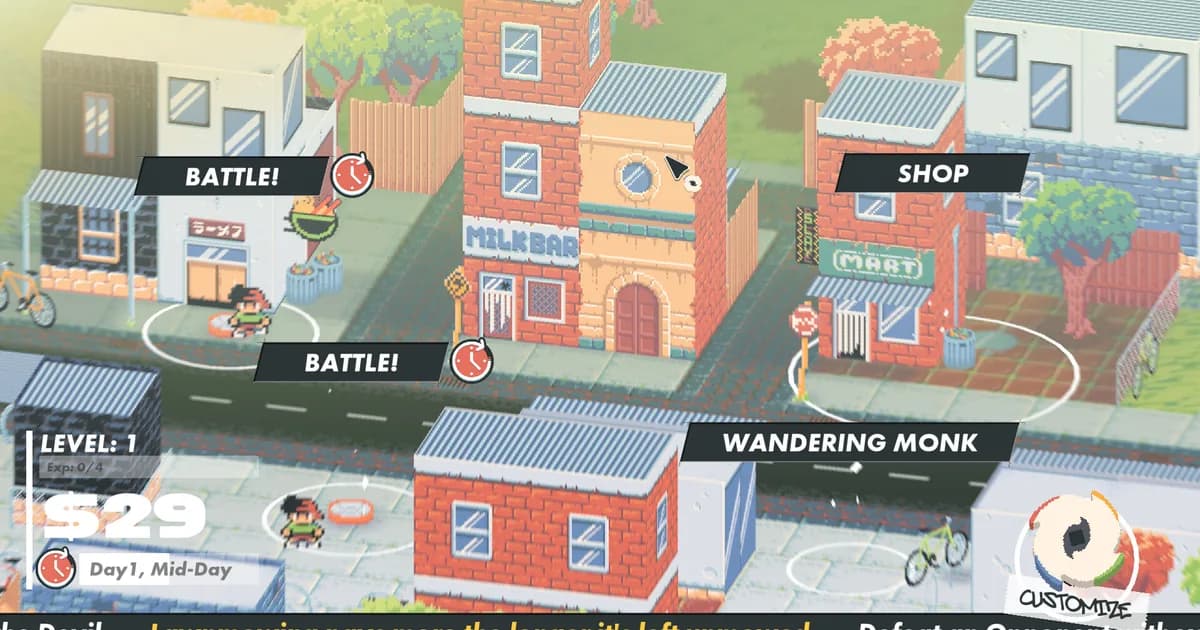
The overworld is a small pixel-art town rendered in an isometric, PS1-adjacent style, walked at a fixed pace between named landmarks. A screenshot from the store page shows a Milk Bar, a corner store labeled Mart, and encounter markers reading "BATTLE!" and "SHOP" scattered across intersections, alongside a wandering NPC labeled "Wandering Monk." A ticker at the bottom of that same screen cycles through flavor tips, including one about a lawn-mowing side job that "pays more the longer it's left unmowed," which suggests there is more going on in the world than the store page's one-line pitch lets on.
Time of day matters mechanically, not just visually. Screenshots show the same city rendered at "Day 1, Mid-Day" and "Day 1, Nighttime," and at least one part's stat block (below) explicitly changes behavior at night. Shops are staffed by named NPCs; one screenshot shows a shopkeeper greeting the player with "Welcome to my shop!" and offering three parts for sale, one of them discounted 30%, with a "Buy" or "Leave" choice for each.
Battles themselves are shown from a top-down, arena-style camera. Two tops spin against each other on a circular playing field, an RPM counter tracks spin speed live (readings across different screenshots range from roughly 10 to 56 RPM), and a crowd of silhouetted spectators lines the edges of the arena. Some arenas use a bare stone floor scattered with barrel obstacles; at least one uses a grass-textured floor with star and coin pickups scattered across it. Cash and experience are earned per match; screenshots show in-run totals anywhere from $29 up to $97, alongside a leveling system with its own experience bar.
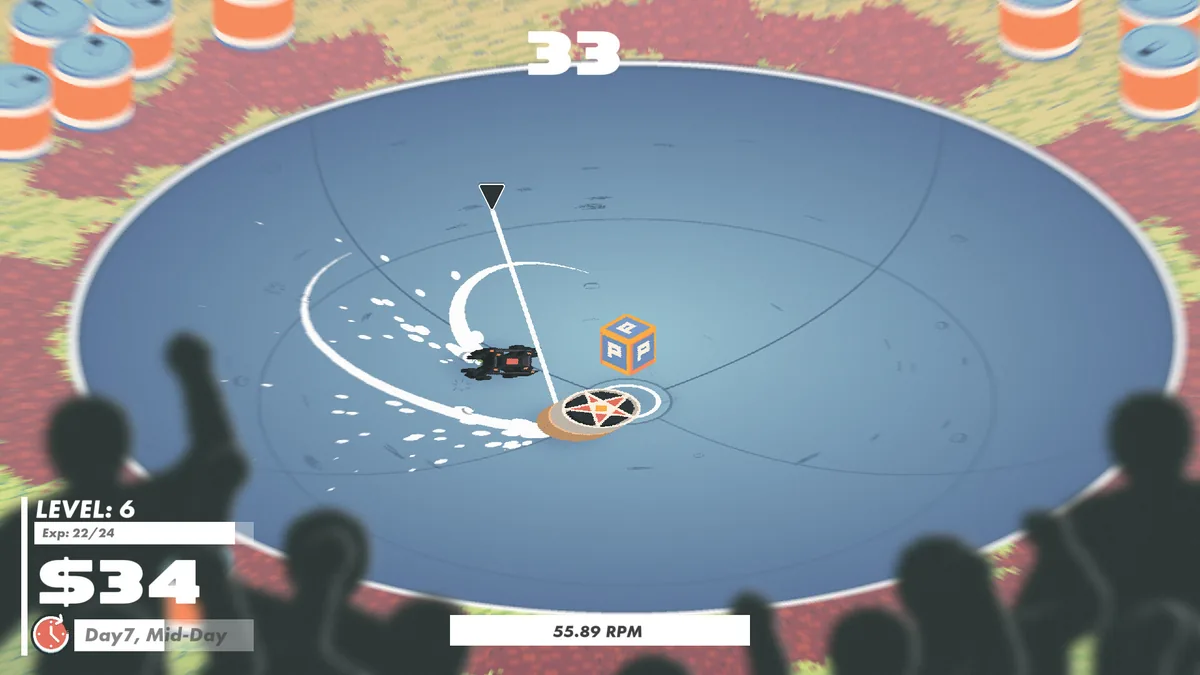 A live match at 55.89 RPM, with a Power Up Cube pickup sitting between the two spinning tops.
GODEEPER: Slayblade is one of several physics-driven roguelites competing for the same audience this year. Best Indie Roguelites Steam Summer Sale 2026: 8 Picks →
The Parts and Merge System: What's Actually Confirmed
The store page's pitch, "Collect 60+ parts, Merge their Powers," is short on specifics, and Henry's House hasn't published a devlog breaking the system down further. What can be confirmed comes from the game's own customization screen, captured in one of the Steam store screenshots.
That screen shows three equipped parts, each labeled a "Power Up Cube" with its own name and a plainly stated stat effect:
- Satanic Head: "Increase your Spin by +5RPM, plus +50% RPM for each Aura on you."
- Vampire Body: "If it's Nighttime, Decrease Opponent's Spin by 50%."
- Just the Tip: "Decrease Slaydium Arena Size by +10%."
Each part also carries a weight value in grams (the equipped loadout in that screenshot totals 75 grams), which implies a weight-budget system governing how many parts a battle-top can carry, similar to the encumbrance systems in deck-building or inventory-limited roguelites. The arena itself is named "Slaydium" in-game, per the Just the Tip description above, a detail that doesn't appear anywhere in the store page's marketing copy.
Here's what isn't confirmed: the exact rules for merging two parts together, whether merges are random or player-directed, how rarity or tiers factor in, or what the full 60-part roster looks like beyond the three named parts visible in that one screenshot. Henry's House hasn't published anything explaining the merge mechanic step by step, and inventing that detail here would be exactly the kind of guesswork that gets a preview like this one wrong. The honest version: parts stack toward specific stat categories (spin speed, opponent debuffs, arena manipulation), and a "merge" appears to combine two parts' cube effects onto one, but the precise formula isn't public yet.
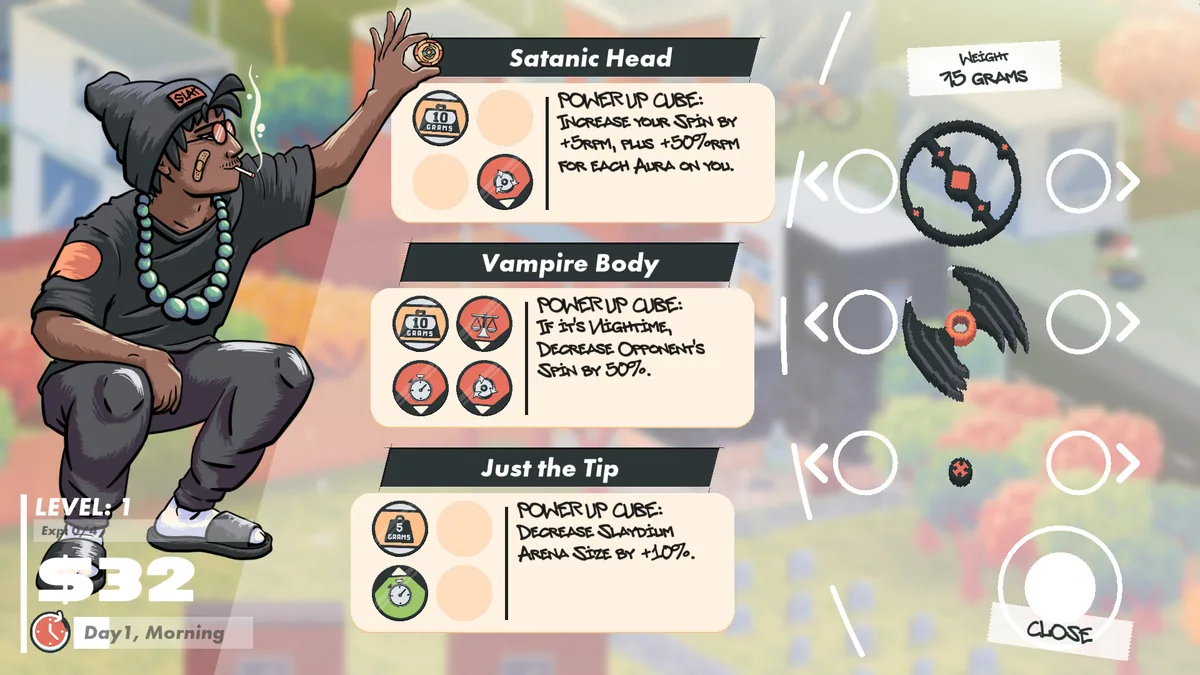 The equipped loadout screen, showing the exact stat text for three named parts and their weight in grams.
GODEEPER: If physics-driven stat stacking is the appeal, Rune Dice runs a similar idea with tumbling dice instead of spinning tops. Compare its physics dice system guide with the Rune Dice complete guide.
Analysis: The Pattern Behind Henry's House's Games
Henry's House is Rob Gross and Oscar Brittain, who founded the studio together in 2020 after meeting, according to the studio's own website, "at a toga party at Henry's house." Gross handles programming, Brittain handles art. The studio operates between Perth and Melbourne. Their first release was Kardboard Kings: Card Shop Simulator in February 2022, a management sim about running a trading card store, still listed under Henry's House on Steam.
Slayblade's own Steam store description credits its creator with three prior games: Nanomon Virtual Pet, Kardboard Kings, and Desert Child. The Kardboard Kings claim is independently verifiable through Steam's own developer search. The Desert Child claim is the one worth checking rather than taking on faith, and it holds up: Desert Child's separate 2018 Steam listing (appid 844050, published by Akupara Games) credits Oscar Brittain, individually, as its sole developer. Two separate official Steam pages, written years apart by different publishers, agree on the same name.
That matters more than trivia. Desert Child was a scooter-racing, drug-dealing narrative game with a distinct hand-drawn art style and a soundtrack-forward identity, not a spinning-top battler. Kardboard Kings was a slow management sim. Slayblade is a fast, physics-driven roguelite with a betting economy layered on top. The throughline across all three is a small team building systems-heavy games around a strong visual identity and an economy loop, rather than repeating a genre. That is a more useful signal for judging Slayblade's ceiling than the one-line store pitch is.
For readers comparing build economies rather than art styles, the Rune Dice bomb relic guide, Rune Dice Necromancer guide, and Black Jacket deck-building guide show three other ways small studios turn stacking decisions into a run identity.
The Black Jacket review is another useful comparison for readers who want a longer look at a wager-driven indie roguelite.
Community reaction ahead of launch was modest but present. Slayblade turned up in a Reddit roundup of Steam Next Fest demos in r/IndieGaming, and separately in r/pcgaming's community-maintained list of the week's PC releases, tagged by the community as "Roguelite, Physics, Relaxing, Replay Value." Neither is a large sample, and neither is a review, but both confirm the game had a working public demo well before launch, which is more than some day-one Steam releases can claim.
Related Reading
- Best Indie Roguelites Steam Summer Sale 2026: 8 Picks: Where Slayblade sits among the current crop of indie roguelites, for readers deciding what to try first.
- Rune Dice Complete Guide 2026: Classes, Relics, and Builds: Another physics-driven roguelite build system, useful for comparing how two different studios handle randomness and stacking effects.
- Killer Bean Early Access: What the New Roguelike Gets Right: A recent example of a small studio's roguelike launch and how its early reception played out.
- Black Jacket Complete Guide 2026: All 21 Journeys, Suits: Another indie roguelite built around a betting-and-wagering economy, for the cash-loop angle specifically.
Frequently Asked Questions
Is Slayblade an Early Access game? No. Steam's own genre and category tags for Slayblade do not include Early Access, and the store page lists a standard launch, not an Early Access one. It released as a complete game on August 20, 2026.
When did Slayblade release? August 20, 2026, confirmed directly through Steam's own listing for the game (appid 4117730). The store page had shown it as coming soon in the days leading up to launch.
Who developed Slayblade? Henry's House, a two-person Australian studio founded in 2020 by Rob Gross and Oscar Brittain. Steam credits both Henry's House and Oscar Brittain individually as developers, with Henry's House as publisher.
Did the same developer make Desert Child? Yes. Slayblade's own Steam page credits its creator with Desert Child, and Desert Child's separate Steam listing independently credits Oscar Brittain as its sole developer. Both pages agree.
How many parts are in Slayblade? 60+ at launch, stated directly on the Steam store page. The free Slayblade Demo carries roughly half that total, and any progress made in the demo carries over to the full release.
Does the Slayblade demo carry over progress to the full game? Yes, according to the demo's own Steam page. Players who unlocked parts or cash in the free Slayblade Demo keep that progress when they move to the full release.
What platforms is Slayblade available on? Windows via Steam only, based on the current store listing. No Mac, Linux, or console version has been announced as of launch.
References
- Slayblade on Steam
- Slayblade Demo on Steam
- Desert Child on Steam (independent source credit for the Desert Child pedigree claim)
- Henry's House official site
- Slayblade official announcements: Patch 1 and Future Plans post
- Slayblade - Official Release Date Trailer (YouTube)
About the author

Senior Critic & Analyst
Former game data analyst turned critic with 11 years covering indie and mid-tier games. Based in Austin. Runs spreadsheets on games most people just play.
- 11 years games criticism
- Former game economy analyst
- Roguelike and strategy specialist
Keep reading
Lost Castle 2 Achievements Guide: All 85 Explained
General · 21 min
Combolands Roguelike Citybuilder Launches August 24
General · 7 min
Risk of Rain 2 Complete Guide: Survivors, Items, Bosses
General · 8 min
Risk of Rain 2 Bosses and the Alloyed Collective DLC
General · 10 min
Risk of Rain 2 Items and Artifacts Guide: All 20 Artifacts
General · 9 min
Risk of Rain 2 Survivors Guide: All 18 Characters Ranked
General · 10 min
Game deals · affiliate links
Disclaimer
This article is published for informational and entertainment purposes. It does not constitute professional financial, legal, or technical advice. Game performance, online services, patch schedules, and store listings change. Verify critical details (pricing, system requirements, regional availability) with publishers and storefronts before you buy. Affiliate links, where present, help support our editorial work and are labelled in our affiliate disclosure.
Comments
Loading comments…