
Complete guideBlack Jacket
Black Jacket Complete Guide 2026: All 21 Journeys, Suits
Black Jacket complete guide hub: suits, deck building, Soul coin economy, Journey progression, boss strategies, and every guide on the site. Updated 2026.
This Black Jacket complete guide covers every system in the game: suit selection, deck building, Soul coin economy, Journey progression, and boss strategies. Black Jacket takes the simplest card game most people know and runs it through a roguelite deckbuilder. You're a soul stuck in hell, playing blackjack against demons, working through 21 Journeys of increasing difficulty. The surface is familiar. Everything underneath it isn't.
Sponsored

About the game
Black Jacket
Mi'pu'mi Games GmbH · Skystone Games
Use this hub as your starting point and follow links to wherever you are in a run.
TL;DR: Black Jacket is a blackjack roguelite where you pick 3 of 8 suits per run and build a deck around their mechanics. The core rule that trips up new players: don't chase 21, win the coin war. For beginners, Diamonds plus Spades plus Clubs is the most forgiving starting combination; Hearts looks friendly but is a high-complexity negative-value suit. The game has 21 Journeys; most players hit their first real wall around Journey 8-12.
Sponsored

Black Jacket complete guide: how the game works (quick answer)
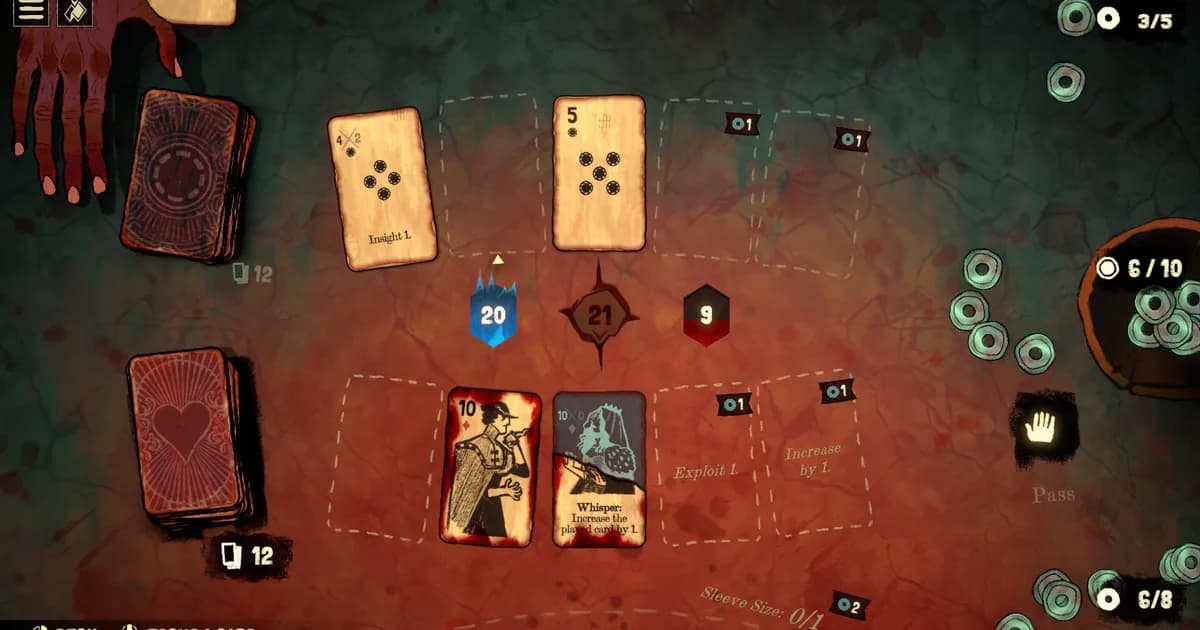
Black Jacket runs on a modified blackjack loop. Both you and the opponent draw from custom decks, not a shared shoe. You pick 3 suits at run start; those suits form your deck's identity for the entire run. Between rounds, you spend Soul coins at shops to upgrade your deck, remove bad cards, or add suit-specific tools.
The goal is not to win every hand. It's to end the run with more coins than you started with at each major encounter. You can lose hands and still win the broader match if your coin management is solid.
GODEEPER: Suit selection, deck archetypes, and the Soul coin economy explained for new players. Black Jacket Guide: Tips and Suit Selection 2026
- Black Jacket Review: The Roguelite That Earns Its Tension: Black Jacket review: 90% Very Positive on Steam.
Key takeaways
- Choose 3 of 8 suits at run start; each suit adds a secondary mechanic beyond raw card values
- The betting decision is as important as the card decision; coin management decides runs
- Journey modifiers change the rules of each difficulty level, not just scale enemy HP
- Card removal at shops is underrated; a smaller, focused deck beats a padded one
- Steam Deck Verified as of May 2026; full handheld support confirmed
The 8 suits: what they do
Each suit provides cards for several number slots in your deck and adds a thematic secondary mechanic. Choosing 3 of 8 means every run has a distinct strategic identity.
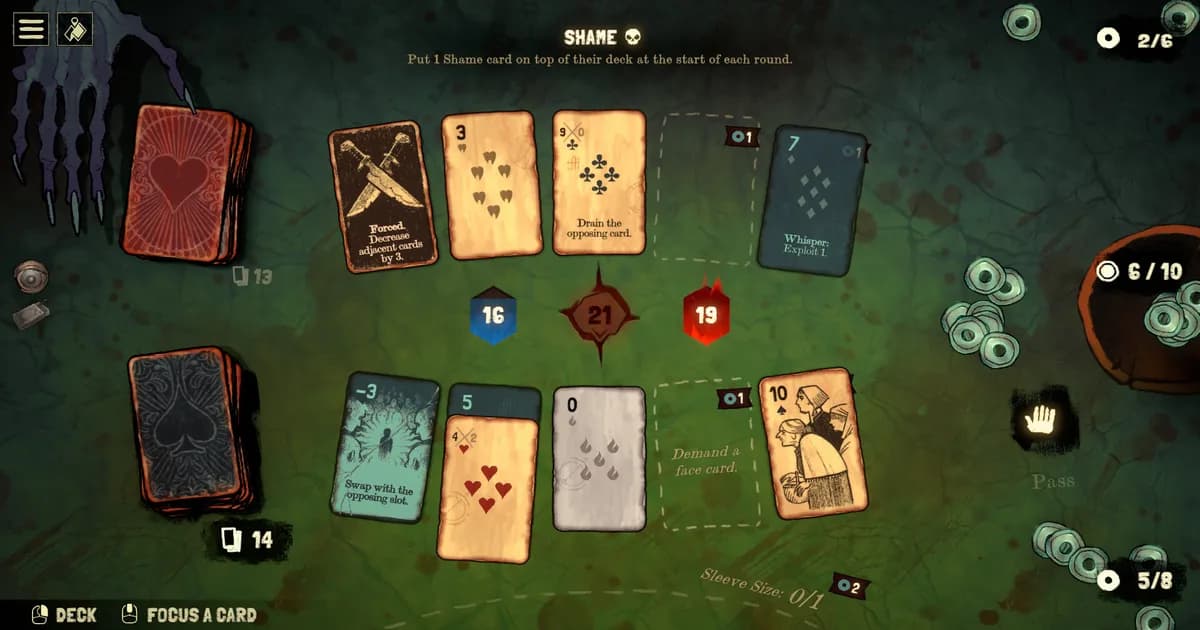
Clubs: Value manipulation. Club cards alter card values and reach across the table, draining the opposing card or swapping with the opposing slot. Best for players who want to manipulate the numbers on both sides rather than only play their own hand.
Hearts: High complexity. Awakened Heart cards take on negative values and can break the opposing card, so Hearts is a removal suit that weaponizes negative numbers. Powerful, but demanding: despite the familiar symbol, it is not a gentle beginner suit.
Diamonds: Draw manipulation. Diamond cards rearrange the top of your deck so you control which cards come up next. This is the most consistent suit because it makes the blackjack variance problem smaller. You know what's coming.
Spades: Flexibility. Spade cards can be played into any slot and lean toward disrupting the opponent. Good as a third suit for runs that need coverage without full commitment to one archetype.
Flames: Removal and tempo. Flames cards apply ignite. A card ignited twice burns away and is exhausted for the rest of the run, so it cannot be drawn again. Some Flames cards ignite your own deck and others hit the opponent's, which makes it a thinning tool that cuts both ways. Unlock it by burning 15 cards across your runs.
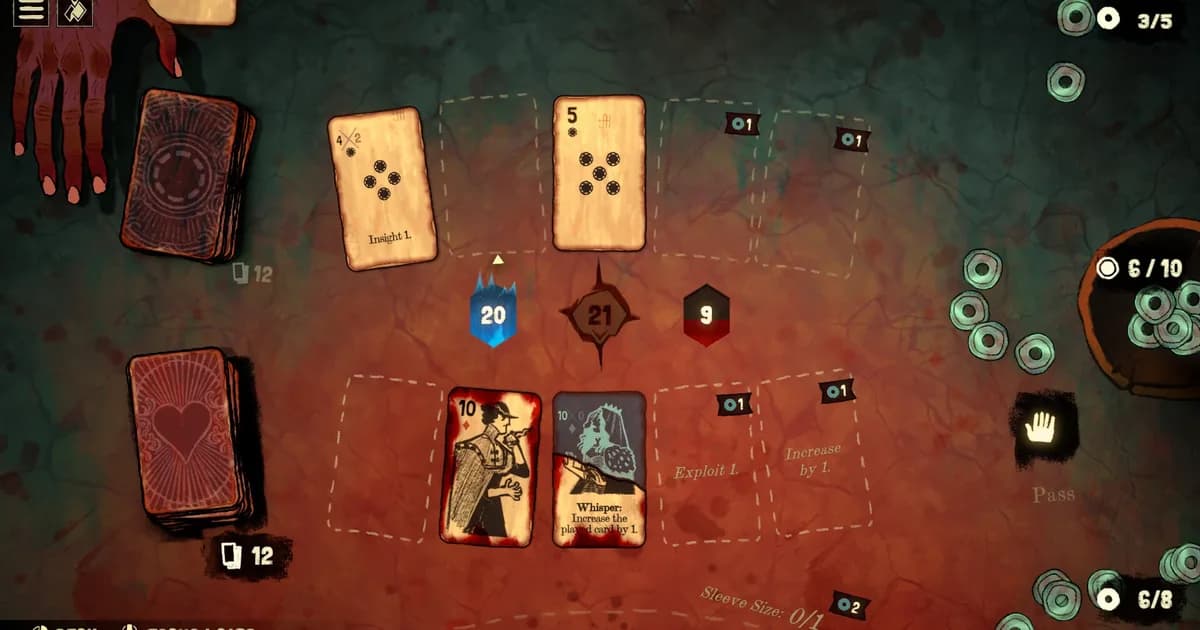
Greed: Value scaling. Greed revolves around sleeving cards. You tuck cards from your deck or slots into a sleeve, and several Greed cards buff whatever is already slotted. The 10 of Greed, for example, lets sleeved cards gain value instead of busting you. It is the suit for players who want a deck that compounds over a long encounter rather than spiking early. Unlock it by discovering 70 cards.
Teeth: Opponent control. Teeth cards lower the score of the opponent's cards, shrinking the totals they can build against you. Instead of racing to a better hand, you drag the opponent's hand down until their strong draws stop mattering. It is strong into bosses that rely on high single-hand totals. Unlock it by awakening 20 cards.
Tumors: Big-number combo. Tumors cards devour other cards for effects, and the devoured scores stack onto a single card. Fill every slot on that card and a secondary effect triggers. It is the most complex suit in the game and the one with the highest ceiling: a fed Tumor card can end an encounter on its own. Unlock it by winning 50 encounters.
That covers all 8 suits. The practical guidance: lead with Diamonds for draw control and pair it with Spades for flexible coverage while you learn. Add Clubs once you want to manipulate the opponent's numbers. Hearts, despite the familiar symbol, is a high-complexity removal suit, and Greed and Tumors are Journey 12+ picks once you can build a deck that scales over a long encounter.
Suit selection happens once per run. The 3 suits you pick determine which card values your deck uses and what secondary mechanics are available for the entire run.
The 21 Journeys: progression explained
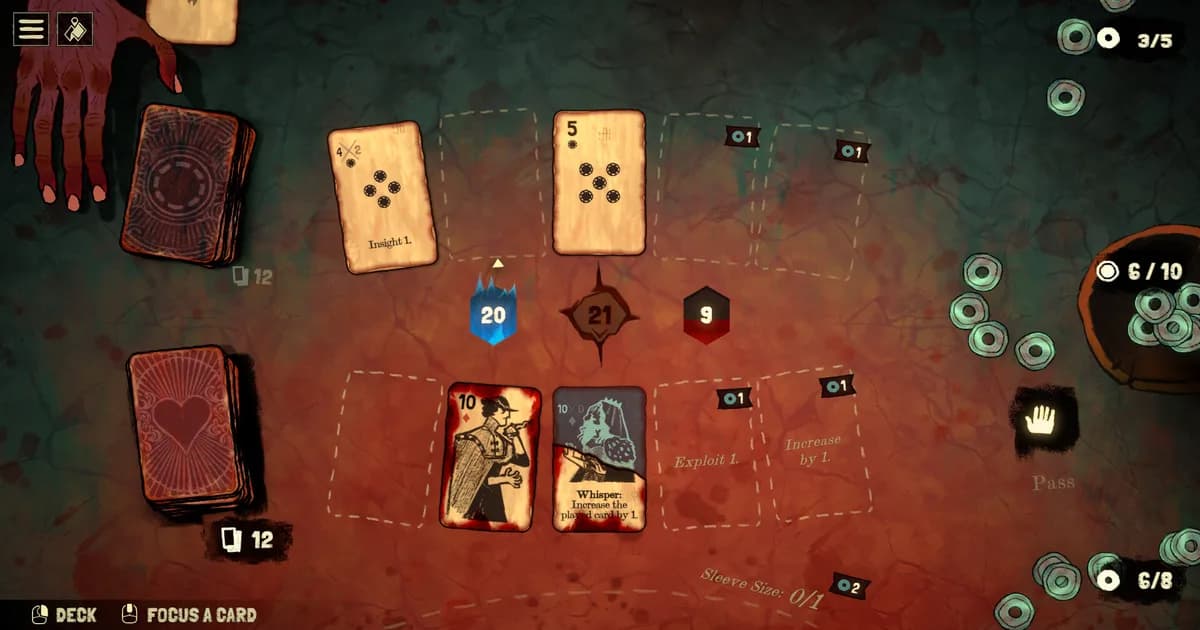
Journeys are Black Jacket's difficulty system. Journey 1 is baseline. Each Journey adds one or more modifiers that change how that difficulty tier plays: new opponent behavior, altered card rules, or specific restrictions.
The modifier system is what separates Black Jacket from a simple difficulty slider. A modifier that increases the opponent's bust threshold on Journey 9 plays completely differently from one that restricts which suits can be played on the same turn. You need to read the Journey's modifier before committing your strategy for that run.
Most players progress through Journeys 1-5 in their first 2-4 hours. The difficulty curve steepens significantly around Journey 8. Journey 12+ requires intentional deck construction; you can't wing it with random card pickups at that point.
GODEEPER: Suit selection, deck archetypes, betting strategy, and how to read opponent patterns for any Journey tier. Black Jacket Guide: Tips and Suit Selection 2026
- Black Jacket Journey Guide: All 21 Journeys Explained: Black Jacket journey guide: all 21 Journeys by tier, modifier types, deck strategies that clear...
Deck building: the rules that matter
Black Jacket's deck building isn't about having the highest-value cards. It's about having cards that trigger your suit mechanics reliably on the turns where the match is decided.
Card removal is the most underused tool. Every shop offers removal options. A 20-card deck where 12 cards are dead draws is worse than a 12-card deck where every card does something. Players who buy every interesting card at every shop end up with padded decks that draw the wrong card on the turn it matters.
Suit coherence over raw power. A Clubs card that costs 3 coins in a Hearts-primary deck gives you less value than a Hearts card at the same cost. Your suit mechanics only trigger if the right cards are in play. Off-suit additions dilute that.
The buy vs. remove decision. When a shop offers both an interesting new card and a removal slot for an existing card, evaluate which does more for your deck's trigger rate before the next major encounter. At Journey 8+, the removal is usually the right call.
- Black Jacket Deck Building Guide: Best Suits and Combos 2026: Black Jacket deck building guide: best suit combinations, how card removal works, when to buy...
- Black Jacket Suit Tier List: All 8 Suits Ranked 2026: Black Jacket suit tier list: Diamonds is the standout S tier, Hearts is a high-complexity...
Soul coin economy
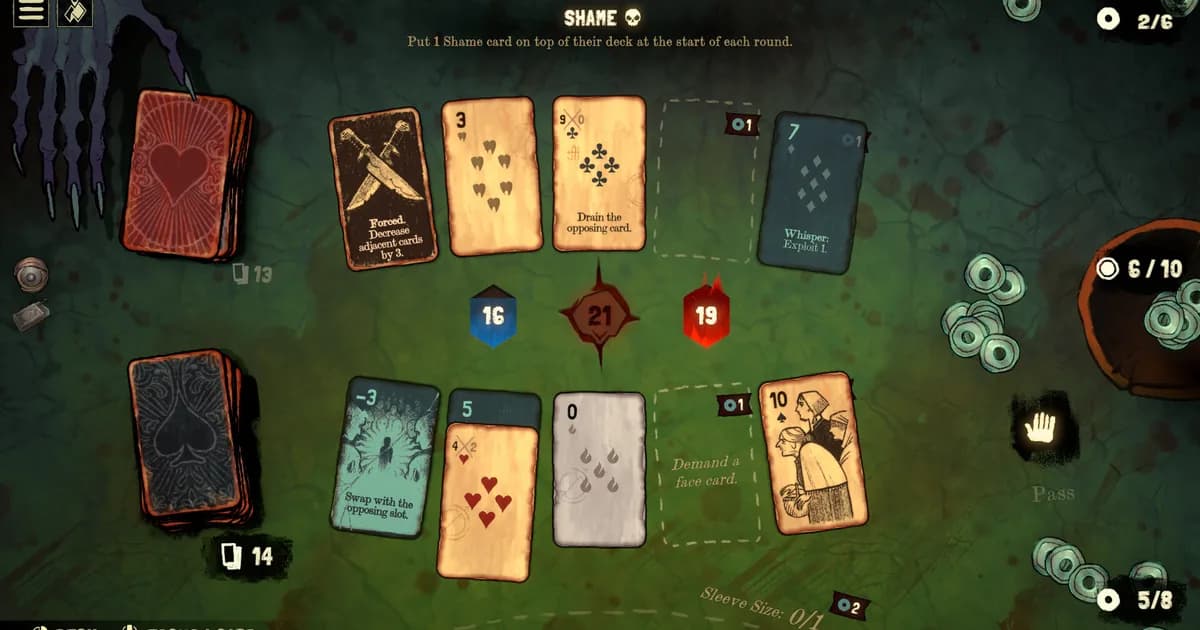
Soul coins are both your betting currency and your upgrade resource. Every decision in Black Jacket relates back to your coin count.
Early runs often fail not because of bad card luck but because of bad betting decisions. Overbetting in round 2 of a set leaves you with too few coins to bet meaningfully in round 3, even if you win. The opponent's chip count matters more than your hand score on any single hand.
Shop spending follows a similar logic. Spending every coin at an early shop leaves nothing for the mid-run shops where the upgrades that compound across later Journeys appear. Treat your coin reserve as both currency and insurance.
Each Journey plays out across a node map like this one. Which path you take between encounters is its own layer of decision-making on top of the deck you're building.
- Black Jacket Soul Coins Guide: Economy & Coin Management: Black Jacket Soul Coins guide: how you earn and spend coins, the in-run sinks that...
Boss encounters
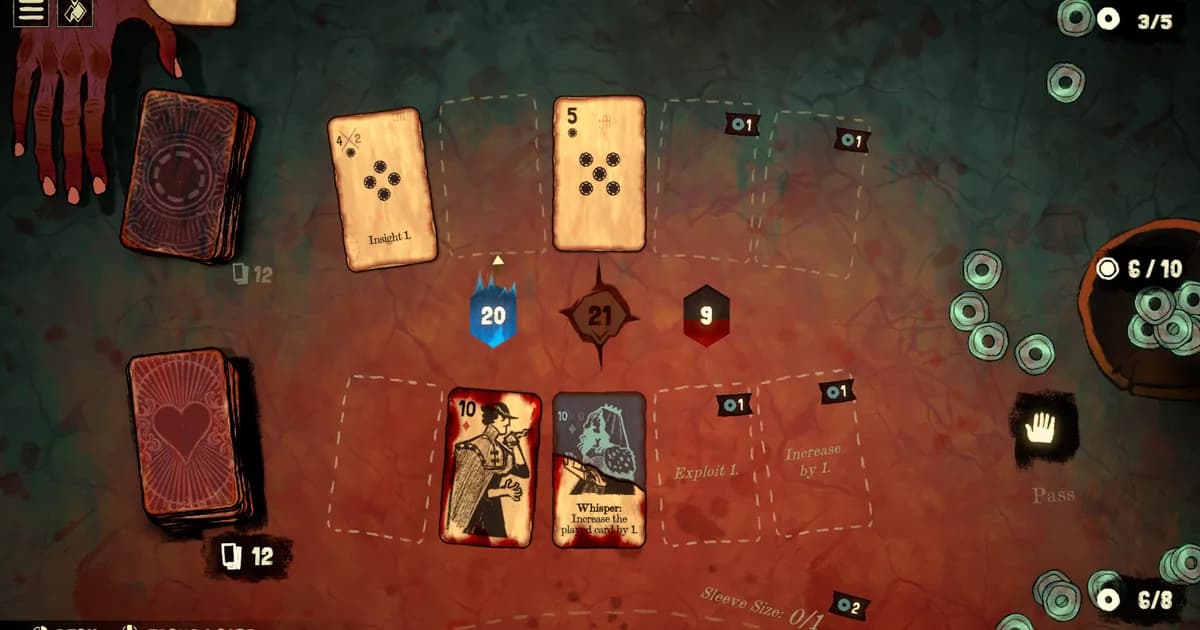
Bosses appear at boss nodes along the run's node map, not one per Journey tier. A successful run means beating three of them, and which bosses you face rotates between runs rather than following a fixed Journey-to-boss mapping. Bosses don't just have higher health. Their decks are built around specific strategies that counter unfocused play.
Boss strategies depend on which suits you're running. Clubs-heavy builds drain the boss's strongest cards before they land. Hearts-heavy builds use negative-value cards to break the boss's burst plays. Knowing the boss's behavioral pattern before committing your major bet each round is the skill that separates Journey 12+ clears from failures.
- Black Jacket Boss Guide: All 5 Bosses and Curse Counters: how to beat Reed, Morgan, Niv, Ivel, and Better, and what each boss punishes.
How to build your first winning deck
New players tend to overbuild in the wrong direction: they collect powerful-looking cards across three suits without letting any single suit's mechanic fully emerge. By Journey 5, the deck has 25 cards with no coherent trigger pattern. The hands that matter go unresolved.
A functional first deck looks closer to this: 12-16 total cards, of which 8-10 belong to your primary suit, 3-4 to your secondary, and 1-2 to the third. The third suit's cards serve as coverage tools, not core pieces. You're using them to handle situations your primary can't.
The card count matters as much as the card quality. In any shuffle, you draw 2-3 cards per hand. With a 25-card deck, the probability of drawing your primary mechanic trigger in the hands that matter is around 35-40%. With a 13-card deck, it's 65-70%. That's the difference between a deck that sometimes wins and one that consistently executes.
What you remove matters as much as what you keep. The starting deck in most runs includes filler cards that have no synergy with any of your three suits. These are the first targets at every shop's removal slot. Removing two filler cards costs the same as buying a mid-tier card and usually does more for your run.
Journey modifier tiers at a glance
Journeys cluster into four rough tiers based on how they change the game:
Journeys 1-5 (introduction tier): Modifiers are additive. Opponents might draw one extra card per hand, or a specific suit of cards gets a bonus. You can largely ignore modifiers at this tier and still win with decent card play.
Journeys 6-10 (pressure tier): Modifiers start interacting with your resource management. You might lose coins on bust regardless of your suit recovery mechanics, or have a card limit per hand. This is where deck construction discipline starts paying off.
Journeys 11-15 (disruption tier): Modifiers target specific strategies. There are Journey modifiers that penalize holding your primary suit's key card types, or that give opponents additional draw capacity if your deck is below a certain size. You need to read the modifier before choosing your run's strategy.
Journeys 16-21 (endgame tier): Multiple modifiers stack. Journey 21 has three active at once. Builds that worked on Journey 14 fail here because the combined modifier pressure closes off certain strategies entirely. Reaching Journey 21 is a meaningful achievement; clearing it requires a purpose-built deck optimized for that specific modifier combination.
Common mistakes new players make
Chasing 21 on every hand. The win condition is your opponent's chip total reaching zero, not your hand score. Sometimes the correct play is standing on 14 because the odds of getting what you need don't justify the bust risk given the current bet size.
Skipping shop removal. The free removal option (if available) is almost always worth taking over a random card buy. Reduction is almost always addition in disguise.
Not reading the Journey modifier before picking suits. If the modifier penalizes your primary suit, pick a different run strategy rather than playing through it and losing anyway.
Spending everything at the first shop. The mid-run shop is where the best suit-specific upgrades appear. Saving 40-60% of your coins past the first shop dramatically improves the ceiling of any given run.
What's coming next
Black Jacket received Steam Deck Verified status in May 2026. The development team has been active with post-launch support: Hotfix 1 through 3 addressed progression blocks, card targeting bugs in the Flames suit, and display issues, then Balance Patch 1.0.6 (June 25, 2026) rebalanced card values and boss decks based on early feedback. Patch 1.0.7, listed in the official Steam announcements on August 3, added Steam Community items and a final cutscene that unlocks after defeating the final boss on difficulty 21, alongside bug fixes. Mi'pu'mi Games' June 30 roadmap still described Patch 2 (Weekly Challenges) and Patch 3 (more cards, more artifacts, and reworked difficulty levels) as planned, not shipped; specifics remain subject to change. Hotfix 4 fixed a save-file crash tied to regional OS timestamp settings. See the full update roadmap for the complete breakdown.
Is Black Jacket worth buying?
If you enjoyed Balatro or Slay the Spire, the answer is almost certainly yes. The blackjack foundation makes each hand legible even on your first run, which is rare for the genre. Most deckbuilders take a while before the core loop feels earned; Black Jacket gets there faster because everyone already knows blackjack.
The difficulty curve after Journey 8 is real and by design. If you want a roguelite you can complete in your first week, this isn't it. If you want one that keeps adding layers through its 21-tier Journey run, it's well-paced.
At the current price point (check the Steam page for any sales), it's a solid value for the genre.
- Black Jacket Review: The Roguelite That Earns Its Tension: Full review verdict with rating, suit breakdown, and how it compares to Balatro.
All Black Jacket guides
- Black Jacket Guide: Blackjack Roguelite Tips 2026: suits, deck building, Soul coin basics, and Journey progression for new players.
- Black Jacket Update Roadmap: Weekly Challenges Next: Black Jacket update roadmap confirmed: Weekly Challenges arrive in Patch 2, then more cards and artifacts in Patch 3.
- Black Jacket Achievements: All 42, Ranked by Rarity: Black Jacket achievements guide: all 42 listed with live global completion rates.
Related Reading
- All Black Jacket coverage: every Black Jacket guide, review, and news post published on GameBrief, in one index.
- Black Jacket Guide: Blackjack Roguelite Tips 2026: complete beginner guide covering suit selection, the core blackjack loop, and Soul coin economy.
- Rune Dice Complete Guide 2026: another physics-mechanic roguelite with a strong community; if Black Jacket's deckbuilder structure appeals, this covers the dice-based alternative.
- Die in the Dungeon Complete Guide 2026: dice-based roguelite with similar strategic depth to Black Jacket's deck building decisions.
- LegionBound Advanced Builds Guide: synergy-focused strategy guide for a different roguelite that rewards the same coherent build-first thinking.
References
- Black Jacket on Steam: official store page, current Very Positive rating snapshot, patch notes, and Steam Deck Verified status from Mi'pu'mi Games and Skystone Games
- Black Jacket Steam Community Hub: community deck discussions, Journey modifier breakdowns, and suit tier threads
- Black Jacket official announcements: Patch 1.0.6 balance notes, Patch 1.0.7 final-cutscene update, and the planned Weekly Challenges roadmap
Frequently Asked Questions
What is Black Jacket? A roguelite deckbuilder where you play modified blackjack against demonic opponents across 21 difficulty Journeys. You pick 3 of 8 suits per run and build a deck around their secondary mechanics. The goal is to win the coin war, not just individual hands.
How many Journeys are in Black Jacket? 21 Journeys, each adding modifiers that change how opponents play and what card rules apply. Most players clear the first 3-5 in their first few hours and hit a difficulty wall around Journey 8-12.
What are the best suits in Black Jacket? For beginners: Diamonds plus Spades plus Clubs. Diamonds control draw order, Spades play into any slot for coverage, Clubs drain or swap opponent cards. Hearts is a high-complexity negative-value suit, so save it for later. Clubs scales further once you understand opponent patterns.
How do Soul coins work? Soul coins are both the betting currency and the shop upgrade resource. Managing your coin count across a full run matters more than winning every individual hand. Never spend everything in early shops.
Is Black Jacket hard? Accessible in Journeys 1-5, gets meaningfully harder past Journey 8. The difficulty comes from deck coherence decisions and reading Journey modifiers, not pure card luck.
Does Black Jacket have a demo? Yes, a free Steam demo covers the first few Journeys. Worth trying before buying.
Is Black Jacket on Steam Deck? Yes, Steam Deck Verified as of May 2026.
About the author

Indie & JRPG Desk
GameBrief's byline for indie, JRPG, visual novel and cozy games. Warm, direct, and willing to say which one to buy.
- Indie, JRPG and visual novels
- Early access and survival
- Sources listed per article
Keep reading
Black Jacket Soul Coins Guide: Economy & Coin Management
Guides · 12 min
Black Jacket Boss Guide: All 5 Bosses and Curse Counters
Guides · 15 min
Black Jacket Journey Guide: All 21 Journeys Explained
General · 16 min
Black Jacket Deck Building Guide: Best Suits and Combos 2026
General · 15 min
Black Jacket Suit Tier List: All 8 Suits Ranked 2026
General · 14 min
Black Jacket Guide: Blackjack Roguelite Tips for 2026
General · 11 min
Sponsored
Disclaimer
This article is published for informational and entertainment purposes. It does not constitute professional financial, legal, or technical advice. Game performance, online services, patch schedules, and store listings change. Verify critical details (pricing, system requirements, regional availability) with publishers and storefronts before you buy. Affiliate links, where present, help support our editorial work and are labelled in our affiliate disclosure.
Comments
Loading comments…