
ReviewSlay the Spire 2
Slay the Spire 2 Review: What the Steam Score Misses
Slay the Spire 2 review: a sharp Early Access deckbuilder, Very Positive in English but Mixed on Steam overall. Who should buy now, who should wait for 1.0.
This Slay the Spire 2 review starts with a number: 574,638 concurrent Steam players in the game's first week of Early Access in March 2026, one of the largest deckbuilder launches the platform has ever recorded. Steam's player reviews tell two stories: English reviews are Very Positive, while the all-language total in our Reception box is Mixed, dragged down by more than 100,000 Simplified Chinese reviews that sit at Mostly Negative. Steam also notes that off-topic review activity is excluded from the displayed score. What follows evaluates the game Mega Crit built, and separately explains why the store score has been unusually noisy.
Sponsored

About the game
Slay the Spire 2
Mega Crit · Mega Crit
Reception
Pros
- The core deckbuilding loop keeps the tight risk-reward math that made the original a genre benchmark
- Necrobinder and Regent play nothing like reskinned versions of the returning three
- Co-op holds up under real use: separate decks, shared map, per-player resources
- The launch handled one of Steam's largest single-week concurrent-player spikes without a server collapse
Cons
- Early Access balance patches have swung hard, sometimes reversing course within weeks
- Steam reviews split by language: Very Positive in English, Mostly Negative in Simplified Chinese, Mixed across all languages
- Some content promised for 1.0 (additional environments, more relics per Mega Crit's own roadmap language) isn't in the build yet
Current status: October 2026
Slay the Spire 2 is still $24.99 in Early Access, with five playable characters and online co-op for up to four players. English reviews are Very Positive (about 92% positive) and Simplified Chinese reviews Mostly Negative, which leaves the all-language total at Mixed. Mega Crit's August 14 Neowsletter says the team is moving away from biweekly patches toward larger content, and lists Steam Workshop support, Bestiary scaffolding, a Badge and Score system, new localizations, and work on experimental modes, an alternate Act 2, and another character. Achievements remain planned for v1.0.
Key Takeaways
- Slay the Spire 2 launched in Steam Early Access on March 5, 2026, priced at $24.99 with no discount as of this review
- Five characters at launch: Ironclad, Silent, and Defect return; Necrobinder and Regent are new
- Co-op supports up to 4 players online, each running an independent deck and resource pool on a shared map
- The launch peaked at 574,638 concurrent players, a top-tier debut by Steam roguelike standards
- Steam: Very Positive in English, Mixed across all languages because of Mostly Negative Simplified Chinese reviews; the review-bomb history is detailed below
- Developed and published solely by Mega Crit, the same two-person-turned-small-studio team behind the original
Overview
Sponsored

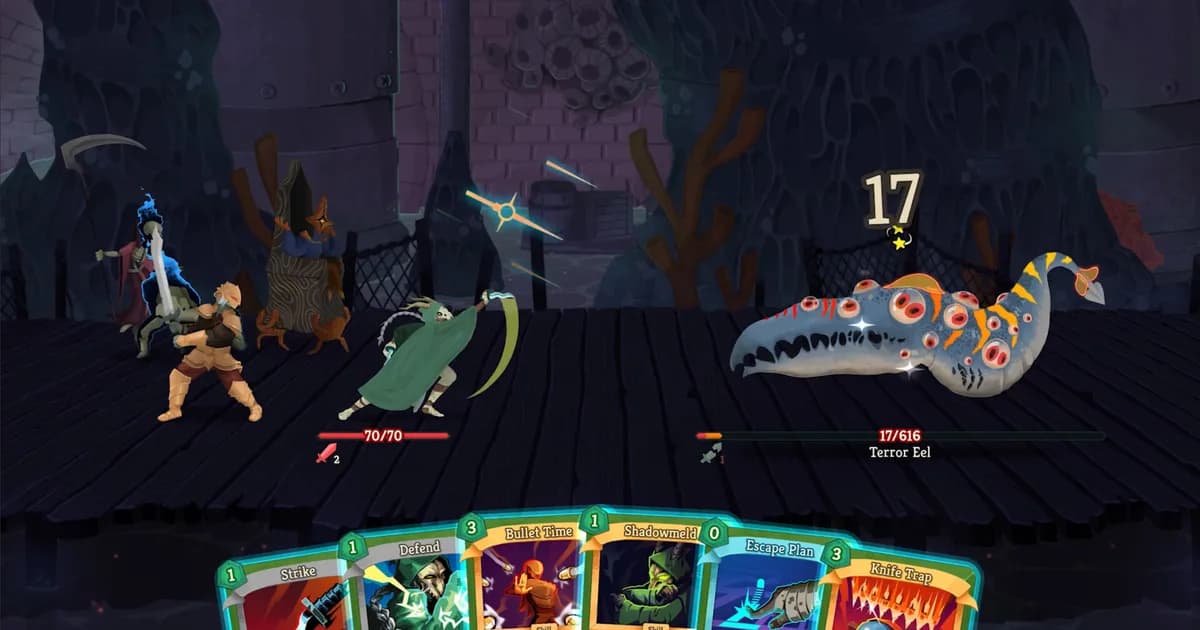
Mega Crit built the first Slay the Spire into one of the defining deckbuilder roguelikes of the last decade, and the sequel doesn't pretend otherwise. It keeps the same premise: climb a hostile tower, build a card-based deck from scratch each run, and lean on relics and potions to survive fights that get meaner with every floor. What's new is scope. Two additional characters (Necrobinder and Regent) join the returning Ironclad, Silent, and Defect, and the whole structure now supports online co-op for up to four players, a first for the series.
At $24.99, it sits in the same price bracket as most Early Access deckbuilders and roguelites on Steam, a bracket where players expect a functioning core loop on day one and content to arrive in patches rather than at 1.0. Mega Crit's own store page says as much: more cards, events, environments, and enemies are still coming, with the studio framing Early Access itself as a return to the community-driven development process that shaped the original game.
The studio hasn't changed shape much. This is still a small team shipping a direct sequel to a game with an enormous, opinionated existing playerbase. That context matters for almost everything below, including the score controversy.
Gameplay
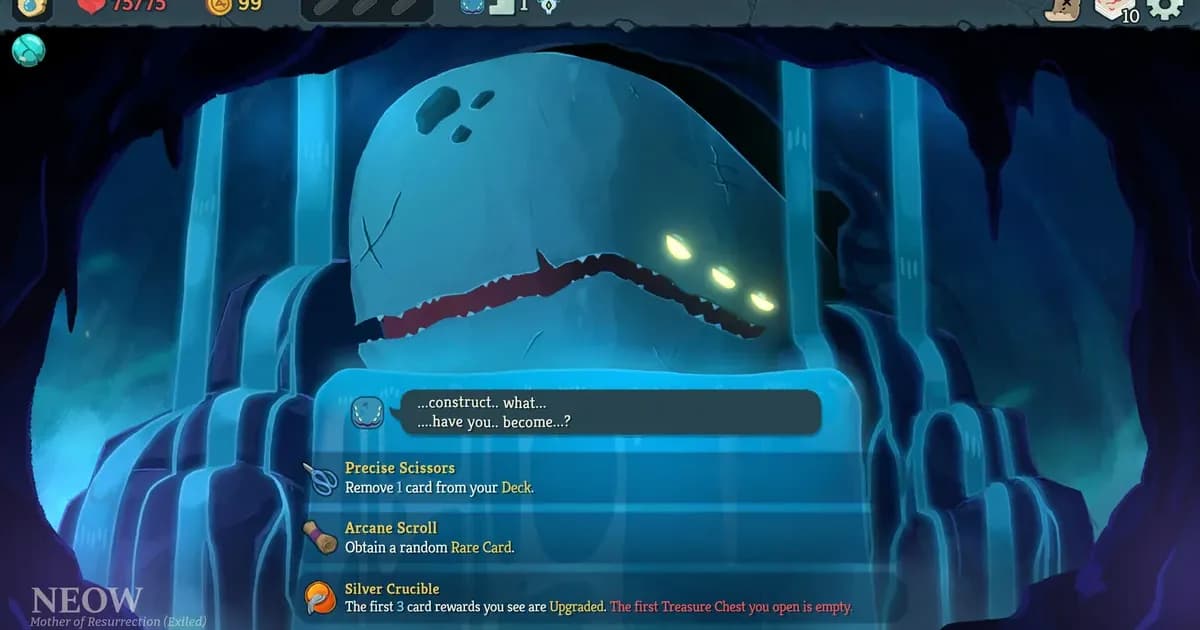
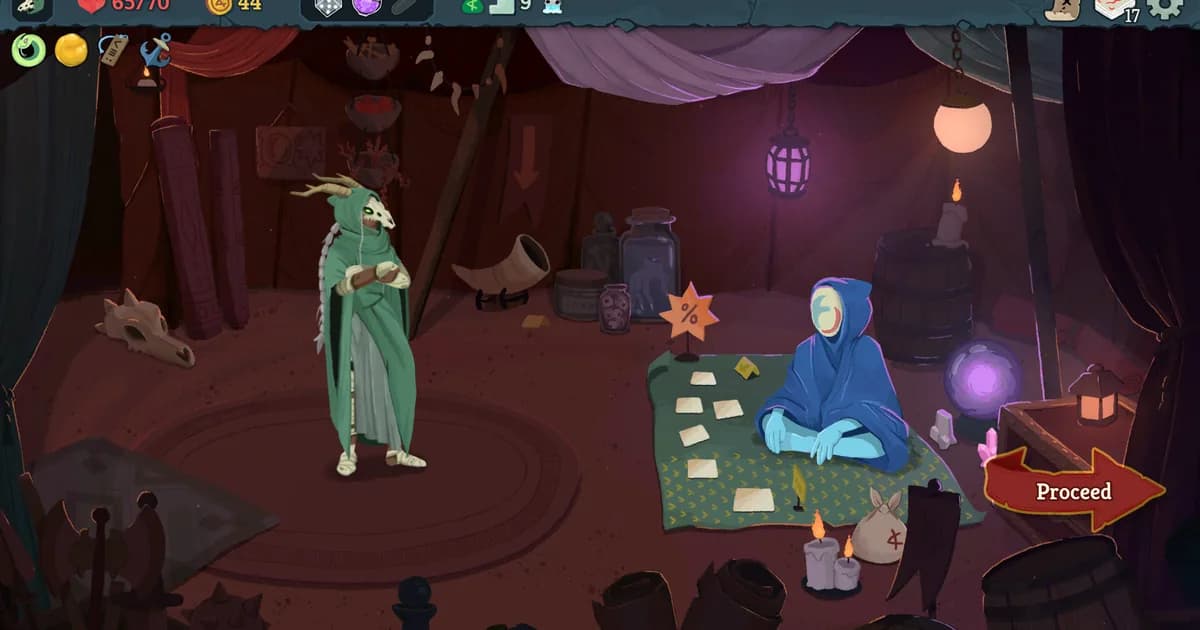
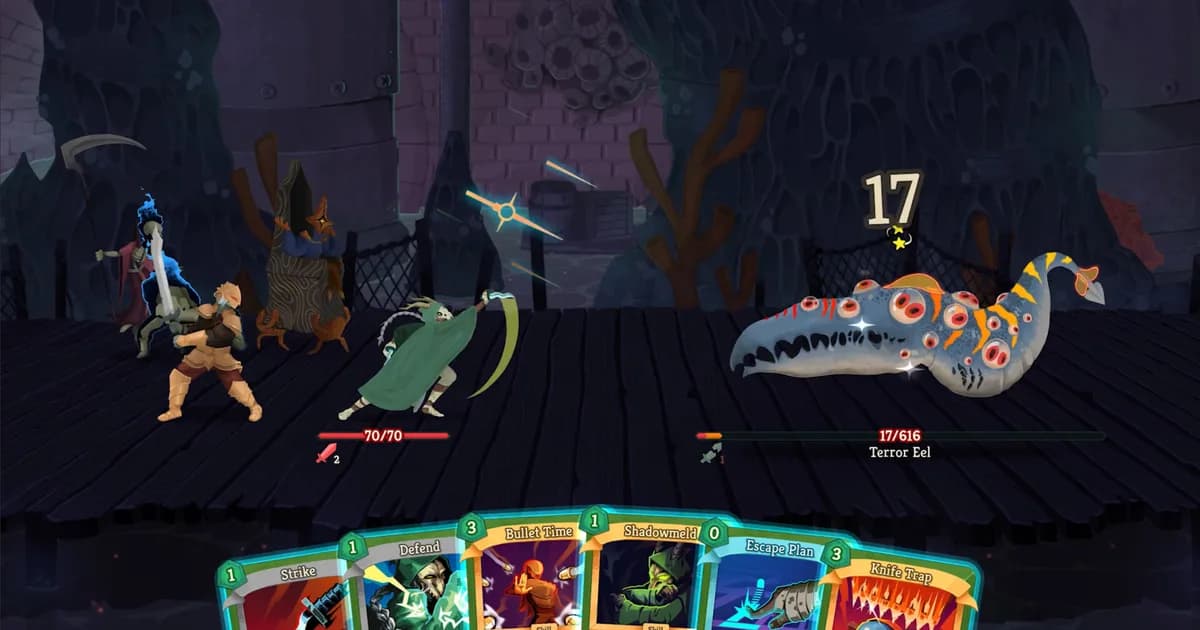
The moment-to-moment loop hasn't drifted far from the original, and that's mostly a compliment. A run still moves through card-based combat encounters, campfire rest points, shops, and event nodes, with the deck you build from run to run determining whether floor twelve is a formality or a wall. What's changed is the density of decisions layered on top: enchant-or-transform choices at event nodes (a "Symbiote" encounter, for instance, offers a card enchant with a drawback versus a straight card transform), branching Neow-style opening bonuses, and relic synergies that reward planning two or three fights ahead rather than reacting turn to turn.
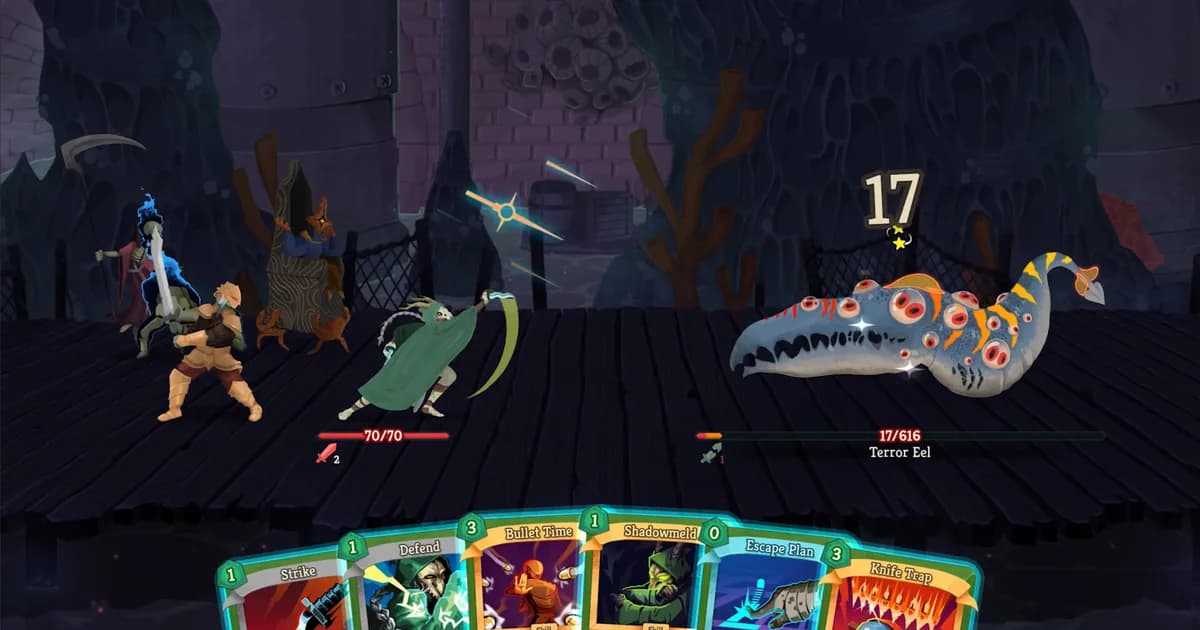
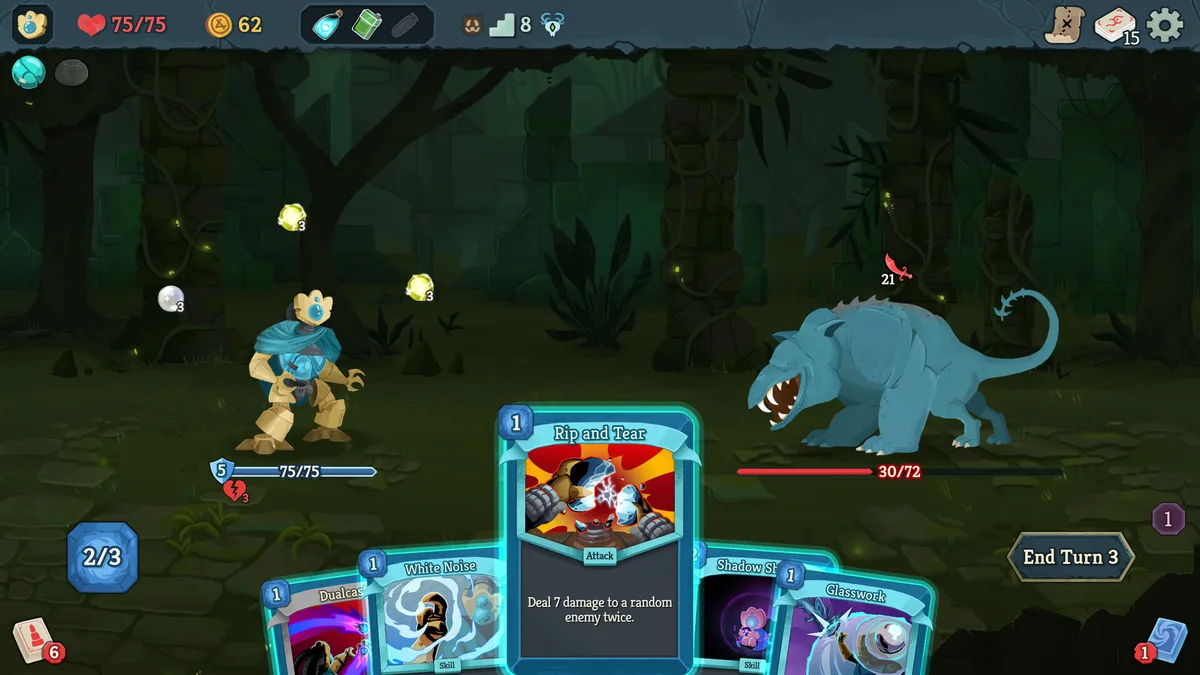 A mid-run combat encounter, card hand and HP totals visible mid-turn.
Necrobinder is the clearest evidence the sequel isn't just running old characters through a new coat of paint. Its passive, Bound Phylactery, summons a minion at the start of every turn, and its companion, Osty, functions as a persistent secondary combatant rather than a one-off relic effect. That turns deckbuilding into a two-track problem: cards that support the deck directly, and cards that keep the summon pipeline alive. Regent runs on an entirely different resource, called Stars, which changes the rhythm of a run again. Neither new class plays like a reskin of Ironclad's straightforward aggression or Silent's stacking-debuff style, which is the bar a new class in this genre actually has to clear.
Co-op is the bigger structural addition, and it holds up under scrutiny better than most bolted-on multiplayer modes in single-player-designed games. Each of up to four players keeps a fully separate deck, relic set, and gold total, but everyone shares the map and fights encounters together, with enemy difficulty scaling to the group. The design forces real coordination: whoever lands Vulnerable or Weak first changes the math for the whole team's turn, and a player who builds a deck with no synergy for their teammates' status effects is actively working against the group. It's not just the original game with a lobby screen glued on.
Ascension levels, the series' traditional difficulty-modifier system, return largely unchanged, and the character-select screen still lets a player dial that up before a run even starts.
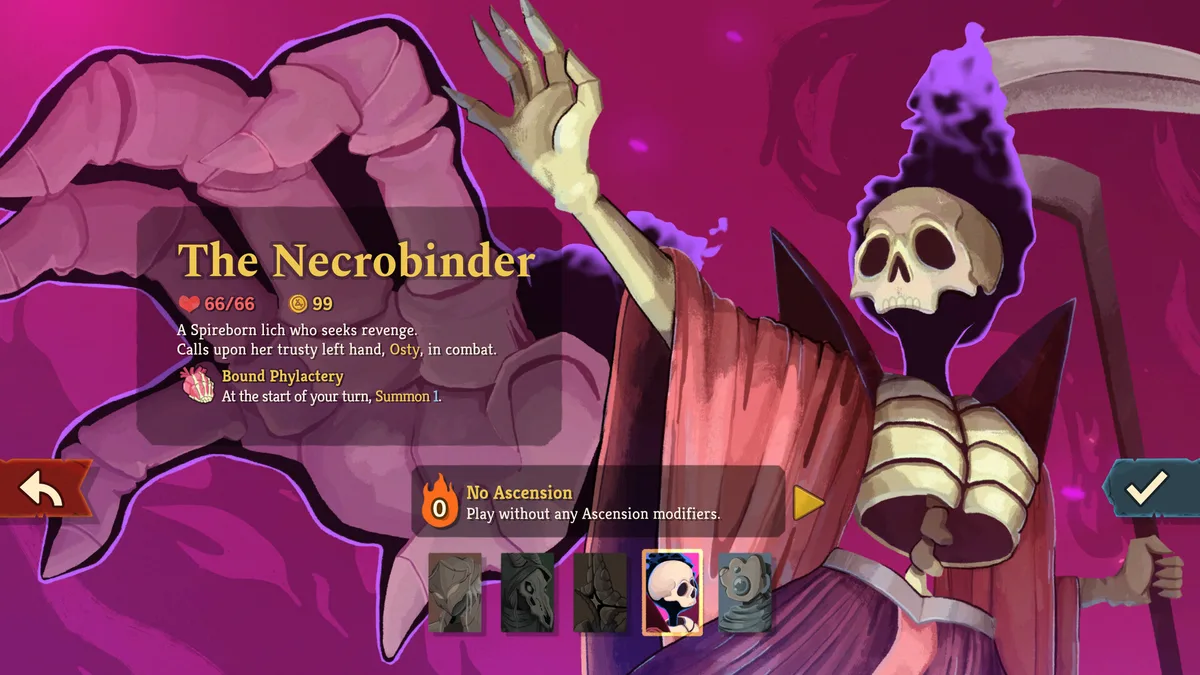 Necrobinder's character-select screen, showing her passive summon ability and starting stats before ascension modifiers are applied.
The three review-bombing waves behind the historical score
A mid-2026 snapshot around 60% positive looked, at a glance, like a game with a genuine quality problem. It wasn't one wave of dissatisfaction. It was three separate incidents, stacked, each with a different cause. The English-language reviews are back to Very Positive after Valve's off-topic review-activity handling, while the all-language total stays Mixed, so the history still matters when comparing old screenshots or cached guides.
The first hit on March 19, roughly two weeks after launch, when a balance patch nerfed several "infinite" combo lines players had built runs around and reworked the Doormaker boss encounter. Mega Crit later described Doormaker as "statistically the easiest Act 3 boss" while still continuing to adjust its fight, and the studio partially walked back one of the more contested nerfs (to the Silent's Prepared card) with a public explanation: "while I still think that the Sly synergies are overall too dominant of a strategy, Prepared is so integral to the Silent's core identity that I will be looking for a different approach to bring Sly in line in the future." That's a normal, if rocky, Early Access balance dispute.
The second wave came from the game's Simplified Chinese-language reviews, now more than 100,000 of them, which cluster around "Mostly Negative" and are tied to further balance changes that landed poorly with that specific regional community. Steam separates review language filters, so this segment is visible distinctly from the aggregate and from the English-language pattern below it.
The third wave started around May 5, when players discovered a "Consultant" credit for Anita Sarkeesian in the game's credits. The backlash that followed was large enough, and coordinated enough, that Steam's own system flagged "off-topic review activity" on the store page, a label Valve applies specifically when review volume spikes are tied to something other than the product itself. The aggregate score dropped from the high 90s to 61% within two days of the discovery, and dipped into "Mostly Negative" territory at points before Steam's off-topic activity handling removed some of that noise from the displayed lifetime score.
None of these three waves says whether the cards are fun, whether the servers hold up, or whether the co-op mode works. Steam's lifetime score now includes a note about excluded off-topic activity, but a glance at the store page still cannot explain the full history. That's why the rubric below judges the game on its own.
Rubric assessment
Design coherence
The sequel knows exactly what it is: more Slay the Spire, built around the same card-combat math, with enough new mechanical surface area (two classes, a resource system apiece, a co-op mode) that it doesn't read as a reskin. The event and relic design shows the same "every choice has a cost" philosophy the original was known for. Nothing about the core systems feels like it's chasing a different genre or a different audience than the first game earned.
Value per dollar
At $24.99 for an Early Access build with five characters, a working co-op mode, and a stated commitment to more content before 1.0, the price sits in line with genre peers rather than ahead of them. The caveat is real: some of what's advertised on the store page (additional environments and enemies) isn't in the build today, so buyers are paying partly for a roadmap, not only for what currently exists.
Onboarding
Series veterans start with an advantage: the core interaction model hasn't changed enough to require relearning, and one Steam reviewer calls it "just the first game but more" (Steam review). New players face the same learning curve the original always had, which is to say a real one: relic and card synergies aren't explained up front, and the game expects failed runs to teach the lesson instead. That's consistent with the genre and the original game's own reputation, not a new problem introduced by the sequel.
Technical quality
Handling a launch-week peak of 574,638 concurrent players without a widely reported server collapse or rollback is a genuinely strong technical result for a two-person-founded studio's sequel. The balance-patch cadence has been the rougher edge: several changes since March have been partially reversed after community pushback, which speaks to responsiveness but also to a tuning process that's still finding its footing six months into Early Access.
Replayability
Five characters, each with a meaningfully different resource system, times an Ascension ladder that scales difficulty well past a first clear, gives this a long runway before repetition sets in. Co-op adds a second axis of replayability on top of that, since team composition changes which relics and status effects actually matter run to run.
Verdict
The question here is whether to buy the game, not how to settle the argument in its Steam reviews. Slay the Spire 2 is a competent, often excellent expansion of a format Mega Crit already proved works, held back mainly by Early Access balance volatility and content that's still arriving. Long-time players are the loudest fans: a 353-hour reviewer says "Im 300 hours into the game and I am still finding new ways that cards interact" (Steam review), and a 275-hour player calls Ascension 10 "hard enough to really push me" while the two new characters are "tremendous" (Steam review).
The fair criticism is about balance, not the review bombs. The most upvoted recent negative review, at 185 hours, says the boss that replaced Doormaker "only allows a small sub set of meta defining decks to beat it" (Steam review), and a 69-hour player calls it "Strictly worse than its predecessor" for now, with more restricted deckbuilding (Steam review).
Who it suits: anyone who wants more Slay the Spire today, co-op groups of up to four, and players who enjoy the churn of Early Access patches. At $24.99 the content already on offer is generous.
Who should wait: players who want the finely tuned balance of the first game (it remains the safer pick for that), anyone who hates having favorite combos nerfed, and achievement hunters, since achievements are planned for 1.0.
New to the deckbuilder? The Slay the Spire 2 beginner guide walks through all 10 Ascension levels before you dive into the historical score controversy. Already past that and pushing Ascension 10 solo? The Silent solo build guide covers the card priorities that hold up at that difficulty.
Frequently Asked Questions
Is Slay the Spire 2 worth buying right now? Yes, if you want more Slay the Spire and don't mind Early Access rough edges. The deckbuilding core is intact and the two new characters add real variety. Wait for 1.0 only if balance-patch volatility bothers you.
Why did Slay the Spire 2's Steam score look Mixed? English-language reviews are Very Positive, but the all-language total is Mixed because Simplified Chinese reviews are Mostly Negative. A mid-2026 snapshot around 60% reflected three distinct review-bomb waves: a balance patch, a regional dispute, and a controversy over a credited consultant. Steam also flags and excludes off-topic review activity from the displayed score.
What are the new characters in Slay the Spire 2? Necrobinder and Regent. Necrobinder summons undead minions through a passive called Bound Phylactery and fights alongside a companion named Osty. Regent runs on a resource called Stars. Ironclad, Silent, and Defect return from the original game.
Does Slay the Spire 2 have co-op? Yes, for up to 4 players online through Steam. Each player keeps an independent deck, relic pool, and gold while sharing the map and fighting encounters together. There's no local or split-screen option.
How much does Slay the Spire 2 cost? $24.99 on Steam for Windows, Mac, and Linux, with no discount active as of this review. That's the same Early Access price it launched at on March 5, 2026.
Is Slay the Spire 2 finished or still Early Access? Still Early Access. Mega Crit has stated more cards, events, environments, and enemies will be added and rebalanced before 1.0, and the store page does not give a 1.0 date.
How does Slay the Spire 2 compare to the original? Same ascend-the-Spire structure and card-based combat, rebuilt with two new characters, a new co-op mode, and an evolving lore system. It's a sequel that expands the format rather than replacing it.
If you're deciding which characters to start with, our Slay the Spire 2 co-op guide ranks all five and covers team pairings for 2-4 player runs. For a wider view of what else is worth playing in the genre right now, see our best roguelike games of 2026 roundup.
Related Reading
- Slay the Spire 2 Complete Guide: 5 Characters and Co-op: central hub for the current roster, systems, and buying context.
- Slay the Spire 2 Beginner Guide
- Slay the Spire 2 Characters and Co-op Guide
- Slay the Spire 2 Silent Solo Build Guide
- Best Roguelike Games of 2026
- Gambonanza Complete Guide
- Vampire Crawlers Review
- Prime Monster Deck Tier List
- Black Jacket Deck-Building Guide
References
- Slay the Spire 2 on Steam (price, review totals, off-topic review notice, and platform data)
- Mega Crit official developer site
- The Neowsletter - August 2026 (official roadmap and development update)
- r/slaythespire community subreddit
- Slay the Spire 2 Early Access Trailer on YouTube
- Mega Crit on X
About the author

Systems & Economy Desk
GameBrief's byline for roguelikes, strategy and simulation. Reads patch notes, wiki tables and Steam stats and puts the numbers on the page.
- Roguelikes, strategy and simulation
- Builds, progression and economy
- Sources listed per article
Keep reading
Slay the Spire 2 Beginner Guide: All 10 Ascension Levels
General · 11 min
Slay the Spire 2 Silent Solo Build Guide for Ascension 10
General · 14 min
Slay the Spire 2 Best Duo Characters: All 5 Ranked
General · 18 min
Slay the Spire 2 Ironclad Build 2026: Strength + Exhaust
General · 14 min
Slay the Spire 2 Defect Build Guide: Orbs and Focus
General · 10 min
Slay the Spire 2 Complete Guide: 5 Characters and Co-op
General · 15 min
Sponsored
Disclaimer
This article is published for informational and entertainment purposes. It does not constitute professional financial, legal, or technical advice. Game performance, online services, patch schedules, and store listings change. Verify critical details (pricing, system requirements, regional availability) with publishers and storefronts before you buy. Affiliate links, where present, help support our editorial work and are labelled in our affiliate disclosure.
Comments
Loading comments…