
GameBrief · General
Rift Wizard 3 Spell Guide: How to Build from 500+ Spells

Reviewing
Rift Wizard 3
Dylan White, Khoops, Jacob Martinez · Dylan White
This Rift Wizard 3 spell guide is for players staring at 500+ spells and artifacts and asking: which ones do I actually buy, and why?
The answer isn't a tier list. Rift Wizard 3's open build system rejects that framing entirely. There's also no clean set of eight discrete schools to rank against each other: spells and monsters carry overlapping tags instead. This guide covers what the major tags do, which enemies reportedly push back against each one, and a useful (unofficial) way to think about role coverage before realm 10 becomes a wall.
TL;DR: Rift Wizard 3 doesn't have a clean set of eight spell schools. Spells and monsters carry overlapping tags instead (fire, ice, lightning, dark, nature, holy, arcane, chaos, and more), and "Physical/Construct" as a single combined school doesn't exist in any source we checked (Physical is a damage type, Construct is a separate creature tag). Legheads and Void Child are real, Steam-named enemies some players report resist fire and arcane respectively, though neither mechanic is officially documented. A useful way to organize a build is by role: something that kills a priority target fast, something that clears a room, a way to escape a bad spot, and something that absorbs hits for you. The crafting system unlocks cross-tag effects (lightning from arcane damage, fire breath on certain summons, both Steam-confirmed) that define the strongest builds.
Rift Wizard 3 spell guide: which schools should you prioritize? (quick answer)
The correct question isn't which school to commit to. It's what your run currently lacks. There isn't a clean set of eight discrete schools to choose between anyway, spells and monsters carry overlapping tags, and build depth mostly comes from stacking several rather than picking one. Fire deals excellent damage early and has good AoE coverage, but Legheads, a real Steam-named enemy, are reported by some players to give fire-only builds trouble. Ice controls the pace of fights with slowing and freezing effects. Lightning is strong against clustered targets, chaining across grouped enemies efficiently.
If you've bought three fire spells and nothing else by the end of realm 3, you're setting up a stall. What you actually want, in practice: one reliable way to kill a priority target fast, one way to clear a room, one movement spell, and one spell that takes hits for you (a summon or decoy). This is a useful mental model for organizing a build, not an officially documented framework, and it can be filled from any combination of tags. Which tags you pick matters less than whether you've covered those needs.
The early game almost always wants fire or lightning as a primary damage tag because their direct damage is straightforward to evaluate. Arcane and dark have higher ceilings. Arcane builds hit hard when they work, but Void Child, another real Steam-named enemy, is reportedly a tough matchup for some arcane approaches, so know your fallback before committing.
Key takeaways
- There's no clean set of 8 discrete schools. Spells and monsters carry overlapping tags: fire, ice, lightning, dark, nature, holy, arcane, chaos, and more
- Legheads and Void Child are real, Steam-named enemies; some players report they resist fire and arcane respectively, though neither mechanic is officially documented
- A useful (unofficial) way to plan a build: single-target nuke, AoE clear, an escape option, and something that absorbs hits for you
- The crafting system enables cross-tag effects not available from spells alone (Steam confirms a lightning-from-arcane effect and fire breath on certain summons)
- 500+ spells and artifacts combined, plus 400 upgrades and 300 craftable items; the pool size is the design and the framework is how you navigate it
- Each spell gets two upgrade picks from four options
The spell tag system and what the major tags do best
The tag system is where this Rift Wizard 3 spell guide earns its keep. There's no clean set of eight discrete schools here, spells and monsters carry overlapping tags, and the confirmed list runs well past eight (fire, ice, lightning, dark, nature, holy, arcane, chaos, sorcery, conjuration, enchantment, translocation, dragon, eye, word, and more, drawn from Steam's own screenshots and developer-endorsed guide videos). Here's what each major tag does and where the confirmed sources run out:
Fire is the most intuitive tag and the most common first buy. Its damage expressions are direct: single-target fire bolts kill individual enemies, mass fire spells clear rooms. The ceiling is high because fire has strong AoE options and synergizes well with burn status effects that persist across turns. Legheads, a real Steam-named enemy that appears in the mid-game, are reported by some players to resist fire, though the specific mechanic isn't officially documented anywhere we could verify. A fire-primary build is safer with a non-fire backup ready before realm 5 regardless.
Ice specializes in crowd control. Freeze and slow effects give you extra turns against enemies that would otherwise trade favorably with your damage output. Ice has fewer dedicated immune enemies in the early and mid game compared to fire, which makes it a more consistent secondary school. The drawback: ice damage tends to be lower than fire for the same skill point investment, so runs that lean heavily ice often win by control rather than raw kill speed.
Lightning chains. Its best expressions hit one enemy and arc to nearby targets, which makes it disproportionately strong in rooms with clustered enemies. Spawner rooms in particular tend to collapse fast under lightning. Like fire, lightning immunity exists among late-game enemies, so treating it as the only damage school eventually causes the same kind of mid-run stall that pure fire builds encounter.
Dark covers necromantic effects, curses, and some of the most powerful single-target damage options in the game. The tradeoff: some dark spells carry a cost to the wizard, either in health, corruption, or stability. Dark builds tend to be higher-variance. The good runs are very good; the bad ones end abruptly when a risk doesn't pay off. For players in their first dozen hours, dark is probably the school to approach second rather than first.
Nature bridges summons and direct damage, with a strong emphasis on biological effects. The nature boss Gaia, introduced in Rift Wizard 3, creates specific encounter situations where nature builds encounter resistance. Nature's summons behave differently from construct summons (the physical school): they're organic, often slower but harder to kill outright.
Holy deals high damage against undead and dark enemies, which makes it situationally dominant in certain realm types but weaker against other enemy categories. If your rift preview shows an undead-heavy realm, one or two holy spells can handle it more efficiently than anything else in the pool. Outside those matchups, holy is most useful as a secondary school.
Arcane is the metamagical tag: its spells often affect how your other spells behave rather than dealing direct damage. Arcane can have a very high ceiling when the build comes together, because it multiplies everything else. Void Child, a real enemy Steam describes as "alien and terrifying," is reported by some players to be a tough matchup for certain arcane approaches, though we couldn't confirm the exact resistance mechanic. The crafting system offers one confirmed hedge regardless: "make lightning fly out of your arcane damage" is a Steam-confirmed crafting effect that lets arcane builds output lightning damage through a different channel, useful insurance against any enemy that specifically shuts down arcane.
Physical and Construct aren't the same thing. Physical is a damage and resistance type. Construct is a creature-type tag used to classify monsters and summons, including the "metallic constructs" Steam's own description calls out. It's less a damage tag and more a threat-absorption tool: constructs take hits, block enemy movement, and create situations where enemies have to kill the summon before reaching the wizard. Every build benefits from at least one construct-type summon in the toolkit, regardless of what other tags you're running, but "Physical/Construct" as a single named eighth school doesn't appear in any source we could verify.
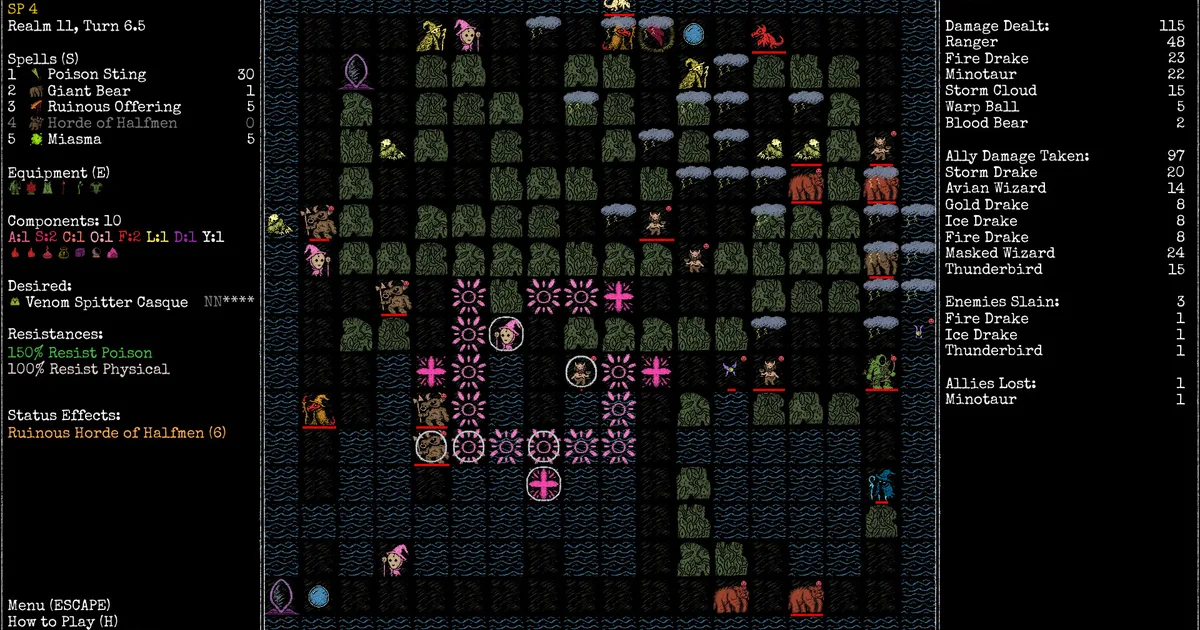
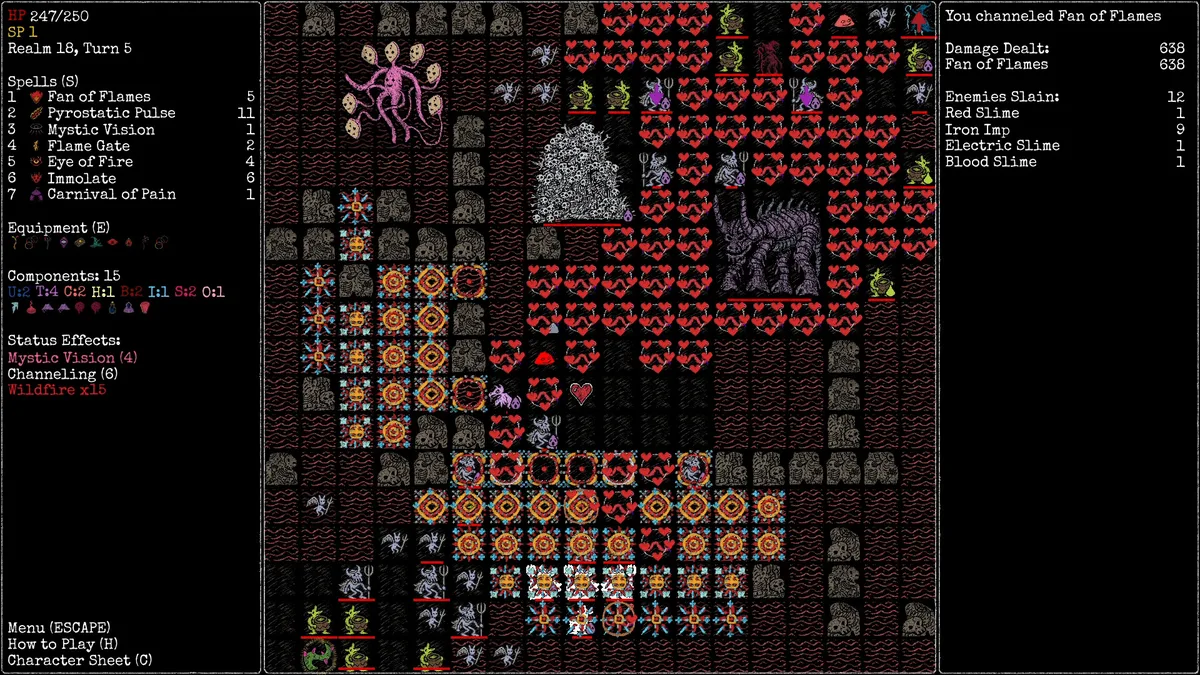 A fire-school build mid-run: the left panel lists active spells by school; the grid is where each one fires.
GODEEPER: For the survival decisions that layer on top of school knowledge, the Rift Wizard 3 tips guide covers rift preview usage, spawner priority, and mana potion efficiency. Rift Wizard 3 Tips: 9 Rules for Surviving Early Runs →
Enemy resistances: fire, arcane, and what each tag runs into
Here's what's genuinely confirmed: Leghead and Void Child are real enemies (Steam's own store page names both), and Gaia is a real "vengeful nature god" boss. What isn't confirmed in any official source we could find is a specific resistance table tying named enemies to named tags. Treat the rest of this section as community-reported pattern-matching, not a documented resistance chart, and check the in-game rift preview and resistance display before betting a whole build on any of it.
Fire and Legheads: Some players report Legheads shrug off fire damage. If that's accurate, a fire-primary build without a backup tag would lose most of its output against them. Either way, having a second damage tag ready is the safer default, since the portal system lets you route around a bad matchup once you see it coming in a rift preview.
Arcane and Void Child: Some players report Void Child, described by Steam as "alien and terrifying," is a tough matchup for specific arcane approaches. The crafting effect that routes arcane damage out through a lightning channel (Steam-confirmed) is a real hedge against any enemy that specifically resists arcane, whether or not Void Child turns out to be that enemy.
Nature and Gaia: Gaia is a real, Steam-confirmed nature boss. Beyond that, we didn't find a documented resistance profile for the fight, so treat any specific claim about Gaia's phases as unverified and check the rift preview before committing a nature-only build to that realm.
Holy considerations: Holy damage is commonly described as strongest against undead and dark-aligned enemies, and weaker elsewhere, though we didn't find an official breakdown confirming this. Buying one or two holy spells as situational coverage is a reasonable low-risk approach either way, rather than treating holy as a primary damage tag.
The portal system is the tool that makes resistance management playable regardless of which specific claims above hold up: you can see the enemy list for a realm before committing to it, and the in-game resistance display shows the actual percentage a target blocks in combat. Trust what you see on your own screen over any secondhand resistance claim, this article's included.
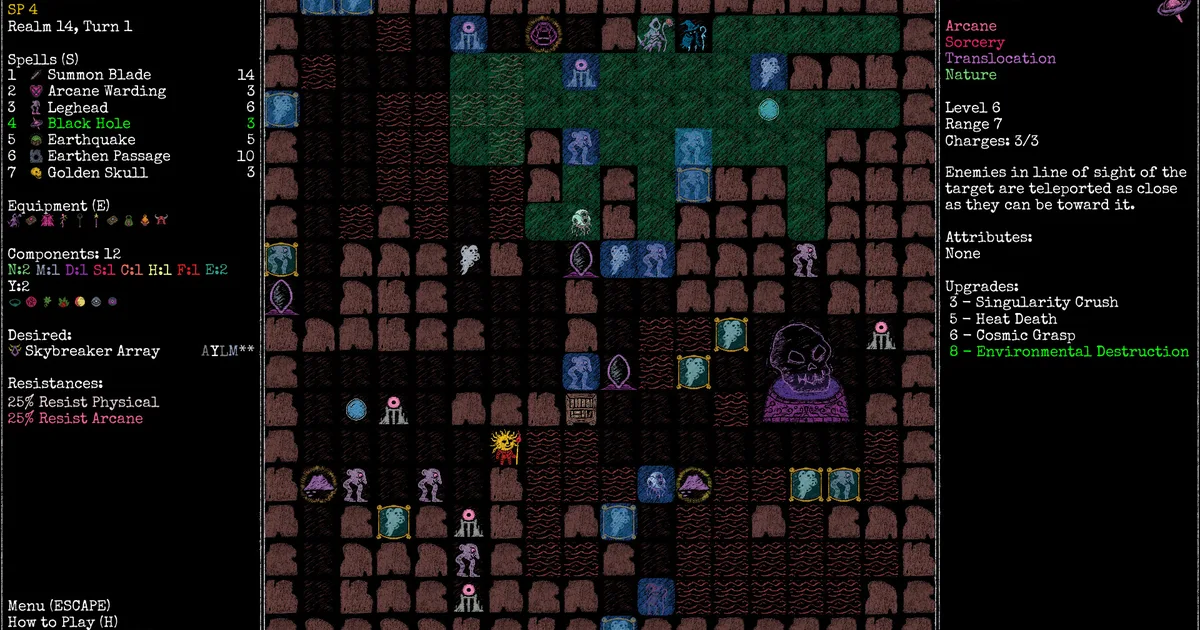
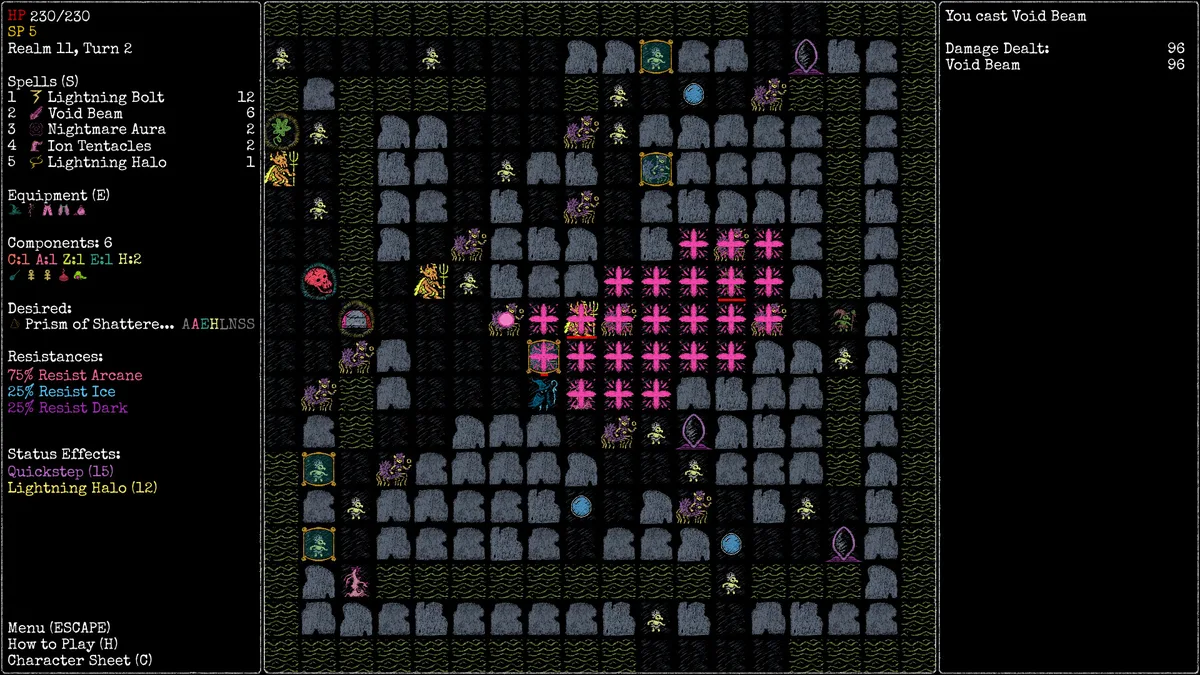 The resistance display shows exactly what percentage of your spell damage this enemy blocks. 75% arcane resistance means Void Beam hits for a quarter of normal.
A useful way to think about roles, not just schools
The way to navigate 500+ spell and artifact options without paralysis is to think in roles, not schools. This is this guide's own organizing framework, not an officially documented game system, but it holds up in practice. These four needs are worth covering by realm 6 at the latest:
Priority-kill option. One spell that reliably kills a priority target in one or two turns. Priority targets in this game are spawners, powerful enemies that would otherwise snowball if left alive, and anything that has hard CC on the wizard. Any tag can fill this need.
Room-clear option. One spell that clears or suppresses a group of enemies in a single room. Fire and lightning both have excellent AoE expressions. Ice has slower but safer AoE through crowd control. The specific spell matters less than having the capability.
Escape option (translocation). This is covered in the section below, but it belongs on this list: movement spells aren't a school specialization, they're a survival tool that belongs in every build.
Threat-absorber option. A construct summon, an organic summon, or a decoy that absorbs enemy attacks and blocks movement. Construct-tagged summons are the most straightforward: buy one, deploy it at the start of fights, let it take hits while your damage spells work. Without a threat absorber, the wizard eventually takes a bad turn and dies to damage that had no good answer.
Filling all four needs often means running two or three tags. That's fine, arguably the point: the open build system rewards covering these gaps, whatever combination of tags gets you there.
How Rift Wizard 3's crafting system changes spell school priorities
Rift Wizard 3 adds a crafting system that wasn't in the earlier games. You collect components throughout each run and combine them into magical artifacts that give the wizard passive bonuses. Three Steam-confirmed effects:
- "Make lightning fly out of your arcane damage": arcane spells trigger secondary lightning damage, creating a cross-school output without buying lightning spells
- "Commandeer enemy spawners": spawners become allies, completely reversing one of the most threatening room elements in the game
- "Give your demon summons fire breath": summon characters gain fire damage output, creating a summon+fire hybrid that doesn't require buying fire combat spells
These effects mean a build's actual damage profile differs from its spell school composition. An arcane-primary build with the lightning crafting effect outputs lightning damage that bypasses arcane-specific resistances. A construct-primary build with fire breath summons deals fire damage without fire immunity being relevant to the wizard's own spell choices.
The implication for spell buying: crafting effects should change what spells you prioritize. If you've crafted the arcane-to-lightning effect, buying more arcane damage spells gives you more lightning output. If you have fire breath on summons, buying summoning-enhancing spells (health, numbers, spawn rate) amplifies your fire damage without buying a single fire spell.
This layer is where the game's depth gets interesting. The first ten hours are mostly about understanding role coverage. The depth comes from realizing the crafting system is its own build axis.
GODEEPER: Build synergy across a large open pool is the core skill in LegionBound too, where class combinations create effects no single class achieves alone. LegionBound Synergy Guide: All Classes and Combos Explained →
Translocation spells: the slot new players skip
The beginner guide covers translocation as a survival tip. Every Rift Wizard 3 spell guide covers it as a system: translocation is a distinct spell category, not just "a Blink spell."
Translocation spells teleport the wizard to a safe tile, either a specific target tile or a random safe location. What this does in practice:
- Escape from surrounded situations that would otherwise be fatal in one or two turns
- Reposition after a summon dies and exposes the wizard
- Leave a room that isn't going well without taking further damage
The error new players make: treating translocation as optional because "I have enough damage." High damage doesn't prevent the wizard from being cornered. The situations that end runs without translocation are specific: surrounded by melee enemies, a corner fight that goes wrong, a spawner that produced more enemies than expected. With translocation, those situations become recoverable. Without it, they end the run.
Buy a translocation spell before realm 4. Treat it as a role (Role 3 from the section above) not as a luxury.
Common Rift Wizard 3 spell mistakes
Most Rift Wizard 3 spell guide mistakes come down to one failure mode: treating the build as a theme instead of a toolkit. Here's what that looks like in practice.
Committing to one school for the first four realms. The early spell pool offers fire heavily because fire is intuitive, but buying four or five fire spells with no backup means the first fire-immune room is a difficulty spike that the build can't absorb.
Upgrading one spell twice before buying coverage. Each spell gets two upgrade picks from four options, which is genuinely compelling (the upgrades are specific and impactful). But using all your spell upgrade resources on one spell leaves holes in the role coverage that kill runs faster than an under-upgraded nuke.
Ignoring the portal system when building. The portal system lets you choose which realms to face. If you've identified that your build has no answer to arcane-countered enemies, actively pick realms that don't feature Void Children. This is the game allowing you to match your spell composition against the enemy pool. Using it is correct play, not avoidance.
Treating construct summons as optional. Construct-tagged summons are the least flashy option in the game (Physical is a damage type, Construct is a separate creature tag, they aren't one combined "school") and the one most new players skip. Runs without threat absorption tend to end on turns where the wizard gets surrounded and takes the full enemy output. A construct summon buys turns. Turns win fights.
Related Reading
- Rift Wizard 3 Tips: 9 Rules for Surviving Early Runs -- the survival mechanics that sit on top of spell selection: rift preview use, mana potion efficiency, spawner priority
- Rift Wizard 3 Early Access Launch Preview -- what the game is and how it fits into the series for players new to Rift Wizard
- Best Roguelike Games in 2026 -- where Rift Wizard 3 sits in the broader roguelike landscape and how it compares to other open-build games
Frequently Asked Questions
How many spells are in Rift Wizard 3? Rift Wizard 3 launches into Early Access with 500+ spells and artifacts combined, per Steam's own listing, plus 400 spell upgrades and 300 craftable items. The developers have stated these numbers will expand throughout the EA period.
Which spell school is best in Rift Wizard 3? No single school is best, and there's no clean set of exactly eight to rank anyway; spells and monsters carry overlapping tags. Fire runs into Legheads, arcane into Void Child, both enemies some players say resist that tag, though neither mechanic is officially confirmed. The strongest runs use two or three tags to cover resistances and fill the role needs described above.
What enemies are immune to fire in Rift Wizard 3? Legheads are a real, Steam-named enemy that appear in the mid-game. Some players report they resist fire, though the exact mechanic isn't officially documented. Running pure fire without a backup damage tag is the safer assumption regardless. The portal system lets you pick around Leghead-heavy realms in the short term, but not permanently.
Do I need to specialize in one spell school? No. The open build system exists to reward covering multiple tags. Specializing in one is one of the most consistent run-ending mistakes because several reportedly-tough enemies push back against specific tags. Aim for two or three tags that fill the role needs: priority kill, room clear, escape, and threat absorption.
What is the most important spell type for survival? Translocation. A movement spell that gets the wizard out of surrounded positions is more consistently run-saving than an upgrade to a damage spell. It belongs in every build before realm 4, regardless of which schools you're running.
How does the crafting system interact with spell schools? The crafting system enables cross-school effects not available from spells alone. Steam-confirmed examples: making lightning fly out of arcane damage, giving demon summons fire breath, and commandeering enemy spawners. These hybrid effects mean a build's actual output often differs from the schools in the spell book.
How do spell upgrades work in Rift Wizard 3? Each spell can be upgraded twice. Each upgrade is chosen from four options. This means you have substantial control over how any individual spell behaves. The error is investing all upgrade resources into one spell before buying role coverage across the build.
References
- Rift Wizard 3 on Steam -- Early Access launch page with feature list and developer details
- Rift Wizard 3 Official Trailer -- gameplay footage showing the spell selection system and combat grid
- r/roguelikes community -- active discussion of build theory and spell school performance
Was this guide helpful?
About the author

News Reporter
Games journalist and news hound with 7 years covering industry moves, studio announcements, and patch notes. Chilean. Writes tight, edits tighter.
- 7 years games journalism
- Industry and esports specialist
- Early access coverage
Keep reading

Disclaimer
This article is published for informational and entertainment purposes. It does not constitute professional financial, legal, or technical advice. Game performance, online services, patch schedules, and store listings change. Verify critical details (pricing, system requirements, regional availability) with publishers and storefronts before you buy. Affiliate links, where present, help support our editorial work and are labelled in our affiliate disclosure.
Comments
Loading comments…