
GameBrief · General
Rift Wizard 3 Late-Game Guide: Advanced Floor Strategy
Reviewing
Rift Wizard 3
Dylan White · Dylan White
This Rift Wizard 3 late-game guide covers what changes past the early floors: the synergy framework stays the same, but the pressure on executing it correctly becomes unforgiving. For the foundation, the Rift Wizard 3 builds guide covers synergy selection and the spell guide covers what each tag does. The early access launch preview covers the game's initial state. A note on sourcing: the specific synergy pairings below (fire+construct, lightning+arcane, dark+nature) reflect this site's own build testing and player discussion rather than an official developer-published tier list, and only the lightning+arcane crafting effect ("lightning flying out of arcane damage") is directly confirmed on Steam's own store page.
Rift Wizard 3 launched into early access on June 23, 2026. The late game has the game's highest difficulty ceiling, and most runs that fail there fail for the same two reasons: a synergy that worked for early floors hits a resistance wall, or the build never fully committed to a complete chain.
TL;DR: High floors require complete synergy chains, at least one coverage school for resistances you'll encounter, and translocation as a genuine defensive tool. Fire+construct is the most reliable completion build. Lightning+arcane is the ceiling build when crafting cooperates. Don't hold early-game utility spells past floor 10-12 if they don't contribute to your chain.
Rift Wizard 3 late-game guide: what actually decides high-floor runs (quick answer)
The difference between a build that completes high floors and one that stalls isn't raw power. It's resistance coverage.
At high floors, enemy encounters increasingly include enemies with resistance combinations that counter single-school strategies. A Fire+construct build running purely on fire damage will hit an enemy with fire resistance and deal a fraction of its normal output. A Lightning+arcane build dependent on arcane amplification hits the same problem differently.
The builds that close runs at high floors have:
- A primary synergy chain that generates the ceiling damage output
- At least one coverage option that handles the resistances the primary chain can't break
- Translocation or repositioning capability to manage enemy spell density
Every run that reaches high floors with only a single-school strategy eventually hits the encounter that counters it.
Key takeaways
- High-floor enemies have resistance combinations that stop single-school strategies
- Complete synergy chains need a coverage option, not just a damage school
- Fire+construct closes runs most reliably; Lightning+arcane is the ceiling when crafting cooperates
- Dark+nature has ceiling potential but requires specific timing: higher variance than fire builds
- Translocation shifts from movement tool to defensive necessity at high floors
- Evaluate early-game picks at floor 10-12 and drop non-synergy spells if better options appear
How floor scaling changes the game
Rift Wizard 3's difficulty scales through two mechanisms as floors increase:
Enemy health and output: Enemy health totals increase significantly at high floors. Spells that dealt efficient damage in the mid-game start needing more hits per enemy, which extends exposure time and increases the number of enemy actions you're taking before the encounter resolves. Builds that relied on burst clearing multiple enemies per turn in the early floors need to adapt because burst clearing doesn't scale as well at high floors without a complete synergy chain providing the amplification.
Resistance coverage: High-floor enemies are more likely to have multiple resistance types. The spell guide's coverage of enemy resistances covers the early-mid game version of this problem. At high floors, it's not uncommon to face enemies with fire resistance, lightning resistance, and high physical damage output. That forces the question of what your damage fallback is when your two primary schools both hit walls.
The practical implication: every school you invest in needs either synergy contribution or resistance coverage. A school that does neither, even if it was strong early, is a slot that isn't helping you close the run.
GODEEPER: The builds guide covers what the primary synergy chains look like and which schools are best paired for coverage. Rift Wizard 3 Builds Guide: Best School Synergies →
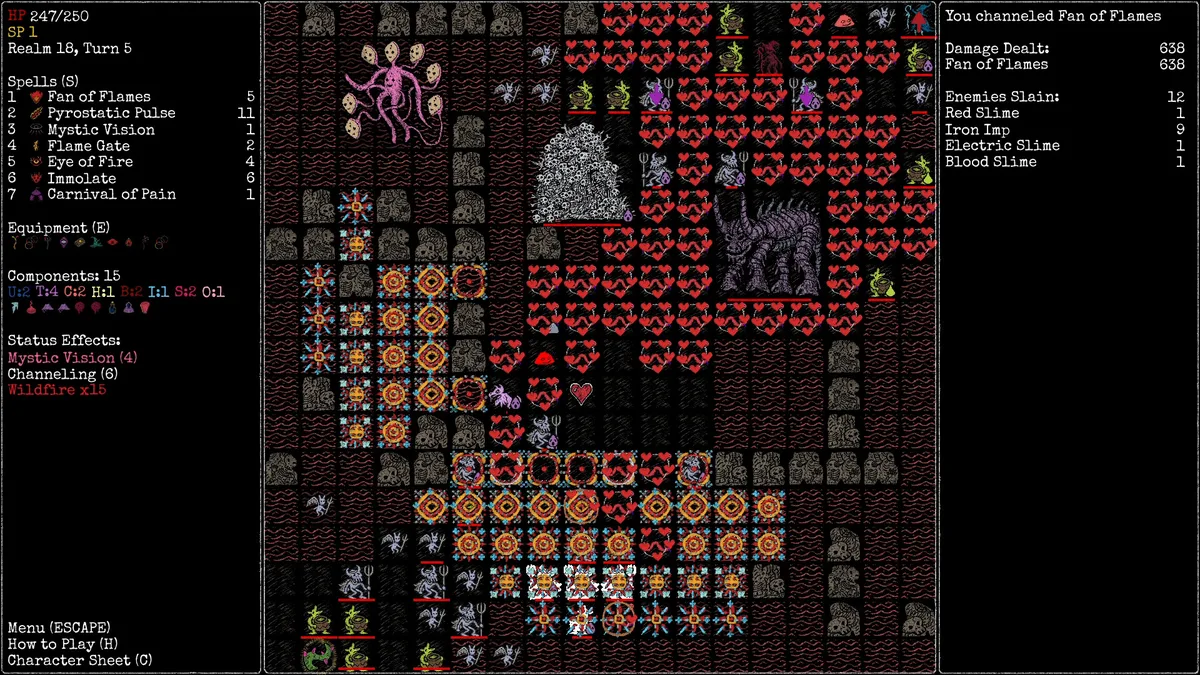 Fire+construct's reliability comes from the construct sustaining damage every turn while fire handles burst clearing in dense encounters.
Fire + construct: why it completes runs most reliably
The builds guide identifies Fire+construct as the foundation synergy. The late-game reason it's the most reliable completion build: the synergy's damage output doesn't require specific crafting items to function at the tier needed to reach high floors.
What the construct school provides at high floors: Constructs persist on the board and deal damage every turn. At high floors where enemy health is high, sustained damage from constructs while you're repositioning or managing your spell slots is more valuable than it was early. Constructs also force enemies to target them, which creates positioning windows for direct fire spell casts.
What fire school provides at high floors: Fire's damage per cast scales acceptably into the late game, and fire coverage spells provide area clearing that constructs can't handle against dense multi-enemy encounters. The combination means the build has both sustained construct output and direct fire burst, which handles the two most common high-floor encounter types: single high-health enemies and grouped lower-health enemies.
The resistance wall: Fire+construct hits a ceiling when enemies with fire resistance appear. The builds guide recommends Holy as a coverage option because it provides a damage fallback without requiring a new synergy chain. At high floors, having Holy as a single-slot investment that provides off-school damage against fire-resistant enemies is what lets fire builds push through the specific encounters that would otherwise stop them.
Lightning + arcane: the crafting ceiling build
Lightning+arcane is the builds guide's identified ceiling build. Its late-game behavior is different from fire builds in a meaningful way:
The crafting dependency: Lightning+arcane's damage ceiling requires specific crafting items. The crafting system in Rift Wizard 3 lets you enhance existing spells with additional properties. For the lightning+arcane synergy, crafting items that add arcane amplification to lightning spells (or vice versa) are what push the build into its highest damage tier. Runs where these items don't appear leave the build at a lower damage floor than fire+construct in practice.
When it comes together: A run where the right crafting items appear produces a build that handles high-resistance enemies through sheer amplified output rather than coverage. The damage numbers on a fully crafted lightning+arcane chain exceed what fire builds can reach, which is why it's the ceiling build. It's also why it's not the most reliable build: you need the crafting luck to align.
The late-floor approach for lightning+arcane: Invest in the synergy chain and crafting items aggressively when they appear. Don't save shop resources for optionality. A crafting item that completes the chain is worth significantly more than a utility spell that provides marginal value. The build's late-floor payoff is specifically dependent on the chain being complete.
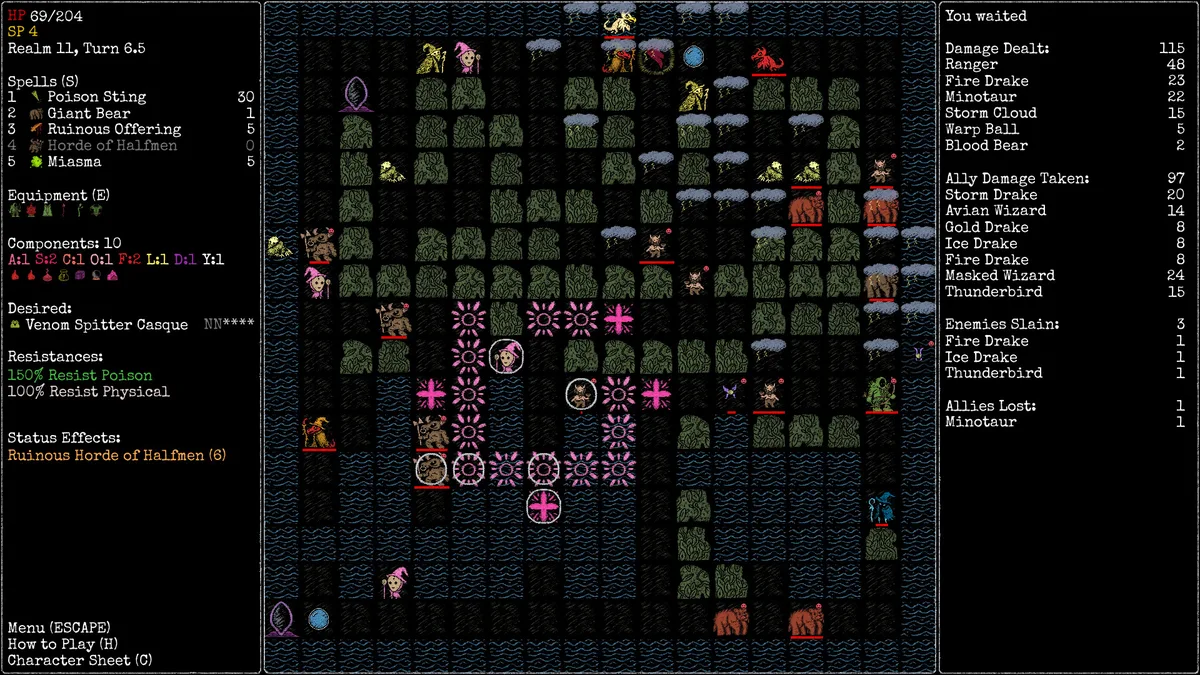 The floor 10-12 evaluation window is visible in spell choice structure: what you keep and what you drop here determines high-floor consistency.
Dark + nature: high ceiling, lower consistency
The builds guide covers dark+nature as the high-risk, high-ceiling option. At late floors, the ceiling is real but the consistency problem is more pronounced than in the midgame.
What makes dark+nature high-risk at late floors: The synergy requires specific enemy interactions and timing to hit its damage peaks. Late-floor enemies have more varied behaviors and more actions per turn, which creates more scenarios where the specific interaction the build relies on doesn't occur in the turn you need it. Dark+nature runs that reach high floors often do so by finding the right encounter sequence; they're not as reliable at guaranteeing that sequence continues.
When dark+nature is the right call: A run where the early drops strongly support dark+nature synergy, where the enemy encounters in the midgame have reinforced the synergy timing, and where you have a coverage option for the resistance types dark and nature each hit hardest. If all three conditions are present at the transition to high floors, dark+nature performs comparably to fire builds at that range.
GODEEPER: The spell guide covers how dark and nature interact with specific enemy types and what resistance profiles each school runs into. Rift Wizard 3 Spell Guide: Best Schools →
Step-by-step: evaluating your build at floor 10-12
The floor 10-12 range is the natural evaluation point for whether your current build direction can reach high floors.
Step 1: Identify your active synergy
Which schools are you using, and are they in a complete synergy chain? Partial chains (one side of the synergy but not the trigger) need the missing piece in the next few floors. If you don't have a complete chain after floor 10, evaluate whether the missing piece is available in the shop or as a floor drop.
Step 2: Identify your resistance coverage
Look at your current damage options. What resistance type stops all of them simultaneously? If fire and construct are your primary schools and both get countered by fire resistance, you need a coverage option before the first fire-resistant encounter on high floors.
Step 3: Drop non-contributing spells
Spells picked in floors 1-8 that don't synergize with your current chain should be evaluated for replacement. A utility spell that saved you on floor 4 but contributes nothing to a lightning+arcane chain is taking a slot that could be a coverage school or a chain-completing item.
Step 4: Commit to the highest-value option in the next shop
Stop hedging. A shop purchase that completes your primary synergy chain takes priority over a strong solo-value spell that doesn't synergize. The build's high-floor performance is determined by chain completeness, not by the sum of individually strong spells.
Tips: late-game mistakes in Rift Wizard 3
Holding translocation as pure mobility. At high floors, repositioning isn't just about getting to better attack angles. Enemy spell density means taking direct hits that could have been avoided with a well-timed translocation. Start using translocation defensively: out of range, around corners, away from ability timers, not just as a gap-closer.
Refusing to drop mid-game utility. A spell that provided reliable utility in floors 1-12 often becomes dead weight in floors 15+. If it doesn't contribute to your synergy chain and doesn't provide resistance coverage you need, it's a slot. Drop it in the next shop that offers a better option.
Trying to complete two synergy chains. Players who see the components of both fire+construct and lightning+arcane in their drops sometimes try to build toward both. At high floors, the build ends up being neither: not enough investment in either chain to reach the damage tiers either school needs for high-resistance enemies. Pick the chain your drops support and go deep on it.
Ignoring crafting until late. If you're in a lightning+arcane run, crafting items that strengthen the synergy are worth shop gold at floor 8 and later. Players who save resources hoping for a "better option" sometimes find that the optimal crafting window for the synergy has passed by floor 15+.
Related Reading
- Rift Wizard 3 Builds Guide: Best School Synergies 2026: all major synergy chains, which are reliable vs. ceiling builds, and how to identify which synergy your run can support
- Rift Wizard 3 Spell Guide: Best Spells and Schools: the real overlapping tag system, enemy resistance notes, and the build roles a run typically needs to fill
Frequently Asked Questions
What's different about late-game floors in Rift Wizard 3? Higher enemy health, more resistance combinations, and denser spell output that punishes poor positioning. The same builds that work early need complete chains and coverage schools to function at high floors.
Which build is best for completing runs? Fire+construct for reliability. Lightning+arcane for ceiling potential when crafting items appear. Dark+nature for high-variance high-ceiling runs.
When should I drop early spells? Floor 10-12 is the evaluation point. Drop spells that don't contribute to your current synergy chain if a better option is available.
Is Holy useful at high floors? As a coverage option, yes. As a primary school, no. One Holy slot that covers fire resistance lets fire builds push through specific encounter types that would otherwise stop the run.
How does translocation change at high floors? It becomes a defensive tool, not just mobility. Enemy spell density at high floors requires repositioning away from ability timers and damage windows, not just toward better attack angles.
Why does Lightning+arcane have lower completion rates than Fire+construct? Its ceiling requires specific crafting items. Runs without the right crafting drops function at a lower damage tier than a well-executed fire+construct run. When the crafting aligns, it outperforms everything else.
References
- Rift Wizard 3 on Steam: official store page with current early access state and spell school information
- r/RiftWizard community: high-floor strategy discussions and synergy optimization threads
Was this guide helpful?
About the author

Senior Critic & Analyst
Former game data analyst turned critic with 11 years covering indie and mid-tier games. Based in Austin. Runs spreadsheets on games most people just play.
- 11 years games criticism
- Former game economy analyst
- Roguelike and strategy specialist
Keep reading

Disclaimer
This article is published for informational and entertainment purposes. It does not constitute professional financial, legal, or technical advice. Game performance, online services, patch schedules, and store listings change. Verify critical details (pricing, system requirements, regional availability) with publishers and storefronts before you buy. Affiliate links, where present, help support our editorial work and are labelled in our affiliate disclosure.
Comments
Loading comments…