
GameBrief · General
Rift Wizard 3 Guide: 500+ Spells and Artifacts (2026)
Rift Wizard 3 guide: a wizard roguelike with 500+ spells and no class system. Every spell tag, build synergy, and boss fight covered in one hub.

Reviewing
Rift Wizard 3
Dylan White, Khoops, Jacob Martinez · Dylan White
This Rift Wizard 3 guide covers the current Early Access systems: 500+ spells and artifacts, a large overlapping tag system instead of a clean set of classes, a crafting system that changes how multi-tag builds work, and a portal routing layer that makes run decisions meaningful past the first realm. The game hit Steam Early Access on June 23, 2026. Dylan White and the two-person extended team (Khoops and Jacob Martinez) built a game where you have access to the full spell and artifact pool from the first run, no class gates anywhere, and a crafting system that creates passive effects no spell produces on its own. It's a hardcore traditional roguelike in the old sense: fully deterministic, turn-based grid combat, no saves, no reflexes required.
TL;DR: Rift Wizard 3 is a turn-based roguelike with 500+ spells and artifacts combined and no class system. There's no clean set of 8 discrete schools: spells and monsters carry overlapping tags (fire, ice, lightning, dark, nature, holy, arcane, and more). Every run you assemble a spellbook from the full pool. The crafting system creates cross-tag passive artifacts (lightning on arcane casts, fire breath on certain summons) that are a main route to late-game power. EA launched June 23, 2026 with a roughly one-year window before 1.0. PC only, single-player, no controller.
Rift Wizard 3 guide: what kind of game is this? (quick answer)
Rift Wizard 3 is a hardcore turn-based roguelike where you build a spellbook from scratch each run using any of 500+ spells and artifacts. Rather than a clean set of 8 discrete schools, spells and monsters carry overlapping tags (fire, ice, lightning, dark, nature, holy, arcane, chaos, and more), so build depth comes from stacking tags, not picking one of eight. You pick spells from realm offerings, craft passive artifacts that create cross-tag effects, and route your run through portals to avoid bad matchups. Death is permanent and fully explainable.
Key takeaways
- No classes. The entire 500+ pool of spells and artifacts is available every run. You define your build through selection, not class choice.
- No clean set of 8 schools. Spells and monsters carry overlapping tags instead: fire, ice, lightning, dark, nature, holy, arcane, chaos, sorcery, conjuration, translocation, and more. You can lean into one or two tags deep or combine several with crafting glue.
- Crafting unlocks cross-tag effects. An artifact that adds lightning procs to arcane casts isn't buyable, it's crafted (a Steam-confirmed example). That's a real route to multi-tag builds.
- Portal routing matters. You choose your path through realms. Fire-heavy builds should avoid ice-resistant rooms early. The system rewards planning your route, not just your spellbook.
- Fully deterministic. All deaths are explainable. No random instant-kill spikes, no timing windows. This is a tactics game first.
- EA window: launched June 23, 2026. Roughly one year of Early Access before 1.0, per the dev team's stated timeline.
The spell tag system: what the major tags do
There's no clean, symmetric set of 8 schools in Rift Wizard 3. Spells and monsters carry overlapping tags rather than one school apiece, and the confirmed tag list runs well past eight: fire, ice, lightning, dark, nature, holy, arcane, chaos, sorcery, conjuration, enchantment, translocation, dragon, eye, word, and more, drawn from Steam's own screenshots and developer-endorsed guide videos. The game is still in Early Access, so treat any total count as a moving target rather than a fixed number. Here's what the major tags do and where the confirmed sources run out.
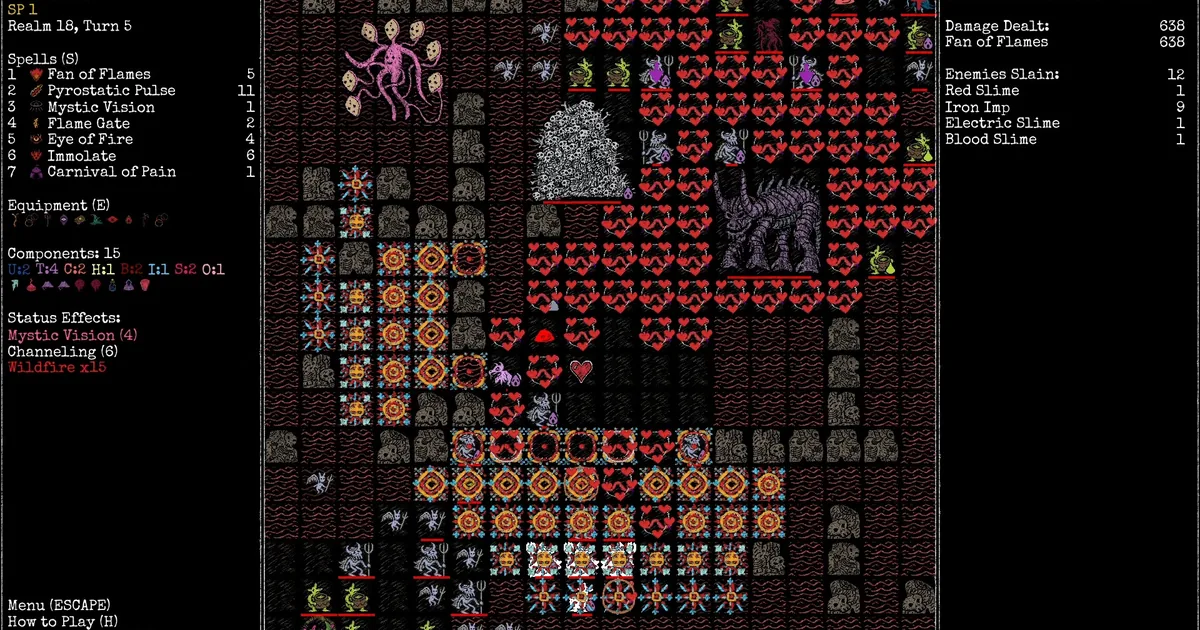
Fire is raw damage with blast spread. The Fan of Flames spell you see in most screenshots hits multiple grid tiles in a cone. It's one of the most forgiving tags to learn because damage output is obvious: if something is burning, it's taking damage. Steam's own page names Leghead as one of the game's enemies; some players describe it as resistant to fire, though we couldn't independently confirm the specific resistance mechanic, so keep a second damage tag ready as insurance.
Ice controls positioning through freeze and slow effects. Frozen enemies skip their turn. It leans defensive, extending your survival window rather than pushing damage on its own.
Lightning chains between clustered targets and has one specific, Steam-confirmed link to arcane through crafting: the store page describes a craftable effect that makes lightning "fly out of your arcane damage." That interaction is real. How far the lightning + arcane pairing extends beyond that one effect isn't documented anywhere we could verify, so treat it as a build worth testing rather than a guaranteed damage ceiling.
Dark deals damage through curses and debuffs, sometimes at a cost to the caster. Players commonly discuss pairing it with nature's summons for a front line, but we couldn't independently confirm the specific mechanical interaction beyond both tags generally working well in overlapping builds. Treat dark + nature as a combination to test yourself, not a documented synergy.
Nature brings summoning and support. Nature summons behave differently from construct summons (organic rather than mechanical), which is a real distinction worth building around even without a confirmed crafting-specific synergy attached to it.
Holy is generally described as coverage: strong against undead and dark-aligned enemies, weaker elsewhere. Adding one or two holy spells as situational utility is a common approach, though we didn't find an official breakdown of exactly which enemy types it counters.
Arcane modifies how your other spells behave rather than dealing direct damage, and it's the tag most directly extended by the crafting system (see the lightning example above). Steam's own page names Void Child as one of the tougher enemies in the roster, described as "alien and terrifying." Some players report it resists certain arcane approaches, but we couldn't confirm the exact mechanic, so keep a non-arcane option in reserve against it.
Physical and Construct aren't the same thing, and this site's own earlier coverage conflated them. Physical is a damage and resistance type. Construct is a creature-type tag used to classify monsters and summons, including the "metallic constructs" Steam's own description calls out. Placing a construct summon on the grid to block movement and absorb hits is a real, commonly used tactic, but "Physical/Construct" as a single named eighth school doesn't appear in any source we could verify. Treat construct summoning as its own tool, not a combined damage school.
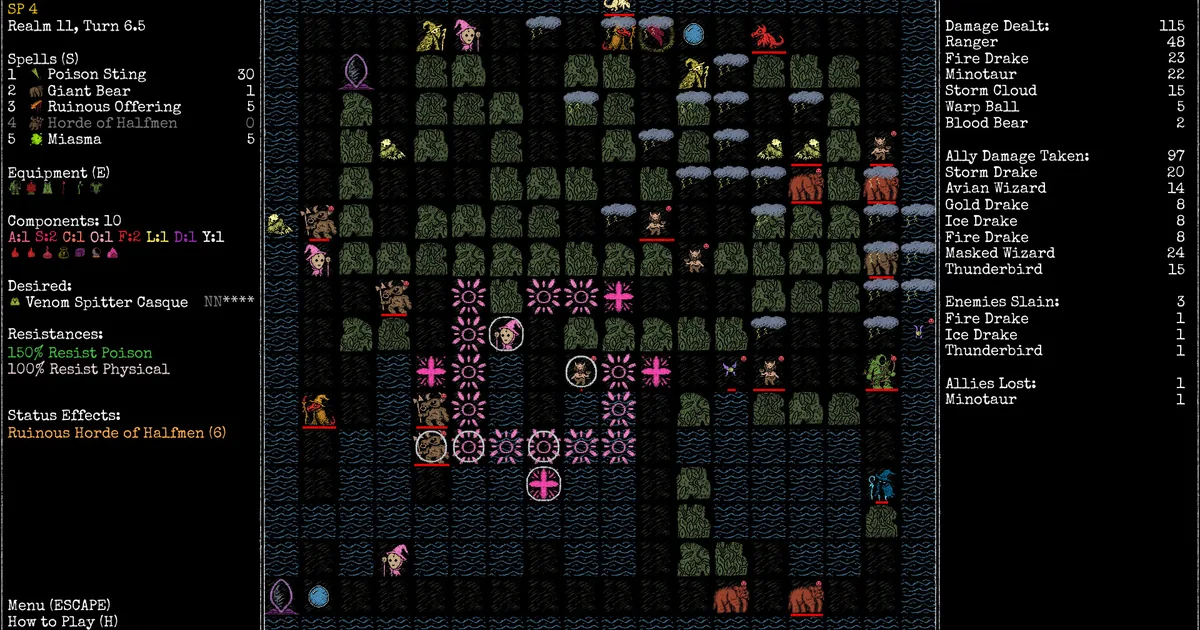
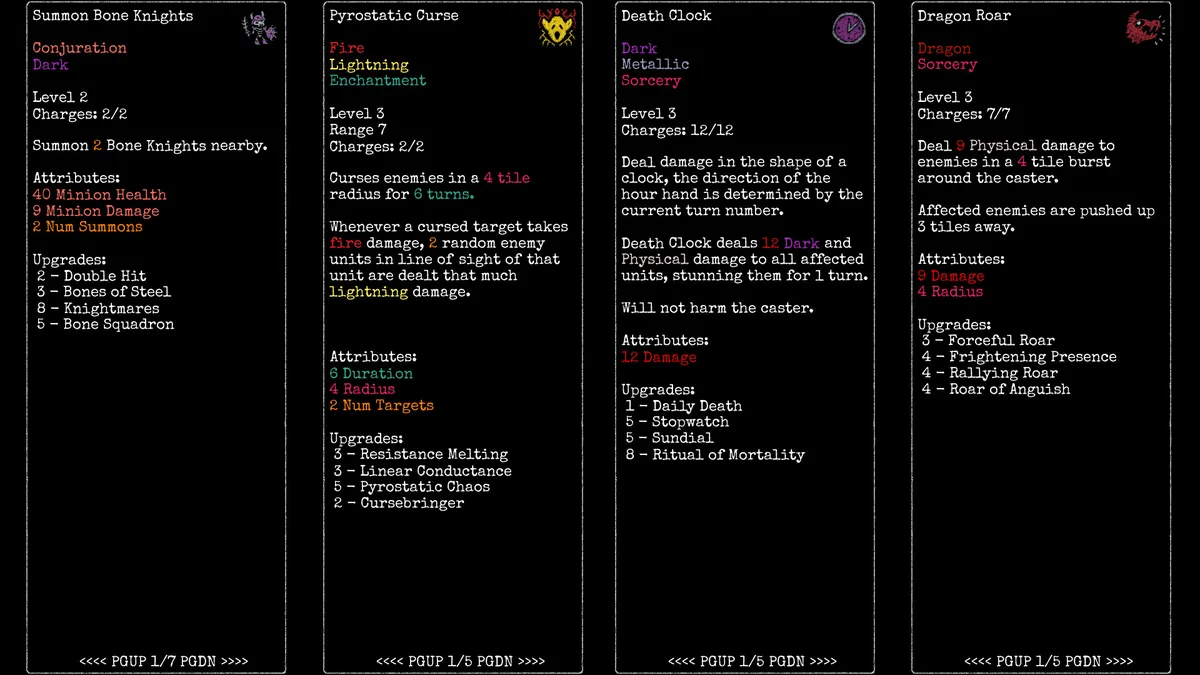 Spells carry multiple tags at once rather than a single clean school, which is part of why crafting cross-tag interactions take real reading of each card.
- Rift Wizard 3 Spell Guide: How to Build from 500+ Spells: Rift Wizard 3 spell guide: the real overlapping tag system, which enemies resist fire and...
Build guide: how to pick and combine schools
The decision isn't "which school is best" -- it's "what does this run support." Each realm offering is semi-random within constraints, so the better question is: what did the first three realms give you?
Commit early. If your first two realms gave you three strong fire spells and one good construct, you're probably running Fire + Construct. Don't hold out for the Lightning + Arcane combination if the offerings aren't there.
Identify your coverage hole. Every single-school build will hit a resistance wall around realm 8-10. Plan one or two utility spells from a second school before you reach that point. Holy is the easiest coverage pick because it hits most enemy types without requiring spell synergy.
Use the portal to protect your build. If you're running a nature-heavy build and see a portal to a poison-resistant realm, take the alternate route. The portal system exists specifically so you can avoid the rooms that counter your current build shape.
GODEEPER: The builds guide looks at the multi-tag combinations players have tested in Early Access, with crafting requirements for each. Rift Wizard 3 Builds Guide: Best School Synergies 2026 →
The crafting system: cross-tag effects explained
The crafting system is what separates Rift Wizard 3 from its predecessors. It produces passive artifacts, items that modify how your existing spells behave, and the defining feature is cross-tag effects.
For example: Steam's own listing confirms a craft effect that makes lightning "fly out of your arcane damage." That bolt doesn't come from a lightning spell; it's a passive proc that bypasses resistances differently than a spell would. Without the crafted proc, you're just casting arcane spells. With it, each arcane cast pulls double duty.
A similar logic applies more broadly to summon-based builds. A construct summon naturally deals physical damage. Steam's own listing confirms a separate craft effect that gives demon summons fire breath specifically, not constructs, so if you're chasing that exact effect, the target is demon-type summons rather than the physical/construct line.
Crafting is not optional for multi-school builds. You can run a mono-school build to around realm 10 on spell selection alone. Past that, the crafting layer is what closes runs. New players who ignore crafting hit a ceiling that feels like a difficulty spike but is actually a systems gap.
Component drops are random, but you can weight your path toward them. Crafting components fall from enemies and room clears. High-density rooms drop more components. Players who route aggressively through dense rooms accumulate components faster than players who take the easiest path. This is a feedback loop: better crafting makes later rooms easier, which makes component gathering faster.
Not every component combination is worth using. Some artifacts add stats that don't synergize with your current build. Saving components for the right cross-school artifact is better than crafting a mismatched item for the stats. The cost of a wrong craft isn't the components -- it's the missed opportunity to hold them for the combination that would have defined your run's ceiling.
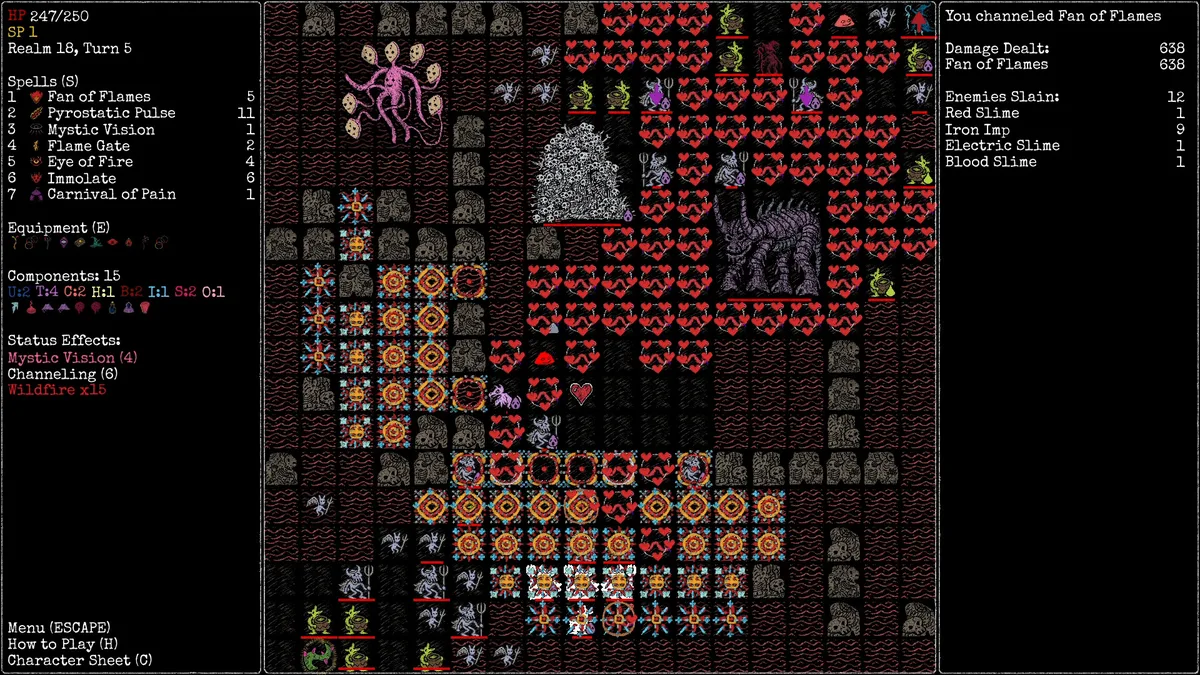 A fire-focused spellbook clearing a dense room. Crafted artifacts are what let effects like this extend into secondary tags instead of staying single-note.
- Rift Wizard 3 Crafting Guide: All 16 Equipment Sets (2026): names eight artifacts straight from Steam's own screenshots, dozens more from patch notes, and the 16 confirmed Equipment Set achievements, plus the letter-coded Components and Desired-target UI.
The portal system: routing your runs
After each realm you choose your next destination from a set of portal options. Each portal shows you the realm type and, if you've encountered it before, gives you information about the enemy composition.
Portal routing is where intermediate players separate themselves from beginners. The decision isn't random -- it's strategic. A fire build wants to avoid ice-resistant realms, not because the game blocks you, but because taking one is an efficiency cost you may not recover from.
When to take a harder path: If a harder realm offers a spell upgrade that completes your build synergy, the trade can be worth it. The portal system isn't just about avoidance -- it's about risk-adjusted decision-making.
Recovery routing: If you've taken heavy HP damage and don't have mana potions, prioritizing a realm with a vendor or a lighter enemy density is sometimes better than pushing toward the build-optimal path.
GODEEPER: The late-game guide covers how portal routing changes after floor 10 when the damage scaling shifts the risk calculus. Rift Wizard 3 Late-Game Guide: Advanced Floor Strategy →
Onboarding tips for new players
Don't skip translocation. Every new player skips movement spells to take damage spells. This is wrong. Without a translocation spell, you're stuck in whatever position you entered the room in. Enemy pathfinding in Rift Wizard 3 exploits static wizards quickly. One translocation spell slot is mandatory.
Damage variety matters more than damage volume. A spellbook with 400 fire damage per turn and nothing else will fail on the first fire-immune room. Aim for two damage types before realm 6.
Spawner enemies are the priority target. Rooms with spawners that generate additional enemies will multiply the problem every turn you delay killing the spawner. Clear spawners first, then address the rest of the room.
Mana scales with spellbook size. The mana potion system rewards having more spells, not fewer. Don't trim your spellbook to keep it "manageable" -- a larger book with some situational picks gives you more mana potion value per use.
Read the HP difference. If you enter a room at 60% HP and the encounter looks like a full room, use a mana potion to run it clean rather than grinding through at low HP and hoping. HP is harder to recover than mana is.
The first three realms set your build direction. Don't arrive at realm 4 without a second damage school in mind. The further you go without coverage, the more work the portal system has to do protecting your gaps.
- Rift Wizard 3 Tips: 9 Rules for Surviving Early Runs: Rift Wizard 3 tips: how the open spell pool works, why damage variety matters, crafting basics, and the positioning mistakes that end most first-run sessions.
All Rift Wizard 3 guides on this site
- Rift Wizard 3 Tips: 9 Rules for Surviving Early Runs: the open spell pool, translocation, crafting basics, and the positioning mistakes that end most first-run sessions.
- Rift Wizard 3 Spell Guide: How to Build from 500+ Spells: the real overlapping tag system explained, enemy resistance notes, and how crafting changes priorities.
- Rift Wizard 3 Builds Guide: Best School Synergies 2026: multi-tag builds players have tested, including Fire + Construct and the Lightning + Arcane crafting pairing.
- Rift Wizard 3 Late-Game Guide: Advanced Floor Strategy: how floor scaling changes what works after realm 10, when to drop mid-game picks, and which synergies actually close high-floor runs.
- Rift Wizard 3 Review: 500+ Spells, Zero Classes (2026): 35 hours of Early Access testing, rubric scoring, and the specific design decisions that make this game different from other roguelikes.
- Rift Wizard 3: Hardcore Wizard Roguelike Hits EA June 23: launch preview covering what's new in the third entry, the crafting overhaul, and what the dev team has said about the Early Access roadmap.
- Rift Wizard 3 Achievements: All 110 Unlocks Explained: Rift Wizard 3 achievements guide: 110 total, only 25.6% of players have won once. Win-streak...
- Rift Wizard 3 Mordred Boss Guide: Realm 21 Final Fight: Rift Wizard 3 Mordred boss guide: his multi-form fight, the summon-heavy corruption pressure, and the ally exploit that skips the kill entirely.
- Rift Wizard 3 Realm 20 Boss Guide: All 12 Bosses (2026): every confirmed Realm 20 "penultimate boss," sourced from Steam's achievement data and official patch notes, with per-boss mechanics where they're documented.
- Rift Wizard 3 Companions Guide: All 5 Confirmed (2026): Bard, Alchemist, Valkyrie, the Great Faery, and Engineer, sourced from official patch notes since no wiki or community guide covers this system yet.
- Rift Wizard 3 Wardrobe Guide: 26+ Outfits, Still In Beta: Rift Wizard 3 Wardrobe guide: 26+ cosmetic outfits confirmed, but the system stays Beta Branch-only as of the latest patch.
- Rift Wizard 3 Weekly and Mutated Modes Guide (2026): what's confirmed about the Mutator system across Weekly, Mutated, and Custom Game modes, and their own Beta Branch-only status.
Frequently Asked Questions
How many spells are in Rift Wizard 3? Rift Wizard 3's current Steam listing describes more than 500 spells and artifacts combined. There's no clean set of 8 schools: spells and monsters carry overlapping tags like fire, ice, lightning, dark, nature, holy, and arcane. Every spell is available in the shared pool each run, with no class restrictions.
Do you need to pick a class in Rift Wizard 3? No. Rift Wizard 3 has no classes. The open build system gives every wizard access to all 500+ spells from the start. You define your playstyle entirely through which spells and artifacts you select during a run.
What is the crafting system in Rift Wizard 3? The crafting system produces passive artifacts with cross-school effects: you can craft a modifier that triggers lightning damage on arcane casts, or adds fire breath to your construct summons. These effects aren't available through spells alone, making crafting the main path to functional multi-school builds.
How does the portal system work in Rift Wizard 3? At the end of each realm you choose from several portal options. Each destination has different enemy compositions and threat levels. You can route around bad matchups: if you're running a fire-heavy build, you pick portals that avoid ice-resistant realms and take recovery paths when you need them.
Is Rift Wizard 3 on controller? No. Rift Wizard 3 is PC-only with keyboard and mouse. No controller support was listed at the Early Access launch on June 23, 2026.
How long is Early Access for Rift Wizard 3? The dev team (Dylan White, Khoops, Jacob Martinez) stated a roughly one-year Early Access window before 1.0, which puts the full release around mid-2027.
Is Rift Wizard 3 hard? Yes, but in a specific way. It's fully deterministic -- no timing checks, no random instant-kills. The difficulty comes from spell selection mistakes, misreading enemy threat levels, and positioning errors on the grid. Most players run 10-15 hours before their first clear.
Related Reading
- All Rift Wizard 3 coverage: every Rift Wizard 3 guide, review, and news post published on GameBrief, in one index.
- Rift Wizard 3 Spell Guide: How to Build from 500+ Spells: deep dive into the real overlapping tag system, enemy resistances, and the roles a build typically needs before realm 10.
- Rift Wizard 3 Builds Guide: Best School Synergies 2026: the multi-tag combinations players have tested in early access, with crafting requirements for each.
- Rift Wizard 3 Late-Game Guide: Advanced Floor Strategy: how scaling shifts the meta after floor 10 and which builds close high-floor runs.
- Rift Wizard 3 Tips: 9 Rules for Surviving Early Runs: the nine rules that apply to every run regardless of build, covering translocation, spawner priority, and mana economics.
- Rift Wizard 3 Review: 500+ Spells, Zero Classes (2026): full 35-hour Early Access review with rubric scoring and verdict.
References
- Rift Wizard 3 on Steam: official store page with current pricing, EA update history, and feature list
- Rift Wizard 3 subreddit: community discussion, player-discovered build interactions, and dev responses
- Khoops on Twitter/X: developer updates and patch notes commentary
About the author

Senior Critic & Analyst
Former game data analyst turned critic with 11 years covering indie and mid-tier games. Based in Austin. Runs spreadsheets on games most people just play.
- 11 years games criticism
- Former game economy analyst
- Roguelike and strategy specialist
Keep reading

Disclaimer
This article is published for informational and entertainment purposes. It does not constitute professional financial, legal, or technical advice. Game performance, online services, patch schedules, and store listings change. Verify critical details (pricing, system requirements, regional availability) with publishers and storefronts before you buy. Affiliate links, where present, help support our editorial work and are labelled in our affiliate disclosure.
Comments
Loading comments…