
GameBrief · General
Rift Wizard 3 Crafting Guide: All 16 Equipment Sets (2026)
Reviewing
Rift Wizard 3
Dylan White, Khoops, Jacob Martinez · Dylan White
This Rift Wizard 3 crafting guide opens the actual crafting panel, something every other guide on the sidebar skips. They treat crafting as a build modifier, a way to make an existing fire or lightning spell hit harder, without ever showing what the letter codes in the Components tray mean, what the "Desired" artifact target is tracking, or naming a single specific artifact beyond the same three generic examples repeated across every other piece of coverage. This one names eight artifacts with their exact tags and effects, sourced directly from Steam's own screenshots, plus dozens more named across seven official patch notes, and it's the only coverage that documents the 16 Equipment Set achievements confirmed on Steam's own achievement list.
TL;DR: Rift Wizard 3's crafting sidebar tracks components by single-letter codes and colors, and shows a "Desired" artifact target with a partially revealed letter string, some letters shown, the rest replaced with asterisks until you've found or identified them. Steam's own screenshots name real artifacts: Volcanic Lance (fire beams that punch through walls), Galvanic Armor (redirects lightning damage back at enemies), Astral Phylactery (a Soul Jar that blocks death until it's destroyed), and five more with confirmed tags and effects. Patch notes since launch add dozens more named pieces, and 16 Steam achievements, confirmed directly from the game's own achievement list, require winning a run while wearing a specific themed collection or combo of named gear. Crafting is also confirmed as the direct replacement for Rift Wizard 2's passive skill tree, most of those old passives came back as craftable gear, plus more than a hundred brand-new items Steam explicitly says are new to this entry.
Rift Wizard 3 crafting guide: how does the crafting system work? (quick answer)
You find crafting components scattered across each realm rather than buying them, and the sidebar tracks what you're holding by single capital letters, each tied to a color and a component type. At any point you're working toward one target artifact, shown on a "Desired" line with its name and a string of letters representing what it needs. Revealed letters are components you've already found or identified; the rest show as asterisks. Combine matching components and the artifact crafts. Steam's own store description confirms rare ingredients "even having unique impacts on the crafted item," so which specific component you use isn't purely cosmetic.
Key takeaways
- Components are tracked by single-letter codes (U, T, C, H, D, and more) with a running count, not a numbered tier or rarity star system.
- The "Desired" line names your current crafting target and shows its letter recipe, partially hidden behind asterisks until you've found the matching pieces.
- Eight named artifacts are visible across Steam's own screenshots: Volcanic Lance, Talking Hat, Venom Spitter Casque, Galvanic Armor, Astral Phylactery, Flame Blade Fragment, Sanctified Locket, and Slime Core.
- Some artifacts carry an "On Pickup" or "On Craft" trigger that fires once; others are always-on passives with no trigger line at all.
- Crafting is the confirmed replacement for the previous game's passive skill tree, most of those old effects returned as craftable gear, alongside 100-plus items that are new to this entry specifically.
- Equipment (already-crafted, worn artifacts) and Components (raw materials waiting to be combined) are tracked as two separate rows in the sidebar, not one combined inventory.
- Sixteen Steam achievements, confirmed directly on the game's own achievement list, require winning a run while wearing a themed Equipment Set. Seven need every piece of a named collection; nine name 2-4 specific items.
- Official patch notes from June through August 2026 name dozens more artifacts and equipment beyond the original eight, including several that tie directly into the Equipment Set achievements above.
How components work: the letter-coded inventory and the Desired target
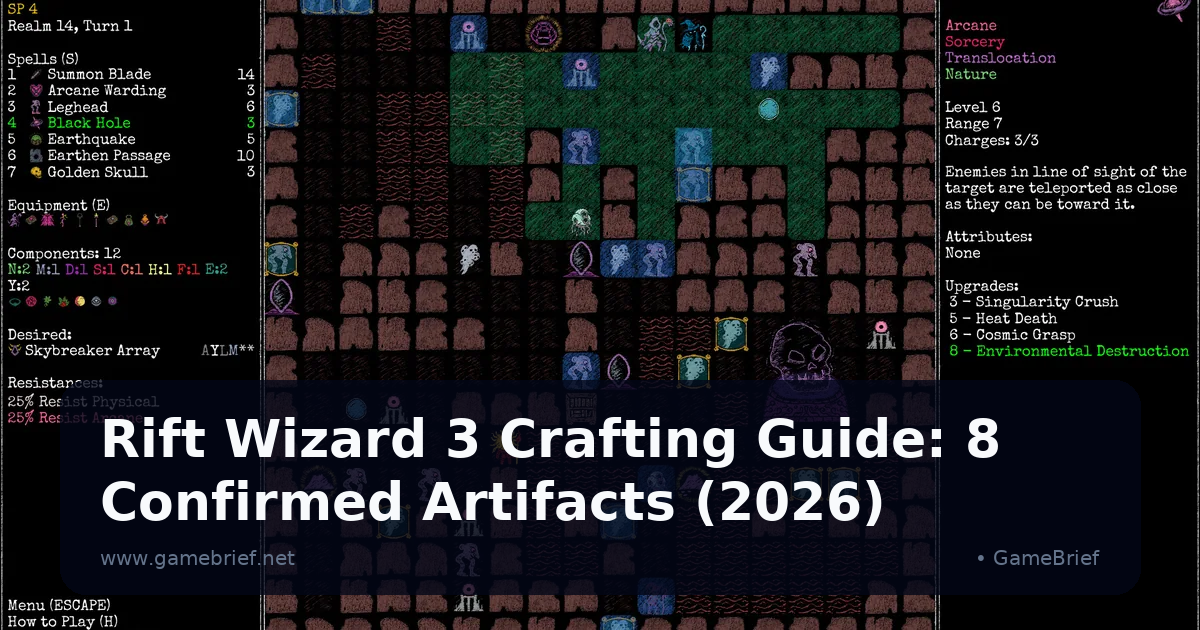
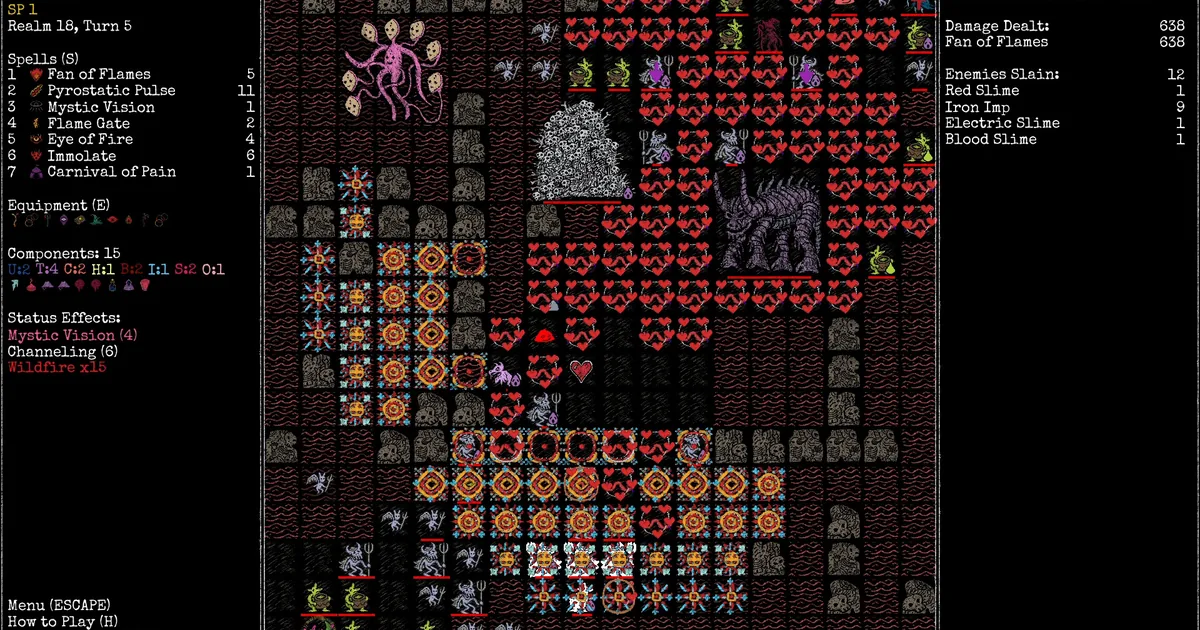
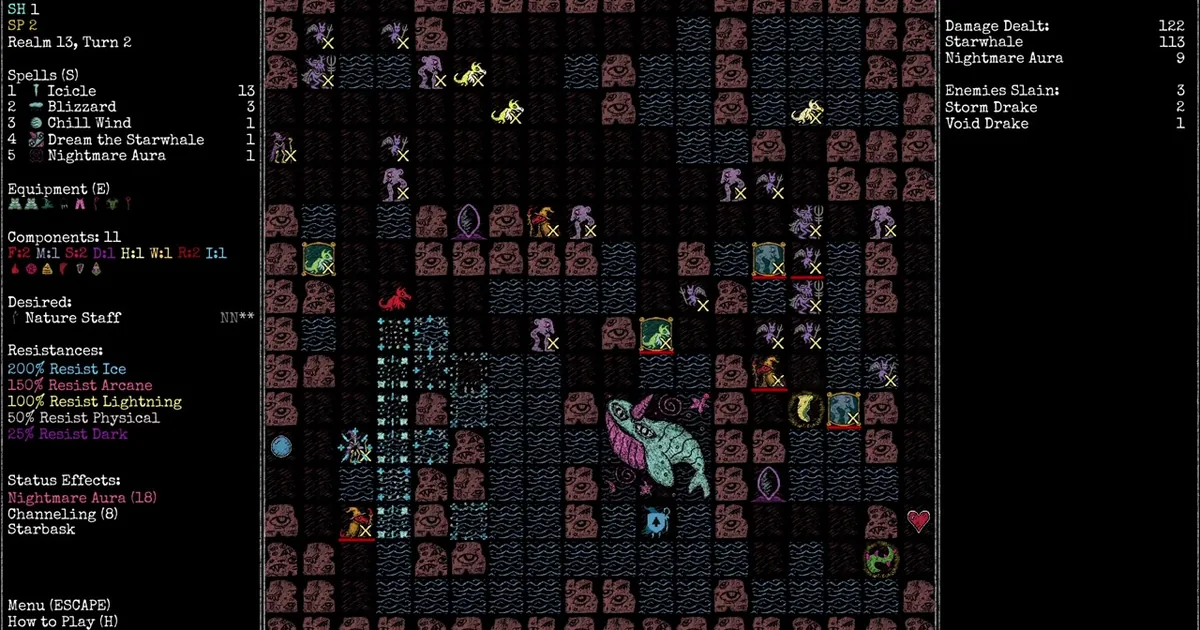
Open the sidebar during any run and you'll see two things that never appear in any other Rift Wizard 3 coverage on this site: a Components count broken into single-letter codes, and a Desired line underneath it. In one realm 6 screenshot from Steam's own gallery, the panel reads "Components: 2, H:1 N:1" with "Desired: Eye of Tamtu KRY**." Two components held, two letters of a four-letter recipe already showing, the last two still blanked out.
That pattern holds across every screenshot Steam has published showing this panel. A realm 8 shot shows "Desired: Menacing Eye Mask DDEYY***," five letters, two revealed. A realm 11 shot shows "Desired: Prism of Shattere... AAEHLNSS," an eight-letter recipe with every letter already visible. A realm 14 shot shows "Desired: Skybreaker Array AYLM**." The exact rule governing when a letter reveals itself isn't documented anywhere outside the game's own UI. What's consistent across every example: more components collected correlates with more of the target's letters showing, and the artifact only crafts once the full string is satisfied.
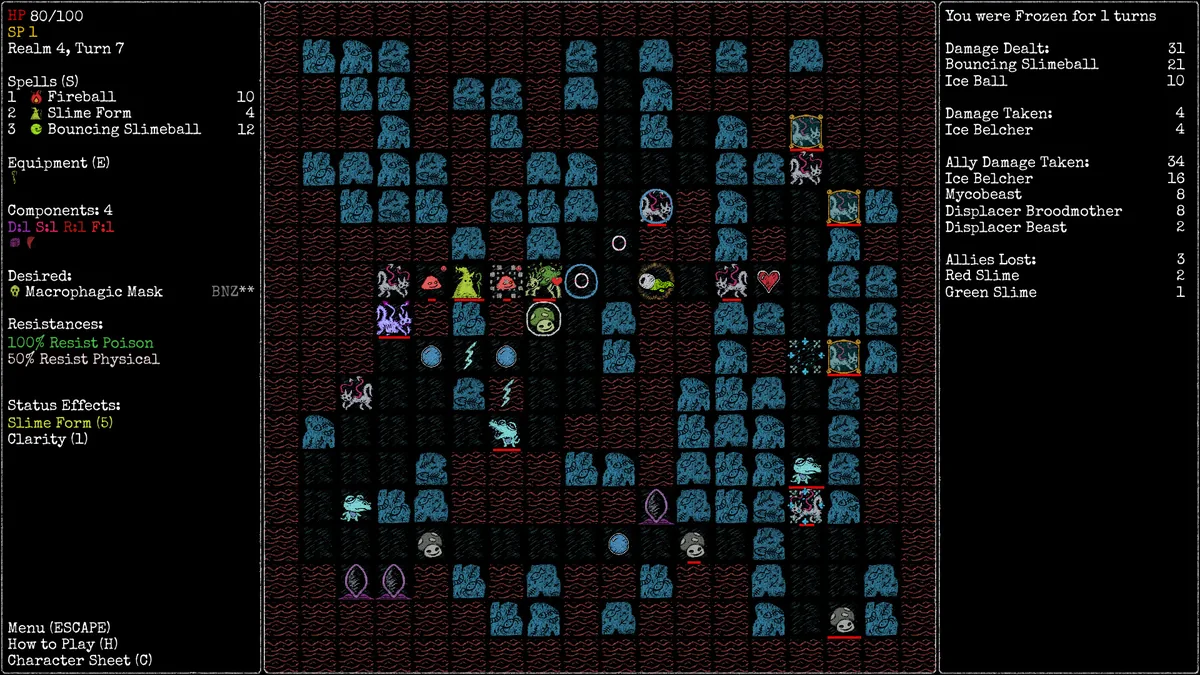 The Components row and Desired line sit directly under your equipped Equipment icons, a separate tracker from anything spell-related.
This changes how you should think about "farming" components. You're not stockpiling a generic currency. You're accumulating specific typed pieces that only count toward artifacts whose recipe calls for that letter. A component that doesn't match your current Desired target isn't useless forever, but it isn't contributing to the artifact you're actively chasing either. Reading the Desired line before you decide which room to clear next is a real decision point the game gives you, and it's one the Rift Wizard 3 guide hub doesn't get into beyond naming the system.
Rift Wizard 3 crafting guide: 8 confirmed artifacts and what they actually do
Every other piece of Rift Wizard 3 coverage on this site cites the same three Steam-confirmed crafting effects: lightning flying out of arcane damage, demon summons gaining fire breath, and commandeering enemy spawners. Those are real and worth knowing, but they're not the only artifacts Steam has shown. Here are eight more, named and detailed directly from official screenshots, with their exact tags. The section right after this one adds dozens more, named across Early Access patch notes but never covered by the screenshot-only approach this guide started with.
Volcanic Lance (Fire). Fire spells and equipment gain 3 range. When you cast a fire spell at an enemy, it sends out a destructive beam toward the target that destroys walls and deals fire damage equal to the total SP you've spent on fire magic. This is a scaling effect, the more you've invested in fire, the harder the bonus beam hits.
Talking Hat (Enchantment). Enchantment spells and equipment gain 1 Quick Cast. Your Enchantment spells gain quickcast, meaning the first one cast each turn doesn't end your turn. For an Enchantment-heavy build, this effectively gives you a free extra action every turn.
Venom Spitter Casque (Nature). Living and Nature allies learn Venom Spit, a spell dealing 4 poison damage with a 10-turn poison duration, 3-tile range, and a 3-turn cooldown. Its listed attributes are 4 Minion Damage, 3 Minion Range, and 10 Duration, meaning it also scales your summons' other stats.
Galvanic Armor (Lightning, Metallic). Lightning spells and equipment gain 1 radius; Metallic spells and equipment gain 1 radius. Carries 25% Resist Lightning and 25% Resist Physical. Whenever you cast a Metallic spell, you gain Galvanic Redirection for a duration equal to that spell's level, which redirects incoming lightning damage into a beam aimed at a random enemy in line of sight. This is the clearest example of an artifact turning a weakness (getting hit by lightning) into offense. One freshness note: the August 13, 2026 beta patch lists "Galvanic Redirection" under Reworked equipment effects, four days after this screenshot was taken. The patch notes don't spell out what changed, so treat the numbers above as the pre-rework version until a newer screenshot confirms the current behavior.
Astral Phylactery (Arcane, Dark, Translocation). On Pickup: summons a Soul Jar near you and makes you Soulbound to it. You cannot die until the Soul Jar itself is destroyed. This is a one-time trigger, not a persistent passive, and it fundamentally changes your death condition for the rest of the run.
Flame Blade Fragment (Fire, Metallic). On Craft: the crafted equipment (whatever weapon or gear you're building) grants a +3 damage bonus to spells and equipment for each of its own tags. A two-tag item gets +6, a three-tag item gets +9, and so on.
Sanctified Locket (Holy, Enchantment). On Pickup: Undead, Demons, and Dark units in line of sight are feared for 5 turns. A crowd-control artifact rather than a stat-boosting one, and it's specifically tuned against the same enemy categories Holy spells already counter.
Slime Core (Arcane, Slime). On Pickup: summons a trio of friendly Void Slimes. A pure summon-on-pickup effect with no listed ongoing passive beyond the initial trio.
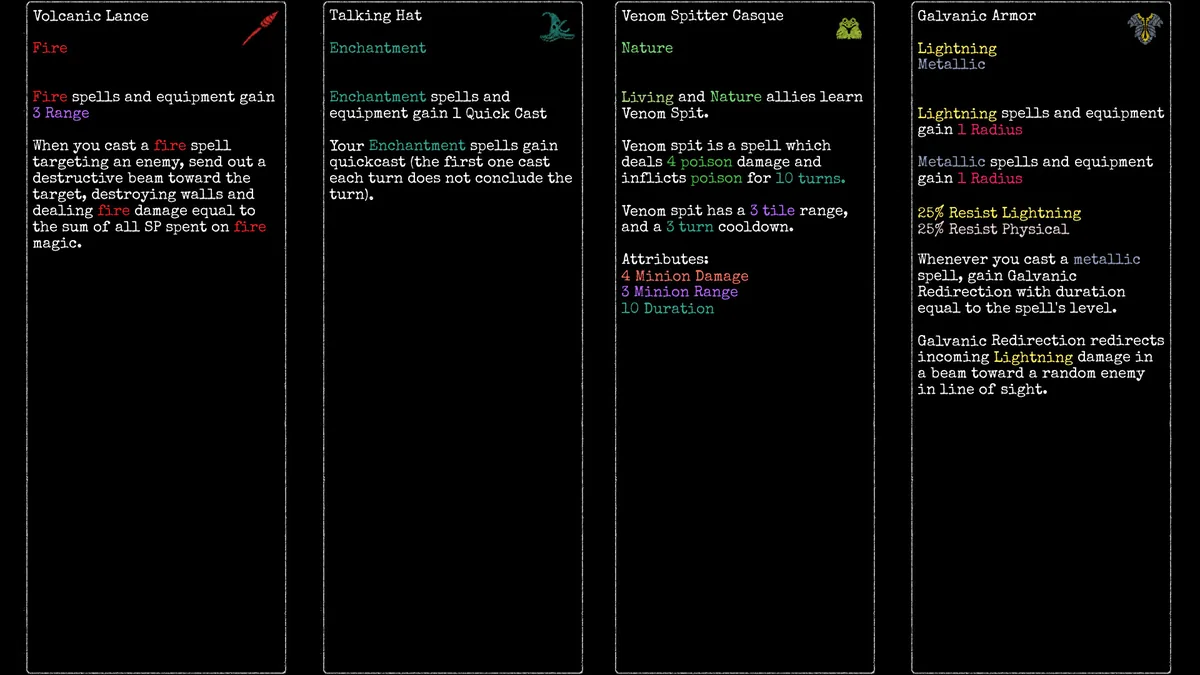 Artifact cards list tags the same way spell cards do, which is the fastest way to check whether a crafted item actually fits your current build before you commit components to it.
GODEEPER: These eight artifacts only matter if they match the tags your build is already leaning on. The Rift Wizard 3 spell guide breaks down what each major tag does and where the confirmed sources run out. Rift Wizard 3 Spell Guide: How to Build from 500+ Spells →
More named equipment confirmed in patch notes since launch
Screenshots are a snapshot. Patch notes are a running record, and Rift Wizard 3 has published seven of them since Early Access opened on June 23, 2026. Cross-referencing every one turns up dozens of named artifacts and equipment pieces beyond the eight above, most without a full effect description in the notes themselves (the small dev team behind the game writes terse balance logs, not patch-note flavor text), but confirmed to exist, confirmed by name, and dated to a specific patch.
A few of these connect directly to systems already covered in this guide:
- Plague Doctor's Mask. Named in the EA Patch 1 notes (June 29, 2026), which changed how it and four other "Any component" pieces interact with status resistance: "now remove the statuses their resistances prevent." It's also the namesake piece of the Plague Doctor Equipment Set achievement covered below.
- Archangel's Halo. Added in the Opening the Beta Branch patch (July 5-6, 2026), nerfed in the August 13 patch cited above. Ties to the Archangel Equipment Set.
- Enchantment Staff. Never covered on this site until now. Steam's achievement list pairs it with the already-covered Talking Hat as the two-piece Enchanter Equipment Set.
- Warlord Banner (renamed from Banner of the Horde) and Warlord's Skull, both touched in the July 9, 2026 patch. Warlord's Skull specifically converts num_targets bonuses into num_summons bonuses, per that patch's own wording. Both tie to the Warlord Equipment Set.
- Galvanic Focus, buffed in the August 17, 2026 patch, sits in the same Galvanic-named family as the already-covered Galvanic Armor.
- Bishop Boots and Castellan Clogs, added in the August 13, 2026 patch (Castellan Clogs was the developer's own favorite addition that update, per the patch's intro note), are the exact two-item combo behind the Royal Movement Equipment Set. The August 17 patch's new "Chess" Wardrobe outfit lines up with that same chess-themed achievement name, though the patch notes don't explicitly state the two are linked.
Beyond that handful, patch notes name a long tail of equipment with balance actions but no effect description: Prismatic Plate, Electroplasm Ampule, Glasya's Bite, Quickstep Boots, Spawning Venom, Storm Caller Staff, Veilpiercer's Monocle, Multicolored Rage Rod, Chalice of X, Heavenrender, Helm of the Host, Glittering Dancer's Robes, Lava Cage, Arbiter Cage, Knight Cage, Amulet of Collected Agony, Storm Beacon, Rain Beacon, and Blizzard Beacon all had recipe costs adjusted in the August 17 patch. Witching Hourglass, Plasmic Distributor, Voodoo Doll, Chelation Claw, Rimeblight Pulverizer, The Boiler, Stone Mask, Boots of Imminent Doom, Nightmare Hexbag, Dowsing Spark, Hemlock Needle, Fae Toxin Pouch, Icy Cruciform, Robe of Fire, Robe of Ice, Robe of Void, Robe of the Druids, Earthwrath, Warlord Vestments, Basilisk Scale Armor, and Jade Shard were buffed the same patch, and Mask of Nihilo was reworked. None of these have a public effect description beyond "buffed" or "reworked," so treat the names as confirmed and the exact numbers as unconfirmed until a screenshot or an in-game check fills them in.
Freecast staves got their own naming wave too: Doombrand, Lightbinder, The Lodestar, and The Haemanthus, all added in the July 5-6, 2026 patch alongside a reworked Oculus (its Any-tag cost dropped from 4 to 3) and reworked targeting on Cracklevoid, Crackledarkener, and Hemocorruptor.
On Pickup vs. permanent passive: two different artifact trigger types
Look closely at the eight artifacts above and a pattern splits them into two groups. Volcanic Lance, Talking Hat, Venom Spitter Casque, and Galvanic Armor read as always-on passives: no trigger label, just a continuous effect that applies for as long as the item is equipped. Astral Phylactery, Flame Blade Fragment, Sanctified Locket, and Slime Core all carry an explicit "On Pickup:" or "On Craft:" label followed by a one-time effect.
That distinction matters for how you plan around a specific artifact. A permanent passive like Galvanic Armor is a build pillar, shaping your entire run from the moment you equip it. A triggered item like Sanctified Locket does its job once (fearing nearby Undead, Demons, and Dark units) and, based on what's shown on its card, doesn't appear to do anything further. Astral Phylactery is the clearest case where this matters: its Soulbound effect isn't something to casually walk past. Once you pick it up, your death condition changes for the rest of the run, whether or not that was the plan.
This site's own crafting coverage elsewhere describes crafting only in terms of ongoing passive bonuses. That undersells what a triggered artifact like Astral Phylactery or Slime Core actually does the instant it enters your inventory. Reading an artifact's card before you pick it up, not just its tags, is worth the extra second.
Equipment Sets: how the 16 confirmed set achievements actually work
Crafting coverage of Rift Wizard 3, including the earlier version of this guide, has treated artifacts purely as an individual-item system: find components, craft one thing, equip it, repeat. Steam's own achievement list tells a different story. Sixteen of the game's 110 Steam achievements, confirmed directly against the live achievement list rather than inferred from screenshots, require winning a run while wearing a specific piece of equipment or a themed collection of it. The developer refers to this collectively as Equipment Sets, first named in the July 9, 2026 patch notes: "Added new Steam achievements and Wardrobe outfits for winning with themed equipment sets and fully upgraded spells."
The 16 split into two distinct patterns, verified directly from the achievement page's own descriptions:
Seven "every piece" Sets, where the achievement description literally reads "Win while wearing every piece of the [name] equipment." Steam doesn't publish how many pieces belong to each collection: Galvanic, Archangel, Plague Doctor, Warlord, Twilight, Crimson, and Virtuous Sin.
Nine named-combo Sets, where the achievement lists 2 to 4 specific items you have to be wearing simultaneously at the moment you win:
- Eldritch: Eldritch Mantle and Skybreaker Array
- Hellfire: Hellfire Mantle and Ghostfire Scepter
- Enchanter: Talking Hat and Enchantment Staff (the already-covered Talking Hat is one half of this combo)
- Dragonlord: Chaos Scale Crown, Dragonspine Cloak, Drakenstaff, and Wyrm Spirit Armor
- Dream Walker: Dream Thief Diadem, Psychopomp Staff, and Hypno Bauble
- Ruinous: Codex of Chaotic Evolution, Prism of Shattered Sensations, Cyst of Eternal Bloom, and Orb of Infinite Slaughter
- Gazing: Eye Helm, Balor's Eye Staff, and Raiment of Eyes
- Oozing: Slimebirth Cantromancy, Macrophagic Mask, and Slimy Voodoo Mantle
- Royal Movement: Bishop Boots and Castellan Clogs
What Equipment Sets do NOT confirm is a stat bonus for completing one. Nothing in the patch notes or the achievement descriptions describes an added passive effect, damage bonus, or synergy that kicks in once every piece is worn together. The confirmed reward is the achievement itself, plus a themed Wardrobe cosmetic outfit for your wizard, tied to the same July 9 patch that introduced the Sets. That's a meaningfully different claim than a Diablo-style item set bonus, and this guide isn't going to invent one just because "Set" sounds like it should carry a bonus. If a future patch adds one, it'll show up in the notes the way everything else in this section did.
Global achievement rarity data from Steam's stats API puts these among the game's least-common unlocks: Plague Doctor and Archangel sit at 1.2% of players, while Royal Movement, tied to a chess-themed pair of boots added the same patch cycle as the Chess Wardrobe outfit, sits at just 0.3%, the rarest confirmed Set in the game. Every Set's exact unlock condition, along with the rest of the game's 110 achievements, is broken out in the Rift Wizard 3 achievement guide.
What crafting replaced from Rift Wizard 2
Rift Wizard 3 doesn't just add crafting on top of the previous game's systems, it replaces one of them outright. Steam's own store description states it directly: "Most passive skills and equipment from the previous games have been brought back in some form as craftable equipment, and more than a hundred new items have been added to the game." There's no separate passive skill tree anymore. What used to be a leveling-driven system in earlier entries is now something you find, not something you unlock by playing longer.
That reframing shows up in early community reaction too. A launch-week thread in r/RiftWizard, posted the same day Early Access went live, credited crafting with making previously underpowered build paths viable: the original poster wrote that archetypes which "felt limited before (metallic, blood) feel like they belong better" now that they lean on crafting instead of the old skill tree. That's one player's read, not a balance statement, but it lines up with what Steam's own description says: the system replaced the passive tree, not just supplemented it.
Whether trading a known, level-gated skill tree for a partially hidden letter recipe is actually an upgrade is a fair question, and it's not an obviously settled one. Players who liked planning a build around guaranteed unlocks lose that certainty here. What they get instead is a system where power is found, not chosen, which is either the more interesting design or a worse one depending on what you valued about Rift Wizard 2 in the first place.
GODEEPER: If you're chasing the Amnesiac or Artificer achievements, both are built directly around how much you lean on crafting during a run. The Rift Wizard 3 achievement guide covers what's confirmed about each condition. Rift Wizard 3 Achievements: All 110 Unlocks Explained →
The practical upshot: don't go looking for a skills menu, there isn't one. Everything that used to live there now lives in the Components tray and the Desired line covered above.
Step-by-Step: how to prioritize your crafting choices each run
Check the Desired line before you clear a room, not after. If the sidebar shows a target you don't recognize or don't want, that's the moment to decide whether this run's crafting path is even worth chasing, before you've spent components confirming letters toward it.
Match tags to your existing build before picking up an untagged component. An artifact tagged Fire and Metallic, like Flame Blade Fragment, is only worth prioritizing if you're already running one of those tags. A component that doesn't feed anything in your current spellbook is a lower priority pickup than one that does, even if you can't identify the exact target artifact yet.
Treat "On Pickup" artifacts as decisions, not loot. Before grabbing anything with a visible on-pickup trigger, read what it does. Astral Phylactery's Soulbound condition is a real commitment. A triggered summon like Slime Core is lower-stakes and safe to grab on sight.
Route dense rooms when your Desired target still has hidden letters. High-density rooms drop more components. If your target is mostly asterisks, prioritize rooms with more enemies over rooms with fewer, since more kills means more chances at the letters you're missing.
Reassess by realm 8 to 10. If your Desired target hasn't filled in significantly by then, the run likely isn't generating what that artifact needs. Don't force a crafting path the run isn't offering, the same logic already applies to spell selection in this game.
Tips: crafting mistakes to avoid
Ignoring tags on artifact cards. Every artifact shown on Steam's own screenshots lists its tags at the top of the card, the same format spell cards use. Skipping that line and judging an item purely by its flavor text is how a Nature-tagged item ends up equipped on a pure Fire build with zero synergy.
Assuming every artifact works the same way. Conflating an always-on passive like Galvanic Armor with a one-time trigger like Sanctified Locket leads to bad expectations. If you're hunting for enemy fear specifically, Sanctified Locket already did its job the moment you picked it up. It won't keep doing it every turn.
Treating the Desired line as fixed forever. The letters revealed on a Desired target update as you identify more components, which means checking back on it periodically (not just once at the start of a realm) is worth the habit. A target that looked hopeless in realm 4 can look close by realm 9.
Forgetting that Equipment and Components are separate rows. New players sometimes assume everything they're carrying shows in one list. The Equipment row (already-crafted, worn artifacts) and the Components row (raw materials) are tracked separately in the sidebar. Checking only one when you're trying to plan your next craft means missing half the picture.
Chasing a Set achievement without checking the combo first. Assuming a themed name means you need to hunt down an entire matching collection wastes time on the 9 Sets that actually only need 2-4 specific named pieces. Check the achievement list before you commit a run to a full "every piece" hunt.
Related Reading
- Rift Wizard 3 Mordred Boss Guide: Realm 21 Final Fight: the final boss fight, including which crafted artifacts hold up against his multi-form pressure.
- Rift Wizard 3 Builds Guide: Best School Synergies 2026: multi-tag build pairings and how the lightning-into-arcane crafting effect fits into them.
- Rift Wizard 3: Hardcore Wizard Roguelike Hits EA June 23: the launch preview covering what changed going into Early Access, crafting overhaul included.
- Rift Wizard 3 Tips: 9 Rules for Surviving Early Runs: general early-run survival habits that pair with the crafting priorities covered here.
- Rift Wizard 3 Realm 20 Boss Guide: All 12 Bosses (2026): Rift Wizard 3 Realm 20 boss guide: all 12 bosses, sourced from Steam achievement data
Frequently Asked Questions
What is the crafting system in Rift Wizard 3? You collect components scattered across each realm, tracked in the sidebar by single-letter codes and colors. Combine them to craft passive artifacts. Rare components can change the crafted item's exact effect, per Steam's own store description.
What does the "Desired" line in the crafting panel mean? It shows the artifact you're currently working toward, named, with a string of letters representing the components it needs. Revealed letters are components you've identified; asterisks mark ones you haven't found or confirmed yet.
What are some confirmed Rift Wizard 3 artifacts? Steam's own screenshots name Volcanic Lance (fire range and wall-breaking beams), Galvanic Armor (lightning redirection), Astral Phylactery (a Soul Jar that prevents death until destroyed), and Venom Spitter Casque (teaches nature allies a poison spit spell), among others.
Does Rift Wizard 3's crafting replace Rift Wizard 2's passive skills? Yes. Steam's store page confirms most RW2 passive skills and equipment returned in craftable form, plus more than a hundred brand-new items. There's no separate passive skill tree in RW3 anymore, it's all routed through crafting.
Is crafting required to beat Rift Wizard 3? Not strictly, spell-only runs are possible and the Amnesiac achievement reportedly rewards winning without crafted artifacts. But the game's own store page frames crafting as the tool for reaching effects spells alone can't produce, so skipping it raises the difficulty.
Where do Rift Wizard 3 crafting components come from? Components drop from enemies and room clears during a run, not from the spell shop. You can't plan a specific artifact the way you plan spell purchases, since which components appear is determined by what the current run generates.
How many craftable items are in Rift Wizard 3? Steam's current store page confirms a combined spell and artifact pool of 500-plus, without breaking out a craftable-only subtotal. Patch notes since June 2026 have added dozens more named artifacts and equipment on top of the launch roster, and that count keeps growing through Early Access.
What are Equipment Sets in Rift Wizard 3? Sixteen Steam achievements, confirmed on the game's own achievement list, require winning a run while wearing specific named gear. Seven need every piece of a themed collection (Galvanic, Archangel, Plague Doctor, and others); nine name 2-4 specific items each.
Do Equipment Sets give a stat bonus in Rift Wizard 3? There's no official confirmation of a set bonus. Patch notes describe Sets purely as an achievement and cosmetic Wardrobe-outfit system, not an added passive effect for wearing a themed collection together.
References
- Rift Wizard 3 on Steam: official store page, crafting system description, current pricing, and screenshots showing the artifact cards referenced above
- Rift Wizard 3 Steam achievement list: source for the 16 confirmed Equipment Set achievements, their exact wording, and global unlock percentages
- EA Patch 1, June 29, 2026: source for Plague Doctor's Mask and the "Any component" status-resistance change
- Opening the Beta Branch, July 5-6, 2026: source for Archangel's Halo and the freecast staff additions
- Beta Update Patch Notes, July 9, 2026: source for the Equipment Sets achievements and Wardrobe outfits announcement, plus Warlord Banner and Warlord's Skull
- Beta Update Patch Notes, August 13, 2026: source for Bishop Boots, Castellan Clogs, and the Galvanic Redirection rework
- Beta Update Patch Notes, August 17, 2026: source for the recipe-cost and buff wave covering Galvanic Focus and the rest of the named equipment list above
- r/RiftWizard: First thoughts about 3: launch-week community discussion on how crafting changed build viability compared to Rift Wizard 2
- Rift Wizard 3 official trailer: gameplay footage from the developers
Was this guide helpful?
About the author

Critical game theorist with a background in film criticism. Writing for print and digital outlets since 2015. Specialises in genre analysis and design heritage.
- Background in film criticism
- 10 years games coverage
- Genre theory and design history specialist
Keep reading


Disclaimer
This article is published for informational and entertainment purposes. It does not constitute professional financial, legal, or technical advice. Game performance, online services, patch schedules, and store listings change. Verify critical details (pricing, system requirements, regional availability) with publishers and storefronts before you buy. Affiliate links, where present, help support our editorial work and are labelled in our affiliate disclosure.
Comments
Loading comments…