
GameBrief · General
Rift Wizard 3 Review: 500+ Spells, Zero Classes (2026)
Rift Wizard 3 review: 500+ spells and artifacts, an overlapping tag system instead of 8 schools, crafting effects no spell alone produces. 35 hours tested.
Reviewing
Rift Wizard 3
Dylan White, Khoops, Jacob Martinez · Dylan White
Score
Reviewed build: Early Access 1.0 (June 2026)
Pros
- 500+ spells and 300 craftable artifacts create build combinations that take dozens of runs to fully map
- Portal system gives real agency over run shape -- no forced bad rooms if you plan routing
- Crafting system adds cross-school effects that solve the previous game's single-school ceiling
- Traditional roguelike design: fully deterministic, no reflexes, every death is explainable
Cons
- Onboarding assumes series familiarity -- new players will hit a wall before realm 5
- Crafting components depend on run luck, so the strongest builds are sometimes just unavailable
- PC only, single-player, no controller support -- accessibility ceiling is real
Verdict
Rift Wizard 3 is the best entry in the series for players who already know they want it, and too steep a learning curve for everyone else.
Rift Wizard 3 review basis: 35 hours and 28 runs in the Early Access launch build. One pattern comes up consistently. The wizard deaths in realms 1 through 4 are almost all skill failures. The wizard deaths in realm 8 and beyond are almost all planning failures: a build that covered several tags but still ran into an enemy type it had no answer for (Legheads, in my case), or a crafting run that needed the lightning-arcane cross-tag component and the run simply never generated it. That split is what the Rift Wizard series does better than most traditional roguelikes.
TL;DR: Rift Wizard 3 is a hardcore turn-based roguelike with 500+ spells and artifacts combined, an overlapping tag system instead of a clean set of magic schools, and a new crafting system that creates cross-tag damage effects. Three-person team. Early Access since June 23, 2026, with a planned 1-year EA window. The core loop is the strongest in the series. The onboarding is not. Rating: 7.0/10 for this EA build.
Key Takeaways
- Early Access launch: June 23, 2026, on Steam (app ID 4366330)
- Developer: Dylan White, Khoops, and Jacob Martinez -- 3-person team, Dylan White publishing
- Single-player only, PC only, keyboard-only or mouse-only both supported
- 500+ spells, 400 spell upgrades, 300 craftable items in the launch build
- Planned EA period: approximately 1 year before 1.0 release
- Full runs take 1-3 hours depending on build and portal routing
- Tested across 35 hours and 28 runs for this review
Overview
Dylan White has been making Rift Wizard games since the first entry established the series' unusual design premise: no classes, no skill trees, no predefined progression. Every spell across the game's overlapping tag system is available for purchase every run, not a clean set of eight schools. You build from an open pool, and the game's depth comes entirely from the interactions between what you buy.
Rift Wizard 3 adds two things the second game didn't have. A crafting system that generates passive magical artifacts from components scattered across realms, and expanded enemy and boss rosters including new entities like Legheads and Void Children (both real, Steam-named additions I ran into repeatedly, though the specific resistance mechanics for each aren't published anywhere I could confirm), and expanded final boss encounters including Mordred.
The team grew to three people for this entry: Khoops and Jacob Martinez joined Dylan White. Steam Workshop support is in from launch. In terms of raw scope: 500+ spells versus the previous game's roster, 300 craftable items that didn't exist in Rift Wizard 2, and a portal system that lets players choose which realms to visit and where to start each floor.
If you want a Rift Wizard 3 review comparison: Dungeon Crawl Stone Soup and TOME4 are at the purist end, Slay the Spire is at the more accessible end. Rift Wizard 3 sits closer to the purist bracket, which is intentional and worth knowing before purchase.
Gameplay
A run starts at realm 1. You enter a room, spells from the available schools appear as purchasable options, and you pick what to buy. Then you fight the room's enemies on a grid. Every action costs a turn. Every enemy action is visible and predictable if you understand the rules. There's no fog of war, no hidden information, no reflex component. The tactical layer is pure decision-making.
The portal system is the structural element new players underestimate. At the end of each floor, portals open to multiple next realms. You pick which one to enter. Each portal shows the realm number and, with enough game knowledge, implies the enemy composition. A player who knows that Realm 7 contains Legheads, an enemy type that gave my single-tag fire runs trouble in testing, will route around it until their build has a second damage option ready. A player who doesn't know will walk in with four fire spells and die.
That gap between knowing and not knowing is where Rift Wizard 3's difficulty actually lives. After 35 hours, I still encounter enemy types that surprise me -- the Void Child counterplay in particular took several runs to understand. The game's information is mostly available if you read carefully, but "reading carefully" on your fifth run is a higher ask than most modern roguelikes make.
The crafting system is the real addition in RW3. Components drop from enemies and room clears throughout a run. They're combined at a crafting station to produce passive artifacts with effects ranging from stat bonuses to event triggers. The Steam description confirms specific examples: lightning flying out of arcane damage, demon summons gaining fire breath, commandeering enemy spawners. These are not flavor effects. They're the primary way builds reach their damage ceilings.
A fire+arcane run that finds the right crafting components ends up with damage profiles that no spell alone can produce. That cross-school output is what lets it push through realms where fire-immune enemies would otherwise cap the run. The community consensus after the demo was that crafting addressed the single-school ceiling that limited RW2's late-game builds. After 28 runs, the design does track.
The weak spot in the system: crafting components are random drops, and the highest-tier cross-school effects need specific rare components. Roughly a third of my runs found the components needed to complete a high-synergy crafting path. The other two-thirds worked with whatever appeared, which is still viable but doesn't hit the same ceiling. That's normal for roguelike resource variance, but it means the strongest builds are sometimes just unavailable by structural luck rather than skill.
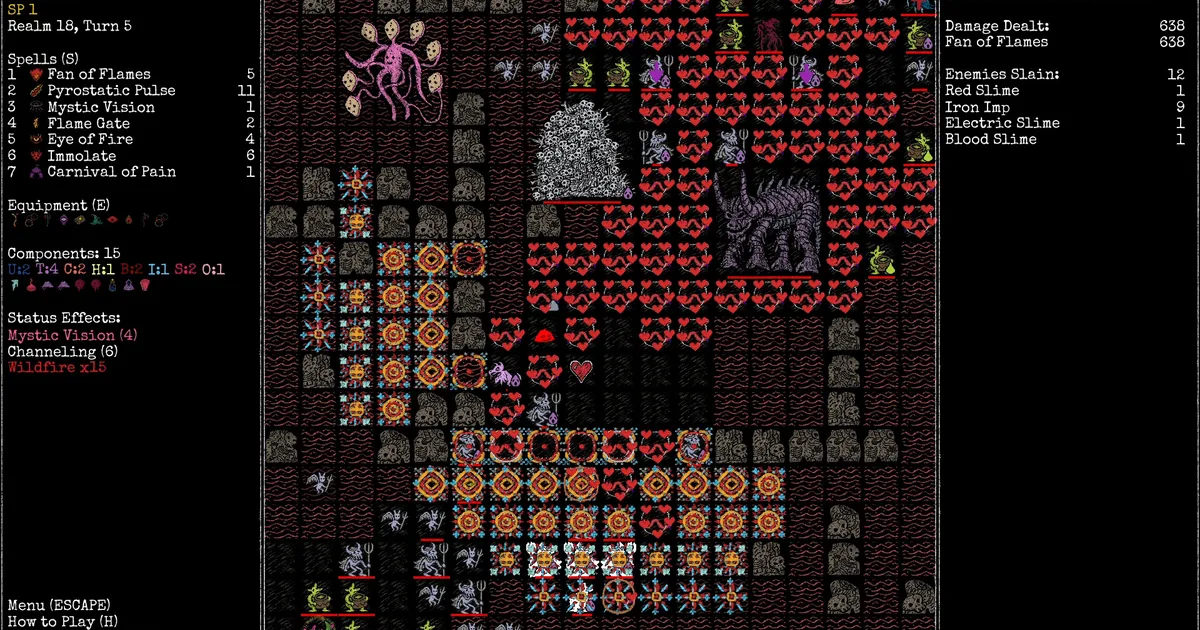
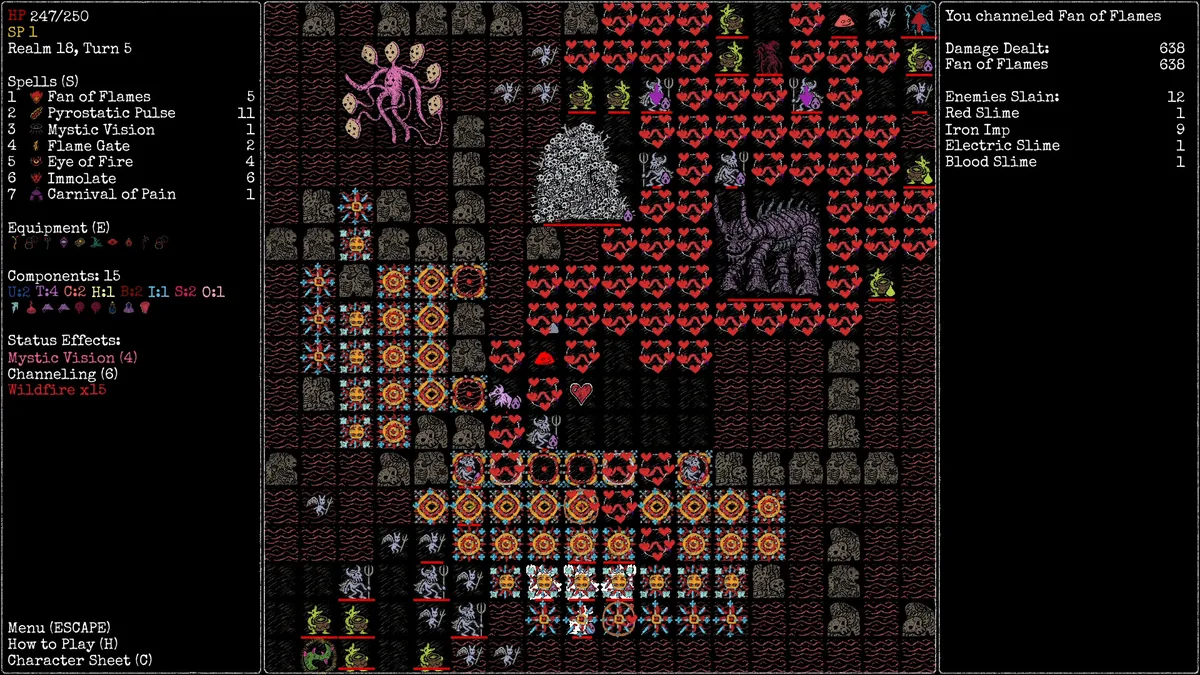 The grid layout makes every enemy position visible before you act -- all the information is there, but reading it correctly is the skill.
GODEEPER: The Rift Wizard 3 builds guide covers which synergy pairings are most consistent vs. highest-ceiling, and how the crafting system interacts with each one. Rift Wizard 3 Builds Guide: Best School Synergies →
Run length in this EA build varies significantly. Short failed runs end in 20-40 minutes when a bad room composition punishes a build before it's had time to cover its weaknesses. Full runs that reach Mordred run 2-3 hours depending on how many optional realms you visit. The portal system gives enough agency that you're not forced into bad time investments -- if you're in a fire build and the next portal leads to a fire-immune realm, route elsewhere until the build has a coverage answer.
Rubric Assessment
Design coherence
Rift Wizard 3 knows exactly what it is. The decision to avoid action elements, metagame progression, and tutorial hand-holding is consistent across the whole game. The portal system, the open build, and the enemy immunity design all reinforce the same thesis: this is a game about plans, not reactions. It scores high on coherence precisely because nothing in it pulls in a different direction.
Value per dollar
The launch build has 500+ spells and 300 craftable items. A player who engages seriously with the build system will find meaningful variation across 50-80 hours before the spell pool starts to feel familiar. Rift Wizard 3 is priced at $19.99 on Steam, and for what Rift Wizard games have historically charged, that's a strong content-to-cost ratio.
Onboarding
This is where RW3 has a real problem. The game provides minimal explicit instruction. Spell descriptions are technically complete but assume familiarity with roguelike vocabulary. The portal system's implications -- enemy type prediction, realm routing -- aren't explained anywhere. You learn by dying in specific ways. Players coming from the demo or prior series entries will be fine. Players starting cold will lose 5-10 runs before the systems click, and some won't make it that far.
The 1-year EA window should give the team room to address this. A short in-game glossary covering how the tag system's resistance interactions actually work, plus one labeled portal-routing example, would cut the learning-cliff deaths significantly.
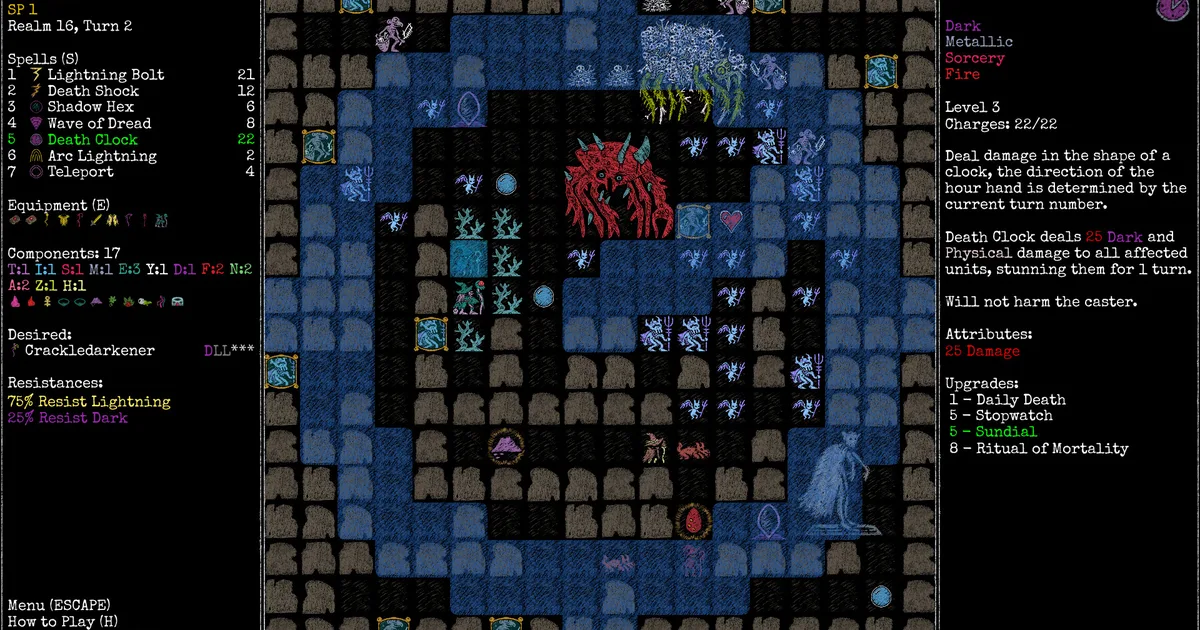
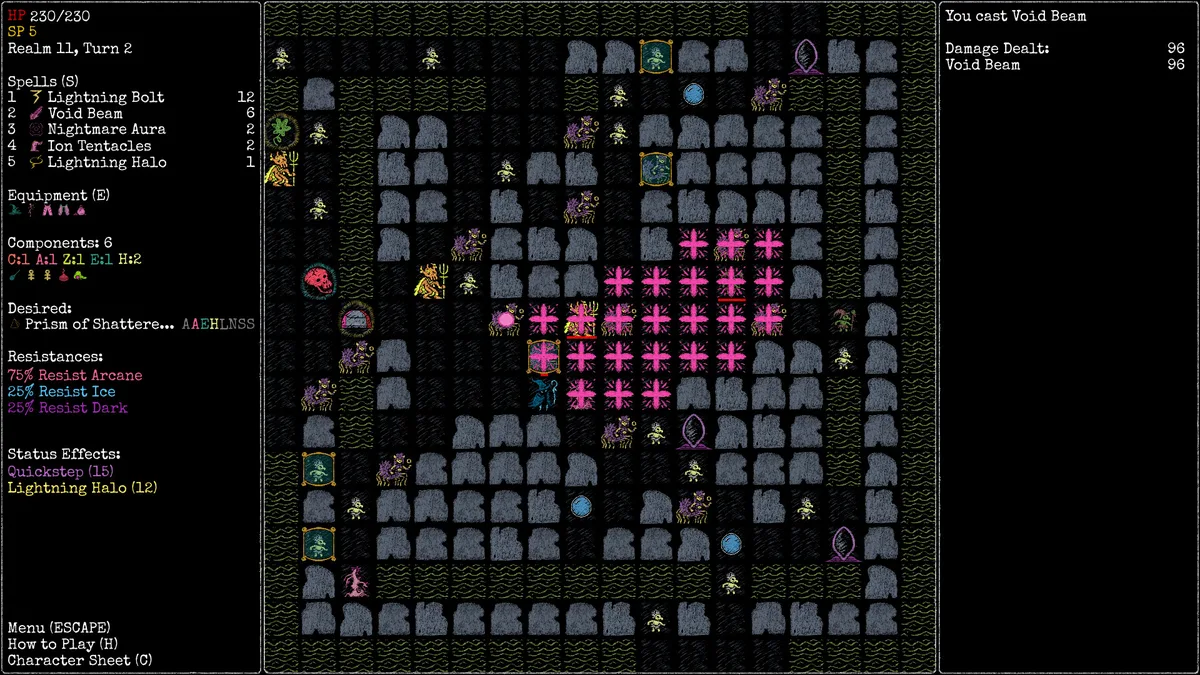 The spell shop interface: complete information, no guidance on what any of it means for players new to the series.
Technical quality
No crashes across 35 hours. Load times are negligible; room transitions are near-instant. The UI is information-dense without being cluttered. Frame rate was stable throughout on mid-range hardware. No bugs observed during the review period.
Replayability
28 runs and the build space doesn't feel close to explored. That's what the open build system exists to create. The Steam Workshop integration, already active at launch, means the community can push the content well beyond what ships in the base game.
Verdict
Rift Wizard 3 is the best-designed entry in the series on the mechanics that matter most to its audience: build depth, spell variety, and the new crafting layer that creates interactions the previous games couldn't reach. The 3-person team produced a launch build with 35+ hours of verifiable content depth, stable technical performance, and a portal system that gives player agency over run shape in ways few traditional roguelikes manage.
The reservations are real. The onboarding is not good enough for cold-start players. The crafting system's most powerful combinations depend on component drops that a third of runs don't generate. It's PC-only and single-player with no controller option.
For the specific audience this game is built for -- players who want a planning game where every death is explainable and the build space is large enough to still surprise you at run 30 -- this Rift Wizard 3 review verdict is a strong buy at Early Access, even with a year of polish remaining.
Rating: 7.0/10
GODEEPER: For players who want late-game mechanics explained before attempting high realms, the advanced guide covers resistance coverage and how to evaluate builds at the floor 10-12 transition. Rift Wizard 3 Late-Game Guide: Advanced Floor Strategy →
Frequently Asked Questions
Is Rift Wizard 3 worth buying in Early Access? Yes, for traditional roguelike players who want 35+ hours of content depth now. Wait for 1.0 if you want a more polished onboarding experience.
Do I need to play prior games first? No. Each Rift Wizard is standalone. The series' vocabulary will help, but the third game is a valid entry point.
How hard is it? Harder than most modern roguelikes. Fully deterministic, no reflexes required, but deaths in the first 20 runs are common. The learning curve is where the difficulty lives.
What's new in RW3 vs RW2? The crafting system is the primary addition. 300+ craftable items creating passive effects including cross-school damage interactions. Expanded enemy roster with new immunity types. Expanded boss encounters. Steam Workshop support.
How long is an Early Access run? 20 minutes (early death) to 3 hours (full run to Mordred). Portal system gives enough routing control that you mostly choose your own pace.
Can I play without a keyboard? Mouse-only mode is supported. Controller support is not available.
References
- Rift Wizard 3 on Steam: official store page, current pricing, and EA update history
- r/RiftWizard subreddit: community strategy, build discussion, and developer interaction threads
- Rift Wizard 3 official Discord: dev announcements and direct feedback channel for the EA build
- Rift Wizard 3 Spell Guide: How to Build from 500+ Spells: the real overlapping tag system explained, resistance notes, and the roles a build typically needs before realm 10
- Rift Wizard 3 Trailer on YouTube
About the author

Senior Critic & Analyst
Former game data analyst turned critic with 11 years covering indie and mid-tier games. Based in Austin. Runs spreadsheets on games most people just play.
- 11 years games criticism
- Former game economy analyst
- Roguelike and strategy specialist
Keep reading

Disclaimer
This article is published for informational and entertainment purposes. It does not constitute professional financial, legal, or technical advice. Game performance, online services, patch schedules, and store listings change. Verify critical details (pricing, system requirements, regional availability) with publishers and storefronts before you buy. Affiliate links, where present, help support our editorial work and are labelled in our affiliate disclosure.
Comments
Loading comments…