
GuidePrime Monster
Prime Monster Coalition Guide: Best Party Combos 2026
This Prime Monster coalition guide covers the parliament strategy layer that the general tips guide introduces briefly: how to read the opening parliament, which coalition archetypes work with each character, and why the neutral approach consistently fails mid-run. For individual character builds, the characters guide covers Chopper, Sucksworth, and Rotilda in detail. For specific card combos, the advanced deck combos guide covers the Retort loop and Drumming Unity chain.
Sponsored

About the game
Prime Monster
Cavalier Game Studios · Cavalier Game Studios / Rekoup
Prime Monster runs 30 representatives across 15 political parties, and your coalition choice determines which resource profile you're building toward. The replayability is mostly in how that parliament composition varies each run.
TL;DR: Build a 2-3 party coalition and commit early. Neutral strategies fail because even-distribution costs more than it returns. Match your coalition to your character's resource profile: Chopper needs authority-heavy parties, Sucksworth needs damage-amplifying ones, Rotilda needs parties that support high-volume play. Read the opening parliament before committing. If your natural profile doesn't match the majority, decide early whether to adapt or fight for minority coalition control.
BESTPRICE: Want Prime Monster? These stores list it: Buy on Eneba → Buy on Loaded → Buy on Kinguin →
Prime Monster coalition guide: why commitment beats neutrality (quick answer)
The tips guide's coalition advice is "pick 2-3 parties and commit." The reason this works is arithmetic: maintaining minimum standing with each of the 15 parties costs more resources per turn than building deep relationships with 2-3.
A neutral run distributes authority, political capital, and poll rating across 15 parties. None of them get deep enough to produce reliable vote counts or resource bonuses. By the midpoint of a run, the neutral player is behind on all four resource bars. A committed 2-party player has at least one source of reliable Political Capital from coalition relationships, which keeps the resource loop running.
This isn't a playstyle preference. The math doesn't support neutrality past the first phase of most runs.
Sponsored

Key takeaways
- 2-3 party coalitions outperform wider distributions at mid and high difficulty
- Match coalition choice to your character's dominant resource profile
- Read the opening parliament before committing; majority party composition changes each run
- Minority coalitions are viable but require early investment to build leverage
- Elder Statesmonster and All Pledges runs strongly favor 2-party depth over 3-party flexibility
- Coalition and deck build reinforce each other; mismatching them is a common mid-run fail state
Reading the opening parliament
The opening parliament composition is the first decision that matters each run. You're looking for:
What's the plurality? Which party type (or 2-3 party bloc) makes up the most seats at the start? If those parties align with your character's resource needs, you have a natural coalition. If they don't, you're either adapting to work with the available majority or committing to build influence with minority parties from behind.
Is the composition favorable for your character? Chopper Badstone's authority-heavy profile works naturally with parties that have similar resource profiles. Sucksworth's damage-burst timing needs coalition partners whose cards amplify per-turn output rather than sustained pressure. Rotilda's Horde archetype requires enough volume in the coalition to generate the creature-type cards she needs. A parliament where the plurality doesn't match your character's resource needs is a harder run, not an impossible one.
How much variance is there? Some opening parliaments have a clear 5-6 party majority. Others split fairly evenly. Even splits mean more work to control any coalition effectively. Heavy majorities mean the dominant parties are easier to court but the minority parties have less leverage if you need to switch approaches mid-run.
The tips guide recommends committing before the first action. This is the reasoning: the resource cost of a misdirected first few turns compounds into later deficits that are difficult to recover from. Deciding your coalition direction before acting is worth the 30 seconds it takes to read the composition.
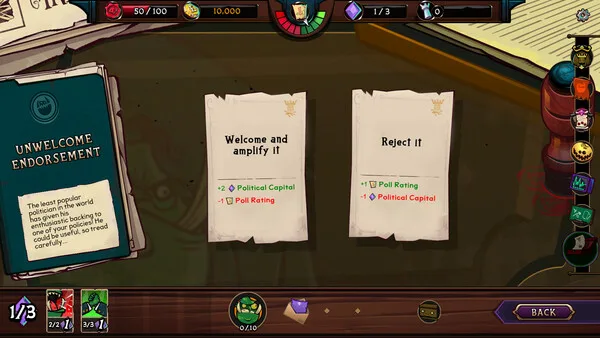 A parliament event forcing a choice between amplifying a rival's endorsement or rejecting it outright, exactly the kind of read that determines whether your opening coalition holds.
GODEEPER: The advanced deck combos guide covers how specific card picks within a coalition reinforce or undermine the resource loop, particularly the Retort loop and No-MP build, which interact differently depending on coalition composition. Prime Monster Advanced Deck Combos Guide →
Coalition archetypes by character
Chopper Badstone: authority-first coalitions
Chopper's Unity mechanic rewards sustained authority investment. His best coalition profiles are parties that:
- Produce authority bonuses from maintained relationships
- Have high MP counts that respond to the Unity passive (Chopper's stacking mechanic rewards having more bodies in the chamber on your side)
- Don't require significant Political Capital upfront to maintain
Chopper is the most forgiving character for coalition building because authority is the easiest resource to generate and maintain. His coalition floor is higher than Sucksworth's. A mediocre coalition still functions for Chopper where it would break Sucksworth's narrower loop.
Where Chopper coalitions fail: when the opening parliament has low authority-profile parties in the majority. If cash-heavy or poll-heavy parties dominate and you're Chopper, you're either running a suboptimal authority profile against the grain or adapting Chopper's play style to the available parties, which reduces his mechanic strength.
Viscount Sucksworth: damage-amplifying coalitions
Sucksworth's per-turn ultimate requires his damage output to reach a threshold each turn. His coalition needs:
- Parties whose cards and Tactics have direct damage output rather than resource-generation emphasis
- Compatibility with the Political Capital exploitation cards the advanced guide covers (Retort builds especially)
- Fewer high-maintenance relationships: Sucksworth's resource loop is tight enough that maintenance costs for a third coalition party often break his per-turn threshold
Sucksworth's coalition is the most constrained of the three characters. A parliament that doesn't have at least one damage-profile majority party is a noticeably harder Sucksworth run. The characters guide notes that new players often struggle with Sucksworth precisely because his coalition needs are less forgiving.
Where Sucksworth coalitions fail: 3-party setups. A third coalition partner adds resource overhead that reduces the per-turn budget for Sucksworth's threshold damage. Most successful Sucksworth runs are 2-party, sometimes even a strong single-party coalition if the math works.
Rotilda De Cay: volume-supporting coalitions
Rotilda's Horde archetype generates large numbers of lower-power cards rather than fewer high-power ones. Her coalition needs:
- Parties that support creature-type card generation
- Overlap in resource types (the advanced guide notes she's optimized for the No-MP build, which replaces coalition with cards; her coalition needs to reinforce that)
- Compatibility with the horde scaling she's building toward, not just near-term vote production
Rotilda is the veterans-first character for a reason: her coalition requirements are more specific than Chopper's and more unusual than Sucksworth's. The horde scaling requires patience and the coalition investments for it don't produce immediate returns.
Step-by-step: building a functional coalition
Step 1: Read the opening parliament
Before the first action, identify the 2-3 parties with the most seats and cross-reference them against your character's resource profile. If they match, those are your initial coalition targets. If they don't, decide whether to work with the majority or target minority parties you prefer.
Step 2: Invest in depth with your first 1-2 parties
Initial relationship building should go to your primary coalition parties before touching any others. The resource cost per party relationship gets cheaper the deeper it goes. Initial investments produce less per unit than mid-depth investments. Spreading to secondary parties before your primary relationships are established is the most common early-game coalition mistake.
Step 3: Evaluate a third party at the midpoint
If your first 2 parties are producing reliable vote counts and your resource bars are healthy, consider adding a third coalition partner. If your bars are under pressure, stay with 2. The decision is resource health-driven, not opportunity-driven. A third party that looks good but would strain your resource loop is worse than staying narrow.
Step 4: Drop maintenance on parties outside your coalition
The tips guide covers this as the "No-MP build" logic. Any authority, capital, or poll rating going to parties outside your 2-3 coalition is overhead that's producing no return. Cutting maintenance on non-coalition parties frees those resources for coalition depth, which produces more per unit.
GODEEPER: The characters guide covers how Rotilda's Horde archetype specifically changes the coalition optimization when you're deep into a high-difficulty run versus managing early parliament composition. Prime Monster Characters Guide →
Coalition at Elder Statesmonster difficulty
Max difficulty changes the coalition calculus in one specific way: the maintenance cost of each relationship scales with difficulty. What was a manageable 3-party coalition on standard becomes unaffordable maintenance overhead at Elder Statesmonster.
Most Elder Statesmonster completions use a 2-party coalition. The characters guide's note that Elder Statesmonster rewards using Sucksworth (despite the narrower loop) over Chopper is partly because Sucksworth's natural 2-party profile is already optimized for the tight resource budget that Elder Statesmonster enforces. Chopper's flexibility becomes a handicap at difficulty levels where maintaining that flexibility costs more than it saves.
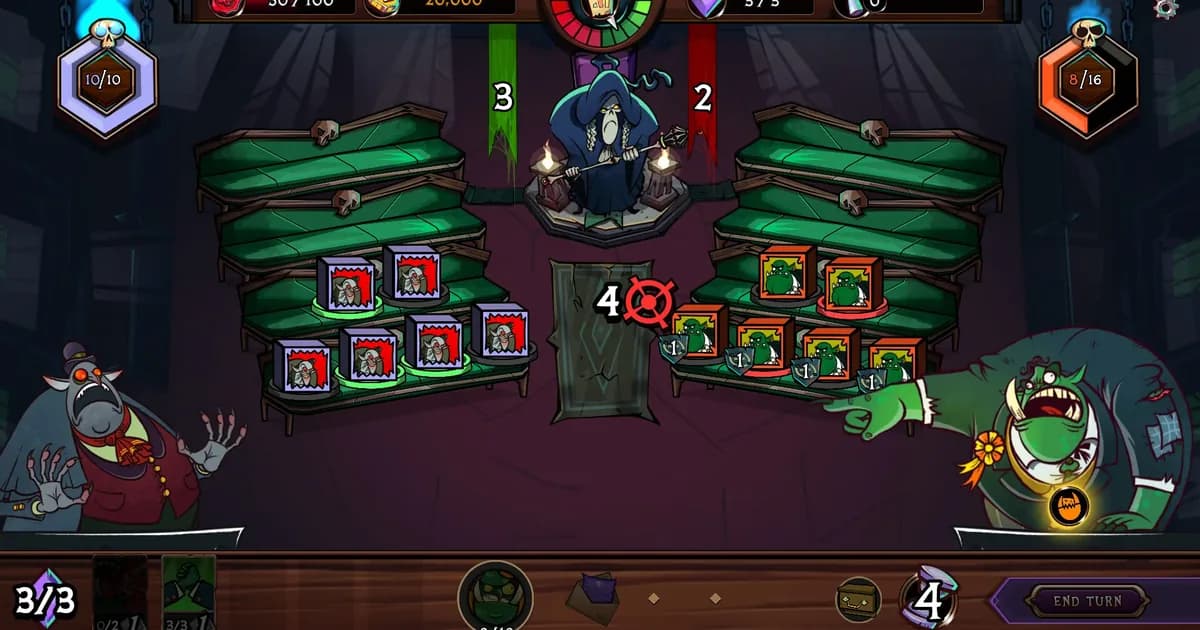
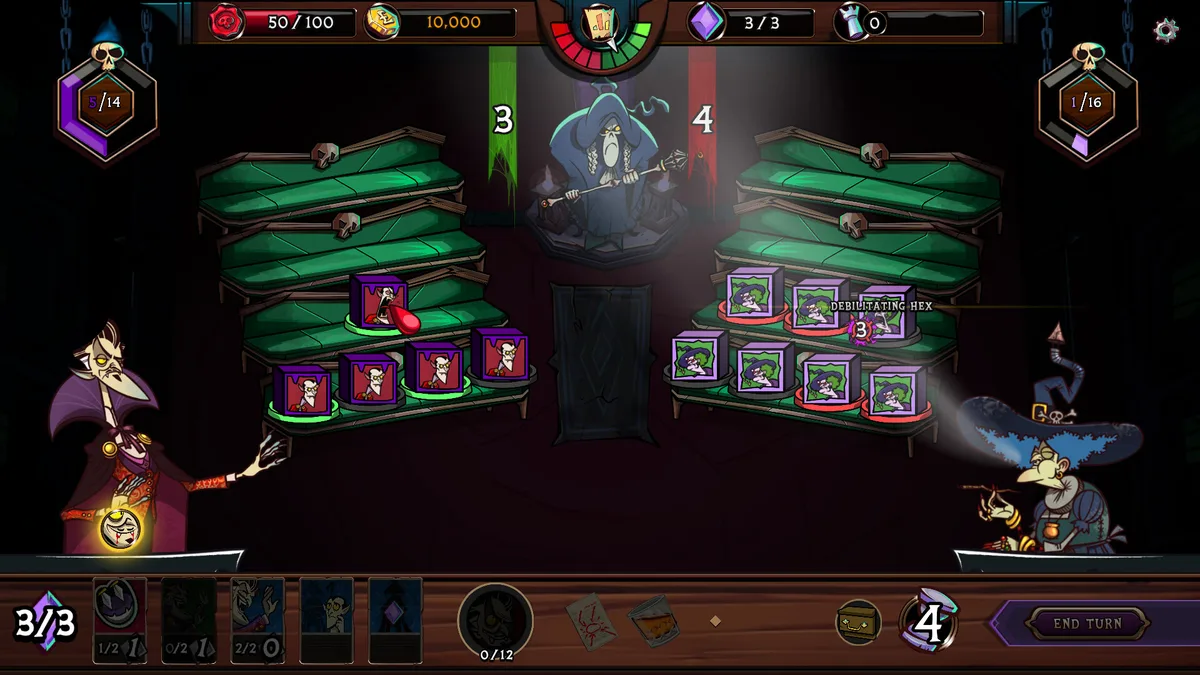 A tight 2-party coalition battle at higher difficulty, note how few card stacks are in play compared to a sprawling early-game parliament.
All Pledges unlocks a different challenge: Elder Statesmonster's entire difficulty curve applied to all run configurations. The advanced guide covers the specific execution path for All Pledges Elder Statesmonster. Coalition discipline is a prerequisite. It's not a run you can complete with a 3-party setup that's working at 80% efficiency.
Tips: common coalition mistakes
Courting parties outside your coalition "just in case." Any investment in non-coalition parties costs resources from your coalition depth. The "just in case" reasoning almost always loses the trade.
Switching coalition mid-run without a plan. A mid-run coalition switch can work if executed cleanly: stop all maintenance on the old coalition, transfer resources to the new parties, accept the transition loss. Half-switching (maintaining some old coalition relationships while building new ones) produces the worst outcome of both.
Building a 3-party coalition before the first 2 are producing. Depth produces more per unit than breadth. Get your first 2 parties to working depth before adding a third.
Ignoring parliament composition at run start. This is the most avoidable mistake. 30 seconds of evaluation before the first action prevents mid-run coalition mismatch.
Treating the characters guide as the coalition guide. The characters guide tells you which character matches which play style. Coalition selection is a separate layer. The same character can run different coalition profiles on different runs depending on parliament composition. The two decisions interact but aren't the same decision.
Related Reading
- Prime Monster Tips Guide: foundational tips covering the four-resource system, when to exploit cards, and the coalition strategy introduction
- Prime Monster Characters Guide: Chopper, Sucksworth, and Rotilda's individual archetypes, including which difficulty tier each is optimized for
- Prime Monster Advanced Deck Combos Guide: the Retort loop, No-MP build, and All Pledges Elder Statesmonster execution that coalition play enables
Frequently Asked Questions
What's the best coalition size in Prime Monster? 2 parties for Elder Statesmonster and All Pledges. 2-3 for standard difficulty. More than 3 is resource-negative at any difficulty level.
Why do neutral runs fail? Even-distribution across 15 parties costs more resources than it returns from any individual relationship. You're perpetually behind on all four bars.
How do I know if the opening parliament is good? If the majority parties align with your character's resource profile, it's good. If they don't, it's a harder run that requires adapting deck and strategy.
Does coalition composition vary by run? Yes. The parliament composition changes each run, which drives the replayability. Your coalition approach shouldn't be fixed. It should respond to what the opening parliament actually offers.
Can I switch coalitions mid-run? Yes, but cleanly: fully commit to the new coalition rather than maintaining partial relationships with the old one. The transition cost is real but usually worth it if the old coalition was mismatched.
Does Rotilda need a different coalition than Chopper? Yes. Rotilda's Horde archetype needs volume-supporting parties. Chopper needs authority-profile parties. The characters guide covers what each character's resource demands are; coalition selection follows from those demands.
References
- Prime Monster on Steam: official store page with current version and content
- r/deckbuildinggames community: Prime Monster coalition strategy discussions and max-difficulty completion threads
Was this guide helpful?
About the author

GameBrief's byline for metroidvanias, RPGs, comparisons and design history. Places each game in its genre and argues both sides before picking one.
- Metroidvanias and RPGs
- Comparisons and design history
- Sources listed per article
Keep reading
Prime Monster Deck Tier List: 6 Build Types Ranked (2026)
General · 9 min
Prime Monster Advanced Deck Guide: 4 Combos That Win
General · 11 min
Prime Monster Tips: 11 Things the Game Won't Tell You
General · 20 min
Prime Monster Complete Guide: Characters, Decks, Tips (2026)
General · 14 min
Prime Monster Characters Guide: All 3 Builds and Who to Pick
General · 21 min
Prime Monster Review: Corrupt Your Way to the Top (2026)
General · 8 min
Sponsored
Disclaimer
This article is published for informational and entertainment purposes. It does not constitute professional financial, legal, or technical advice. Game performance, online services, patch schedules, and store listings change. Verify critical details (pricing, system requirements, regional availability) with publishers and storefronts before you buy. Affiliate links, where present, help support our editorial work and are labelled in our affiliate disclosure.
Comments
Loading comments…