
GameBrief · General
Prime Monster Advanced Deck Guide: 4 Combos That Win
Reviewing
Prime Monster
Cavalier Game Studios · Rekoup
This Prime Monster advanced deck guide covers the combos that actually separate 70+ damage runs from mid-game stalls. The tips guide covers exploitation floors and deck size. The characters guide covers build paths and Elder Statesmonster rankings. Neither covers the specific setups that define the game's ceiling.
Prime Monster is at 307 Steam reviews, Very Positive. The players posting Retort numbers and All Pledges clears have put in significantly more time than a first-run player. This is what they found.
TL;DR: Four builds define Prime Monster's advanced ceiling: (1) Retort loop, which generates 36+ Retort minimum per turn using free defense with no Political Capital cost; (2) Drumming Unity chain, Chopper's stacking passive that makes Harness Anger hits do double duty as damage; (3) No-MP build, which replaces coalition management with direct authority generation; (4) All Pledges Elder Statesmonster, where the Little Clonker pledge requires specific opponent avoidance and Demand Defence upgrades. Each has a distinct setup, distinct failure mode, and is documented by r/PrimeMonster players who have cleared max difficulty.
What does the Prime Monster advanced deck cover? (quick answer)
Four combo structures: the Retort loop, the Drumming Unity chain, the No-MP authority build, and the pledge-management framework for Elder Statesmonster All Pledges. All four come from actual cleared runs documented in r/PrimeMonster. None appear in a standard one-paragraph tips writeup.
If the exploitation loop, four-resource management, and deck size principles don't feel automatic yet, start with the tips guide first. This one picks up from there.
The Retort loop: no Political Capital required
The Retort build is the most discussed advanced strategy on r/PrimeMonster for a simple reason: it runs across all three characters and doesn't need Political Capital to stay at full output.
Three steps. First, the build generates 3x4 defense for free every turn through a Tactic that costs no Capital. Second, a conversion Tactic turns that defense total into Retort. Third, the Retort stack gets tripled, bringing the minimum to 36 before any opponent hits land. Two Provoke plays fire the stack, dealing at least 71 damage per turn.
The math compounds when opponents attack into the Retort counter. Each hit adds before it fires back, so aggressive opponents actually resolve faster. Discord items (consumables that cause opponents to attack you) fit the engine directly. Two Discord items in a debate where the build was running were enough for a documented 282-damage single hit.
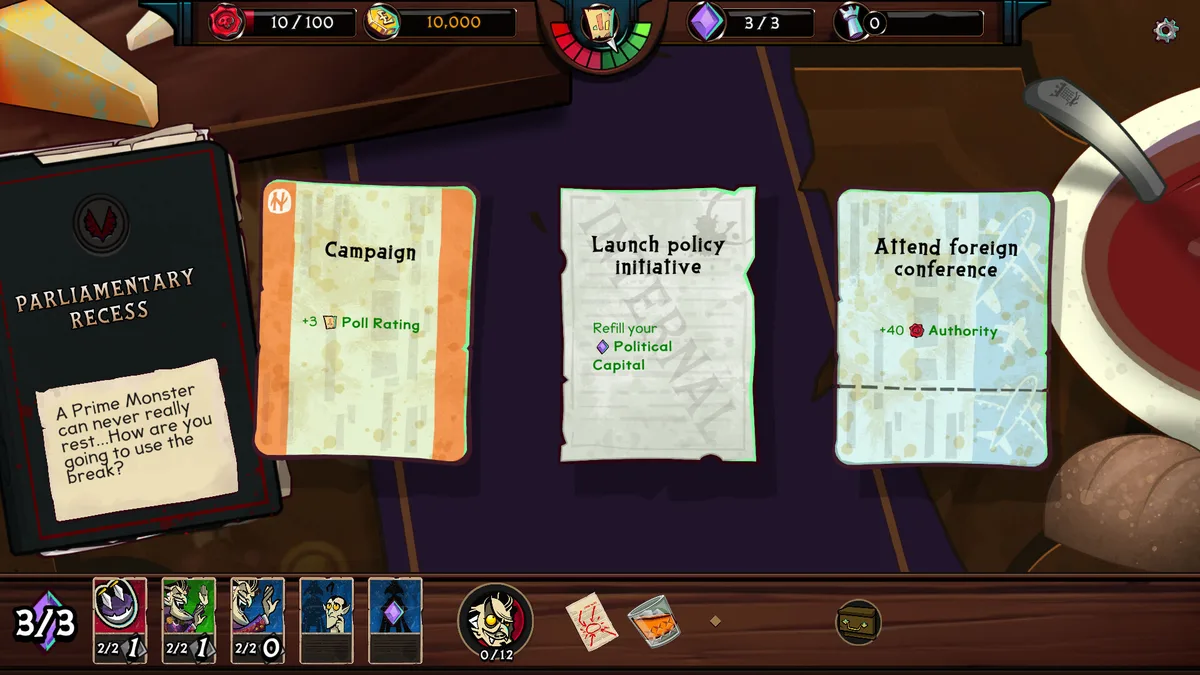 Refilling Political Capital at a Parliamentary Recess is one of the few reliable top-ups outside of exploiting cards in a live debate, which matters for a Capital-hungry build like Retort.
Two real failure modes. First: the setup sequence requires clicking through several steps every turn. The player who documented the all-pledges Retort clear called it "quite long to click through" before the engine is up. Fast Mode from Patch 1.2 helps, but this build has more per-turn overhead than most. Second: the Retort Tactic pool has some genuinely bad options. "Gain 3 Retort at end of turn" is widely flagged as one of the worst Tactics in the game. End-of-turn timing fires after the main stack resolves, so it adds nothing to the Provoke damage. Skip it when better conversion options exist.
Unity cards that make all MPs defend or increase defense stack well with this setup. If the run offers them, take them.
GODEEPER: The characters guide covers how Retort fits each character's archetype differently, including why Rotilda's Horde mechanics can accelerate the stack faster than straightforward provoke setups. Prime Monster Characters Guide: All 3 Builds and Who to Pick →
The Drumming Unity chain: Chopper's stacking passive
The Drumming combo is Chopper's strongest build and the reason his Unity archetype has a ceiling that most players never reach.
Three mechanics stack. Chopper assigns specific MPs to drum, which generates Unity passively at the end of each turn. Other MPs can be set to Frenzied, which adds bonus Unity every time any Unity is gained. Harness Anger, Chopper's Tactic, doubles the next Unity action's output and deals that same doubled amount as damage to the opposition.
Put together: drummers generate Unity, Frenzied MPs boost that total, then Harness Anger fires and doubles everything. The damage equals the doubled Unity total. A well-set-up Drumming turn flips several of your MPs while hitting the opponent's line hard. Both problems in one action.
It takes time to come online. Early turns go toward assigning MPs to Drum and setting the Frenzied condition, which costs card plays and Tactic investment. Before the engine is running, debates are rough. The mid-run is where it pays off. Several drumming, Frenzied MPs running simultaneously means Harness Anger turns do things no other build can match.
One non-obvious point: build your own party first, attack second. The Drumming passive scales with how many of your MPs are already generating Unity. Attacking early with a half-assembled drum line is just mediocre damage output. Wait, set up, then fire.
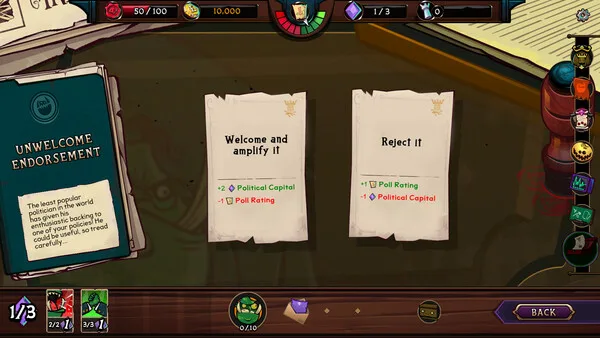 An event choice screen, not a live debate: "Unwelcome Endorsement" trades Poll Rating against Political Capital depending on which option you pick. Shown here for the resource trade-offs it illustrates, not the Drumming mechanic described above.
The weakness is opponent-specific. Enemies who clear your party, neutralize MP states, or strip Frenzied conditions directly kill the engine. Knowing which opponents do that matters more here than in the Retort loop, which is self-contained enough to survive most disruption.
The No-MP build: replacing coalition with cards
One r/PrimeMonster post, titled "I don't need MPs to win," documents what the game allows if you find the right cards and Tactics.
Specific cards generate authority and Political Capital directly, without requiring MP relationships. Coalition management, the system governing 30 representatives across 15 parties, just gets bypassed.
That matters because coalition management is genuinely expensive. Keeping useful standing with even 2-3 parties burns authority, capital, and poll-rating across multiple turns. A deck generating those resources on its own redirects all of that toward damage or other win conditions.
It's the hardest of the four builds to evaluate mid-run. The Retort loop has explicit math and identifiable Tactics. The No-MP approach requires recognizing independence-generating cards before the run is over, and it's not always obvious which cards qualify. The tips guide says "add cards only if they fill a specific gap." This build demands that more strictly than usual: a card producing authority without MP conditions is worth a lot, but only if you're actually replacing the coalition layer with it.
GODEEPER: For a comparable setup in a different roguelite where a single engine replaces the expected resource loop, the LegionBound advanced builds guide covers Endbringer setups that bypass the standard class synergy framework. LegionBound Advanced Builds: Endbringer Guide 2026 →
Practical take: once you know what independence-generating cards look like (authority listed as a direct effect, not a relationship modifier), start asking whether the run can skip the coalition layer entirely. A full No-MP run is a deliberate goal, not something that happens by accident.
All Pledges Elder Statesmonster: specific execution
The characters guide covers which character gives the best odds at Elder Statesmonster with All Pledges (Sucksworth, by community consensus). What it doesn't cover is what the runs actually look like.
The Little Clonker pledge is the hardest constraint. From the player who documented the all-pledges Retort clear: avoid debates against Abacus and Bonar when Little Clonker is active. Both opponents effectively empty your hand, which cuts off Capital-generating turns and makes Little Clonker's constraints compound into a loss. It's not that the pledge is unfair. It's that two matchups become nearly unwinnable when it removes hand access, and knowing which two ahead of time matters.
The Political Capital upgrade is the first thing to prioritize. Cards that raise Capital gain from 1 to 3 per exploitation change how many Tactics you can fire per session. For Chopper, Demand Defence is the specific card to hit. This upgrade doesn't matter much at normal difficulty, which is why the tips guide doesn't mention it. At Elder Statesmonster All Pledges, with no slack anywhere, it's Tactic availability versus Tactic starvation.
Authority is the slow bleed. No Recess means no passive recovery. Ghost Staff Blunder events cost authority and give nothing back. The player who cleared it put it clearly: "After early game this is what mainly will lose you the run." Keeping authority above the floor through active play isn't optional.
The early game at All Pledges has real luck dependency. MPs die at debate starts under certain pledges, and losing one who was voting with you shifts the debate math in ways that can't be fully managed. Everyone who cleared this took multiple attempts after already knowing the execution details.
Opponent-specific adjustments
Builds are static. Debates aren't.
Slime opponents multiply MPs in play. For the Drumming build, that's more targets but also more incoming hits if those MPs are aggressive. For Retort, more incoming attacks is fine, often good. Slime debates are where the Retort loop genuinely thrives.
Werewolf opponents eliminate your MPs if left unaddressed. That directly disrupts the Drumming build, since your Drum-assigned MPs are the ones you can't afford to lose. Against werewolves, flip the usual order: deal damage and convert early rather than setting up the drum passive. The Drumming rule "set up first, attack second" reverses here.
Charm-effect opponents can redirect your own cards or MPs. Against these, cards with fixed non-targeted effects are more reliable. The Retort loop is mostly immune to charm disruption, since the core mechanics are self-contained.
One matchup the Sucksworth community flagged specifically: the early-game opponent with strong authority removal. Before the damage engine is online, it's nearly unwinnable. The workaround is winning other debates by large margins early, which can unlock block Tactics that give indirect authority coverage. Having that buffer before hitting the authority-removal opponent is what makes the matchup manageable rather than run-ending.
Deck construction at advanced level
These builds require different drafting instincts than early-game play.
The worst mistake in the Retort build is drafting weak Retort Tactics to fill slots. "Gain 3 Retort at end of turn" has been called out specifically by the community as one of the worst Tactics in the game. End-of-turn timing fires after the main stack resolves, so it adds nothing to Provoke damage. At normal difficulty, a weak Tactic is just a weak Tactic. At Elder Statesmonster, every slot costs something.
For the Drumming build, draft in this order: Unity generation cards first, Frenzied-condition cards second, Harness Anger access third, damage output last. Reversing it is the most common error. Players who build damage first and add Drumming later find the setup time means the engine rarely comes online in the same debate where they need it.
A rule that applies across both builds: cards that interact with your existing engine are worth more than their face value. A card doing moderate damage that also sets the Frenzied condition on a Drum-assigned MP isn't a moderate-damage card. It's multiplying every future Harness Anger turn.
Key Takeaways
- Retort loop: free 3x4 defense per turn, convert to Retort, triple the stack, Provoke twice for 71+ damage. Needs no Political Capital. Discord items feed the stack faster.
- Drumming Unity chain: assign MPs to Drum (passive Unity per turn), set others Frenzied (bonus Unity on any Unity gain), fire Harness Anger to double the total and deal that as damage. Set up party first, attack later.
- No-MP build: cards that generate authority and Capital without requiring coalition management replace the relationship layer entirely. Worth building toward when the right cards appear.
- All Pledges Elder Statesmonster: avoid Abacus/Bonar under the Little Clonker pledge, upgrade Demand Defence to 3 Capital per exploitation, maintain authority actively, accept that early-game luck dependency is real.
- Never draft "gain 3 Retort at end of turn." Its timing is wrong for the Retort engine.
- Werewolves disrupt Drumming setups specifically. Against them, prioritize early conversion over passive generation.
Related Reading
- Prime Monster Tips: 11 Things the Game Hides: exploitation floor, four-resource management, deck size discipline, and Patch 1.2 changes. Start here if the advanced builds feel out of reach.
- Prime Monster Characters Guide: All 3 Builds and Who to Pick: deep breakdown of which character suits each build archetype, and why Sucksworth gives the best Elder Statesmonster odds.
- Prime Monster: Card Roguelike From The Sexy Brutale Devs: overview of the game, the political satire premise, and the Very Positive Steam data.
- Black Jacket Guide: Blackjack Roguelite Tips for 2026: another card roguelite where a narrow late-game build path outperforms generalist play by a wide margin.
- LegionBound Advanced Builds: Endbringer Guide 2026: comparable advanced build structure from a different roguelite, useful for thinking about when to commit to a single engine.
References
- Prime Monster on Steam: store page, 307 reviews at Very Positive (83%), 77 achievements, free demo
- r/PrimeMonster community: player-documented builds including the all-pledges Retort clear and No-MP win run
- Cavalier Game Studios Patch 1.2 notes: Fast Mode and action cancellation additions referenced in execution sections
Frequently Asked Questions
What is the Retort combo in Prime Monster? The Retort combo generates 3x4 free defense every turn, converts that defense to Retort using a Tactic, then triples the stack to reach a minimum of 36 Retort before any opponent interaction. Two Provoke plays then fire for 71 or more damage per turn. The build requires no Political Capital to sustain, making it uniquely resistant to Capital drain pressure.
How does the Drumming Unity chain work in Prime Monster? Chopper's Drumming combo assigns MPs to drum, which generates Unity at the end of each turn passively. Frenzied MPs then add bonus Unity every time any Unity is gained, stacking multiplicatively. Harness Anger doubles the next Unity action and simultaneously deals that same amount as damage to the opposition.
What is the No-MP build in Prime Monster? The No-MP build uses card and Tactic chains that generate authority and Political Capital directly, bypassing coalition management entirely. Specific cards that produce authority without requiring MP relationships are the core. Once identified, these cards are worth drafting above most alternatives because they replace an entire game system.
How do you beat Elder Statesmonster with All Pledges in Prime Monster? The community consensus from players who have cleared it: avoid debates against Abacus and Bonar when the Little Clonker pledge is active, as both opponents effectively remove your hand. Upgrade cards that raise Political Capital gain from 1 to 3 (Chopper's Demand Defence is the priority upgrade). Maintain authority aggressively because Recess is unavailable and Blunder events cost authority without recovery.
Can Rotilda De Cay run a Retort build in Prime Monster? Yes. Retort works across all three characters. On Rotilda, the Horde mechanic provides an additional acceleration layer: Horde MPs absorbing hits feed the Retort stack faster than normal provoke-based setups. Her ceiling with a properly assembled Retort deck may actually exceed Chopper's because the Horde generates more consistent incoming hits.
Which Discord items help the Retort build in Prime Monster? Discord items are consumables that cause opponents to attack you, which directly feeds the Retort counter. Two Discord items in a single debate session were enough for a documented 282-damage Retort hit.
What cards should you prioritize removing from the deck in Prime Monster? Any card that generates neither damage nor Political Capital on its most useful play is a removal candidate once the core combo is established.
Was this guide helpful?
About the author

Senior Critic & Analyst
Former game data analyst turned critic with 11 years covering indie and mid-tier games. Based in Austin. Runs spreadsheets on games most people just play.
- 11 years games criticism
- Former game economy analyst
- Roguelike and strategy specialist
Keep reading
Disclaimer
This article is published for informational and entertainment purposes. It does not constitute professional financial, legal, or technical advice. Game performance, online services, patch schedules, and store listings change. Verify critical details (pricing, system requirements, regional availability) with publishers and storefronts before you buy. Affiliate links, where present, help support our editorial work and are labelled in our affiliate disclosure.
Comments
Loading comments…