
GameBrief · General
Prime Monster Tips: 11 Things the Game Won't Tell You
Reviewing
Prime Monster
Cavalier Game Studios · Cavalier Game Studios / Rekoup
Prime Monster tips tend to get one paragraph in most write-ups: exploit cards, don't let resources drop, Chopper is the beginner pick. None of that prepares you for the specific ways Cavalier Game Studios buried the actual mechanics behind a parliament-themed exterior, including a Unity meter that decides debates and that barely anyone explains. Very Positive at 82% across 297 reviews as of this update, but most of those reviewers got there after losing three or four runs in ways they couldn't explain.
TL;DR: Prime Monster tips for new players: (1) exploit at least 1 card per turn as a floor, not a ceiling, (2) Tactics are your win condition -- without Political Capital they never fire, (3) keep the deck under 15 cards for the first three runs, (4) the Unity meter, not raw damage, is what actually flips MPs to your side, and overfilling it triggers a character-specific bonus the game never explains, (5) Patch 1.3 (July 2, 2026) added Sucksworth Bat tactics and nerfed the old Retort build, so guides written before that date are running on stale numbers, (6) avoid Legacy pledges until the base game feels routine.
What do Prime Monster tips actually cover? (quick answer)
Prime Monster tips address the card exploitation system, the Political Capital floor, deck size discipline, pledge timing, and what the game actively hides in its UI. The biggest early-run failure is not spending enough time exploiting cards -- players default to using everything for its effect, never build Capital, and run out of Tactics at the moment they need them most. That single mistake accounts for most first-run failures.
The exploitation floor: one card per turn minimum
Every card in Prime Monster offers two paths. Play it for its listed effect, or exploit it to fill your Political Capital bar. The game mentions this, then most players promptly forget it and play every card for effect.
The result is a Capital bar that sits near zero, Tactics that never fire, and a session where parliament just grinds you down. Tactics are the highest-damage plays in the game. A run where they fire consistently feels like a completely different game from one where they don't.
One exploitation per turn is the floor, not the target. It's the minimum to keep the Capital bar from stagnating. Two per turn starts building toward real Tactic availability. Three per turn is aggressive, but there are turns where all the card effects are low-value and you exploit everything -- those turns are usually correct.
The specific decision: if a card's effect is urgently needed right now (authority is critically low, a specific vote is about to fail), play for effect. Otherwise, default to exploitation unless you have a strong reason not to.
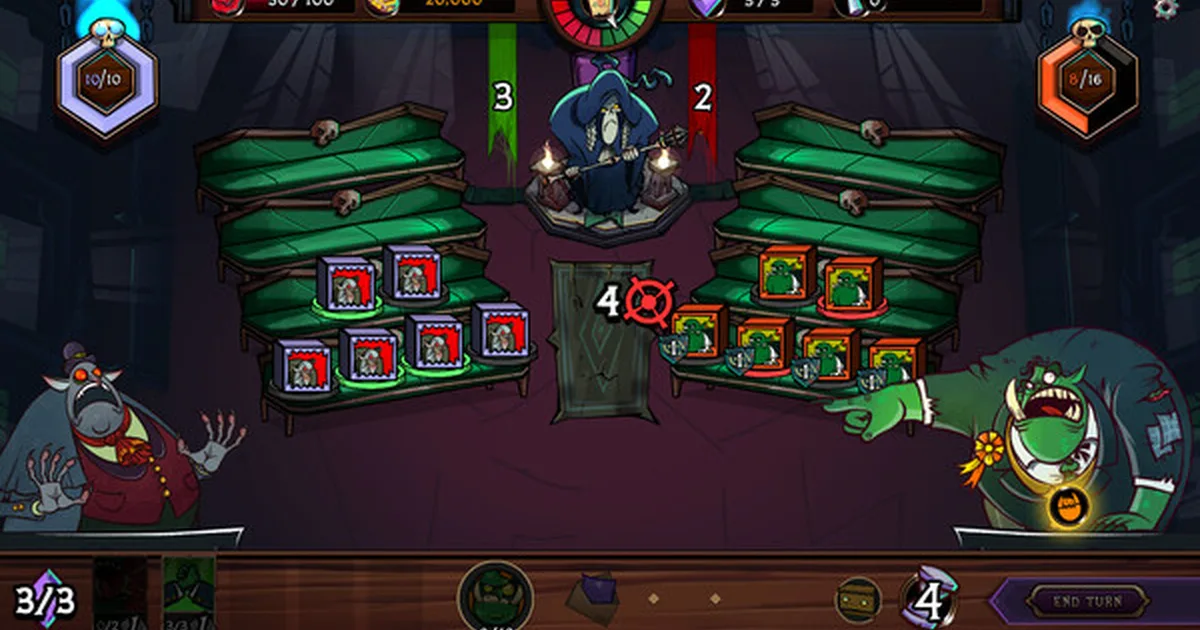
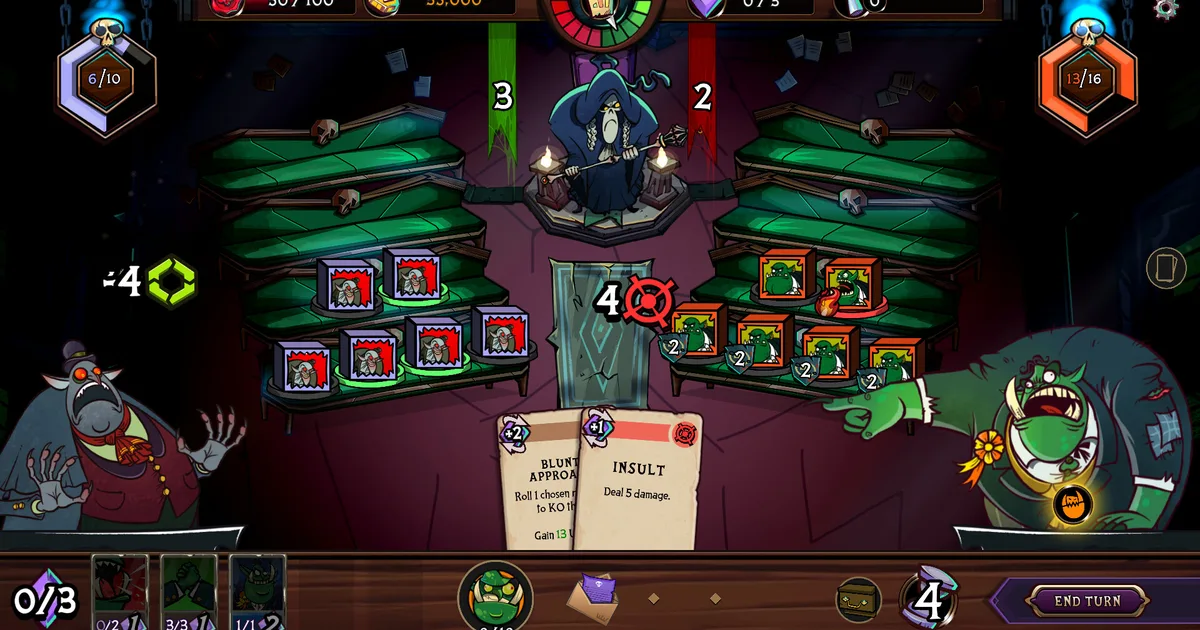
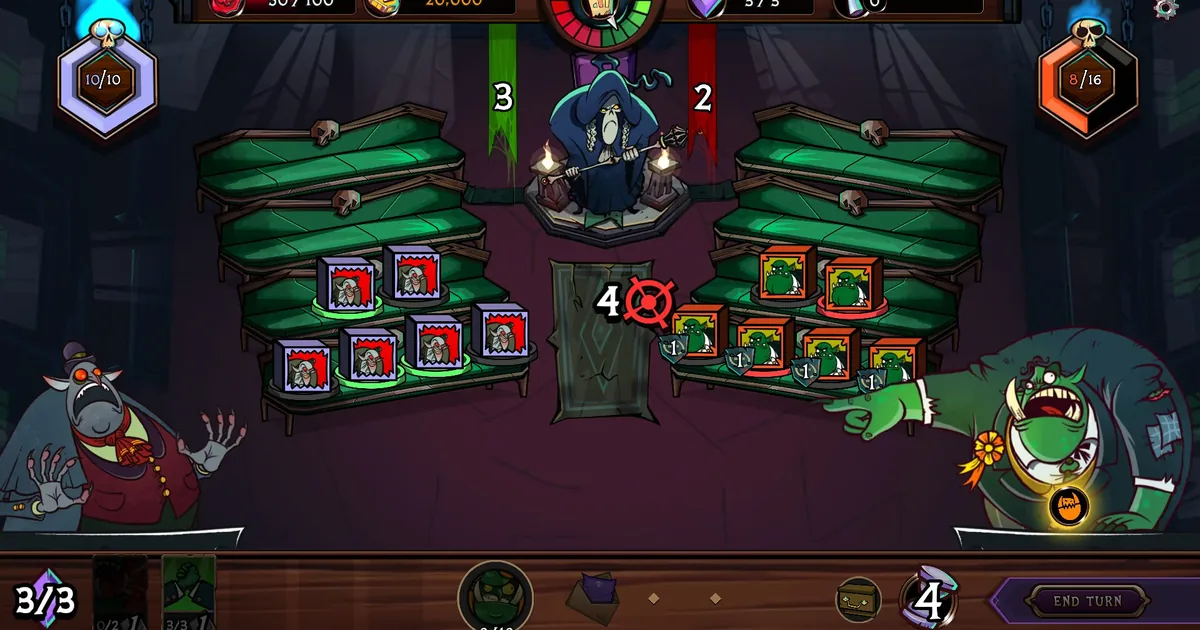
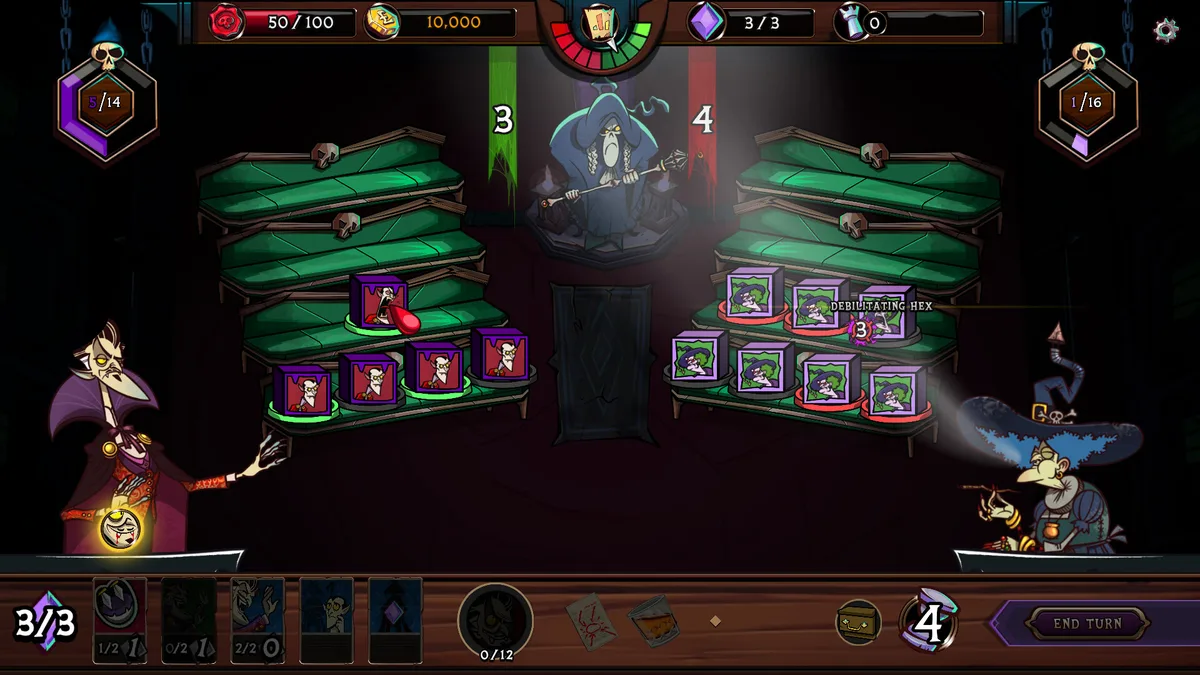 A live debate: both sides' card stacks are visible, and the Debilitating Hex effect shown here is the kind of Tactic that only fires when Political Capital has actually been maintained.
The four-resource system and where it actually breaks
Four resources running simultaneously is the thing most guides mention in passing and then don't explain. Personal authority, political capital, poll rating, and cash all track independently and each has its own failure state.
Authority is the most readable. When it drops, you feel it immediately in how other MPs respond. Poll rating creates pressure that's less visible turn-to-turn but compounds across sessions. Cash feels optional until specific cards and bribes become suddenly necessary. Political capital is the hidden engine, and it doesn't build on its own in any meaningful amount.
The failure pattern in early runs: a player watches one bar (usually authority), lets the others drift, then hits a cash or poll-rating crisis with no Capital left to spend on Tactics either. All four bars just need a minimum threshold -- none of them need to be maxed, they just can't hit zero.
Scan the panel at the start of each turn before you decide what to play. The bar that's lowest relative to its safe floor is the priority. That one habit catches most of the drift before it turns into a crisis.
There's a fifth system underneath all four of those bars that most write-ups skip entirely: the Unity meter. Every MP in a debate carries their own Unity gauge, and it fills as you play Unity-generating cards and Tactics. When an MP's gauge fills completely, that MP flips allegiance: a neutral MP becomes a supporter, and an enemy supporter drops to neutral first before eventually switching sides. This is the mechanism that actually wins or loses a debate. Political Capital and damage matter because they buy you the Tactics that move Unity, not the other way around.
Push Unity past the cap and you trigger Unity Overfill, which pays out differently per character: on Chopper it charges his Harness Anger tactic (the closest thing he has to a big payoff move), on Sucksworth it stacks a damage bonus that keeps growing the more you overfill, and on Rotilda it draws you an extra card. None of this shows up anywhere except a small on-screen flash the first time it happens, which is exactly why new players read Political Capital as the whole resource picture when Unity is quietly running the debate underneath it.
The Shop deserves a specific mention too, since it's easy to click through without reading closely. It offers five slots per visit: the first two are always items, the last two are always staff, and the middle slot rotates randomly. You can only carry three items by default, so a weak consumable filling one of those slots is a real opportunity cost, not a free pickup.
GODEEPER: Die in the Dungeon runs a similar dual-use economy where dice can be played or banked. If the exploitation decision in Prime Monster interests you mechanically, the Die in the Dungeon tips guide breaks down how the board economy functions under a comparable resource trade-off. Die in the Dungeon Tips: Dice, Board, and Build Basics →
Deck bloat: the failure mode that's the same in every deckbuilder
Prime Monster is a deckbuilder. Deckbuilders have a consistent failure mode: adding too many cards too fast. A deck of 25 cards draws worse than a deck of 14 focused ones. The math doesn't change because the cards are satirical instead of combat-based.
The specific trap here: Prime Monster's cards are funny. "Decriminalise Arson" and "Allow Same Hex Marriage" are cards worth picking up for the premise alone, and players do exactly that. Five sessions later, those cards are arriving in hand during completely wrong situations.
Add a card only if it fills a gap in what the deck can't currently handle, or if it synergizes with a Tactic you're already building toward. "This might be useful later" is the sentence that builds bad decks in every deckbuilder ever made. Prime Monster is not an exception.
Under 15 cards for the first three runs. Under 20 for the next several. The game starts rewarding smaller, more coherent decks well before you have enough experience to evaluate a 25-card pile correctly.
What Patches 1.1 through 1.3 actually changed (matters for new players)
Patch 1.1, released four days after launch, addressed the bulk of early balance and bug reports from the first wave of players. The patch notes say the team "read every word" of early reviews and forum posts, and the changes reflect it: multiple cards were rebalanced, specific MP behaviors were adjusted, and edge cases in the vote system were fixed.
Patch 1.2 added two things that matter specifically for new players. Fast Mode: you can now toggle off all animations, pauses, and delays in Settings at any time mid-run. Early reviews complained that parliamentary speeches got tedious on repeat runs, and Fast Mode was the direct fix. Turn it on after your first two or three runs once you actually know what's happening visually.
Action cancellation: if you play a card or Tactic and it produces a follow-up choice, you can back out with the X in the top-right corner. If you're still figuring out what cards do before committing to them, this removes the "wait, I didn't mean that" problem. Use it freely.
Patch 1.3, which shipped July 2, 2026, is the current build and adds real content on top of the polish. Your very first Red Box decision now grants a Tactic choice instead of nothing, so you're not sitting on zero Tactics through your opening turns anymore. You can hold right-click on any Tactic to preview its upgraded form before spending resources toward upgrading it. Sucksworth got two new Bat-transformation Tactics, "Flight Response" and "High-Fliers," both of which turn an MP into a Bat MP. Rotilda now starts every run with a Shock Collar item instead of Smelling Salts. Term 2 can also throw a new opponent pairing at you: the Earl of Dirtby and Trollpole. Underneath all of that, dozens of individual Tactics got rebalanced across all three characters, including a meaningful nerf to Chopper's Bait tactic that directly affects the Retort build covered below.
If you played the demo or an early build before Patch 1.3, expect the opening two or three turns of every run to feel different now that the first Red Box decision hands you a Tactic instead of nothing.
Sucksworth's Bloodlust stacking: how his Unity Overfill bonus actually works
Viscount Sucksworth is the character the Prime Monster subreddit can't stop talking about, and the vampire theme isn't just cosmetic dressing. His actual identity runs on Unity generation and Bat-transformation Tactics (Loom, Party Animals, and the two Patch 1.3 additions, Flight Response and High-Fliers) rather than a single cooldown-gated finisher.
The specific payoff: when Sucksworth overfills Unity, he stacks a bonus damage effect that keeps growing the more times he overfills in a single debate, confirmed by community testing on the Steam forums. That's a different mechanic than a damage-threshold "ultimate" -- it rewards a Unity-heavy deck that overfills often, not a single burst turn built around raw damage cards. If you're building Sucksworth around damage cards instead of Unity generation, you're underusing his actual strength.
The build path is narrower early on than it looks. Unity-gain Tactics like Loom and Party Animals both got buffed in Patch 1.3, Loom's Unity gain went from 7 to 12 and Party Animals from 3 to 6, which makes the overfill loop noticeably faster to trigger now than it was at launch. If a run doesn't offer those Unity-gain cards, Sucksworth still underperforms compared to Chopper's more forgiving authority approach.
Three completed Chopper runs before touching Sucksworth is still the community consensus threshold. At that point you'll know the exploitation loop and the Unity mechanic well enough to evaluate whether a given run's card offerings can actually support an overfill-heavy Sucksworth build.
The Retort build: what the community actually found
The Prime Monster subreddit has documented Retort builds turning into large single-turn damage swings by stacking Retort with cheap generation Tactics before releasing it. Retort is a real, named mechanic: Tactics like Bait, Pre-Prepared Lines+, and Diss Artist generate or apply it, and Diss Artist specifically was changed in Patch 1.3 to apply its Retort at the start of the turn instead of the end, which changes how far a stack can grow before it fires.
Worth knowing before you go looking for the numbers in older threads: Patch 1.3 cut Chopper's Bait tactic, one of the main Retort-generation tools, from 4 Retort gain down to 2 (the upgraded version dropped from 6 to 3). That's roughly half the generation rate the build relied on before July 2, so treat any specific damage total you find in a pre-Patch 1.3 post as outdated rather than a target. The core idea, stack Retort with cheap generation Tactics, then release it with a Retort-applying card, still works. The scale it can reach on the current build is smaller than what older community posts describe.
Rotilda's Horde stacks pair with Retort conceptually, since Horde MPs revive rather than dying outright, which gives a Retort-focused deck more turns to keep building a stack before it has to fire. Retort builds work across all three characters, but they're not something to aim for on your first few runs.
"Would this card enable Retort?" is worth asking once you've seen the resource loop enough times to evaluate the answer, but don't build your first three runs around chasing a specific pre-Patch 1.3 damage number.
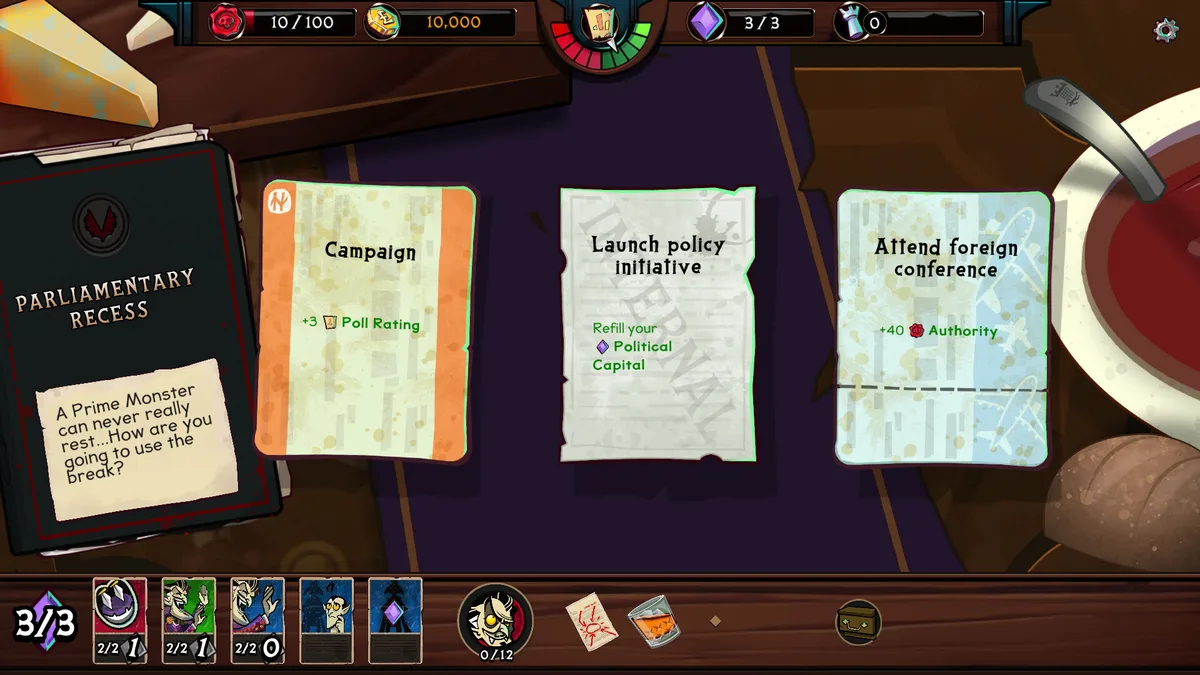 Between-session events like Parliamentary Recess are where resource decisions compound. Refilling Political Capital here is often worth more than the flashier Authority or Poll Rating options.
The Shrieker of the House: don't learn it the hard way
The game lets you kill MPs. The Shrieker of the House exists to catch you if you do it carelessly. Cards involving direct physical harm to other MPs trigger a detection check -- if caught, there are consequences.
The detection window is deliberately opaque. The game doesn't explain precisely when the Shrieker will catch you versus when you'll get away with it, which means early-run players treat aggressive removal cards as either a free resource or an unpredictable disaster. Neither reading is accurate.
Until you have two or three runs completed, stay away from cards that harm MPs directly. Authority and poll-rating plays remove threatening MPs from relevance without triggering the Shrieker at all. Once you understand the Shrieker's behavior from observation, aggressive removal becomes a risk-managed resource rather than a lottery.
Legacy pledges: treat them as post-mastery content
Legacy pledges let you make voluntary commitments to the electorate that raise difficulty in exchange for public support. They're for players who've already figured out the base game and want harder problems.
The mistake new players make: seeing the public support gain and adding a pledge without knowing which resources they can afford to constrain. A pledge that looks manageable at the start becomes a compounding problem once the four bars are all fluctuating and you've got no slack left to honor it.
Three complete runs before any pledge. Five is more honest. The community consensus from the highest-difficulty thread (Elder Statesmonster + All Pledges) is that Sucksworth is the most consistent character for that combination, because his per-turn ult gives more consistent output under constrained conditions. But that build is completely inaccessible to someone who hasn't mastered the base game's exploitation loop first.
GODEEPER: For another card-based roguelite where pledge-style escalation systems add replay value once the base loop is mastered, the Black Jacket guide covers the Journey difficulty system in detail. Black Jacket Guide: Blackjack Roguelite Tips for 2026 →
Coalition strategy: pick 2-3 parties and commit
Thirty representatives across 15 political parties means a lot of competing interests. Most early runs attempt neutrality -- a few favors to each party, no specific commitments. Neutral runs usually fail.
Neutrality costs more resources than it saves. Maintaining minimal standing with all 15 parties burns authority, capital, and poll rating simultaneously without building the depth with any single party needed to get reliable votes. By mid-run, the neutral player is behind on all four bars while a player who committed to a 2-3 party coalition has actual allies working with them.
Check the opening parliament composition before committing to a resource strategy. If the majority leans toward parties that work with your character, build toward them. If your natural allies are in the minority, figure out early whether to fight for that coalition or work with what's actually available. The party composition changes each run, and that variation is most of where the replayability actually lives.
The "no MPs" approach: a real advanced strategy
One community post is titled "I don't need MPs to win" and it's not a troll. Prime Monster has enough design space that specific card and Tactic chains can generate authority and Capital independently of coalition support, making MP relationships secondary rather than essential.
It's not the right approach for learning the game -- you need to understand normal coalition play before you can evaluate what you're replacing it with. But it's worth knowing the line of play exists. Cards that generate authority and Capital without requiring MP relationships are worth more than their face value once you understand what they're actually replacing.
Key Takeaways
- Exploit at least one card per turn. Two is better when the session is stable.
- Check all four resource bars before each play. The one you ignored is the one that ends the run.
- Unity, not raw damage, is what actually flips MPs to your side. Overfilling it triggers a per-character bonus the game never explains on-screen.
- Under 15 cards for your first three runs. The funny cards are usually wrong for the deck.
- Patch 1.3 (July 2, 2026) nerfed the Bait tactic that powered the old Retort build and added new Sucksworth Bat tactics, so pre-patch guides and posts are describing a different balance than what's live now.
- Patch 1.2's Fast Mode is worth turning on after run two or three, once you know what's actually happening.
- Skip direct-harm cards for a few runs until you've seen how the Shrieker's detection works.
- No Legacy pledges until the resource loop feels comfortable. Three runs minimum. Five is more honest.
- Pick 2-3 parties and commit. Trying to stay neutral with all 15 runs you out of resources before mid-run.
- Sucksworth with All Pledges on Elder Statesmonster is a real build, but it assumes you've already mastered the exploitation loop and the Unity mechanic.
Related Reading
- Prime Monster Complete Guide: Characters, Decks, Tips (2026): the full hub linking every Prime Monster guide on this site, from characters to deck tier lists.
- Prime Monster Characters Guide: All 3 Builds and Who to Pick: deep breakdown of Chopper, Sucksworth, and Rotilda's build paths, what differentiates them mechanically, and what the community discovered about each character's ceiling.
- Prime Monster: Card Roguelike From The Sexy Brutale Devs: the overview article covering the premise, what makes the political satire mechanics work, and whether Very Positive at 83% holds up after launch patches.
- Prime Monster Coalition Guide: Best Party Combos 2026: which character combos actually synergize when you're building a full coalition, not just a solo run.
- Die in the Dungeon Tips: Dice, Board, and Build Basics: another deckbuilder with dual-use resources; the "exploit or play" decision maps closely to Prime Monster's card exploitation loop.
- Best Roguelike Games 2026: 6 Picks for Every Budget: genre context for where Prime Monster sits among other deckbuilders and roguelites releasing this year.
- Prime Monster Advanced Deck Guide: 4 Combos That Win: Prime Monster advanced deck strategies: Drumming Unity chain, Retort loop, No-MP build, and All Pledges.
References
- Prime Monster on Steam: store page, demo download, review data (82% positive, 297 reviews), and system requirements
- Cavalier Game Studios patch notes hub: official changelogs for Patch 1.1, 1.2, and 1.3, including full per-Tactic balance changes
- Prime Monster Unity Overfill discussion: community thread confirming the per-character Unity Overfill payoff (Chopper's Harness Anger charge, Sucksworth's damage stacking, Rotilda's extra card draw)
Frequently Asked Questions
What are the four resources in Prime Monster? Personal authority, political capital, poll rating, and cash. Each tracks independently and each has its own failure state. Political capital is the most mismanaged in early runs because it requires active exploitation of cards to generate rather than building passively. Letting any one resource hit zero creates a crisis that compounds into the next parliament session.
How does the card exploitation system work in Prime Monster? Every card in Prime Monster can be played for its listed effect or exploited to generate Political Capital instead. The exploitation path is the one most new players skip, which means their Tactics bar never fills. A reliable floor: exploit at least one card per turn unless an effect is urgently needed. This keeps the Capital bar functional without sacrificing too many plays.
What did Patch 1.2 add to Prime Monster? Patch 1.2 added Fast Mode (speeds up all animations and reduces delays, toggleable in Settings at any time) and action cancellation (lets you back out of a played card or Tactic if it produces a follow-up choice, using the X button in the top-right). Both address the pacing complaints in early player reviews.
Which character should Prime Monster beginners start with? Chopper Badstone (Orcs-4-U) is the best entry point. His self-damage cards charge his Harness Anger tactic, and he leans on authority and cash rather than a steep learning curve. Sucksworth's Unity Overfill damage stacking needs more system knowledge to use well. Start with Chopper, get two runs done, then switch.
What is the Retort build in Prime Monster? Retort stacks a damage counter using specific Tactics like Bait, Pre-Prepared Lines+, and Diss Artist, then releases it as burst damage. Patch 1.3 cut Bait's Retort generation roughly in half (4 to 2), so older community damage numbers no longer apply at that scale. The core loop still works across all three characters.
What did Patch 1.3 add to Prime Monster? Patch 1.3 (July 2, 2026) gave Sucksworth two new Bat-transformation Tactics, let Rotilda start runs with a Shock Collar item, added a new Term 2 opponent pairing (Earl of Dirtby and Trollpole), and made your first Red Box decision grant a Tactic. It also rebalanced dozens of Tactics across all three characters.
How does the Unity meter work in Prime Monster? Unity is the per-MP meter that actually decides debates: filling it flips that MP to your side, and enemy supporters drop to neutral first. Overfilling it triggers a character-specific bonus (Chopper charges Harness Anger, Sucksworth stacks bonus damage, Rotilda draws a card), something the game never explains on-screen.
When should I take Legacy pledges in Prime Monster? Not on your first three runs. Legacy pledges voluntarily raise difficulty in exchange for public support, but new players don't yet know which resources they can constrain. The community consensus from the Elder Statesmonster thread is that Sucksworth with All Pledges is the most consistent high-difficulty build, but that approach is meaningless to someone still learning the base game.
How does the Shrieker of the House work in Prime Monster? The Shrieker enforces parliamentary rules around direct violence against other MPs. Cards that physically harm opponents carry a risk of being caught by the Shrieker, which triggers consequences. The detection window is not fully explained in the game. Until you have three or four runs completed, stick to authority and poll-rating plays for MP removal rather than direct harm.
Does Prime Monster have a free demo? Yes. A free demo is available on the Steam page for Prime Monster (App ID 3214480). The demo covers the card exploitation system and the four-resource loop well enough to judge whether the political satire tone works for you. The demo was updated before launch with additional balance changes and new Tactics.
Was this guide helpful?
About the author

Games Critic
Games writer and reluctant optimist who has reviewed over 400 titles across 9 years. Irish, currently in Berlin. Has strong opinions about tutorial design.
- 400+ games reviewed across 9 years
- Platformer and horror specialist
- Narrative design focus
Keep reading
Disclaimer
This article is published for informational and entertainment purposes. It does not constitute professional financial, legal, or technical advice. Game performance, online services, patch schedules, and store listings change. Verify critical details (pricing, system requirements, regional availability) with publishers and storefronts before you buy. Affiliate links, where present, help support our editorial work and are labelled in our affiliate disclosure.
Comments
Loading comments…