
GameBrief · General
Gambonanza Review: Chess Balatro or Something Better?
Gambonanza review: capture every piece on the board or lose the run. Blukulélé's chess roguelike earns the Chess Balatro tag, with real caveats at 1.0.

Reviewing
Gambonanza
Blukulélé · Sidekick Publishing, Stray Fawn Publishing
Score
Reviewed build: 1.0
Pros
- Documented Gambits generate new synergies across every run without feeling scripted
- Reserve system and tile upgrades add board-state depth chess fundamentals alone can't reach
- Crumble Mode forces aggressive captures: no stalling loops, no time-wasting
- 200-item collection screen gives long-run progression a concrete target
Cons
- Stage boards repeat identically on revisit: low procedural variance hurts replayability past hour ten
- Unskippable animations (players report 7s per gacha open, 15s per boss cutscene) slow the pace
- No undo button means a misclick permanently costs you a piece mid-run
Verdict
An inventive chess roguelike that earns its Chess Balatro comparisons: the gambit system is genuinely creative and the board-crumble pressure is distinct, though repeated stage layouts and unskippable animations are real friction at launch.
Every Gambonanza review has to address this first: changing chess's win condition from "capture the king" to "capture every piece" sounds minor. It isn't.
I logged 11 runs in three hours. That's not enthusiasm: that's how fast rounds resolve. That pace is the design.
Gambonanza review: key takeaways
- Developer: Blukulélé | Publisher: Sidekick Publishing, Stray Fawn Publishing
- Release: May 1, 2026 | Platforms: PC, Mac, Linux
- Price: check Steam for current price
- Run length: 20-40 minutes per run; 15-25 hours to 200-item collection completion
- Review score: Mostly Positive on Steam (75.7% positive across 1,544 reviews as of this writing)
- Scope: dozens of Gambits across a 200-item Collection spanning six categories
Gambonanza overview
Blukulélé is an independent studio. Gambonanza is their release under the Sidekick Publishing and Stray Fawn Publishing banner: a combination that placed it alongside Die in the Dungeon in a curated Dice & Checkmates bundle sale at launch. The co-marketing isn't accidental. Both games are short-session roguelikes built around modifiers that compound across a run, and both released within a day of each other.
The Gambonanza premise: chess, but the win condition has been flipped. In standard chess, the king's capture ends the game. Here, you must clear every enemy piece from the board to advance. That rule change eliminates the most fundamental chess tactic: sacrifice. Trading a pawn to open a diagonal, giving up a bishop to fork the king: these are classic moves that become liabilities in Gambonanza. Every piece you lose is gone permanently from your collection for that run.
The community's "Chess Balatro" comparison appeared within hours of launch and earned its legs quickly. Both games use escalating rule modifiers (Gambits here, jokers in Balatro) to build combinations that feel discovered rather than designed. Where Gambonanza diverges is the board-state pressure: you aren't just building a high-scoring hand. You're managing spatial relationships against a board that fights back.
Gambonanza review: gameplay
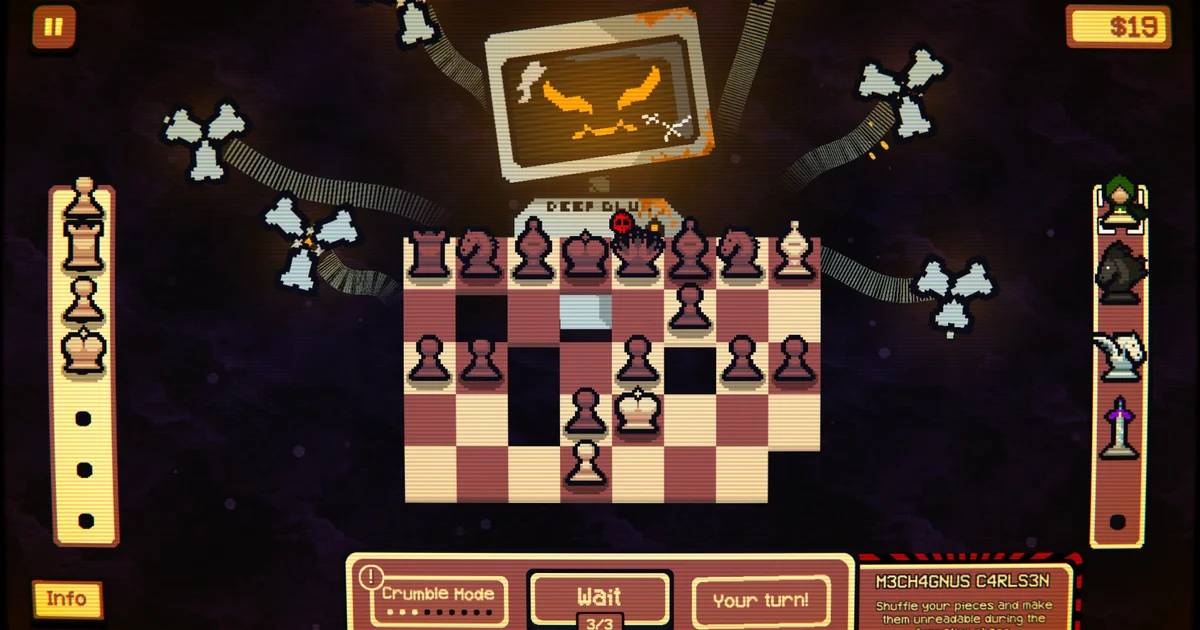
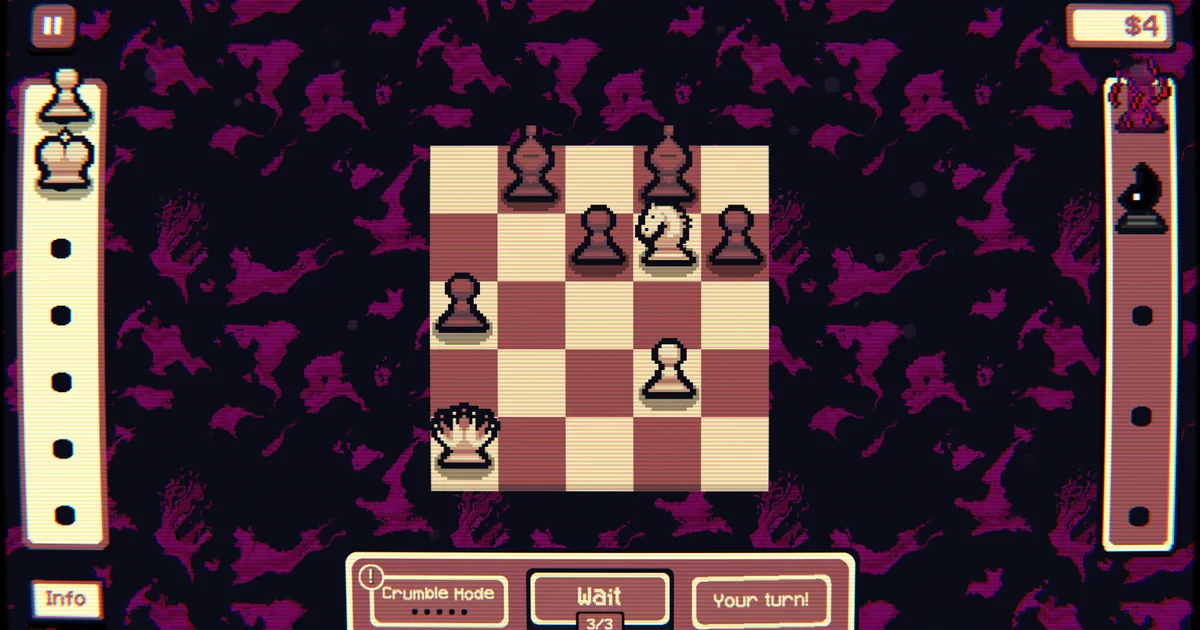
You drop into a board (smaller than standard chess) and pieces alternate turns. You capture all enemies. The board tracks a counter called Crumble Mode: waste too many consecutive moves without capturing anything and the board degrades from the edges, shrinking your options. The counter runs to 3/3 before the board starts crumbling: three stalled turns is your entire margin. It's not a death timer. It's a commitment meter that forces aggression even when the position isn't clean.
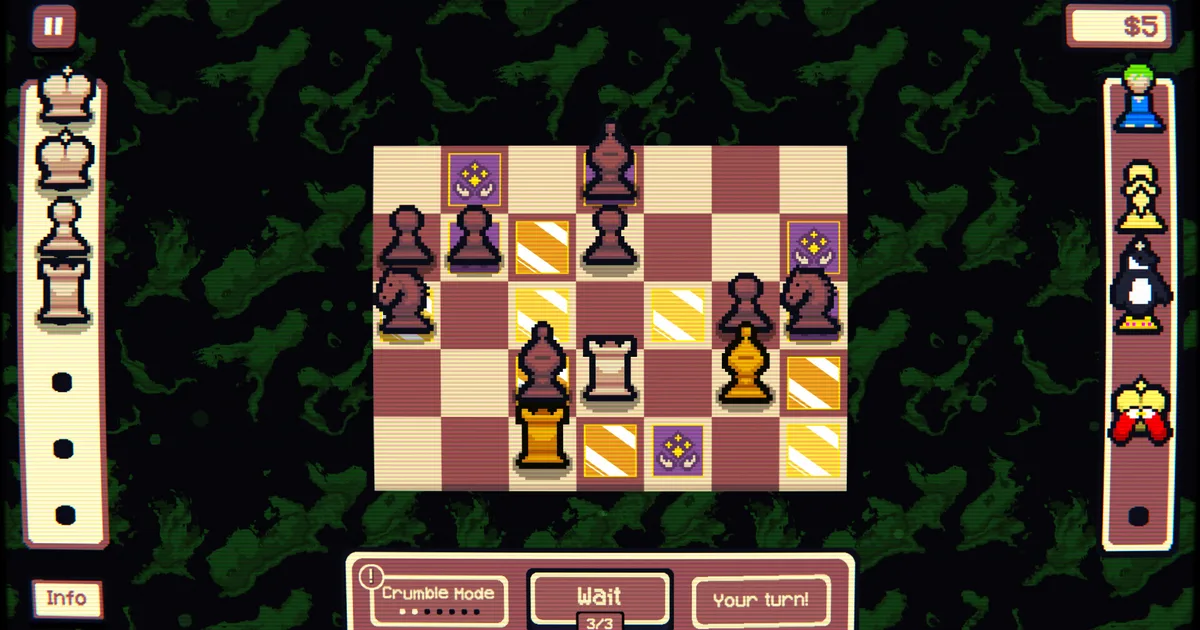
The reserve system is where Gambonanza actually separates from chess. Two column panels run along the sides of the board. Pieces held in reserve aren't on the board; they can be deployed on your turn at a position of your choosing. Standard chess pieces are always visible and always in play. Gambonanza's reserve lets you hold a knight off-board, wait for an enemy to step into fork range, and drop it back in at the correct moment. Late-game Gambit builds use the reserve to set up chains that wouldn't be possible if every piece were always present.
Tile upgrades add a third layer. The shop between rounds sells board enchantments: ghost tiles that trap passing pieces, gold tiles that convert enemy captures into currency, blessing tiles that buff pieces on contact. "Max Piece on Board" is an upgradeable stat: more pieces on the field means more captures available, but also more targets the enemy can use.
What doesn't work: the Crumble Mode pressure that creates urgency in theory creates opacity in practice when the enemy AI doesn't signal its intentions clearly. At higher stages, some losses read as positional bad luck rather than readable mistakes.
The stage boards are authored, not procedurally generated. Players who push past ten hours report replaying identical board configurations across runs. For a roguelike, this is a meaningful caveat: the system that makes each Gambit combination feel discovered works best when the underlying board hasn't been memorized.
Animation timing is a documented issue: players report 7 seconds per gacha item opening and 15 seconds per boss introduction cutscene, neither skippable. At eleven runs per session, those seconds accumulate. It's the most common complaint in the negative reviews and the clearest patch target.
GODEEPER: Gambonanza sits in the same 2026 roguelite wave as Die in the Dungeon and All Hail the Orb (the roundup breaks down how all three compare by price, depth, and who each one is for. Best Roguelike Games 2026) 6 Picks →
Gambits and progression
The Gambits are the content that justifies the gambit-focused pitch. These aren't minor percentage boosts. Thunder's Gambit turns pawn captures into a free extra turn. Chemist's Gambit copies your first triggered tile onto a random one, turning a single good placement into a repeating asset. Falling Crown's Gambit turns a safe wait into a pawn promotion. Each Gambit changes movement rules, capture conditions, or tile behavior in a way that reshapes how a run plays, not a flat stat boost.
The Collection screen tracks 200 unlockable items across six categories: Gambits, Pieces, Tiles, Enemy Modifiers, Bosses, and Strains. At three hours in, 109 of 200 were unlocked. The locked slots (visible as chained black squares on the collection grid) give the game its long-term direction without explicitly stating "do this next."
Caption: The collection screen at roughly three hours in. Six categories, 200 items total: the chained locked slots show how much content sits past the beginner stage.
The shop between rounds uses a coin economy. You earn currency during boards, spend it on rerolls, piece upgrades, or board enhancements. The economy is right-sized for the run length: frivolous spending on minor piece upgrades leaves you underpowered for the stage boss, but hoarding through a bad board is a different mistake.
Caption: The inter-round shop at Stage 2. Kev Borclick's STASIS ability is shown bottom-left: knowing the boss mechanic before you spend changes which upgrades are worth buying.
Kev Borclick, one of the game's bosses, selects 2 of his own pieces each turn and applies STASIS to them, blocking those pieces from capture until enough waits remove the state. Knowing this before you shop for that stage is the correct adjustment, and boss order isn't fixed between runs, so check the preview rather than assuming which boss is next.
Queens remain the strongest piece type at baseline. Gambit builds that center other pieces can outperform a queen-heavy approach in specific combinations, but the queen baseline is the safest default when a run's Gambit sequence hasn't clarified a stronger direction. This is a different problem than Balatro's joker economy (you're solving a board, not an accumulating score) but it has the same early-run uncertainty where the right play isn't obvious.
For players coming from Die in the Dungeon's dice-building system, Gambonanza occupies related territory (short sessions, escalating combinatorics) but the spatial board element gives it a different decision texture. Die in the Dungeon is about what you select. Gambonanza is about where you position what you've already selected. The field is splitting into those two camps. Murim Survival, out the same week, takes a third direction: layering a mastery system on top of the roguelite loop rather than rethinking the decision texture.
Gambonanza verdict
Gambonanza gets the core structure right on the first try. Blukulélé built a system where Gambits interact in ways that feel discovered rather than authored. Run 7 played differently from run 3 because the Gambit sequence diverged, not because I played differently. That's a hard design problem and they mostly solved it.
The friction is specific: unskippable animations at a pace where most players will run ten games per session, authored stage boards that repeat on extended play, and AI that doesn't telegraph clearly enough for the Crumble Mode pressure to always feel earned. Compare that to Skull Horde's auto-battler approach, where the pace loops are legible from run one. Gambonanza's friction comes from the same creative density that makes it interesting, which doesn't make it less frustrating.
None of these are disqualifying for a 1.0 release. All of them are patchable. At its current price point the entry risk is manageable.
If you play deckbuilders and want one that requires you to think about position as well as combination (actually moving pieces around a board rather than selecting cards from a hand) Gambonanza does that better than most games releasing this spring. If unskippable animations are a dealbreaker in otherwise-good games, wait a patch cycle.
Rating: 7.5/10
GODEEPER: Die in the Dungeon uses board positioning too, but with dice-relic mechanics instead of chess pieces: if the spatial decision texture is what drew you to Gambonanza, it's the closest comparison in this price range. Die in the Dungeon Review →
Frequently Asked Questions
How long is Gambonanza? A single run takes 20-40 minutes depending on difficulty and build. The collection screen tracks 200 unlockable items across six categories, so completionists can expect 15-25 hours before seeing everything Gambonanza has to offer.
Does Gambonanza have controller support? Gambonanza supports mouse and keyboard on all platforms. Controller compatibility is listed on the Steam store page, but the community has reported Xbox joystick issues at launch. Check the Steam discussions for current status if controller play is your preference.
Is Gambonanza worth buying? Yes, particularly for players who like deckbuilders and want something with real spatial decisions. Check Steam for the current price: the launch discount has expired. The price-to-content ratio is solid for the run count most players will get out of it. If unskippable animations frustrate you, waiting a patch cycle is reasonable.
What makes Gambonanza different from regular chess? Three changes. First, you win only when every enemy piece is captured: not just the king. Second, pieces are permanently lost when captured, so sacrifice tactics are eliminated. Third, Crumble Mode degrades the board if you waste moves without capturing anything. Together these turn chess into a resource-management puzzle.
Is Gambonanza similar to Balatro? The Chess Balatro comparison is community-coined and partially accurate. Both games build escalating rule modifiers from mundane starting pieces. Balatro modifies poker hand scoring via joker cards; Gambonanza modifies chess piece behavior via Gambits. Gambonanza adds board-state pressure (the Crumble Mode counter) that Balatro has no equivalent for.
Are there bosses in Gambonanza? Yes. Bosses have specific abilities that change how you should build before each stage. One early boss, Kev Borclick, applies STASIS to two of its own pieces each turn. The game's structure runs across multiple stages, with a boss encounter at each stage end.
Related Reading
- Gambonanza Complete Guide 2026: Hub for all Gambonanza guides: builds, tier lists, gambit pieces, tips, and vs-Balatro comparison.
- Gambonanza Tips Guide: Crumble Mode, Reserve, and Gambits
- Gambonanza Best Builds: 3 Gambit Pairings That Work
- Gambonanza Tier List: The Best Gambits Ranked 2026: full S-to-B tier breakdown with cost, rarity, and trigger condition for every documented Gambit.
- Gambonanza vs Balatro: Which Is Better in 2026?: a direct comparison against the genre's biggest name, for readers deciding between the two.
References
- Gambonanza on Steam: store page, release data, features list, system requirements
- Gambonanza Steam Community Discussions: player-reported mechanics, animation timing data, feature request threads
- Stray Fawn Publishing on Steam: publisher portfolio context
About the author

Senior Critic & Analyst
Former game data analyst turned critic with 11 years covering indie and mid-tier games. Based in Austin. Runs spreadsheets on games most people just play.
- 11 years games criticism
- Former game economy analyst
- Roguelike and strategy specialist
Keep reading


Disclaimer
This article is published for informational and entertainment purposes. It does not constitute professional financial, legal, or technical advice. Game performance, online services, patch schedules, and store listings change. Verify critical details (pricing, system requirements, regional availability) with publishers and storefronts before you buy. Affiliate links, where present, help support our editorial work and are labelled in our affiliate disclosure.
Comments
Loading comments…