
GuidePratfall
Pratfall Biomes Guide: Dirt Cave, Ice Cave, and Lava Cave
The three Pratfall biomes are Dirt Cave, Ice Cave, and Lava Cave. That is the part Quad Head confirms directly. The game has many physics interactions, but the official launch post and patch feed do not publish a complete, permanent table of every surface or hazard.
Sponsored

About the game
Pratfall
Quad Head
Updated 2026-10-05: Rechecked the three-biome roster and removed unsupported claims about universal surface, fire, catch, tool, and hazard behavior.
TL;DR: Pratfall officially has Dirt Cave, Ice Cave, and Lava Cave. The Weekly Challenge uses a fixed seed for everyone and changes weekly, with the developer calling out consistent item drops and lava flow. Use biome-specific route advice as a tested observation unless Quad Head documents the mechanic in a current update.
BESTPRICE: Want Pratfall? These stores list it: Buy on Humble Bundle →
Pratfall biomes: the quick answer
The launch announcement lists the three biomes and more than 30 items. The current update feed adds narrow, versioned details such as the Weekly Challenge seed, Bomb Bat line of sight, and reduced Bomb Bat numbers in Ice Cave. Those specific notes are more reliable than broad claims that every cave has a fixed friction, collapse, or fire system.
For the wider game loop, see the Pratfall complete guide, Pratfall items guide, and Pratfall beginner tips. This article keeps the biome roster and current official observations separate from community route advice.
Sponsored

What the official sources confirm
Quad Head's launch post identifies Dirt Cave, Ice Cave, and Lava Cave. It also lists online co-op, a Weekly Challenge with leaderboards, 25 achievements, 80 or more cosmetics, and more than 30 items. These are scope facts, not a promise that every named item or hazard behaves the same after later patches.
Devlog #02 says the Weekly Challenge uses “a fixed cave seed for everyone, changing weekly.” It describes consistent behavior from item drops to lava flow, a rotating Dirt, Ice, and Lava set, and shorter 300 m runs. Hotfix 1.0.0R2502 fixed the start drill behaving differently between challenge attempts and corrected starting orientation.
The Parks & Recreation update supplies a useful example of versioned detail: Bomb Bats ignite only on line of sight, and their amount was reduced in Ice Cave. It is safe to cite that enemy behavior. It is not safe to generalize it into a complete Ice Cave hazard table.
Dirt Cave: the orange starting environment
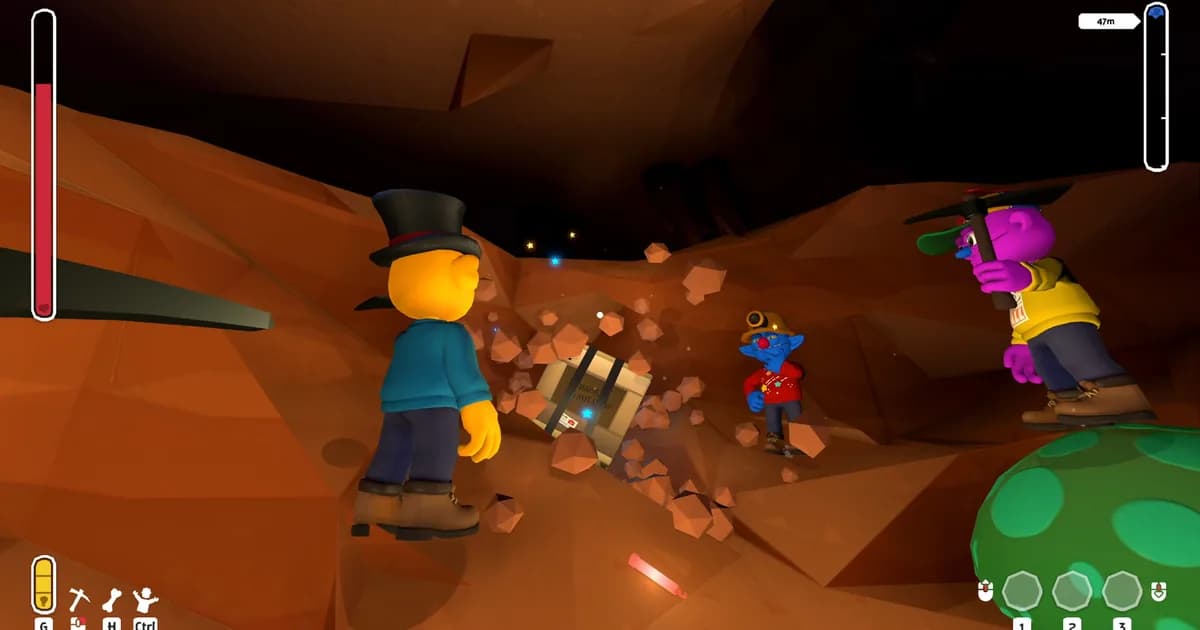
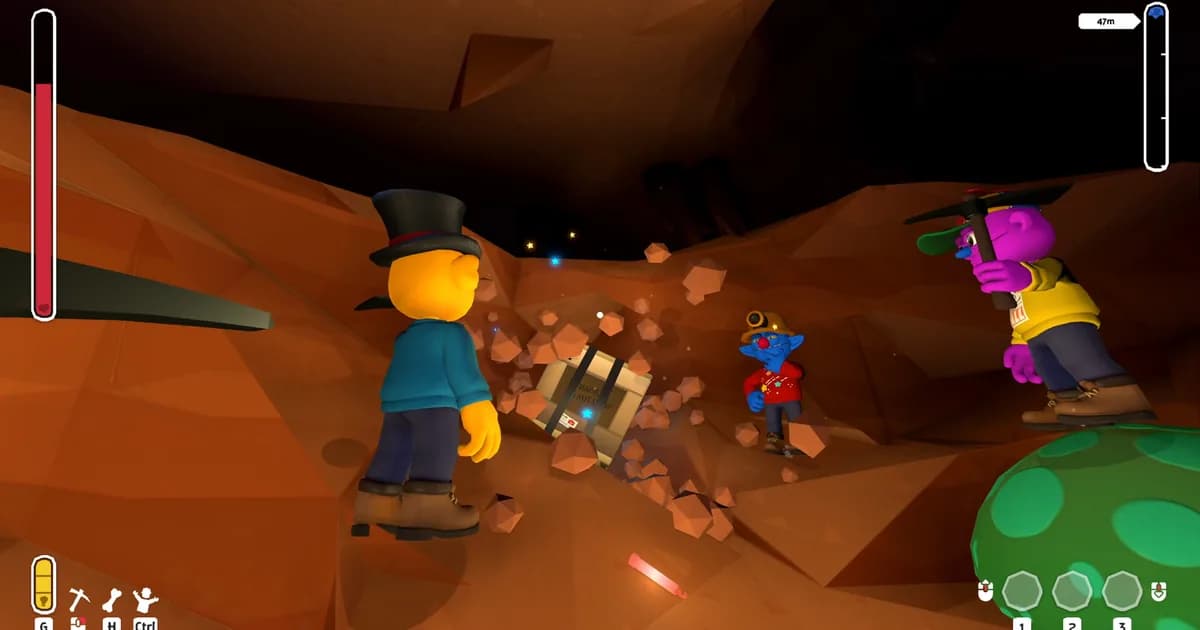
The launch post names Dirt Cave as one of the game's three biomes. The hero image here shows an orange cave chamber, players digging near a crate, and a glowing green object. Those visible details help identify the environment, but they do not prove a universal hazard or tool priority.
On a first run, use Dirt Cave to learn the controls, read the next opening, and see how your current tools interact with destructible terrain. Record what happens in your build instead of assuming that a guide's “static hazards” or “most forgiving biome” label is an official rule. If you are playing the Weekly Challenge, record the seed and route separately from campaign observations.
Ice Cave: verify the current enemy behavior
The official roster includes Ice Cave, and the Parks & Recreation notes specifically mention it when reducing the amount of Bomb Bats. The same note says Bomb Bats ignite only on line of sight. Those are useful current checks when a team is preparing for an Ice run.
The patch feed does not define a universal “one flare per player” rule, a fixed slippery-surface formula, or a guaranteed zipline route. Carry the visibility and traversal tools your run provides, but treat recommendations about exact quantities or mandatory equipment as player strategy. A visual surface read can still be helpful without turning it into a hard system claim.
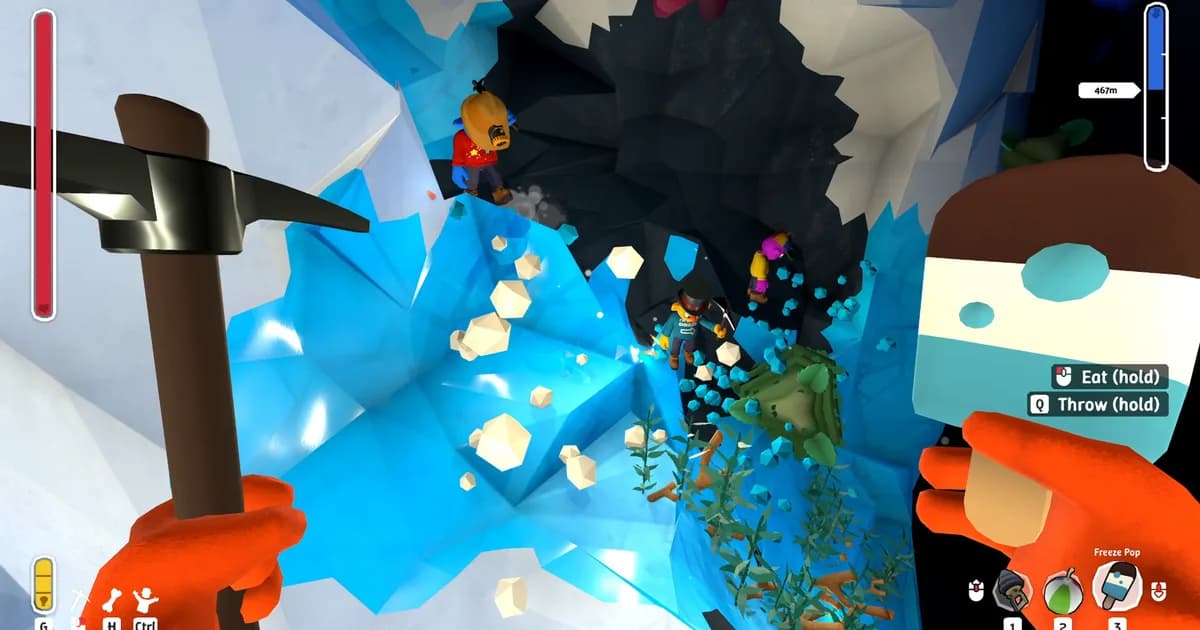
The blue crystalline terrain and pickaxe are visible in this Ice Cave screenshot; the image does not establish a universal movement formula.
Lava Cave: follow the versioned notes
Lava Cave is the third official biome. Devlog #02 specifically says the Weekly Challenge keeps lava flow consistent within a fixed weekly seed. That supports learning a route for the current challenge, but it does not establish a permanent rule for every campaign cave or every explosive.
The official material checked here does not document a universal reactive-terrain chain reaction, a mandatory flare count, or a complete list of fire interactions. Scout the next section, make a safe route call, and write down what the current build actually does. If an update changes lava flow or an enemy, retire old route notes instead of treating them as timeless.
The red cracked terrain and Foam Cannon are visible in this Lava Cave scene; the screenshot alone does not define a fire or explosion formula.
Weekly Challenge biome rotation
Weekly Challenge is the strongest reason to keep biome advice versioned. The developer says the seed is fixed for everyone and changes weekly. Item drops and lava flow are described as consistent within that challenge, and the biome set rotates through Dirt, Ice, and Lava. The launch post also confirms leaderboards.
Use the first attempt to map the current route. On later attempts, compare detours, item locations, and completion times. Keep a note of the date or patch beside every observation. The Pratfall speedrun guide can help with route planning, but a community route is not proof of an undocumented mechanic.
Co-op and solo context
The Steam store page lists single-player and online co-op. The launch announcement also calls out online co-op. The official sources do not require a particular number of players for a particular biome, so choose the group size that matches your route and communication.
Patch 1.1 added standard-mode mid-run joining. The host receives a popup, and accepting the join restarts the current cave at the last hydrant. That rule matters in any biome: a reconnect is possible, but the exact room and position are not preserved. See the Pratfall multiplayer guide for lobby context.
Step-by-Step: learn each biome without overfitting
1. Identify the environment. Confirm whether the current section is Dirt, Ice, or Lava, then note visible terrain and enemy behavior without assuming an undocumented formula.
2. Test one tool interaction. Try the route with the equipment available in that run. Record what happened, the patch version, and whether the result came from the Weekly Challenge seed.
3. Recheck after an update. Compare your notes with the latest Steam news, especially when an announcement changes lava flow, Bomb Bats, joining, or challenge behavior.
Key takeaways
- Dirt Cave, Ice Cave, and Lava Cave are the three biomes named in the launch announcement.
- The launch post lists more than 30 items, online co-op, and a Weekly Challenge with leaderboards.
- Weekly Challenge uses a fixed cave seed for everyone and changes weekly.
- The Weekly Challenge devlog describes consistent item drops and lava flow within the challenge.
- Bomb Bats ignite only on line of sight, and the Parks & Recreation update reduced their amount in Ice Cave.
- Exact friction, collapse, catch, fire, tool-priority, and voice-distance rules are not all documented in the official feed checked here.
- Keep route notes tied to a date and patch instead of treating observations as permanent mechanics.
Related Reading
- Pratfall Advanced Tips: Current Mechanics and Patch Rules
- Pratfall Items Guide: Pickaxe, Drill, Glow Sticks and More
- Pratfall Tips: 3 Biomes, 30+ Items, and the Catch Mechanic
- Pratfall Speedrun Tips: Clear Caves Faster in 2026
- Pratfall Multiplayer: 4 Players and Custom Mode
- Pratfall Achievements Guide
- Pratfall Cosmetics Guide
- Pratfall Complete Guide 2026
References
- Pratfall on Steam
- Official launch announcement
- Devlog #02: Weekly Challenge
- Hotfix 1.0.0R2502
- Patch 1.1
- Parks & Recreation update
- Current Patch 1.3.2.R5312
Frequently Asked Questions
How many biomes does Pratfall have? Three: Dirt Cave, Ice Cave, and Lava Cave, according to the official launch announcement.
What is the Pratfall biome order? The Weekly Challenge devlog describes a rotating Dirt, Ice, and Lava set. It does not establish one permanent campaign order for every run.
What is the hardest Pratfall biome? Quad Head's official posts name the biomes but do not rank their difficulty. Calling Lava Cave hardest is a player judgment, not an official label.
What tools should you bring into each biome? The launch post confirms more than 30 items but does not assign a fixed loadout to each biome. Use the tools available in your current run and verify specific claims after updates.
Does each cave have different hazards? The environments differ, but the official feed does not publish a complete hazard matrix. Confirmed examples include consistent weekly lava flow and the Bomb Bat line-of-sight rule.
Can you play all three biomes solo? The Steam store page lists single-player and online co-op. It does not describe a separate solo biome restriction, so the official material supports solo access without specifying every mode detail.
Was this guide helpful?
About the author

Indie & JRPG Desk
GameBrief's byline for indie, JRPG, visual novel and cozy games. Warm, direct, and willing to say which one to buy.
- Indie, JRPG and visual novels
- Early access and survival
- Sources listed per article
Keep reading
Pratfall Multiplayer: Player Count, Voice Chat and Joining
Guides · 7 min
Pratfall Tips for Beginners: 3 Caves, Catching and Solo Play
Guides · 9 min

Pratfall Items Guide: 11 Named Items, Flares & More
General · 10 min
Pratfall Guide 2026: Max Players, Biomes, Items & Tips
General · 23 min
Pratfall Speedrun Tips: Clear Caves Faster in 2026
General · 8 min

Pratfall Advanced Tips: Mechanics the Game Won't Teach You
General · 7 min
Sponsored
Disclaimer
This article is published for informational and entertainment purposes. It does not constitute professional financial, legal, or technical advice. Game performance, online services, patch schedules, and store listings change. Verify critical details (pricing, system requirements, regional availability) with publishers and storefronts before you buy. Affiliate links, where present, help support our editorial work and are labelled in our affiliate disclosure.
Comments
Loading comments…