Loading…
Loading…
GameBrief · General
Deep Rock Galactic Rogue Core launches May 20 — every confirmed mechanic before EA. All 5 classes, the upgrade economy, and what Ghost Ship changed.
Reviewing
Deep Rock Galactic: Rogue Core
Ghost Ship Games · Coffee Stain Publishing
Deep Rock Galactic Rogue Core is five days out from Early Access, and Ghost Ship has confirmed enough that the picture is clear. This isn't a sequel. It's not DLC. It's a structurally distinct game that borrows the setting and dwarven attitude of the original while tearing out the gameplay loop and replacing it with something different.
The question worth asking before May 20 isn't whether it's good — nobody knows yet. It's whether Ghost Ship has worked out the central tension in co-op roguelite design: how do you build enough procedural variety to sustain dozens of runs without dissolving the class identity that makes any given session feel like a deliberate choice?
Everything confirmed so far, before Early Access opens.
The original Deep Rock Galactic has a simple loop: choose a mission type, drop into a cave, complete the objective, call the drop pod, fight to the exit. The objective rotates — mine Morkite, escort Doretta, destroy egg clusters — but the exit is always a drop pod.
Rogue Core removes the drop pod.
In its place is a descent structure: your team pushes floor by floor toward the Core, building power from scratch as you go. No pre-mission loadout screen. You start with basic equipment and find everything else underground. Death ends the run. Between sessions, a meta-layer called Promotions and Security Clearance gradually unlocks starting conditions and harder tiers — that's your permanent progress.
Ghost Ship's stated design goal is "co-op first, team build," which they distinguish from "four individuals who happen to share a cave." Whether the upgrade system actually enforces that distinction is the one thing confirmed details can't answer before launch.
GODEEPER: We covered the structural break from the original DRG — including the Retcon class's time-rewind mechanic — in our launch announcement. Deep Rock Galactic Rogue Core Early Access: All 5 Classes →
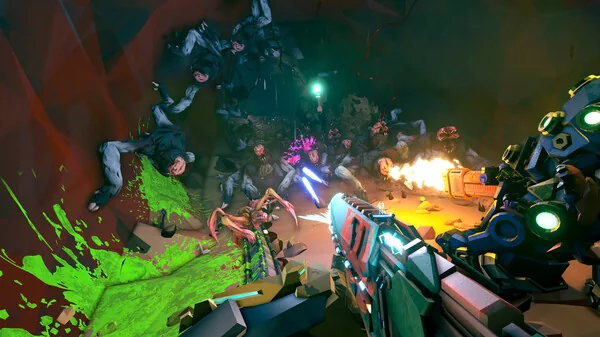 The upgrade decision tree differs by run — no single build path dominates all mission types.
Disclaimer
This article is published for informational and entertainment purposes. It does not constitute professional financial, legal, or technical advice. Game performance, online services, patch schedules, and store listings change. Verify critical details (pricing, system requirements, regional availability) with publishers and storefronts before you buy. Affiliate links, where present, help support our editorial work and are labelled in our affiliate disclosure.
About the author

Critical game theorist with a background in film criticism. Writing for print and digital outlets since 2015. Specialises in genre analysis and design heritage.
Five playable Reclaimers at EA launch. None carry over from the original DRG's four (Driller, Engineer, Gunner, Scout) — Ghost Ship built entirely new archetypes. All five share identical base stats, which means class identity comes from signature abilities and the Enhancement deck you build around them during a run.
Guardian uses Seismic Gloves, which stun enemy groups and create a 4-second fear zone. A secondary mode fires 12 Concussive Barrage munitions, each applying a 6-second stun. Ghost Ship has described Guardian as "designed to be the last operative standing" — phrasing that tells you something about how punishing wipes are expected to be in high-difficulty content.
Slicer swings a Plasma Blade in a horizontal arc for 560 damage, converting terrain within 3 meters to glass on activation. Kill-chain bonuses stack through the deck. This is the class that solo players will gravitate toward — and probably the sharpest test of whether Rogue Core actually needs you to play as a team or just benefits from it.
Falconer runs a Lightning Drone with 5 charges on a 10-second replenishment timer. Each charge fires 3 bursts for 25–35 damage with an electrocution effect that arcs between nearby targets. More importantly: the drone can revive downed teammates remotely. Falconer is the only confirmed class with an in-run revive mechanic. In a game where death ends the run, that's not a utility pickup — it's a structural role.
Spotter fires Crit Darts that mark a target for 5 seconds, applying +100% crit chance to all damage from any teammate. Alternatively, hitting the ground creates a 10-second crit zone for positional play. Three charges, 18-second cooldown per charge. In a duo, Spotter contributes modest damage amplification. In a full four-player squad where every teammate lands crits on marked targets for 5 seconds, the math changes considerably.
Retcon has two ability modes: Time Rewind (damage negation) and Rage (damage doubling). The 6-second window in Rage mode requires timing that punishes mistakes — getting hit during the vulnerability frames wastes the buff. Ghost Ship calls it a hybrid tank/dealer, but the design reads more like a class with a skill floor. None of the other four operate this way.
Each run's loop runs on Expenite — a mineral your team mines as you descend. Deposit enough into the R.E.P.D. device and it triggers an upgrade selection event. The cost structure is fixed and worth knowing:
First upgrade costs 120 Expenite. Each one after adds 10 to the price, up to a cap of 230 before exponential scaling starts. Roughly 12 standard upgrade events per player across a typical run, assuming steady Expenite flow.
When an event triggers, the game pauses. In a four-player squad, each player gets 6 options. Players pick in random order. One exception: Health Reward always appears in the final slot and is available to every player regardless of selection order. Everything else is exclusive — one player's pick is off the table for the others.
Six rarity tiers: Common, Uncommon, Rare, Epic, Legendary, and Artifacts. The Artifact tier is where Ghost Ship put the deliberate imbalance — Glass Cannon gives +150% damage and cuts max health by 90%, Extreme Vigor handles aggressive passive regeneration. Artifacts can't be stacked and often have explicit penalties. The official wiki already documents around 25 distinct Artifact modifiers, which is a meaningful signal about how seriously Ghost Ship is treating build variety at the ceiling.
Over 100 total upgrades confirmed. For comparison: Hades II opened Early Access with roughly 50 boons per god, fewer in total across the whole pool. Risk of Rain 2's EA launch sat around 75 items. Rogue Core's count is competitive on paper. Whether the actual design quality holds up is the question nobody can answer until May 20.
GODEEPER: The roguelite upgrade meta is increasingly sophisticated. For comparison with a game that nailed the "team vs. individual build" tension in a different structure, see our breakdown. All Hail the Orb Complete Guide 2026 →
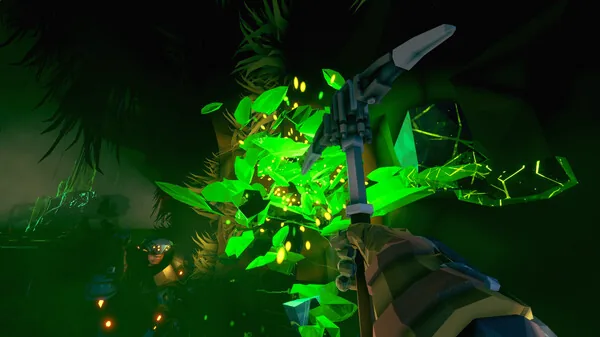 Late missions add environmental hazards that punish stationary play — build for mobility early.
Hoxxes IV, same as the original. The framing event is called The Greyout — mining operations went dark while Expenite extraction was underway, and the Company has sent Reclaimers to find out why and push to the Core.
Three enemy types at EA launch: Corespawn (primary faction), Rafkan, and Shatterclaw. The original DRG shipped with multiple distinct biome factions and dozens of creature types. Rogue Core is starting narrower. Ghost Ship has said enemy variety is a roadmap priority, but that's a gap players will feel immediately if they're coming from the original.
The difficulty curve is structurally different from DRG's. The original let you select hazard levels 1–5 before dropping, with a fairly stable threat level within the mission. Rogue Core ramps continuously as you descend — enemies get more dangerous with each floor rather than holding a steady pressure. The practical consequence is that late-run upgrade decisions carry more weight than early ones. Your first 120-Expenite pickup is less critical than the one you take when your squad is down a player on floor six. That's not better or worse than the original design — it's a different game.
Ghost Ship has said 1.0 will differ from EA through "expanded breadth and depth of content" rather than quality fixes. The studio originally targeted late 2025, pushed to May 2026, and acknowledged the game "needs a few more months to be the best it can be."
At EA launch: five classes, three enemy types, the Expenite upgrade economy. No official biome count — the original DRG shipped with five biomes; whether Rogue Core matches that isn't confirmed. Mission variety is ambiguous; whether there are multiple run configurations or a single descent path at launch isn't confirmed either. Local co-op hasn't been confirmed for EA.
18–24 months is a long runway. Ghost Ship maintained six-plus seasons of active development on the original DRG, which is a track record worth something. But players who show up expecting that game's content density will find a much smaller scope on May 20. That's not a critique — Early Access means exactly that. It's just an accurate description of what's been confirmed.
Co-op roguelites are a crowded category now. The design choices that distinguish Rogue Core from its competition are worth naming before launch.
Legionbound takes a card-draft approach where class synergies are assembled between runs, not during them. Rogue Core's mid-run upgrade selection inverts that — synergies emerge during play, in real time, as your squad builds around what the R.E.P.D. offers. That's harder to balance and easier to feel chaotic. Whether it produces better session-to-session variety than pre-run drafting is a matter of taste as much as design. Legionbound on Steam sits at the other end of the spectrum and is worth knowing before you decide.
What Rogue Core carries into that market is IP weight. The original Deep Rock Galactic has over 100,000 Steam reviews, nearly all positive. No independent roguelite can manufacture that launch audience from scratch. Ghost Ship's challenge isn't getting players to show up on May 20 — it's getting them to stay past hour 10 when the roguelite loop has to carry its own weight.
Ghost Ship is being straight about the EA scope: work in progress, player feedback will shape development, 1.0 will have more content. Players who want to wait for 1.0 have a reasonable position. Players who want to participate in what 1.0 becomes — and who trust Ghost Ship's track record from the original DRG — have a different but equally reasonable one.
For a sense of how other co-op roguelites handled the early-access-to-full-release arc, the Legionbound launch coverage from April is a useful comparison.
Is there permadeath in Rogue Core? Yes. The run ends when the team wipes. Meta-progression carries through the Promotions and Security Clearance system, but within a run there are no checkpoints.
Does the Falconer's drone require line of sight? Confirmed drone behavior includes remote revives, which means it has some form of autonomous pathing. Whether line-of-sight rules apply in specific cave configurations hasn't been clarified in pre-launch materials.
Can different players play the same class in co-op? Not confirmed either way before launch. The original DRG permitted duplicate classes but gave no mechanical reason to run them — mission kits were designed around four distinct roles. Rogue Core's class design, with each class owning a unique signature ability, makes duplicates structurally weaker, but Ghost Ship hasn't ruled them out.