
GameBrief · Guides
Far Far West Boss Guide: All 4 Bosses and Strategies

This far far west boss guide starts with the rule that most guides bury: the moment a stage boss dies, the game spawns an infinite enemy wave. Not a large wave. An infinite one.
If you haven't finished exploring the map before the boss triggers, you won't finish after. Every chest, every secret objective, every bell or medallion for a side mission: clear them first. Boss first means loot lost.
TL;DR: Far Far West has four named Cryptic bosses in Early Access: Cryptic Necromancer, Cryptic Saloon, Cryptic Train, and Cryptic Vulture (plus a Horseman miniboss on harder contracts). Cryptic Train is the most demanding, a multi-part fight where the locomotive and each cart has its own health bar. Cryptic Saloon is generally considered the easiest. Always explore the full map before triggering a boss: killing it spawns an infinite enemy wave that ends your looting window permanently. Spell recommendations and attack breakdowns below.
Far Far West boss guide? (quick answer)
There are four named Bounty Bosses in the current Early Access build: Cryptic Necromancer, Cryptic Saloon, Cryptic Train, and Cryptic Vulture. Horseman is a separate Special-tier enemy on Hard and above. Explore the whole contract before summoning a boss, because defeating it starts the infinite storm and ends the safe looting window.
Current status: September 2026
Far Far West is still in Early Access. The official wiki lists version 0.2.0.20, released September 7, after the Frostburn update added frost spells and melee weapons; that patch focused on balance and bug fixes rather than adding a fifth bounty boss. The current wiki roster still lists four Bounty Bosses, while Horseman remains a separate Special-tier enemy. Exact HP and damage values below should be read alongside the current per-boss wiki tables because Early Access balance can move between patches.
Key takeaways
- Four named Cryptic boss encounters confirmed as of September 2026, plus a Hard-plus Horseman Special enemy with a guaranteed Joker drop
- Cryptic Train: locomotive plus four carts, each with its own health bar; bring all four to near-zero before finishing any, to deny the death-ray retaliation
- Cryptic Saloon: planks and eyes deal flat, gear-independent damage, so AoE loadouts clear it faster than single-target burst; widely considered the easiest, if most tedious, of the four
- Cryptic Vulture: destroy the orbiting skull shield first, then burst the exposed head; scales far more gently in co-op than Train or Necromancer, making it the better group target
- Cryptic Necromancer: lateral movement breaks its homing-projectile tracking almost completely
- Every boss death triggers infinite enemy waves: explore the full map before engaging
- Electric's Strikes + Rain covers shield and add-heavy phases; Cactus's Pistolero + Wallo adds a slow once a weak point is exposed
Step-by-step: clear a Far Far West boss contract
- Explore the contract map first and open its chests, secrets, and side objectives before touching the boss spawner.
- Finish the main objective and use the resulting key or objective reward to unlock the Boss Spawner.
- Assign co-op roles, choose a loadout for the boss's shield or add phase, and summon the encounter only when the map is cleared.
- Break the relevant weak point, defeat the boss, and survive the infinite storm long enough to extract.
The Far Far West spells guide is the quickest companion reference when a boss phase exposes a gap in your loadout.
New players can pair this with the Far Far West beginner guide, co-op teams can use the Far Far West co-op guide, and anyone returning after Frostburn should check the Frostburn update guide before trusting an old build recommendation.
How boss fights work
Far Far West boss encounters don't follow the typical looter-shooter formula. Understanding two structural facts changes how you approach every boss mission:
The infinite wave rule. When the boss dies, an infinite enemy wave spawns immediately. No wind-down, no grace period. Players who haven't finished the side areas, secret missions, and chest loops before the boss are stuck in wave survival mode with no time to loot. The practical read: a boss marker on the map means that's the last thing you do in that region, not the main event.
Boss encounters aren't random. Unlike standard enemy spawns, boss locations are fixed to specific maps and mission contracts. The map marks them with a skull icon. You won't accidentally stumble into a boss fight. The game signals boss encounters clearly.
Phases and safe windows. Every boss in Far Far West has phases where damage is efficient and phases where you're meant to reposition or manage adds. Identifying which phase you're in is more important than raw damage output. Wasting burst spells during an unsafe phase is the main reason players hit bosses for longer than they should.
GODEEPER: Before you hit the first boss, make sure your spell loadout can handle the phase transitions. Far Far West Spells Guide →
Boss HP and damage at a glance
Numbers below are solo HP totals and per-hit damage ranges from Easy through Nightmare difficulty, verified directly against Far Far West Wiki's per-boss data pages, which break every boss down by both difficulty tier and player count (Far Far West Guide's own boss breakdown lists noticeably different totals for Necromancer and Train, likely stale from an earlier balance patch, so the wiki's per-difficulty tables are the more current source used here).
| Boss | Solo HP (Easy → Nightmare) | Signature attacks (damage range) | Resists |
|---|---|---|---|
| Cryptic Necromancer | 2,800 → 16,000 | Flame Wall 7.5-40, Slicing Scythes 3.75-20, Dark Harvest 3.75-20 | Knockback, Slow |
| Cryptic Saloon | No single HP pool: gated by destructible planks and mines | Ground Smash 11.25-60, Saloon Ball 6.75-36 | N/A |
| Cryptic Train | 1,400 → 8,000 (locomotive plus four carts) | Barrage 6.75-36, Ghost Charge 6-32 | Knockback, Slow |
| Cryptic Vulture | 3,700 (Easy) → 7,000 (Nightmare) | Vulture Blast 9.75-52, Vulture Shot 6-32 | Knockback, Slow |
Three of the four bosses resist Knockback and Slow entirely, so crowd-control-heavy loadouts underperform against them. Sustained single-target damage (Minigun, Long Ranger) consistently outpaces burst-and-CC builds across community reports.
Co-op HP scaling isn't uniform across bosses. At Nightmare difficulty, a solo fight to a full 4-player squad roughly triples both Cryptic Train's HP (8,000 → 24,000) and Cryptic Necromancer's HP (16,000 → 48,000). Cryptic Vulture scales much more gently over that same jump, only about 2.1x (7,000 → 15,000 solo to four players), so a full squad clears Vulture proportionally faster than it clears Train or Necromancer at the same difficulty. If you're picking which boss to farm in a group for Jokers, that softer scaling curve is the actual reason Vulture is the better time investment at high player counts, not just that its shield-then-head structure is easier to read.
Cryptic Saloon
Cryptic Saloon, a dilapidated saloon possessed by an aggravated spirit, is widely considered the easiest of the four named bosses, especially in a full squad. It's also the only boss in the current build with a genuine second phase, which most guides skip past.
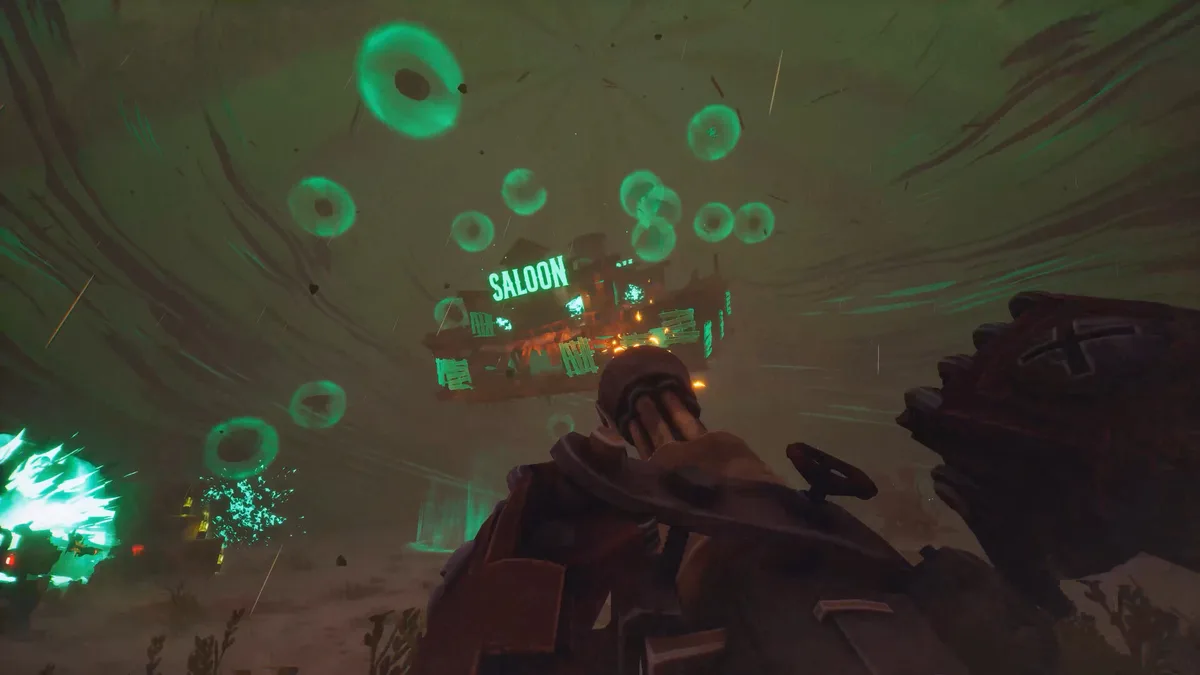
Phase one. The exterior itself can't be damaged directly. What look like weak points, the barricades and glowing window-eyes, are ghostly planks that cling to the outside walls: shoot them and they vanish, then reappear moments later elsewhere on the structure. Both the planks and the eyes line up from the front, so approaching head-on chunks a large amount of progress at once. Attacks to watch for: big, easy-to-spot orb projectiles flung across the arena (stay mobile to dodge), a furniture barrage that launches bubble-encased objects which explode if not shot down, a spinning laser beam that fires from both ends and rotates 180 degrees (move parallel to it rather than straight across it), and Ground Smash shockwaves that deal some of the highest single-hit damage of any Saloon attack.
The boss periodically turns to face a new direction; keep repositioning to stay in front of it so you keep hitting planks and eyes rather than its blind side.
The damage-gated detail most guides miss. Each plank and eye breaks for a flat amount regardless of your weapon's damage stat, so overkill damage doesn't carry over the way it does against Necromancer's, Train's, or Vulture's HP pools. Players on r/FarFarWest confirmed this directly and also found that a plank left partially damaged regenerates within a couple of seconds if you don't finish it off. That's why a maxed-out weapon feels like it's taking the same time on Saloon regardless of your gear level, and why AoE-leaning loadouts (fire tornado spells, Cactus's Pistolero, boomerang throws) clear the exterior faster than single-target burst here, the opposite of what works best on the other three bosses. Enough players find this tedious that some skip Saloon entirely when a contract lets them.
Phase two. Once the plank/mine pool is cleared, the building's spirit breaks free and flies erratically through the interior. The spirit itself doesn't attack directly, so the real threat is the wave of lesser Saloon Spirit adds it spawns (roughly 175 HP each per community data). Sniper-class weapons shred these adds at range efficiently; a Cactus turret handles cleanup while you reposition. Killing the fleeing spirit outright ends the fight immediately and drops an equipment fragment plus gold, so it's often faster to commit to chasing it down than to grind through every add wave.
Cryptic Train
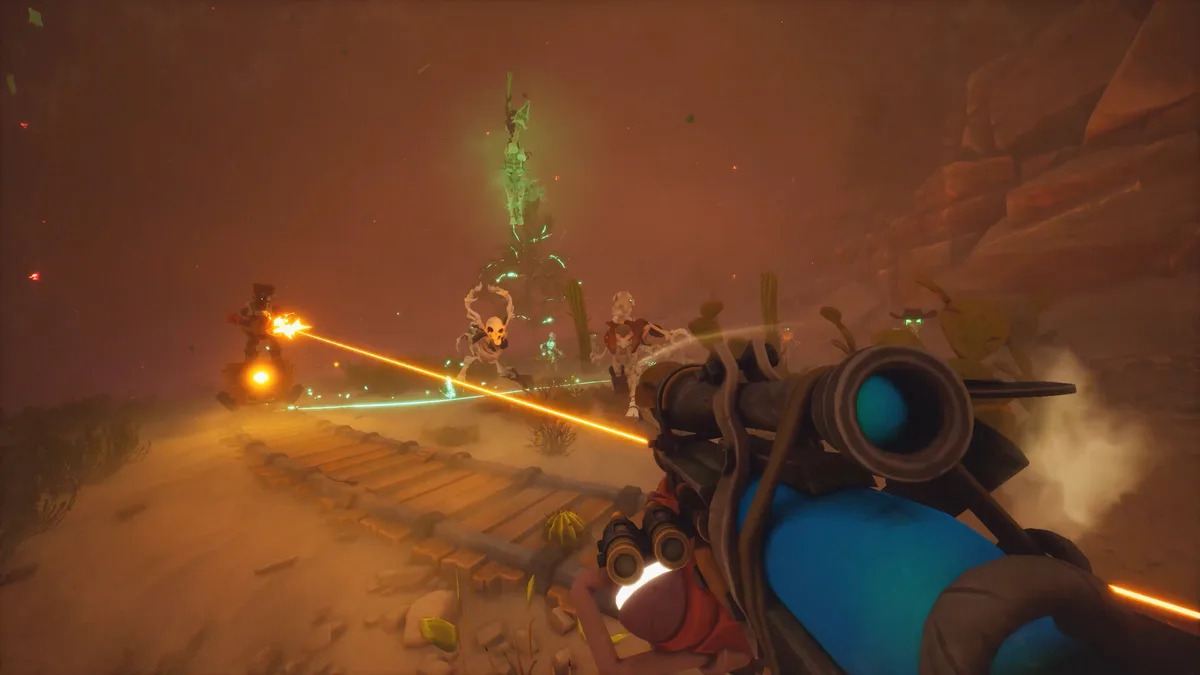
Cryptic Train is the most structurally different fight in the current build. Rather than one health bar, the locomotive and four attached carts each carry their own separate health pool and attack independently at the same time. Trying to spread damage across every section evenly wastes time: focus one wagon down completely before moving to the next. Solo HP runs from 1,400 on Easy up to 8,000 on Nightmare, and unlike Cryptic Vulture's gentler co-op curve, that HP roughly triples at full 4-player Nightmare (24,000). A full squad doesn't clear Train proportionally faster the way it does Vulture.
Two attacks define the fight. Barrage has every train segment fire a projectile starting from the front car, dealing 6.75 damage on Easy scaling to 36 on Nightmare, and these early volleys are slow enough to dodge on the move. Train Ghost Charge telegraphs a line on the ground, then a spectral train charges through it after a short delay for 6 to 32 damage on contact: this is the "rapid arrow-style" attack that trips up players who don't recognize the telegraph. Keep distance during this phase and use healing items if you get clipped rather than trying to tank through it.
On Hard difficulty and above, destroying a segment triggers spinning lasers firing in four directions and a small explosion at that segment, so don't stand adjacent to a cart you're about to finish off. The boss resists Knockback and Slow, and stacking Acid with Pyro or Electric doesn't trigger a bonus explosion the way it does on some regular enemies, so don't build around that combo expecting it to work here.
A specific counter to the death-ray retaliation: rather than fully destroying each cart as you go, bring all four down to roughly 1 HP first, then finish them off in the same short window. The spinning-laser retaliation only fires when a segment actually dies, so killing all four in quick succession leaves the boss too little time to trigger and sustain each cart's death-ray phase individually. Multiple players on the Far Far West subreddit independently confirmed the trick works. It's a real time save once you're comfortable enough with Barrage and Ghost Charge to juggle four low-HP carts instead of one at a time.
Build recommendation: prioritize whichever section is blocking your line to the next one, and hold a cooldown-heavy burst combo for whenever a section's health bar is close to breaking rather than spreading damage evenly across all of them.
Cryptic Vulture
Cryptic Vulture is a two-phase fight built around a shield you have to break before you can hurt the boss at all. Solo HP is 3,700 on Easy, climbing to 7,000 on Nightmare, and it resists Knockback and Slow like Necromancer and Train.
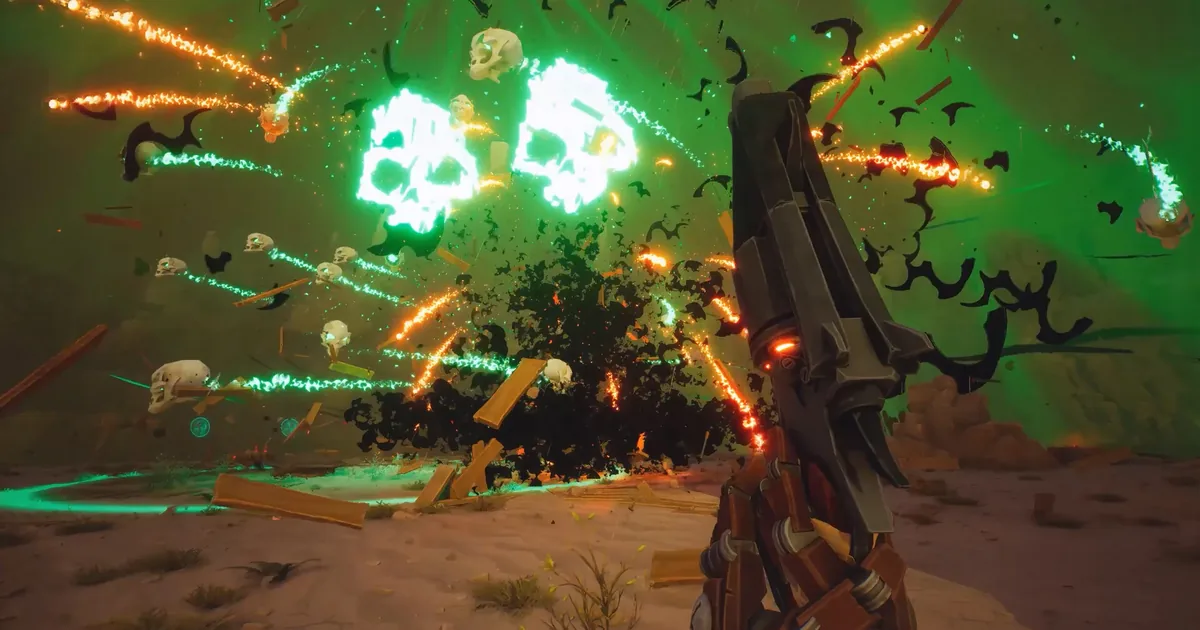
Phase one: the Wing Shield. The Vulture's Wing Shield is made of orbiting skulls circling the boss. None of your damage matters until every skull is destroyed. Focus one skull at a time while staying mobile to dodge the incoming projectile spam, primarily Vulture Blast (9.75 to 52 damage) and the weaker single-target Vulture Shot (6 to 32 damage). Electric's Strikes + Rain combo is a strong pick here: the area coverage means you don't need precise aim to keep chipping away at whichever skull is in front of you. The Vulture also periodically spawns a swarm of Ravens, which should be cleared with AoE before they pile up rather than ignored in favor of the skulls. A patch fix (0.1.1.18) resolved an earlier bug where the shield could persist even after every skull was destroyed, so the current build's phase transition is reliable.
Phase two: the head. Once the last skull breaks, the shield drops and the Vulture's head becomes its only weak point. Switch entirely to burst damage on the head. Cactus's Pistolero + Wallo combo summons a turret that also applies a movement slow, which is particularly useful here since it reduces how aggressively the Vulture repositions and gives you more consistent hits. A Long Ranger or Leveredge as your primary weapon with a Revolver secondary covers most of this phase.
Staying mobile throughout is the universal answer to Far Far West's projectile-heavy bosses, and Cryptic Vulture punishes standing still more than most.
GODEEPER: Team compositions handle shield-and-add phases like Cryptic Vulture's more efficiently when one player manages skulls while another holds burst for the head. Far Far West Co-op Guide →
Cryptic Necromancer
Cryptic Necromancer is a large flying boss that fights with a scythe and tracking projectiles, and it's the clearest example of how movement, not gear, wins Far Far West boss fights. Solo HP starts at 2,800 on Easy and scales to 16,000 on Nightmare, the widest spread of the four named bosses.
Its melee attack, Slash, is fast and has real range, sometimes too quick to dodge outright (eating the hit at full health is often the correct call). Flame Wall has the boss spin its scythe to conjure rotating walls of fire radiating out from itself for 7.5 to 40 damage; move alongside the rotation rather than trying to outrun it. Dark Harvest is a telegraphed ground slam covering a large rectangular area for 3.75 to 20 damage, easy to sidestep once you recognize the wind-up. The boss also summons minions that scale with difficulty: Ghosts on Easy and Normal, Grunts on Hard, and Revolvers on Very Hard and above, so what you're clearing changes as the run gets harder. Its signature attack is Slicing Scythes, fast tracking projectiles (3.75 to 20 damage) that home on your current position with a generous wind-up; standard strafing doesn't reliably break the lock.
Bunnyhop sideways instead. Continuous lateral movement in the same direction throws off the tracking almost completely, and players who find this early describe the fight going from dangerous to close to trivial. The same principle applies to any other Far Far West boss that fires homing shots.
A Long Ranger sniper is a strong single-target pick here since the fight is largely stationary once the tracking is solved. On the spell side, Cactus's Pistolero + Wallo combo and Electric's Strikes + Rain combo both perform well against it. The Necromancer's minion waves are generally lighter than Cryptic Saloon's plank/mine pressure or Cryptic Vulture's shield-phase Raven swarms, so a single Cactus turret is usually enough to keep them off you.
Cryptic Horseman: the miniboss most guides skip
The Horseman isn't one of the four named Cryptic bosses. It's classified in-game as a "Special" enemy rather than a boss, but it's worth planning for separately: it only spawns on Hard difficulty contracts and above, and it can show up alongside a boss encounter rather than in place of one. It floats above the ground on a spectral mount, which lets it ignore ground-based spell effects that would otherwise slow or damage it, and it stays put until it spots your posse before closing the distance.
Three attacks define the fight: Portal Blast fires an instant light beam out of spawned portals with effectively no dodge window once it triggers, so watch for the portal itself rather than trying to react to the beam; Deathly Duplicate launches explosive ghost clones that can be shot down before they connect; and Lightning Wall throws up a high-damage bolt barrier at close range, which is the main reason to fight it at range rather than in melee. HP runs from 800 on Hard solo up to 4,800 on Nightmare with a full 4-player squad. A June 2026 balance patch (0.1.1.10) brought its HP in line with the Elite enemy tier after Elite HP was reduced the same patch, so it hits harder relative to trash mobs than it did earlier in Early Access.
The reason to actually seek this fight out: the Horseman has a guaranteed 100% Joker drop on death, the only non-boss enemy in the game with that drop rate. If you're farming Jokers on a Hard-plus contract and spot the Horseman on the map, it's worth the detour even if you weren't planning to engage it.
General Far Far West Boss Tips
Explore everything before you engage. The post-boss infinite wave ends your looting window. Complete every side objective, open every chest, and trigger every secret mission before pulling the boss encounter. Missing a Joker card because you killed the boss early costs you that card for the run.
Focus one section at a time on Cryptic Train. It's the only fight where the boss has multiple independent health bars (locomotive plus carts). Spreading damage evenly across all sections takes longer than clearing them one by one.
Break the shield before you touch the head on Cryptic Vulture. The head is invulnerable until every orbiting skull is destroyed. Don't waste burst spells on the boss body during phase one.
In co-op, assign roles before the fight. Shield-and-add phases (Cryptic Vulture's skulls, Cryptic Saloon's barricades) go faster when one player commits to clearing them while another holds burst for the exposed weak point. Uncoordinated teams often have everyone hitting whatever's closest.
Bunnyhopping breaks tracking. Any boss that fires homing projectiles is neutralized by continuous lateral movement. Cryptic Necromancer is the clearest example, but the principle applies to tracking attacks in other encounters too.
Bring all four Cryptic Train carts to near-zero before finishing any of them. Killing carts one at a time lets each one fully trigger its Hard-plus death-ray retaliation; bringing all four down together and finishing them in the same window denies the boss the time to sustain that phase on each cart.
Don't skip the Horseman if you spot one. It's a Hard-plus "Special" enemy, not a boss, but it's the only non-boss enemy with a guaranteed Joker drop. Worth the detour on a Joker-farming run.
Frequently asked questions
Q: What bosses does this far far west boss guide cover? A: The four named Cryptic bosses are Saloon, Train, Vulture, and Necromancer. Saloon has plank and eye phases; Train has separate locomotive and cart health bars; Vulture has skull-shield and head phases; Necromancer uses tracking Slicing Scythes. Horseman is a Hard-plus Special enemy with a guaranteed Joker drop. No fifth boss has shipped as of September 2026.
Q: What happens when you kill a boss in Far Far West? A: An infinite enemy wave spawns immediately after boss death, with no grace period. Loot the entire map before engaging the boss or remaining chests, secret objectives, and Joker card missions become inaccessible for that run.
Q: How do you beat the Cryptic Train? A: The locomotive and four carts each have separate health bars. On Hard and above, bring all four carts near zero HP, then finish them together so each cannot fully trigger its death-ray retaliation. Watch the slower Barrage volleys and the faster-telegraphed Ghost Charge.
Q: What spell is best for bosses? A: It depends on the fight. Electric's Strikes + Rain covers shield and add-heavy phases such as Vulture's skulls. Cactus's Pistolero + Wallo slows movement after a weak point opens, helping against Vulture's head and Necromancer. A Long Ranger or Leveredge with a Revolver secondary covers single-target windows.
Q: Can you solo Far Far West bosses? A: Yes, all four Cryptic bosses are designed for solo play, though Cryptic Train's multi-part health bars and Cryptic Vulture's shield phase both take longer alone since there's no second player to split the workload.
Q: How do boss encounters unlock in Far Far West? A: Boss encounters are tied to specific contracts accepted from the Town Sheriff rather than fixed map spawns. The four Cryptic bosses and the Horseman miniboss come up across different contract maps as you progress into harder difficulty tiers.
Q: What is the Cryptic Horseman? A: A Hard-plus Special enemy, not one of the four named bosses. It floats above ground-based spell effects and uses Portal Blast, Deathly Duplicate ghost clones, and Lightning Wall at close range. Its guaranteed Joker drop makes it worth engaging outside a boss run.
References
- Far Far West on Steam: official Early Access page, patch notes, and developer roadmap
- Far Far West Wiki, Bounty Bosses: current boss roster and encounter structure
- Far Far West Wiki, Gameplay Basics: current objective, Boss Spawner, and extraction flow
- Cryptic Necromancer boss page, Far Far West Wiki: per-difficulty and per-player-count HP tables and exact attack damage ranges used in this guide
- Cryptic Horseman page, Far Far West Wiki: Horseman HP tables, attack names, and confirmation of its guaranteed Joker drop
- FROSTBURN and current Steam announcements: official update history, including version 0.2.0.20 and the September devlog
- Far Far West on X: official developer social account linked from the Frostburn announcement coverage
- Far Far West complete guide: weapons, spells, bosses, beginner tips, and all cluster guides
- Far Far West is listed at $19.99 on Steam; promotional pricing can change.
Related Reading
For complete spell breakdowns covering all 25 spells across five schools, including which options work best for each boss phase covered in this far far west boss guide, see the Far Far West spells guide.
New to the game and still working toward the boss encounters? The Far Far West beginner guide covers early progression, gold farming, and the upgrade priorities that matter most before the far far west boss fights start in earnest.
Running bosses in co-op? The Far Far West co-op guide covers team compositions, how spell reactions fire cross-player during boss fights, and how to manage the post-boss wave as a group.
- Far Far West Fire Spells: All 5 Pyro Spells & Combos: Pyro spells and the Fireball-then-Surcharge order.
- Far Far West Voodoo Spells: All 5 & the Healing Rule: healing spells and the rule that healing only works in the right state.
- Far Far West Builds Guide: All 3 Archetypes (2026): spell combos, Joker picks, and difficulty planning.
- Far Far West Co-op Guide: role assignments for shield, add, and post-boss phases.
- Far Far West Spells Guide: the full school-by-school spell reference.
- Far Far West Frostburn Update: the current Frostburn systems and balance context.
- Far Far West Frost Spells Guide: the frost options added in the latest major update.
- Far Far West Complete Guide: weapons, spells, bosses, and progression in one hub.
Was this guide helpful?
About the author

Senior Critic & Analyst
Former game data analyst turned critic with 11 years covering indie and mid-tier games. Based in Austin. Runs spreadsheets on games most people just play.
- 11 years games criticism
- Former game economy analyst
- Roguelike and strategy specialist
Keep reading




Disclaimer
This article is published for informational and entertainment purposes. It does not constitute professional financial, legal, or technical advice. Game performance, online services, patch schedules, and store listings change. Verify critical details (pricing, system requirements, regional availability) with publishers and storefronts before you buy. Affiliate links, where present, help support our editorial work and are labelled in our affiliate disclosure.
Comments
Loading comments…