
GameBrief · Guides
Far Far West Best Weapons: Tier List and Loadout Picks

Reviewing
Far Far West
Evil Raptor
The Far Far West best weapons list looks different once you check it against the game's real ten-weapon roster instead of guesswork: five primaries, five secondaries, and four utility grenades, not more. Two guns carry the first fifteen hours of play. A third earns its slot the moment you understand how the elemental combo system actually works, which is not the way some older weapon breakdowns describe it. Most guides also still describe unlocking weapons by hitting a player level. That system was removed before Early Access even launched, and the real one, tracking and collecting equipment fragments, changes how you should plan your first few hours.
This guide ranks the current roster using Evil Raptor's own data-mined weapon stats, the accuracy patch that hit the Minigun in June, and the real mechanic behind Fire, Electric, and Acid application, cross-checked against the game's official wiki and live Steam community discussion. Far Far West sits at Overwhelmingly Positive across more than 35,000 Steam reviews as of this update, so the tier calls below reflect a genuinely large player base weighing in, not a handful of early access opinions.
TL;DR: Far Far West's real weapon roster is 10 combat weapons (primaries: Leveredge, Long Ranger, Minigun, Quad Cylinder, Shotgun; secondaries: Boomerang, Bow, Dual Revolvers, Revolver, Sheriff Star) plus 4 utility grenades. Leveredge and Minigun lead the community S tier, though a June 13 patch cut Minigun accuracy by roughly 30 percent. Every weapon except Quad Cylinder and Revolver unlocks by tracking 6 equipment fragments, not by player level, despite what older guides still claim. Every secondary, not one unique weapon, can be assigned Fire, Electric, or Acid for the combo system. Dual Revolvers posts the highest raw secondary DPS (73) but ranks low in community tier lists because of ammo economy, and Healing Area is the one item players agree to skip.
Update, August 28, 2026: the August 27 Frostburn update changed two things this guide covers below. First, Far Far West's weapon roster is no longer 10, Knuckles and Lasso (primary slot) and Banjo (secondary slot) shipped as the game's first melee weapons and aren't yet tier-ranked here. Second, the fragment-tracking unlock system described throughout this guide is gone: fragments are now a universal "Blueprints" currency earned during missions rather than tracked per-weapon, and unlocking a weapon with Blueprints buys it directly instead of requiring a separate gold purchase. The DPS and stat figures below for the original 10 ranged weapons are unaffected. Full details: Far Far West Frostburn update coverage.
Key takeaways
- Leveredge (S tier): forgiving lever-action primary, 60 DPS, 10-round magazine, base stats untouched by patches so far
- Minigun (S tier): 8-second spin-up from a base 7 DPS to roughly 87.5 DPS at its 750 RPM cap, interrupting the burst resets your ramp to zero; accuracy was cut 30 percent in the June 13 patch (version 0.1.1.10)
- Sheriff Star (S tier secondary): thrown star that returns to you, 18 damage per hit (the highest per-shot damage of any secondary), 15-round magazine, effectively unlimited ammo if you recover the stars
- Every weapon except Quad Cylinder and Revolver needed 6 tracked equipment fragments and a 300-gold Gunsmith purchase to unlock as of this guide's last stat check. As of the August 27 Frostburn update, fragments are gone: unlocking a weapon now spends a universal "Blueprints" currency earned during missions, no separate gold purchase required. Nothing in the current build gates a weapon behind a player level
- Any secondary weapon, not a unique gun, carries your Fire, Electric, or Acid combo element: assign the element to the secondary you already like
- Dual Revolvers has the highest raw secondary DPS in the game (73) but ranks C/D tier in community consensus because of ammo economy
- Healing Area heals 5 HP per second in a 5-meter circle for 45 seconds; Bottle Crate drops 3 bottles worth 70 HP each over 3 seconds and can be carried between rooms, which is why the Steam community rates it higher
The Complete Weapon Roster and Tier List
| Weapon | Type | DPS | Magazine | Unlocks | Community tier |
|---|---|---|---|---|---|
| Leveredge | Primary | 60 | 10 | 6 fragments | S |
| Minigun | Primary | 7 base, up to 87.5 at full RPM | 300 total | 6 fragments | S |
| Long Ranger | Primary | 38 | 7 | 6 fragments | A |
| Shotgun | Primary | 18 per pellet, up to 127 point-blank | 10 | 6 fragments | A (meta shifted after Quad Cylinder's buff) |
| Quad Cylinder | Primary | 64 (highest primary) | 24 | Start | B |
| Sheriff Star | Secondary | 36 | 15 | 6 fragments | S |
| Bow | Secondary | 15 per charged hit | 1 | 6 fragments | A |
| Boomerang | Secondary | up to 25 per throw (5 hits) | 1 | 6 fragments | A |
| Revolver | Secondary | 39 | 5 | Start | B |
| Dual Revolvers | Secondary | 73 (highest secondary) | 12 | 6 fragments | C/D |
Two things stand out. First, Quad Cylinder and Dual Revolvers post two of the three highest DPS numbers in the entire roster and both still land in the bottom half of community tier lists. Read the next sections for why the tooltip number and the practical ranking disagree. Second, the "Unlocks" column isn't a player level for anything except the tutorial-issued Quad Cylinder and Revolver. Every other weapon, Leveredge and Minigun included, requires tracking and collecting 6 equipment fragments, then buying it from the Gunsmith for 300 gold. Fragments drop from killing the mission boss, killing a Coyote, forging one at an Anvil, or getting one from a Wishing Well, and only one weapon can be tracked at a time. Several older guides still describe a level-gated unlock system; that was removed during the Steam Next Fest demo build in February 2026, months before the game left closed playtest.
Primary Weapons Ranked
Leveredge
Leveredge is Far Far West's lever-action rifle, and the "Winchester" name that still floats around community threads isn't a fan nickname guessing at its design; the weapon was literally called Winchester in Evil Raptor's own Steam Next Fest demo patch notes back in February 2026, before it was renamed for Early Access. It deals 30 damage per shot at a 0.50-second fire rate for 60 DPS, with a 10-round magazine, and needs the standard 6-fragment unlock like most of the roster. Aside from a June 5 tweak that normalized its ADS sensitivity to match other weapons, data-mined stats show no nerf to its base damage or fire rate since launch, and the Steam community still rates it S tier: wide aim window, no severe drawback, effective from hour one through the current end of content.
What makes it work: the aim window is wide enough that landing shots doesn't depend on reflexes, and the firing cadence keeps you in DPS during enemy attack windups. What it won't do is out-damage a fully spun-up Minigun or a fully upgraded Quad Cylinder in a pure DPS race. It's the consistent baseline, not the burst tool.
Minigun
The Minigun doesn't reload in the traditional sense. Its clip is tied directly to a 300-round total ammo pool, so there's no reload animation to interrupt a suppression burst. Instead it runs on an 8-second spin-up: holding fire revs the barrel toward its 750 RPM cap, and damage output climbs as RPM increases. At its slowest, the base 7 damage per hit lands roughly once a second; at the full 750 RPM cap, that same 7 damage works out to about 87.5 DPS, the highest sustained output of any primary in the game once you've paid the full eight-second toll to get there. Interrupting the burst before that ramp completes resets RPM to zero, which wastes the entire eight seconds of commitment. That's the real skill gate, not a reload window tied to boss phase timing.
A balance patch on June 13, 2026 (version 0.1.1.10) cut the Minigun's accuracy by exactly 30 percent, and it drew visible pushback on the Steam forums: several posters noted the weapon "wasn't laser accurate to begin with" and that most builds already spent points on accuracy buffs to compensate. It still shreds groups once fully revved. It just costs more Joker or upgrade investment than it used to before you can rely on it the way older guides describe.
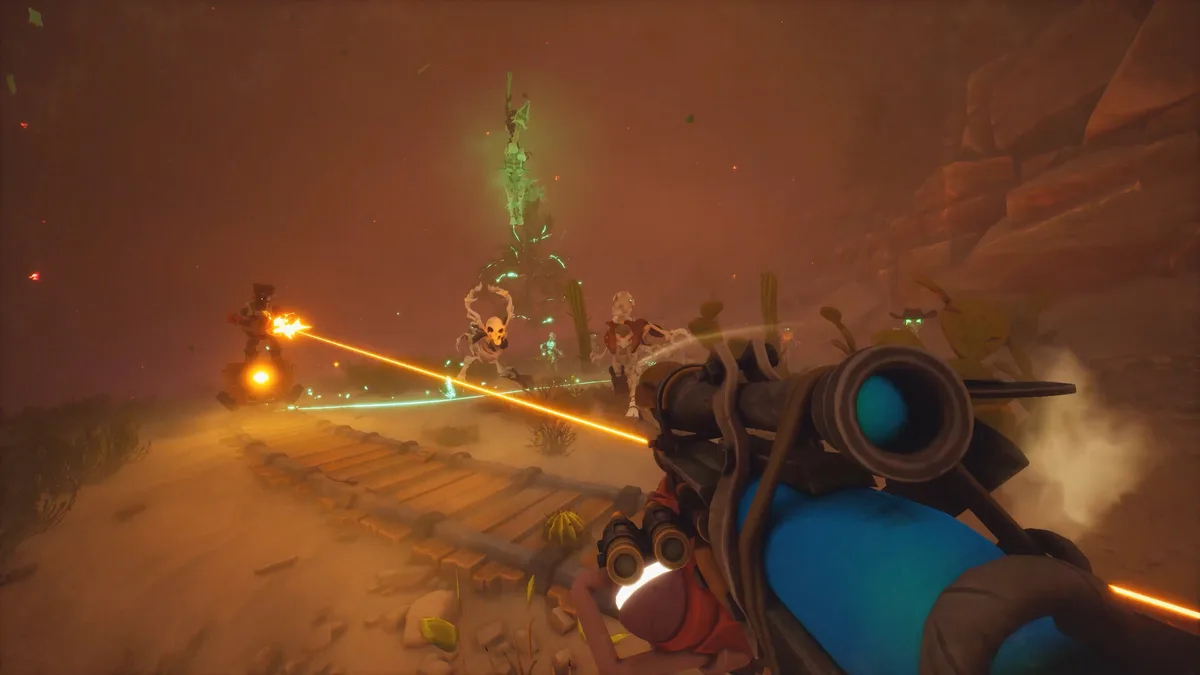 Cryptic faction enemies, skeletons and the occasional spectral apparition, tend to cluster along exposed lines like these rail tracks. A wide aim window matters more here than raw per-shot damage.
GODEEPER: Elemental combos, the Joker system, and the Gamba Machine basics covered for new players. Far Far West Beginner Guide →
Long Ranger
Long Ranger is the precision pick: 50 damage per shot, a 1.33-second fire rate that works out to roughly 38 DPS, and a 7-round magazine. The math favors picking off single high-priority targets, an elite Cryptic or a Marauder sniper, over sustained wave clear. Community sentiment places it a clear step below the S tier primaries: useful in the right moment, not a default equip.
Shotgun
Shotgun fires 7 pellets per shot at 6 damage each, on a 0.33-second interval. A single connecting pellet works out to roughly 18 DPS, which is why it reads as unimpressive on paper; land several pellets at point-blank range and that climbs past 125 DPS in one shot, which is the entire point of the weapon. It sat in the community's S-tier consensus for months after launch, but the Quad Cylinder's June 12 buff (version 0.1.1.10: base damage up from 8 to 9, total ammo up from 192 to 216 rounds, plus a cumulative 90 percent hipfire and ADS accuracy improvement across three patches) gave players a viable, far more forgiving alternative, and current Steam tier-list threads split the two rather than defaulting to Shotgun. Treat it as a close-range specialist rather than an all-rounder.
Quad Cylinder
On paper, Quad Cylinder is the best primary in the game. 9 damage at a 0.14-second fire rate works out to 64 DPS, the highest of any primary, with a 24-round magazine. Those exact numbers are current as of the June 12 patch (0.1.1.10), which raised base damage from 8 to 9 and total ammo from 192 to 216 rounds on top of a cumulative 90 percent accuracy buff spread across three earlier patches. It's also one of only two weapons, alongside the Revolver, sitting in your loadout the moment you finish the tutorial: no fragments to track, no Gunsmith purchase required. In practice, the Steam community still ranks it B tier. Its fire-rate scaling rewards heavy upgrade investment more than any other weapon in the roster, so a low-rank Quad Cylinder undersells the ceiling badly. If you're not planning to sink resources into it early, the raw DPS number on the tooltip overstates what you'll actually feel in the first several hours.
Secondary Weapons and the Real Elemental System
Some weapon breakdowns describe a single secondary as "the electric weapon," as if only one specific gun can apply that element. That is not how the system works. Every secondary weapon can be assigned one of three elements, Fire, Electric, or Acid, and the fire-electric-acid sequence applied in order to a boss is what triggers a detonation burst. Which physical gun you're holding doesn't lock in an element. Your assignment does.
In practice that means your electric-carrier can be a Revolver, a Sheriff Star, or Dual Revolvers, whichever secondary suits your preferred range, ammo economy, and fire rate. You make the assignment at the Gunsmith in Town, and it costs nothing to change between missions. Pick the secondary you actually want to use first, then assign it whichever element your build or squad composition is missing.
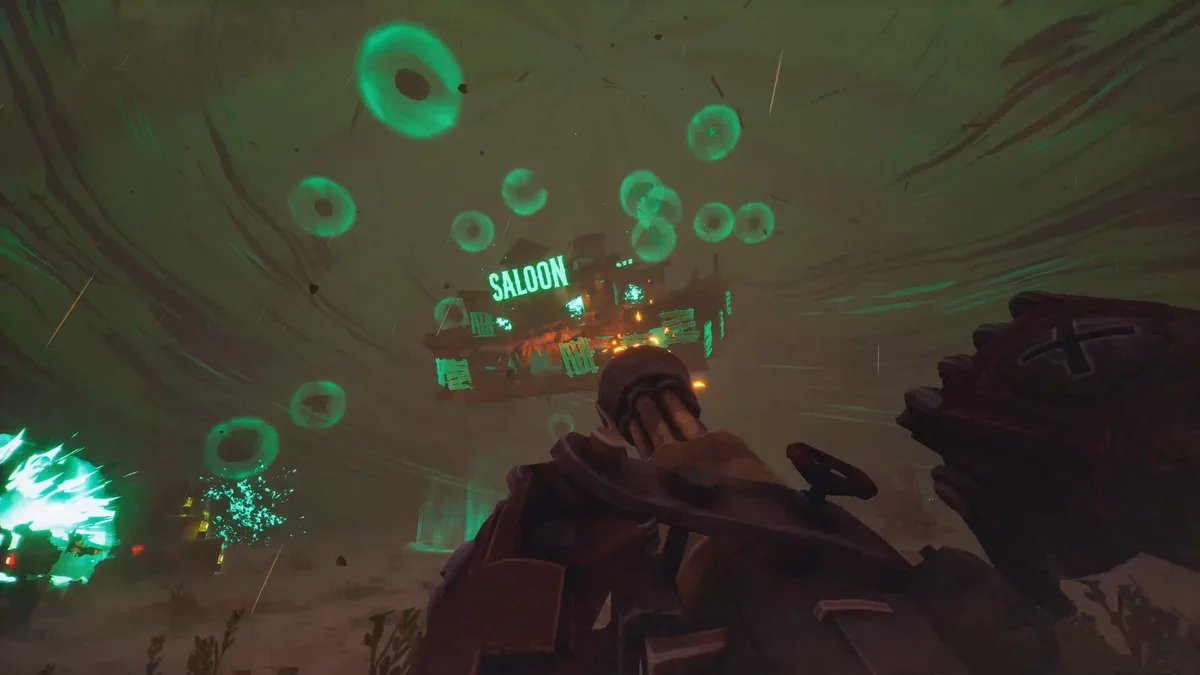 The Cryptic Saloon is one of the game's named set-piece encounters. Elemental application, not raw weapon damage alone, usually decides how fast fights like this one end.
Sheriff Star
Sheriff Star throws a star that returns to you after impact, needs the standard 6-fragment unlock, and carries a 15-round magazine. At 18 damage per hit, the highest per-shot damage of any secondary in the game, on a 0.5-second interval, it puts out roughly 36 DPS whenever you're not busy retrieving stars. Because you recover the stars, ammo is effectively unlimited if you pick them back up between throws, and any that go unrecovered can still be refilled from ammo pickups. Fast, quiet hits make it the community's top-rated secondary right now.
Bow
Bow is a charge weapon that needs the standard 6-fragment unlock: a quick tap fires a cheap 15-damage arrow, a full draw releases an explosive shot that scales hard with the Ultra Draw and Overdraw Jokers, both Bow-exclusive uniques. It's mobile enough to fire while kiting on horseback, which makes it a strong pick for players who want to apply an element from range without standing still. Its charged shots also leave lingering elemental puddles on the ground, which is what makes it the pick community threads keep pointing to for spawner and chaff cleanup.
Boomerang
Boomerang needs the standard 6-fragment unlock and burns no ammo at all: it's the one secondary that can't run dry mid-fight. A single throw lands its initial 5-damage hit, then up to 4 more 5-damage hits as it returns, for up to 25 damage and up to 5 separate element procs from one throw if every hit connects. That makes it a genuinely strong pick for players leaning on the elemental combo system rather than raw damage, though the game's own community discussions note the unlimited-ammo angle matters less than it sounds: ammo chests and the Ammo Pack already keep most loadouts topped up, and the Boomerang's base DPS is below average and inconsistent hit-to-hit.
Revolver
Revolver deals 13 damage on a 0.33-second interval for roughly 39 DPS, with a 5-round magazine and 48 rounds in reserve. Alongside the Quad Cylinder, it's the only secondary you start with, no fragment tracking required. Its main trait is accuracy: it holds a flatter, more reliable aim at range than any other secondary in the roster. It's a solid standalone option and a perfectly fine electric or acid carrier if you'd rather not commit to a charge weapon or a thrown one.
Dual Revolvers
Dual Revolvers posts the highest raw DPS of any secondary in the game at 73 (11 damage per shot, 0.15-second fire rate), beating even the Revolver's number. What most breakdowns skip: reloading isn't dead time here. The weapon throws both cylinders as explosive projectiles the instant you hit reload, each detonating for 16 damage in an area, turning a retreat-to-reload into a small burst of crowd control instead of pure downtime. Community tier lists still rank it toward the bottom of the secondary roster. The gap between paper DPS and practical standing comes down to ammo economy: a 12-round magazine burning that fast empties your reserves faster than the tooltip number suggests, especially before you've upgraded reserve capacity.
GODEEPER: A weapon with the best DPS on paper underperforming in practice isn't unique to Far Far West. ARC Raiders players run into the exact same trap with certain picks. ARC Raiders Weapons Tier List →
Utility Items and the Gamba Machine
Four grenade-type items round out the loadout: Ammo Pack (free from the start), Bottle Crate, Healing Area, and Impulse Grenade. The three unlockable utilities each need only 3 equipment fragments instead of the 6 that weapons require, tracked and collected the same way: killing the mission boss, killing a Coyote, forging one at an Anvil, or getting one from a Wishing Well.
The actual numbers explain the Steam community's near-unanimous verdict that Healing Area is the weakest item in the current build. It creates a 5-meter healing circle that ticks for 5 HP per second over 45 seconds, which only reaches its full 225 HP if you stand inside it for the entire duration, rarely realistic mid-fight. Bottle Crate instead drops 3 bottles that each restore 70 HP over 3 seconds, can be picked up individually, and can be carried into the next room, for up to 210 HP delivered faster and without a "stand still" requirement. If you're choosing your first unlockable utility, Bottle Crate is the safer default; Impulse Grenade is worth tracking next for the mobility it adds.
The Gamba Machine in Town is a 250-soul pull for Joker cards. It's not a source of weapon stat variants; no system in the current build trades one weapon stat for another. Its odds, last confirmed via Hotfix 3 (version 601, released May 3, 2026), run Normal 25 percent, Fine 35 percent, Prime 20 percent, Mythic 16 percent, Legendary 4 percent, and that same patch is what made the odds visible before you spend souls on a pull. What actually changes a weapon's raw stats is the separate Upgrades system: each weapon earns one upgrade point per level, capping at 20 points once a weapon hits level 40 (six more available through Prestige), spent across categories like Damage, Fire Rate, Clip Size, and Reload Speed, plus weapon-specific categories such as Ammo Bag on the no-reload weapons (Minigun, Bow, Dual Revolvers) or Pickup Range on the Sheriff Star.
Recommended Loadouts
Solo run loadout
Leveredge primary, Sheriff Star secondary assigned Electric, Fire spell. This combination covers sustained wave damage through Leveredge, an ammo-efficient ranged option in Sheriff Star, and the first two steps of the elemental chain. Acid still needs to come from a separate spell rotation when you're playing solo, which is the one real gap in a one-player combo loadout.
Two-player squad loadout
Player 1: Leveredge primary, secondary assigned Electric, Fire spell. Player 2: Minigun primary, secondary assigned Acid, a support spell of choice. Splitting the elemental chain this way means detonations land consistently on bosses, and both players still carry a strong wave-clear primary for everything between boss phases.
Four-player squad loadout
Distribute by role:
- Front-line: Shotgun plus Sheriff Star, parry-type spell. Close range fits the aggro-tanking position, and Sheriff Star's returning ammo keeps the front-liner sustainable.
- Flanker: Long Ranger plus Bow (assigned Electric), Fire spell. Precision picks off priority targets while the Bow's horseback mobility supports repositioning.
- Damage: Minigun plus Dual Revolvers (assigned Acid), any damage spell. Once fully spun up, Minigun's sustained output combined with Dual Revolvers' burst covers the pure-damage role.
- Support: Leveredge plus Boomerang (assigned Acid or Electric depending on squad need), Bottle Crate utility slot. Boomerang's multi-hit nature helps proc the assigned element reliably from a safer position.
Tips
Assign your secondary's element to match your squad's gap, not out of habit. Any secondary can carry Fire, Electric, or Acid. If a teammate already covers Electric, don't duplicate it on your own loadout.
Commit to the Minigun's spin-up or skip it for that encounter. Breaking the burst before the 8-second ramp completes wastes the entire investment. If you can't guarantee 8 seconds of clear, uninterrupted fire, pick a different primary.
Spend fragments on Upgrades investment, not variant hunting. There's no system that trades one weapon stat for another. The Gamba Machine is Jokers only, at a fixed 250 souls per pull, and real stat gains come from the Upgrades menu once a weapon is leveled. Prioritize the weapon you've already committed 6 fragments toward unlocking.
Don't trust a DPS number in isolation. Quad Cylinder and Dual Revolvers post the highest raw DPS in their categories, and both rank lower in practice because of ammo economy and required upgrade investment. Check community sentiment and your own ammo reserves, not just the tooltip.
Skip Healing Area for your first unlockable utility. It needs the same 3 fragments as Bottle Crate but heals slower over a fixed radius instead of dropping bottles you can carry with you. Bottle Crate outperforms it in every category the community has compared.
Common Mistakes
Assuming any weapon besides Quad Cylinder or Revolver unlocks at Start. Every other weapon in the roster, Leveredge and Minigun included, needs 6 tracked fragments and a 300-gold Gunsmith purchase first. Guides that mention unlocking a secondary "at level 27" or "at level 6" are describing a system the game removed during the February 2026 demo build, months before Early Access launch.
Assuming a specific secondary is "the" electric weapon. There's no gun locked to one element. Any secondary can be assigned Fire, Electric, or Acid; picking a weapon by reputation instead of its range and ammo profile is the actual mistake.
Interrupting the Minigun's spin-up mid-fight. New players start firing, get flanked, stop to reposition, and lose the entire 8-second ramp in the process. Either hold a position you can defend for 8 or more seconds, or bring a different primary for that fight.
Running Dual Revolvers expecting its 73 DPS to translate directly into results. The ammo economy doesn't support that fire rate the way the raw number implies, especially before you've upgraded reserve capacity.
Ignoring the June 13 accuracy patch (version 0.1.1.10) on the Minigun. If you're following a build guide or muscle memory from before the nerf, the Minigun now needs more Joker or upgrade investment to hit the same reliability it had at launch.
Frequently asked questions
What is the best weapon in Far Far West? Leveredge is the strongest all-purpose primary: forgiving aim, 60 DPS, no accuracy nerf to date. Minigun has a higher ceiling once you commit to its spin-up. Sheriff Star is the community's top secondary.
Should I use the Minigun? Yes, if you can commit to its 8-second spin-up without interruption. The June 13 patch cut its accuracy by roughly 30 percent, so pair it with an accuracy Joker if it's your main primary.
What weapon applies Electric for the combo chain? Any secondary can be assigned Electric. It's a property you choose, not a unique gun. Pick a Revolver, Sheriff Star, or Dual Revolvers based on range and ammo, then assign the element.
Is Dual Revolvers worth using? It has the highest raw secondary DPS at 73, but the ammo economy can't sustain that fire rate without upgrades. Fine as a burst option, not a default pick.
What's the weakest item in the game? Healing Area, by near-unanimous Steam community agreement. Bottle Crate outperforms it in healing speed, range, and reliability.
How does weapon upgrading work? The Gamba Machine only sells Joker cards for 250 souls a pull, with odds visible since the May 3, 2026 Hotfix 3 patch. Raw weapon stats improve separately, through the Upgrades system tied to a weapon's own level.
Related Reading
- Far Far West Boss Guide: Cryptic Train, Vulture, Saloon & Necromancer
- Far Far West Character Guide: All Characters and Builds
- Far Far West Advanced Strategy Guide
- Far Far West Fire Spells: All 5 Pyro Spells & Combos: Far Far West fire spells: all 5 Pyro spells from Fireball to Finger Guns, and the order that starts the elemental combo chain.
- Far Far West Voodoo Spells: All 5 & the Healing Rule: Far Far West Voodoo spells: all 5 healing spells and the rule that governs when healing actually lands.
- Far Far West Spells Guide: Schools, Combos, and Reactions: Far far west spells guide covering all 25 spells across 5 schools, unlock levels, and cooldowns.
- Far Far West Builds Guide: All 3 Archetypes (2026): Far far west builds explained: all 3 archetypes with spell combos, Joker picks, and difficulty notes.
- Best Early Access Games Worth Buying Right Now: May 2026: Early access games worth buying in May 2026, including Windrose and Subnautica 2.
References
- Far Far West on Steam: official store page, current pricing, and player review data (Overwhelmingly Positive, 35,776 reviews as of this update)
- Far Far West Wiki (wikily.gg): data-mined weapon damage, DPS, and magazine size source
- Far Far West Minigun mechanics (wikily.gg): spin-up time, ammo pool, and interruption penalty detail
- Far Far West Equipment (wiki.gg): the real fragment-tracking unlock system, Upgrades categories, and Joker slot mechanics
- Far Far West Steam community discussions: live player tier consensus and the Minigun accuracy nerf thread
- Evil Raptor on Steam: developer page with patch announcements
- Far Far West Beginner Guide: elemental combos, Joker system, and the basics this guide assumes
- Far Far West Early Access Launch: launch context, Early Access roadmap, and what's coming
- ARC Raiders Weapons Tier List: comparable extraction game weapon meta for cross-genre context
- Far Far West is $19.99 on Steam with no discount currently active. Loaded (sponsored) has periodically listed the same key for less: worth a quick price check before buying at full price.
Was this guide helpful?
About the author

Games Critic
Games writer and reluctant optimist who has reviewed over 400 titles across 9 years. Irish, currently in Berlin. Has strong opinions about tutorial design.
- 400+ games reviewed across 9 years
- Platformer and horror specialist
- Narrative design focus
Keep reading


Disclaimer
This article is published for informational and entertainment purposes. It does not constitute professional financial, legal, or technical advice. Game performance, online services, patch schedules, and store listings change. Verify critical details (pricing, system requirements, regional availability) with publishers and storefronts before you buy. Affiliate links, where present, help support our editorial work and are labelled in our affiliate disclosure.
Comments
Loading comments…