
FeatureWindrose
Windrose Best Weapons Tier List 2026: All 8 Ranked
Rapier and Saber lead, the Club trails because it can't Perfect Block, and every stat here is checked against Windrose DB and game.wiki.
VerdictBuild around a Rapier or Saber, keep a Musket or Blunderbuss for range, and skip the Club: Crude weapons can't Perfect Block.
Windrose best weapons, short version: Rapier and Saber are the two types we'd build around, and the Club is the one we'd replace first. Two things decide it: whether the weapon can Perfect Block, and how well its scaling stat turns your level-up points into damage. Crafting cost barely matters.
Sponsored

About the game
Windrose
Kraken Express
This tier list ranks all eight dedicated Windrose weapon types (Rapier, Saber, Club, Halberd, Greatsword, Pistol, Musket, and Blunderbuss) by how they perform in Early Access combat, cross-checked against Windrose DB's item data, game.wiki's item pages, the Windrose Codex Wiki's tier notes, and community testing on r/crosswind and the Steam forums. Windrose DB also exposes Fists and Machete filters: Fists is unarmed, while Machete has no catalogued item in the current browse.
Updated 2026-10-20: Rechecked every weapon stat against Windrose DB and game.wiki, and corrected how weapon rarity works and why the Club ranks last (correction at the end).
Current build (October 20, 2026): version 0.10.0.9 is still the latest patch, and Ashlands, the next biome, is due this winter with no exact date, per the official trailer shown at the Triple-i Initiative on October 8. The rankings below cover the live weapon pool, not Ashlands previews.
TL;DR: Rapier and Saber are the strongest weapon types in Windrose right now: both can Perfect Block, and both scale with Precision or Agility. Musket and Blunderbuss are the best ranged picks, the Blunderbuss for close range. Club is the weakest type, because Crude weapons (Club and Halberd) can't Perfect Block, and the Club has no reach to make up for it. Base weapons are Uncommon and crafted at the Weaponsmith Workshop; named variants are Rare and ascend to Epic with Tumbaga Ingots.
Sponsored

What's the best weapon in Windrose? (quick answer)
Rapier and Saber are the best weapon types in Windrose right now, both S-tier. They scale with Precision and Agility respectively, both can Perfect Block, and both stay useful from the early game through the endgame. Club and Halberd deal Crude damage, and players on the Steam forums report that Crude weapons can't Perfect Block at all, which keeps the Club at the bottom of the list regardless of rarity.
- Rapier (S-tier): fastest parry-punish weapon, Precision scaling, strong from the Foothills onward
- Saber (S-tier): cheap to craft, built for cramped boarding fights, strong from the Coastal Jungle into the Foothills
- Musket (A-tier): base version is unremarkable, but the Reliable Musket variant reaches S-tier with faster reload and bonus crit damage
- Blunderbuss (A-tier): the best close-range option, a full spread into one big hitbox
- Pistol (B-tier): strong opener and headshot crits, but a secondary weapon rather than a main-hand carry
- Greatsword (B-tier): inconsistent base type, but its rarity ceiling includes some of the hardest-hitting named weapons in the game
- Halberd (B-tier): long reach, useful against grabs and lunges, replaceable once you have a good Greatsword
- Club (C-tier): can't Perfect Block, and has no reach to fall back on
How the Windrose Best Weapons Tier List Works
Weapon names don't carry a Copper or Iron tag the way tools do. Each base type is Uncommon and crafted at the Weaponsmith Workshop from Copper Ingots plus Wood or Rough Hide, and most also turn up in chests. Named variants are Rare, and only they climb further: you ascend a Rare weapon to Epic at the Weaponsmith Workshop with Tumbaga Ingots, an alloy looted from ruin chests, most densely in the Foothills.
The criteria used here:
- Stat scaling fit: the weapon's governing stat (Strength, Agility, or Precision), its scaling grade, and what max-level community testing shows it returns; the talent tree guide covers where your 45 stat points go
- Perfect Block capability: Windrose's combat runs on timed parries, and a weapon that can't Perfect Block is working with one hand tied
- Reach and swing pattern: single-target speed versus reach and posture damage
- Rarity ceiling: whether a type's Rare and Epic named variants (Rapier of a Thousand Cuts, Plague Halberd, Soul Eater, and similar) meaningfully outperform its Uncommon baseline
This list draws on item data from Windrose DB, game.wiki and the Windrose Codex Wiki, cross-checked against community testing. For context on how weapon choice interacts with armor and stats, the Windrose combat guide covers the full build picture.
Base damage, by the numbers. Windrose DB lists a raw attack value for every Uncommon-rarity weapon and game.wiki names the stat each one scales with. The spread across the eight types shows why the governing stat matters more than the tooltip number:
| Weapon Type | Damage Type | Governing Stat | Base Damage (Uncommon) |
|---|---|---|---|
| Musket | Pierce | Precision | 550 |
| Halberd | Crude | Strength | 340 |
| Pistol | Pierce | Precision | 360 |
| Greatsword (Two-Handed Sword) | Slash | Agility | 300 |
| Club | Crude | Strength | 280 |
| Saber | Slash | Agility | 210 |
| Rapier | Pierce | Precision | 205 |
| Blunderbuss | Pierce | Agility | 150 |
The Blunderbuss has the lowest raw base damage of all eight types and still ranks A-tier here: its value comes from hitting one large hitbox with a full spread at close range, not from the tooltip number. The Musket has the highest base damage by a wide margin, but a slow reload at Uncommon rarity is exactly why it sits at A instead of S until the Reliable variant fixes that weakness.
One pattern repeats across nearly every named Rare weapon covered below: the Rare version unlocks a base passive, and the Epic version keeps that passive and layers a second effect on top rather than just scaling the numbers up. The Rapier of Devastation's heal, the Reliable Musket's Critical Damage bonus, Drake's Double-Barreled Pistol's Vulnerability debuff, and Soul Eater's Vitality scaling are all Epic-exclusive additions, not something the Rare version of the same weapon does. Every rarity gate below is cross-checked against Windrose DB's per-item rarity breakdowns rather than assumed from the Rare-tier description alone.
Type, not item. Most Windrose weapon rankings we read, Nitrado's among them, rank named Rare and Epic weapons (Reliable Pistol, Rapier of a Thousand Cuts, Dragon's Breath) instead of the eight base types, and that's a reasonable way to do it. A single named weapon can beat its own type's Uncommon baseline by a mile. But it also means two lists both claiming to name "the best weapon" are often talking about two different items, not the same decision at all. This list ranks by type first, because that's the choice you're making at the Weaponsmith Workshop before a named drop lands in your inventory. It's also why Blunderbuss sits at A here and not higher: base Blunderbuss gives up 400 raw damage points against the Musket for a spread pattern that only pays off at close range. You're getting the highest floor of any ranged option in a boss fight, not the highest ceiling. When you're picking a type instead of hoping for a specific drop, floor beats ceiling.
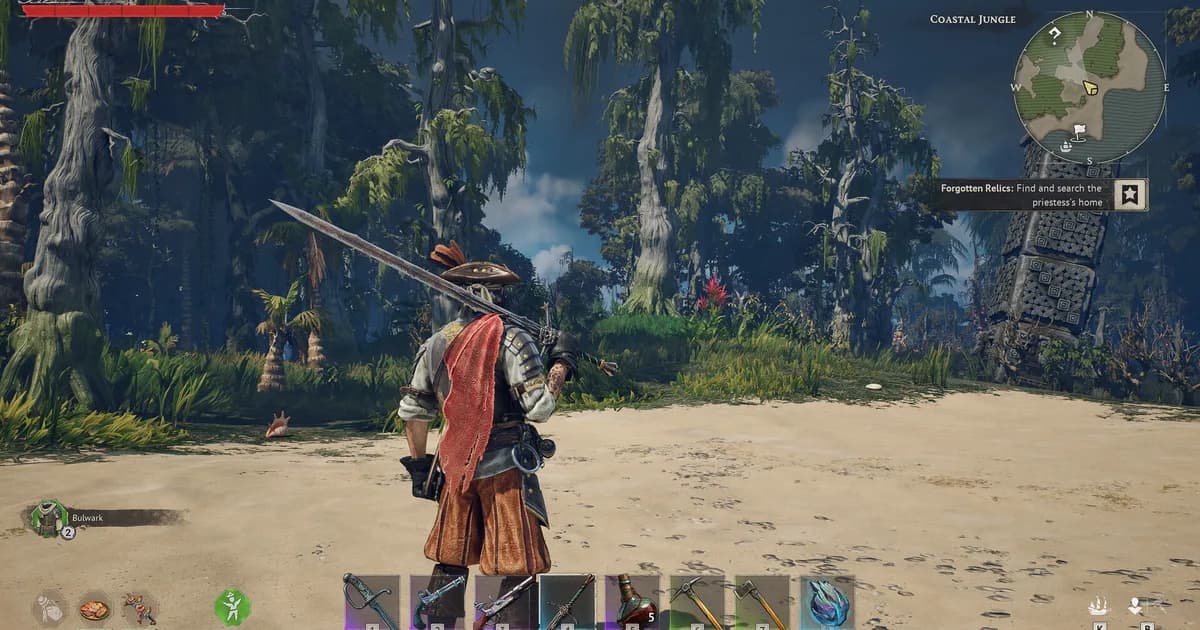
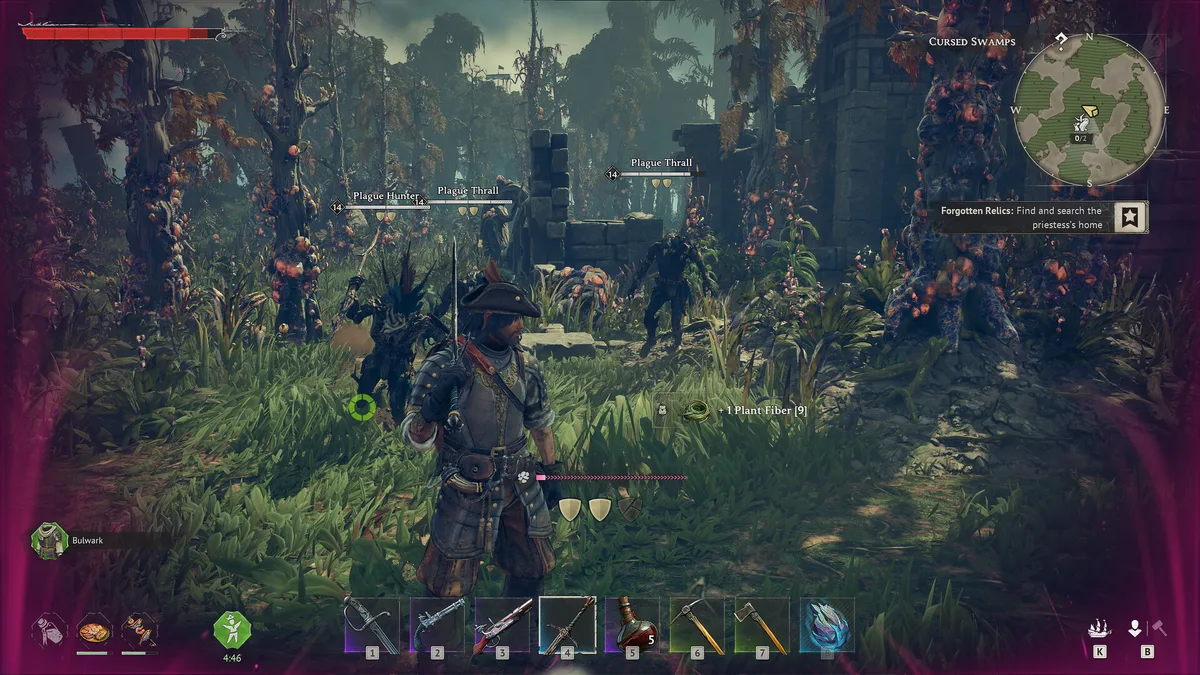 Level 14 Plague enemies in the Cursed Swamps, one level under the cap: this is where a named Rare or Epic weapon earns its place over a base Uncommon one. Screenshot: Steam store page
GODEEPER: Crafting costs and material locations for every weapon in this tier list. Windrose Crafting Guide →
S-Tier: Rapier
What it is: One-handed blade, Precision scaling, Pierce damage
Why it tops the list: The Rapier is the fastest parry-punish weapon in Windrose, and its speed means you're rarely caught mid-swing when an enemy telegraphs an attack. Windrose's combat runs on timed parries: the game's own loading tip says a Perfect Block costs you no Posture while your enemy loses theirs. A weapon fast enough to punish right after that block beats one that hits harder but leaves you exposed for an extra half-second.
The type's rarity ceiling backs this up. The Rapier of a Thousand Cuts, a Rare-tier named weapon, applies a stacking Bleed effect: up to 5 stacks, each dealing 25 damage per second, for up to 125 damage per second of pure damage-over-time layered on top of normal hits. At Epic rarity the same weapon adds a second passive: bleed damage dealt while you hold it restores Temporal Health, the grey bar you win back by attacking. The Rapier of Devastation works differently: light attacks build Plague marks up to a cap of 8, and a heavy attack consumes everything accumulated for bonus damage. The 40% max-health restore on consuming more than 5 marks with a heavy attack is an Epic-only addition; the Rare version does the bonus-damage conversion without the healing. The Sturdy Rapier, a third Rare drop, pushes the Perfect Block angle further still: it widens the Perfect Block timing window itself, and at Epic rarity adds a flat 20% Critical Damage bonus on top.
This holds up past the early game too. One max-level player on r/crosswind, with every weapon fully upgraded, reported a level-15 Sturdy Rapier landing over 1,000 damage per poke in zone 3, "killing enemies 4x faster than 1000cuts." Testing each weapon with its main stat maxed, the same player found the Rapier of Devastation doing four to five times the DPS of the other weapons and kept it for the zone-3 boss. That lines up with the mechanical reasoning above: Thousand Cuts' bleed is flat damage that gets outscaled as your Precision climbs, while Sturdy Rapier and Devastation both turn that same stat investment straight into more damage.
Best for: Single-target pressure, boss fights, any encounter where getting punished for a slow swing costs more than the extra damage was worth.
One caveat: The Rapier's single-target focus means it struggles in dense pirate camps where three or four enemies close in at once. That's the Saber's job.
S-Tier: Saber
What it is: One-handed blade, Agility scaling, Slash damage
Why it earns S: The Saber is cheap to make (7 Copper Ingot and 2 Rough Hide at the Weaponsmith Workshop), and its in-game description calls it "well-suited to hacking down foes on cramped ship decks," which is exactly where boarding fights happen. Unlike the Club and Halberd, it can Perfect Block, so it plays into the same parry loop as the Rapier. And Agility carries over if you later move to the Two-Handed Sword, which scales with the same stat.
The base Uncommon Saber (210 base damage, Slash type) is strong enough to carry a player through the Coastal Jungle and stay relevant into the Foothills without an immediate replacement. It's worth being precise here: Cutlass is not just an early name for the base Saber, it's a separate Rare-tier drop with its own passive, a stacking Take Aim! effect that builds up to 9 times and adds 10% bonus damage per stack to your next shot. Razor, another Rare Saber, adds a flat 10% base Critical Hit Chance instead. Arboris Saber is the type's one true scaling exception: it deals Crude damage and scales with Strength instead of Agility, and builds its own Plague Echoes stacks toward a 5-stack special attack, the same mechanic the Plague Halberd uses.
Best for: Boarding actions, early camp clears, players who want one weapon that doesn't need to be swapped out every biome.
One caveat: Against a single hard-hitting target, the Saber's damage per swing loses to the Rapier's speed and to the Greatsword's best named variants. Carry a second weapon for single-target fights if you can.
A-Tier: Musket
What it is: Two-handed firearm, Precision scaling, Pierce damage, long range
Why A-Tier: The base Musket hits hardest of any weapon type at 550 base damage, but a slow reload holds it back at Uncommon rarity. The Reliable Musket variant closes that gap in two steps: at Rare rarity it already reloads faster than any other Musket, and the Epic version keeps that reload speed and adds a flat 20% Critical Damage bonus on top, enough to push it toward S-tier performance on its own, especially for bosses where you can hit a weak point repeatedly. Musket rewards precision (headshots and weak-spot hits), which fits the Precision-scaling identity it shares with Rapier and Pistol.
Best for: Long-range engagements, bosses with exposed weak points, players willing to hunt for the Reliable variant.
One caveat: Reload speed is the type's real weakness at base rarity. A poorly timed reload in a pirate camp with multiple attackers closing in can get you killed. Pair it with a fast melee weapon (Rapier or Saber), not a Halberd or Club.
A-Tier: Blunderbuss
What it is: Two-handed firearm, Agility scaling, Pierce damage, close-range spread
Why A-Tier: The Blunderbuss is the best close-range option in the game despite having the lowest base damage of any weapon type. Our case for it in boss fights is simple: a point-blank spread lands in full on a single large hitbox, not just on groups. The Dragon's Breath variant adds fire damage on top, though its overall stopping power is closer to solid than exceptional once you're past the initial hit. The Reliable Blunderbuss trades raw damage (180 base at Rare) for a close-range knockdown chance on every shot, and its Epic version reduces the gunpowder each shot consumes, letting you fire more often before reloading.
Best for: Boss fights at close range, opening an engagement before enemies close the gap, situations where a burst of damage matters more than sustained DPS.
One caveat: It's a two-handed firearm with a spread pattern, so it loses most of its value at range and needs the same reload window as the Musket. Not a main-hand weapon for open-field fights.
B-Tier: Pistol
What it is: One-handed firearm, Precision scaling, Pierce damage, off-hand capable
Why B-Tier: The Pistol is a strong opener and headshot tool, not a main weapon. Drake's Double-Barreled Pistol can already fire two quick shots in succession at Rare rarity; the Epic version adds a Vulnerability effect on hit that increases all damage the target takes by 15%, which pairs well with a hard-hitting melee weapon. The Plague Pistol, which only exists at Epic rarity, restores 40% of dealt damage as health, turning a ranged shot into sustain mid-fight. The Reliable Pistol deserves a mention too: it fires 3 shots without reloading even at Rare rarity, and the Epic version adds 15% bonus damage against human enemies (pirates, outlaws, and similar), strong enough that Nitrado's tier list puts it in S-tier on its own. None of that changes the Pistol's overall placement here. Ammo pacing and modest per-shot damage keep the type a support pick rather than a carry.
Best for: Opening a fight with a debuff or a headshot before switching to melee, off-hand pairing with a one-handed Rapier or Saber.
One caveat: Ammo and reload pacing mean the Pistol can't sustain a full fight on its own the way Musket or Blunderbuss can at range.
B-Tier: Greatsword
What it is: Two-handed blade, Agility scaling, Slash damage
Why B and not higher: The baseline Greatsword you'll find early (simply named Two-Handed Sword) is genuinely average: modest effects, no standout passive at Uncommon rarity. That's what keeps the type out of a blanket A-tier recommendation.
Why it's still worth building toward: The type's rarity ceiling is one of the highest in the game. Soul Eater, a named Rare Greatsword, is the reward for beating Israel Hands, the second boss, and game.wiki also lists a Weaponsmith Workshop recipe (10 Copper Ingot, 2 Rough Hide, 7 Undead Essence) and Cursed Swamps crypt chests. Its special attack (F key, 3-minute cooldown) drains Health from nearby enemies. Its base scaling is Agility, like the rest of the Greatsword line, and the Epic version adds a further layer: the special attack's damage additionally scales with Vitality, a stat that doesn't touch weapon damage on any other named weapon in this list. Greatswords also deal high posture damage, enough to stagger humanoids and break Boatswain-tier guards, and the Codex Wiki calls the type its cleanest pick for High Priestess weak-spot windows.
Best for: Players who found or crafted a good named Greatsword. Skip it at base rarity in favor of a Saber or Rapier until you have one.
One caveat: This is the least consistent type in the tier list. A plain Two-Handed Sword is a mediocre stick; Soul Eater is one of the strongest weapons in the game. That gap is why it's B and not A.
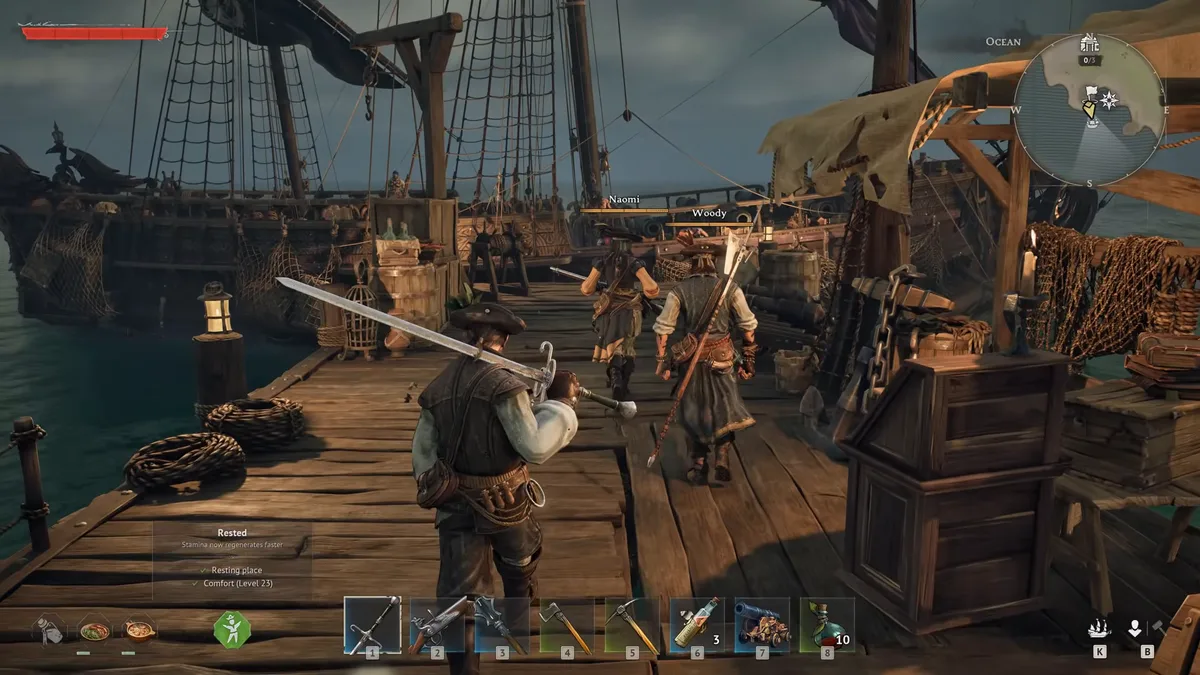 Greatsword on the shoulder, halberd on a crewmate's back: the two long weapons trade swing speed for reach and posture damage. Screenshot: Windrose Early Access Release Date Reveal Trailer (official)
B-Tier: Halberd
What it is: Two-handed polearm, Strength scaling, Crude damage, long reach
Why B-Tier: The Halberd's reach is its whole case: it keeps you out of retaliation range against enemies that grab or lunge, which the shorter weapons can't do. It shares the Club's biggest weakness, no Perfect Block, but the reach advantage against grab and lunge enemies is enough to keep it a tier above. In co-op it can do better than B suggests: one r/crosswind player says their group's Strength user with a halberd "is the undisputed king of boarding actions."
The Plague Halberd is the exception. Dealing damage builds Plague Echoes stacks, and at five stacks you unlock a special [F] attack. At Epic rarity that same special attack instantly restores 35% of your maximum health, turning the Plague Halberd from a damage tool into a sustain tool mid-fight. P4wnyhof, who tests it in the video below, calls it "easily one of the best weapons, if not the best weapon in the game," for boarding and bosses alike. The Executioner variant stacks a Decimation effect on kills, +10% Critical Hit Chance per stack up to a 30% cap (3 stacks), and its Epic version layers on an Apathy effect while Decimation is active, adding 10% Damage Resistance on top of the crit boost.
Best for: Enemies with grab or lunge attacks, players who found a Plague Halberd or Executioner and want to build around it.
One caveat: Swing speed is the tradeoff for that reach. Against fast, low-HP enemies, a Saber clears the same room faster.
P4wnyhof runs the special-attack weapons (Plague Halberd, Arboris Saber, Rapier of Devastation, Soul Eater, Plague Pistol) through damage tests and shows which gear and talents actually scale each special:
GODEEPER: The combat guide covers which attacks to dodge vs. block for each weapon type and how gear choice interacts with enemies. Windrose Combat Guide →
C-Tier: Club
What it is: One-handed blunt weapon, Strength scaling, Crude damage. The base item is named Club in Windrose DB; some third-party guides call the type Mace.
Why C-Tier: The Club shares the Halberd's weakness (no Perfect Block) without the Halberd's reach to compensate. Windrose's combat is built around timed parries, and a weapon that can't take part in that system is fighting the game's core combat loop instead of using it. One Steam player who tried it found out the hard way: "Got in a fight expecting to parry with the club and got stun-locked instead."
Named variants help less here than with other types. Sturdy Mace adds a flat +1 Posture Point and, at Epic rarity, cuts the Stamina cost of attacks by 15%. Bonebreaker, Crusher, and Swamp Creature's Tooth each bring their own effect, but none of them fixes the core problem: no Perfect Block, no reach to fall back on, no way to reliably no-hit a camp clear the way a Rapier or Saber can.
Best for: Early exploration before you've found a Saber or Rapier. Replace it as soon as you can.
One caveat: In co-op, if a teammate is already covering parry-punish duty, a Club's raw Crude damage against armored targets is still usable in a support role. It's a C-tier weapon, not a last-resort one.
F-Tier: Tools as Weapons
Copper Axes, Iron Pickaxes, and every other gathering tool in Windrose can technically swing at an enemy, and the Codex Wiki lists real attack power for them (a Copper Axe sits at 140, an Iron Axe at 200), but none of them are weapons. They're gathering tools that happen to deal some damage as a side effect, and the gap between a tool's attack power and even a base-rarity dedicated weapon's damage number is large enough that fighting with a Pickaxe should only happen if you were ambushed with nothing else equipped.
There is no Sword or Battleaxe category in Windrose's weapon filters. Axes are gathering tools first. The eight dedicated weapon types, Rapier, Saber, Club, Halberd, Greatsword, Pistol, Musket, and Blunderbuss, cover every combat role a tool was never built for.
This tier isn't F for novelty. Every point of Copper or Iron spent keeping a tool in your weapon slot is a point not spent on the Weaponsmith recipe that actually solves the problem.
Honorable Mentions
Fists: Windrose technically lets you fight unarmed. It's not viable past the tutorial, but it's there if you lose every weapon slot mid-fight and need to survive one more swing.
Rare and Epic named weapons: Named weapons come with real passive effects, and they change the tier ranking more than the base type does. A Rare Rapier of a Thousand Cuts or a Rare Soul Eater outperforms a fresh Uncommon weapon of a "better" type. If you find a strong named weapon early, use it rather than chasing the theoretical S-tier type.
Ship Cannons: Not a personal weapon, but the dominant damage source for naval encounters. Cannons scale from 12lb to 24lb to 36lb across ship classes, with only the Frigate able to mount the 36lb tier. See the Windrose ship building guide for the full progression, which runs on its own upgrade path separate from personal weapon tiers.
Frequently asked questions
What is the best weapon in Windrose? Rapier and Saber are both S-tier, the strongest weapon types in the current build. Rapier wins single-target and boss fights; Saber is the boarding and early-camp pick.
Do weapons deal more damage than tools in Windrose? Yes. All eight dedicated weapon types significantly outdamage gathering tools like Axes and Pickaxes, even though tools carry a small attack stat of their own.
What is the best early-game weapon in Windrose? Saber. The base Uncommon version is cheap to craft, can Perfect Block, and stays useful well into the Foothills. Cutlass is a separate Rare-tier Saber with its own damage passive, not just an early name for the base Saber.
Is the Rapier better than the Saber in Windrose? For single targets and bosses, yes. For boarding fights and early camps, we'd take the Saber. Most players carry both.
Should I upgrade weapons or tools first in Windrose? Tools first, to fund gathering. Then prioritize a Saber or Rapier before anything else in the weapons category.
Does Windrose have ranged weapons? Yes. The Steam store page names pistols and muskets, and the item database adds the Blunderbuss. There's no bow, but all three ranged roles are covered.
Can you upgrade a weapon's rarity in Windrose? Only for named weapons. Base Uncommon types stay Uncommon; named Rare weapons ascend to Epic at the Weaponsmith Workshop with Tumbaga Ingots from ruin chests, most densely in the Foothills.
Is there a Machete weapon type in Windrose? Windrose DB lists Machete as a filterable weapon type, but no Machete item has dropped or been catalogued in the current browse. It's an unreleased or planned type, not a weapon available right now.
How we checked this
Every stat and effect above was checked on October 20, 2026 against Windrose DB's weapon browse (game version 0.10.0.9) and game.wiki's item pages, which also give recipes, scaling stats and where each weapon drops. Rankings are our call, weighed against max-level community testing on r/crosswind, P4wnyhof's video and Nitrado's named-weapon tier list. Two limits: the Perfect Block rule for Crude weapons comes from players on the Steam forums, not from patch notes, and the video dates from April 23, before the July and August patches, so its exact damage numbers may have moved.
Correction (2026-10-20): Since July this guide said weapons climb from Uncommon to Rare to Epic, and that the current balance patch favors fast Precision and Agility attacks. Only named Rare weapons ascend to Epic; base Uncommon weapons stay Uncommon, so don't hold Tumbaga Ingots for a plain Saber or Club. No patch note makes that balance call either, so the Club's last place now rests on its missing Perfect Block. We also corrected the Rapier of a Thousand Cuts' Epic heal, which restores Temporal Health rather than regular Health.
Related Reading
New to Windrose? The Windrose beginner guide covers which tools and weapons to prioritize in the first few hours before you're making informed tier-list decisions.
The biome you're in shapes which weapons matter most. The Windrose Ashlands biome guide covers what's confirmed so far about the next biome, due this winter.
Boss fights stress-test your weapon choice. The Windrose boss guide covers which bosses require sustained single-target damage (favoring heavy weapons) versus ones where swing arc and speed matter more.
Your weapon is only half a build. The Windrose combat guide covers the gear, stats, and fighting-style choices that turn a strong weapon into a working build.
The Windrose ore respawn times guide covers how to keep your crafting materials flowing, which becomes the limiting factor once you're upgrading to Iron-tier gear.
- Windrose Guide 2026: All Biomes, XP, Factions & Ships: every biome including the Cursed Swamps, the High Priestess fight, and the main progression path.
- Windrose Thomas Richards Boss Guide: How to Beat Richards: Copper-tier gear check, poise shield mechanic, all 4 attack patterns, and arena cover routing.
- Windrose Armor Guide: 6 Rare Sets, Bonuses and Upgrade Order: three tiers, five slots, and the 30-40% efficiency gap in the Swamps for mixed Iron-Steel loadouts.
- Windrose Talent Tree Guide: Best Talents and Builds 2026: current level-15 totals of 12 Talent Points and 45 Stat Points, plus branch priorities for progression.
- Windrose Foothills Guide: Camps, Iron Gear, Israel Hands: levels 6-10, Iron crafting chain, Veteran Corsair camp circuits, and Israel Hands strategy.
- Windrose Max Level 15: Fastest XP Paths in Early Access: Windrose max level is 15 in Early Access.
- Windrose Endgame Guide: What to Do After the Story: Windrose endgame guide: faction Level 3 priority order, Frigate build-out, Steel gear farming loops, and.
- Windrose Faction Tier List 2026: which factions and reputation rewards deserve priority while you build around a weapon type.
- Windrose Faction Quests and Reputation Guide: how faction progress unlocks the materials and routes that feed a weapon upgrade plan.
- Windrose Naval Tactics Guide: ship combat positioning and cannon choices for fights where personal weapons are not enough.
- Windrose Multiplayer Tips Guide: co-op roles, shared progression, and group decisions that change which weapon loadout is useful.
- Windrose Voice Chat and Ping Guide: how Windrose handles team communication when a weapon swap or retreat needs calling out.
- Windrose Updates Tracker: Every Patch Since Launch 2026: Windrose updates tracker: every patch and hotfix since the April 14 launch, what each one.
- Windrose Comfort Level Guide: how Comfort feeds the Rested buff you want before a hard fight.
- Windrose Israel Hands Boss Guide: the Foothills boss and the weapon tier that handles him.
References
- Windrose on Steam: official Early Access page, patch notes, and developer announcements
- Windrose: Kraken Express official Steam announcement post
- Windrose DB weapons database: current item-level stats, rarity, damage type, and weapon-type filters
- Windrose Codex Wiki weapons and tier notes: community tier reasoning cross-referenced for this list
- Windrose community on Reddit: r/crosswind is the active player community (r/Windrose is a metal band)
- Windrose weapon balance discussion on r/crosswind: max-level community damage testing across weapon types, cited in the Rapier section above
- game.wiki Windrose weapons: recipes, scaling stats and loot sources for every weapon, including Soul Eater
- game.wiki Windrose combat: Perfect Block, Posture, Temporal Health and stat effects
- Parrying/Perfect Block With Halberd, Steam discussion: players reporting that Crude weapons can't Perfect Block
- Nitrado's Windrose weapon tier list: named-weapon rankings, including the Reliable Pistol at S
- Windrose BEST Weapons Tier List, Special Attacks are Broken!, P4wnyhof: damage tests of the special-attack weapons, embedded above
About the author

Indie & JRPG Desk
GameBrief's byline for indie, JRPG, visual novel and cozy games. Warm, direct, and willing to say which one to buy.
- Indie, JRPG and visual novels
- Early access and survival
- Sources listed per article
Keep reading
Windrose Ship Building Guide: Ketch, Brig and Frigate
General · 10 min
Windrose Faction Tier List 2026: Best Order to Level
General · 11 min
Windrose Endgame Guide: What to Do After the Story Ends
General · 10 min
Windrose In-Game Chat: Voice Chat, Proximity Chat & Discord
Guides · 6 min
Windrose Comfort Level Guide: Max Comfort and Rested Buff
General · 6 min
Windrose Leveling Tips: Max Level 15, Fastest XP Path
General · 9 min
Sponsored
Disclaimer
This article is published for informational and entertainment purposes. It does not constitute professional financial, legal, or technical advice. Game performance, online services, patch schedules, and store listings change. Verify critical details (pricing, system requirements, regional availability) with publishers and storefronts before you buy. Affiliate links, where present, help support our editorial work and are labelled in our affiliate disclosure.
Comments
Loading comments…