
GameBrief · Guides
Windrose Cooking Guide: Fire Pit, Food Buffs, Camp Tips

Reviewing
Windrose
This Windrose cooking guide skips the recipe list and focuses on what most players miss: the Fire Pit does two things at once, and understanding both changes how you set up your base camp entirely.
TL;DR: The Fire Pit costs 10 wood and 5 stone. Build it near your bonfire (it counts as a comfort item, helping you reach the comfort level 5 threshold for the Rested buff. Food buffs from cooking extend your effective health pool in fights. Cook before every boss attempt and major camp run. Stack cooking buffs with the Rested buff and your consumable stack) they're all independent systems that work together.
I spent about four sessions treating the Fire Pit as a nice-to-have. Cook a fish or whatever, eat it, forget it existed. Then I was reading about the comfort system for the Rested buff and realized I'd been building my bonfire setup wrong: the Fire Pit was sitting across the camp instead of next to the bonfire, contributing nothing. That's the mistake this guide is here to prevent.
Windrose Cooking Guide: Key Takeaways
- Fire Pit cost: 10 wood, 5 stone: one of the cheapest quality-of-life builds available
- Dual function: it's a cooking station AND a comfort item (decoration category); place it near your bonfire
- Food buffs extend your effective health pool before fights: not a heal, a ceiling increase
- Rested buff (comfort level 5 bonfire) and food buffs are separate systems; activate both before fights
- Comfort level 5 = 5 comfort items near the bonfire; the Fire Pit counts as one of those slots
- Cook before every boss fight and every major camp run: the buffs costs nothing beyond basic materials
- Food items don't expire: cook more than you need for a session and carry the rest
Why Most Players Treat Windrose Cooking as Optional
There's a pattern I've seen repeatedly in the early hours of Windrose. Players pick up the cooking mechanic, see the Fire Pit cost, build it somewhere in their base camp, make a couple of food items, and then... mostly ignore it.
The reason is that the game never explains clearly what food buffs actually do in a fight. If you think of cooked food as a healing item, it doesn't seem worth the prep. Healing Potions are faster and more immediate. Why bother cooking?
The answer is that food buffs and Healing Potions are doing different jobs. A Healing Potion restores health you've already lost. A food buff starts the fight with a larger health pool before you've taken any damage. Against the High Priestess (who puts plague DoT, AoEs, and adds on you simultaneously) a larger starting health ceiling means more time to respond before the situation becomes critical. That's not a redundancy with Healing Potions; it's a layer underneath them.
The other thing players miss is the Fire Pit's comfort category. Which brings me to the mechanic that actually changed how I play.
Building the Fire Pit
The Fire Pit costs 10 wood and 5 stone. Both materials are immediately available in the Coastal Islands starting area: wood from trees, stone from cliff faces and rock nodes. No crafting level gate, no prerequisite buildings. If you have the materials, you can build it.
The build order that works: place the Fire Pit during your first or second session, before you've worried about advanced crafting. The material cost is negligible and the session preparation habit it enables is worth establishing early.
One limitation: the Fire Pit only works at its placed location. You can't cook in the field, mid-camp-run, or while sailing. Cook at base before your session. Carry the food with you.
Note: Cooked food doesn't expire in the current Early Access build. If you cook more than you need for a session, it stays in your inventory. Batch cooking before long sessions is worth the habit.
The Comfort Station Trick
Here's the part most guides skip.
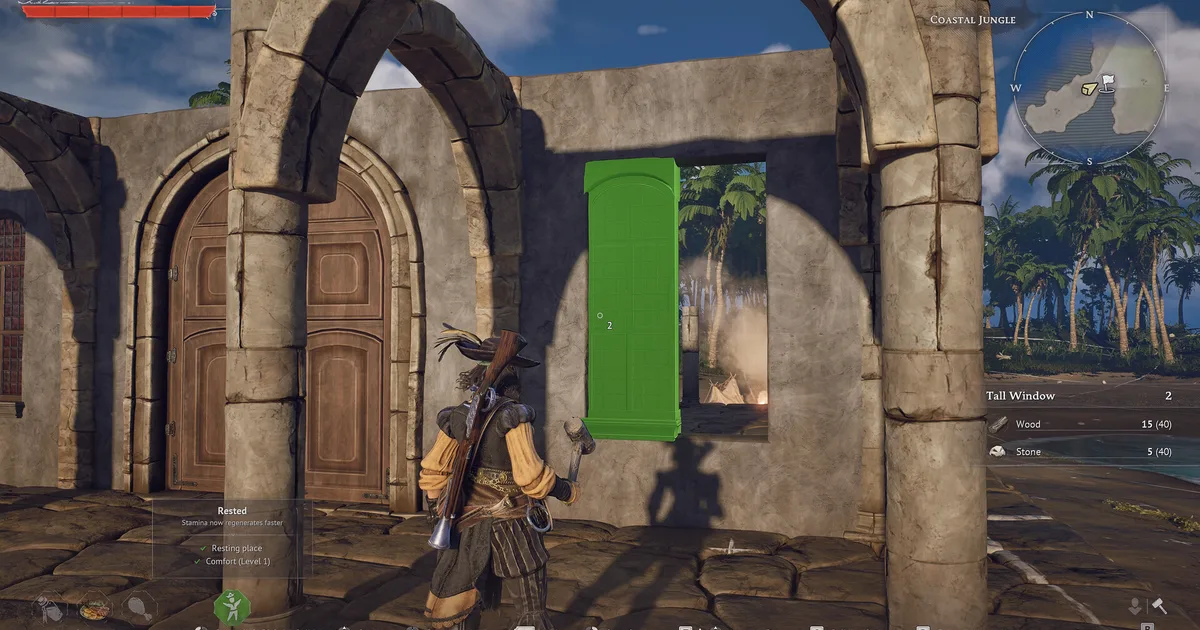
The Fire Pit is categorized as a decoration in Windrose's comfort item system. That means placing it near your bonfire contributes to your camp's comfort level: the same comfort level you're building toward for the Rested buff.
Comfort level 5 requires five comfort items placed near the bonfire. Five shells from the beach do the job, and they're free. But if you're setting up a proper base camp with functional buildings anyway, the Fire Pit earns its slot as one of those five items. One building, two functions: cooking station plus comfort contributor.
The Rested buff at comfort level 5 gives 2.5x stamina regen for around 15 minutes per session (long enough for a full pirate camp run. Stamina controls everything in combat) attacks, dodge rolls, ability use. That buff at zero ongoing cost is one of the highest-value things your base camp produces. Any building that helps you reach comfort level 5 is worth building. The Fire Pit happens to also feed you.
The placement matters. Comfort items need to be near the bonfire, not across the camp. If your Fire Pit is sitting 30 meters away from the bonfire, it's not contributing to the comfort radius. Put it in the bonfire cluster.
GODEEPER: The complete pirate camp prep loop, Rested buff setup, Fast Travel Point strategy, and XP optimization, is in the farming guide. Windrose Pirate Camps Farming Guide, XP Loop & Respawn →
Place the Fire Pit in the bonfire cluster (not across camp) so it contributes to the comfort level that unlocks the Rested buff.
Food Buffs in Fights
Food buffs in Windrose extend your effective health for a duration. Consuming a cooked food item before entering a fight gives you a larger health pool than your base HP for that buff's duration. Specific values change between Early Access patches, but the mechanic is consistent.
The fight where this matters most is the High Priestess. She spawns Plague Thralls throughout the fight, and they apply damage-over-time plague effects on hit. Even one or two plague stacks drain health faster than direct attacks. A food buff going into that fight means more effective health before the Plague Thralls start stacking, which means more time to consume anti-plague consumables before the DoT threat becomes unmanageable.
The food buff, Rested buff, and Elixir of Pain Relief all stack. They're independent systems:
- Rested buff: 2.5x stamina regen (from bonfire at comfort level 5)
- Food buff: extended health ceiling (from cooked food)
- Elixir of Pain Relief: passive damage reduction (consumed before fight)
- Healing Potions: reactive health recovery (used during fight)
All four active simultaneously is the complete pre-fight preparation stack. Most players only use one or two by default.
GODEEPER: How all three story bosses interact with your consumable preparation (gear check, fight mechanics, and what to bring. Windrose Boss Guide) Richards, Israel Hands, High Priestess →
Full consumable stack before a boss fight: Rested buff from bonfire, food buff from Fire Pit, Elixir of Pain Relief, Healing Potions, anti-plague items. Each one is independent.
Step-by-Step: Using This Windrose Cooking Guide Before Every Session
The cooking and buff loop has a specific sequence: getting the order wrong wastes the food buff duration on travel time. Here's the exact routine.
-
Check your Fire Pit supply before leaving base. Cook a batch of food items if inventory is running low. Cooked food doesn't expire, so batch cooking every few sessions is fine: you don't need to cook every session if you have supply.
-
Activate the Rested buff at your bonfire. You reach the 2.5x Rested buff at comfort level 5: place items from five different decoration categories near the bonfire. Duplicates of the same item only count once (five identical shells register as a single point), so vary them: a shell, a torch, a chair, a rug, and so on. The Rested buff gives 2.5x stamina regen, and its duration grows with your comfort level. Activate it just before you leave, not hours earlier.
-
Check your full consumable stack before departing. Healing Potions, anti-plague consumables if heading to the Cursed Swamps, and Elixir of Pain Relief. This is the same checklist every session: build the habit at base, not at the fight.
-
Fast Travel or sail to your first objective. Don't eat the food buff yet. The buff has a limited duration and you don't want to burn it on transit time.
-
Eat the food buff immediately before your first fight. Not when you arrive at the island: when you're about to pull the first enemy. This keeps the extended health ceiling active for the fights that actually need it.
-
In boss fights, stack all four systems simultaneously: Rested buff (from bonfire), food buff (from Fire Pit), Elixir of Pain Relief, and Healing Potions available for during the fight. All four are independent systems that work together: using fewer than all four is leaving margin on the floor.
The Rested buff activates at base and persists through the session window. The food buff activates at the fight. Both should be active for boss encounters and major camp runs.
Session Prep Routine
The question that comes up a lot: when do you eat the food buff?
Not at base camp before you leave. Eat it at your first objective, right before you start fighting. If you eat the buff while prepping at base and then spend 10 minutes sailing to island 2, you've burned part of the buff duration on travel. Pop it when you arrive.
The bonfire Rested buff activates at the start and lasts the full session. The food buff has a shorter window: time it to your first engagement.
Tips for Getting the Most from the System
Build the Fire Pit in session one, not session three. The material cost is nothing and the habit of pre-session cooking has immediate returns. I waited too long my first playthrough and missed the food buff going into the Richards fight where I actually needed it.
Place it in the bonfire cluster, not wherever there's open space. Comfort items need to be near the bonfire to count toward your comfort level. This sounds obvious, but I've seen enough base camp screenshots with the Fire Pit sitting 30 meters from the bonfire to know it's a real mistake.
Cook more than you need each session. Cooked food doesn't expire. I do a batch every few sessions: cook until my inventory has a comfortable supply, then forget about it until I'm running low. No daily micro-habit needed.
Food buffs are worth using on pirate camp runs, not just boss fights. The Rested buff plus food buff combination makes camp clears smoother because you take hits more efficiently without breaking the loot loop for a Healing Potion. The buff has a long enough duration to cover a full camp circuit.
Don't eat the food buff when you activate the Rested buff at base. Rested buff: activate before leaving. Food buff: eat right before the first fight. They last different amounts of time, and the food buff is wasted on the sailing trip. Get the timing right and both are active for your most important fights.
Frequently asked questions
Q: How do you cook in Windrose? A: Build a Fire Pit (10 wood, 5 stone) at your base camp. Interact with it to open the cooking interface and select available recipes. Cooked food goes into your inventory. You can't cook in the field: only at a placed Fire Pit.
Q: What does the Fire Pit cost in Windrose? A: 10 wood and 5 stone. Available immediately from trees and rocks in the Coastal Islands starting area. No crafting level required.
Q: Is the Fire Pit a comfort item in Windrose? A: Yes. It's categorized as a decoration in the comfort item system. Placing it near your bonfire contributes toward the 5-item comfort level 5 threshold that unlocks the Rested buff.
Q: What do food buffs do in Windrose? A: They extend your effective health pool for a duration. Not a heal: a pre-fight ceiling increase. Consuming cooked food before a fight gives you more health to work with before Healing Potions become necessary.
Q: How does cooking stack with the Rested buff in Windrose? A: They're independent. The Rested buff (2.5x stamina regen) comes from the bonfire at comfort level 5. Food buffs come from the Fire Pit. Both can be active simultaneously and should be for boss fights.
Q: Can you cook in the field in Windrose? A: No. Cooking requires a placed Fire Pit at your base camp. Cook before your session and carry food with you. Cooked items don't expire, so batch cooking works well.
Q: Does the Fire Pit count toward comfort level in Windrose? A: Yes. It's a decoration/comfort item. Place it near your bonfire and it counts as one of the five comfort items needed for comfort level 5 and the Rested buff.
References
- Windrose on Steam: official Early Access page; cooking mechanics and specific recipe values may update between patches
- Windrose Steam Community: player discussions on Fire Pit placement, comfort level setup, and food buff timing
Related Reading
For the full base camp setup (bonfire, comfort level, and the daily XP loop the Rested buff enables) the Windrose Pirate Camps Farming Guide covers the complete pre-session routine.
Food buffs fit into the same consumable stack as boss fight preparation. The Windrose Boss Guide covers the full consumable list for Richards, Israel Hands, and the High Priestess: where food buffs make the biggest difference.
Setting up your first base camp and not sure where to start? The Windrose Beginner Guide covers first-session priorities, including the first buildings to place and why the comfort system is worth understanding early.
The Rested buff that food supports comes from your camp's comfort level. The Windrose Comfort Level Guide covers how to max comfort and keep the Rested XP buff active between sessions.
- Windrose Foothills Guide: Camps, Iron Gear, Israel Hands: Windrose Foothills guide: levels 6-10, Iron crafting chain, Veteran Corsair camp circuits, Israel Hands strategy, and which faction....
- Windrose Naval Tactics Guide: All 5 Tactics Ranked 2026: Windrose naval tactics guide: the real 5 options (Ambush, No Quarter, Stretch The Supply, Shipshape, Silence the Guns), cannon rotation technique,....
- Windrose High Priestess Boss Guide: Cursed Swamps Fight: Windrose High Priestess boss guide: how to beat the Cursed Swamps endgame boss, destroy her pustules, dodge the....
- Windrose Next Update: 40+ Building Pieces & 50 QoL Fixes: The Windrose next update isn't Ashlands. It's an interim patch adding 40+ new building pieces and 50+ QoL....
- Windrose Ashlands: Everything Confirmed So Far (2026): Windrose Ashlands release date: Kraken Express said 'at least 6 months' on April 29, so.
- Windrose Endgame Guide: What to Do After the Story: Windrose endgame guide: faction Level 3 priority order, Frigate build-out, Steel gear farming loops, and.
- Windrose Best Weapons Tier List 2026: All Tiers Ranked: Windrose best weapons tier list 2026: Steel Halberd S-tier, Copper Sword B, Stone tools F.
- Windrose Faction Guide: All Factions and How to Progress: Windrose faction guide: all four factions covered, Journal quest XP system explained, Insignia types, which.
Was this guide helpful?
About the author

Indie & JRPG Critic
Indie game evangelist and lifelong JRPG fan covering small studios since 2017. Mumbai-born, London-based. Writes the way she talks.
- 7 years indie games coverage
- JRPG and visual novel specialist
- Narrative design focus
Keep reading


Disclaimer
This article is published for informational and entertainment purposes. It does not constitute professional financial, legal, or technical advice. Game performance, online services, patch schedules, and store listings change. Verify critical details (pricing, system requirements, regional availability) with publishers and storefronts before you buy. Affiliate links, where present, help support our editorial work and are labelled in our affiliate disclosure.
Comments
Loading comments…