
GuideWindrose
Windrose Armor Guide: 6 Rare Sets, Bonuses and Upgrade Order
This Windrose armor guide covers the six rare bonus sets commonly listed by current community databases, the reported 2-piece and 4-piece effects, and how to verify a recipe before buying or upgrading. Survivor and common armor also exist, so “all sets” needs a qualification. Windrose armor identity comes from the named set you are wearing, not only its material, and from the faction vendors and drops available in your build.

Sponsored

About the game
Windrose
Kraken Express
TL;DR: Current community references list six rare bonus sets: Conquistador, Pikeman, Flibustier, Tracker, Privateer, and Marksman. Survivor and common pieces are separate gear families. The table below is a community/in-game snapshot, not a complete official stat sheet; verify vendor rank, price, material, and tooltip values in the current Armor and Clothing Workshop before committing.
BESTPRICE: Want Windrose? These stores list it: Buy on Eneba → Buy on Loaded →
Windrose armor guide: quick answer
Windrose armor includes a Survivor/common gear family plus six rare sets frequently listed with 2-piece and 4-piece effects: Conquistador, Pikeman, Flibustier, Tracker, Privateer, and Marksman. The exact bonuses below come from community-maintained references and observed tooltips, not a complete official table. Which piece you want depends on your build and the live recipe screen, not just your current biome.
Five slots per character: helmet, chest, arms, legs, boots. Seven gear slots total when you include the primary weapon and firearm (weapons follow their own separate Uncommon/Rare/Epic rarity ladder, not the armor set system).
The 6 commonly listed rare bonus sets:
| Set | Faction vendor | 2-piece bonus | 4-piece bonus |
|---|---|---|---|
| Conquistador | Smugglers of Port Royal | +15% damage resistance | Bulwark (early hits don't interrupt actions) |
| Pikeman | Smugglers of Port Royal | +160 max health | +15% two-handed weapon damage |
| Flibustier | Rogue Buccaneers | Attacks cost 20% less stamina | +15% one-handed weapon damage |
| Tracker | Rogue Buccaneers | +35% healing effectiveness | +15% damage resistance |
| Privateer | People of Tortuga | +10% critical hit chance | +10% crit damage per nearby enemy, up to 30% |
| Marksman | People of Tortuga | -30% sprint/jump/dash stamina cost | +15% ranged damage |
The table is a current community/in-game snapshot. It omits Survivor and common pieces because they do not appear in the same six-set bonus list. Rank 2 vendor plans and 200 Piastre prices are reported for specific pieces, but the official Steam page does not guarantee that every set piece follows that route. Check the live vendor and recipe tooltip before treating a price, drop source, or bonus as universal.
Sponsored

Current status: September 2026
Windrose remains in Early Access. The official Steam page describes three biomes, around 30 procedurally generated islands, more than 90 handcrafted points of interest, three ships, armor, weapons, talents, factions, and up to eight-player co-op. It also gives a broad Early Access expectation of 1.5 to 2.5 years and around 50% more content, not a fixed 1.0 date.
The latest official patch reference is 0.10.0.9, whose notes include cannonball collision/damage fixes against the stern, sails, and hull. The Ashlands preview remains work in progress and says the final lineup may change. Because armor values and set sources are not fully published by the developer, use the Workshop and vendor tooltips as the final authority for a live save.
Step-by-Step: choose and verify Windrose armor
- Identify the job. Decide whether you need survivability, one-handed or two-handed damage, ranged mobility, healing value, or crit scaling.
- Check the live item family. Separate Survivor/common pieces from the six rare bonus sets before comparing a tooltip.
- Verify the source. Read the current vendor, Workshop, reputation, price, and material requirements in-game; community tables are reference points, not patch-proof data.
- Test the smallest commitment. Try a two-piece bonus or one upgrade first, then compare the result before buying a full five-slot collection.
GODEEPER: The five armor slots pair with a primary weapon and firearm for seven total gear slots. Here's how weapon choice affects which armor set actually fits your build. Windrose Best Weapons Tier List: All Tiers Ranked →
Key takeaways
- 6 commonly listed rare bonus sets, plus separate Survivor/common gear: Conquistador, Pikeman, Flibustier, Tracker, Privateer, Marksman
- Five armor slots: helmet, chest, arms, legs, boots (seven total with weapon and firearm)
- Specific Rank 2 vendor plans and 200 Piastre prices are reported for some pieces; verify the live vendor rather than assuming every set follows the same route
- Conquistador and Pikeman come from Smugglers of Port Royal; Flibustier and Tracker from Rogue Buccaneers; Privateer and Marksman from People of Tortuga
- Upgrade materials differ by set type: Ingots (Copper/Iron/Mire Metal) for Conquistador and Pikeman, Leather for Flibustier and Tracker, Cloth and Linen for Privateer and Marksman
- Mixing 2 pieces from two sets to stack two different 2-piece bonuses is a common, viable hybrid build
- Community references also report POI drops, but the exact set-to-location table is not official and can change
Conquistador and Pikeman: Smugglers of Port Royal (tank sets)
Community references associate Conquistador and Pikeman with the Smugglers of Port Royal and metal-oriented recipes. Some Rank 2 plans are reported at 200 Piastre, but the vendor does not establish a universal complete-set purchase rule. Check the current crafting guide and Workshop for the live Copper, Iron, Mire Metal, and other material requirements instead of copying an old ratio.
Conquistador is the pure defense set. Its 2-piece bonus grants +15% damage resistance, and the 4-piece bonus is Bulwark, which stops the first few hits you take from interrupting whatever action you're mid-swing on. That's a genuinely different kind of survivability than a flat damage reduction number: it keeps your own attacks and heals from getting cancelled in a crowd.
Pikeman trades pure mitigation for a bigger health pool and offense. Its 2-piece bonus is +160 max health, and the 4-piece bonus adds 15% two-handed weapon damage. If you're running a Halberd or similar two-handed weapon, Pikeman's 4-piece turns your armor into a damage stat, not just a defense stat.
Common hybrid build: 2 pieces of Conquistador plus 2 pieces of Pikeman gives you both 2-piece bonuses (damage resistance and bonus health) without committing to either 4-piece effect. This is the most frequently recommended tank setup in community discussion for players who haven't settled on a single damage type yet.
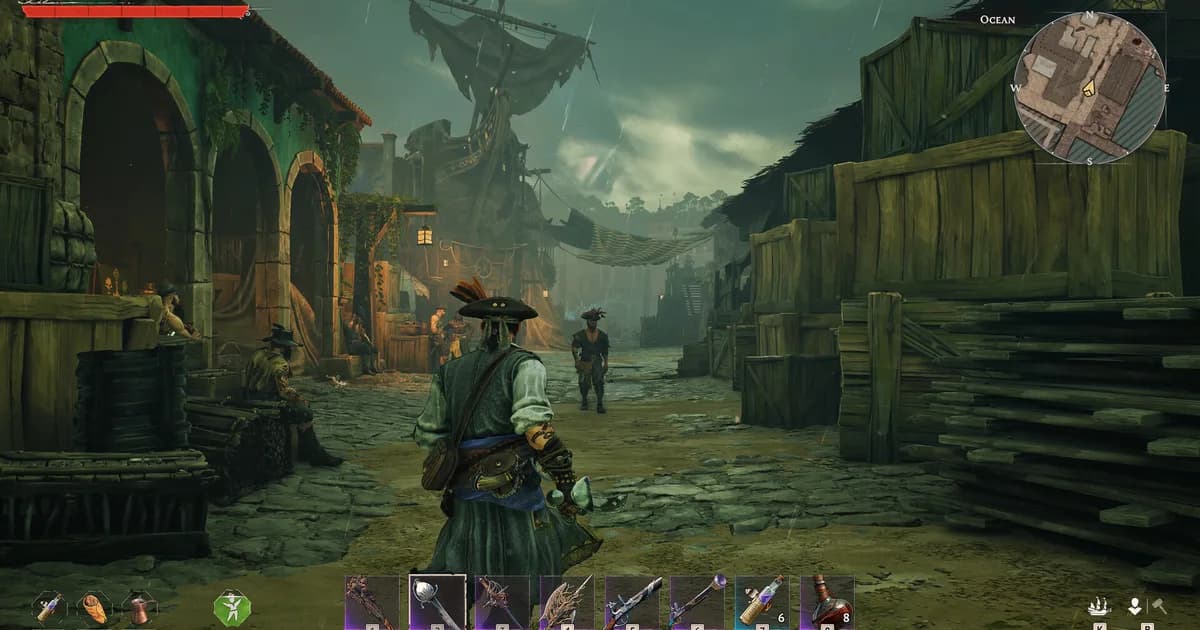
Faction vendors and their rank-gated plans are useful starting points; this image does not prove a Level 2 unlock, a price, or a complete set source.
Flibustier and Tracker: Rogue Buccaneers (melee and sustain sets)
Community references associate Flibustier and Tracker with the Rogue Buccaneers. Leather is commonly reported for relevant pieces, but verify each current Workshop recipe rather than treating the material family as universal.
Flibustier is built for one-handed melee builds that want to stay mobile. Its 2-piece bonus cuts attack stamina cost by 20%, and the 4-piece bonus adds 15% one-handed weapon damage. This is the set for a Rapier or Cutlass build that leans on attack frequency over single big hits.
Tracker is the sustain option. Its 2-piece bonus increases all healing effectiveness by 35%, which applies to potions, Elixirs, and any other healing source, and the 4-piece bonus adds 15% damage resistance on top. Tracker doesn't deal damage itself, but it stretches your healing supply further across a long session.
Privateer and Marksman: People of Tortuga (crit and ranged sets)
Community references associate Privateer and Marksman with People of Tortuga. Cloth and Linen appear in reported recipes, but the live Workshop remains the source of truth for each piece.
Privateer is a crit-scaling set. Its 2-piece bonus adds 10% critical hit chance, and the 4-piece bonus adds 10% critical damage for every nearby enemy, up to 30%. That scaling makes Privateer's 4-piece strongest in crowded fights, not one-on-one encounters, since the bonus depends on how many enemies are near you when you land the hit.
Marksman is the mobility and ranged set. Its 2-piece bonus cuts sprint, jump, and dash stamina cost by 30%, and the 4-piece bonus adds 15% ranged damage. For a Musket or Pistol build that needs to reposition constantly to keep range, Marksman's 2-piece alone is worth running even before you complete the full 4 pieces.
GODEEPER: How talent tree branch choice (combat vs survival) interacts with armor set bonuses and consumable math. Windrose Talent Tree Guide: Best Talents and Builds 2026 →
Choosing and completing a set: the priority framework
With 6 named sets and only 5 armor slots, the real decision isn't slot order, it's which sets to combine:
1. Decide your build first. Tank (Conquistador/Pikeman), melee sustain (Flibustier/Tracker), or crit/ranged (Privateer/Marksman). The 4-piece bonus only triggers with 4 matching pieces, so a full-commitment build needs 4 of one set plus 1 flex slot, or 2+2 for two 2-piece bonuses with no 4-piece payoff.
2. Full 4-piece vs. 2+2 hybrid. A full Pikeman set (4 pieces) gets the two-handed damage bonus; 2 Pikeman plus 2 Conquistador gets bonus health and damage resistance but neither 4-piece effect. Which is better depends on whether the specific 4-piece bonus (Bulwark, extra weapon damage, scaling crit) matters more to your build than a second 2-piece bonus.
3. Verify the vendor route before buying in bulk. Some Rank 2 plans are reported at 200 Piastre per piece, but the six-set list does not prove that every five-piece collection is sold by one vendor for 1,000 Piastre. Confirm the plan, price, and available slot in the live vendor first.
One exception: if you're still short on Piastre, prioritize the pieces that matter most for your damage type first (chest and the weapon-relevant slot), and fill in cheaper pieces as reputation and gold allow.
The Armor and Clothing Workshop shows exact DEF values and item level per piece before crafting, this is where you'll check stats on any armor set.
How armor sets interact with the four-buff stack
The pre-session buff stack (Rested at the bonfire, food buff, Elixir of Pain Relief, Great Healing Potions) applies regardless of which armor set you're wearing, but which set you have on changes how much value each buff adds.
Tracker's 2-piece healing bonus stacks directly with the Elixir and food buffs, so a Tracker-geared character gets more out of every healing item than a Conquistador or Marksman character does. Conquistador's Bulwark 4-piece reduces how often a fight interrupts your healing in the first place, which is a different kind of efficiency than raw healing power.
Matching your consumable choices to your armor set, rather than treating both as separate systems, is where the buff stack actually pays off. A Privateer crit build burning healing items meant for a Tracker build is wasting the set bonus you paid Piastre for.
Related Reading
- Windrose SSD Bug Fixed: What the Hotfix Actually Changed: The Windrose SSD bug was writing up to 108GB per hour to your drive. What
- Windrose Israel Hands Boss Guide: Foothills Fight & Loot: Windrose Israel Hands boss guide: how to beat the Foothills boss, parry his combo, dodge
- Windrose Faction Tier List 2026: Best Order to Level: Windrose faction tier list 2026: Smugglers S-tier, Buccaneers A, Brethren B, Tortuga C. Reputation costs,
- Windrose Endgame Builds Guide 2026: what a full Mire Metal armor upgrade unlocks for endgame builds, Naval Tactics, and the four-buff stack math at the level 15 ceiling.
- Windrose Combat Guide: Fighting Tips, Builds and Gear 2026: biome-by-biome gear requirements, how armor tier affects consumable use, and the deflect system that matters most at Swamps difficulty.
- Windrose Foothills Guide: Camps, Iron Gear, Israel Hands: Windrose Foothills guide: levels 6-10, Iron crafting chain, Veteran Corsair camp circuits, Israel Hands strategy, and which faction....
- Windrose Guide 2026: All Biomes, XP, Factions & Ships: Windrose guide hub for 2026: biomes, XP system, factions, ships, combat, co-op, and the road.
- Windrose Ashlands: Release Window and Confirmed Plans: Windrose Ashlands release date: Kraken Express said 'at least 6 months' on April 29, so.
- Windrose Max Level 15: Fastest XP Paths in Early Access: Windrose max level is 15 in Early Access.
- Windrose Best Ship Build Tier List: Brig and Frigate 2026: Windrose best ship build in 2026: Blackbeard Frigate is S tier for combat.
References
- Windrose on Steam: official store page, patch notes, and crafting system details from Kraken Express
- Windrose Steam Community Discussions: armor set discussion, hybrid build reports, faction vendor pricing threads
- Windrose Steam Community discussions: player breakdowns of Conquistador, Pikeman, Flibustier, Tracker, Privateer, and Marksman set bonuses
Frequently Asked Questions
What armor should I use in Windrose? It depends on your build, not your biome. Current community references list six rare bonus sets (Conquistador, Pikeman, Flibustier, Tracker, Privateer, Marksman), while Survivor/common gear is separate. Verify the live tooltip before treating a bonus as current.
How many armor slots are there? Five: helmet, chest, arms, legs, boots. Seven total gear slots with the primary weapon and firearm included.
Does Windrose have armor set bonuses? The six rare sets are reported to have 2-piece and 4-piece bonuses. Community references list Pikeman at 160 max health for its 2-piece and 15% two-handed weapon damage for its 4-piece, but the official Steam page does not publish a complete bonus table.
Where do I get armor sets? From faction vendors and POI drops, depending on the piece and current build. Community references associate the six rare sets with those three factions, and some Rank 2 plans show 200 Piastre, but verify the live vendor, reputation gate, and drop source.
What materials do I need to upgrade armor? It depends on the specific piece and current recipe. Community references group some rare sets around ingots, leather, cloth, or linen, but the official Steam page does not publish a complete material table, so check the live Armor and Clothing Workshop.
Can I mix pieces from different sets? Yes, and it's a common build choice. Running 2 pieces from one set and 2 from another gives you both 2-piece bonuses, though you give up either 4-piece effect. Full 4-piece commitment is better when that specific bonus (Bulwark, extra weapon damage, scaling crit) matters more to your build.
Was this guide helpful?
About the author

News Desk
GameBrief's byline for industry news, patch notes, studio announcements and esports results. Tight sentences, dated facts.
- News, patch notes and early access
- Industry and esports results
- Sources listed per article
Keep reading
Windrose Talent Tree Guide: Best Talents and Builds 2026
General · 9 min
Windrose Best Ship Build Tier List: Brig and Frigate 2026
General · 9 min
Windrose Foothills Guide: 5 Priorities for Gear and Boss
General · 9 min

Windrose Thomas Richards Boss Guide: 5 Attack Patterns
Guides · 7 min
Windrose Naval Tactics Guide: All 5 Tactics Ranked 2026
General · 9 min

Do Mines Respawn in Windrose? Full Ore Timer Guide
General · 4 min
Sponsored
Disclaimer
This article is published for informational and entertainment purposes. It does not constitute professional financial, legal, or technical advice. Game performance, online services, patch schedules, and store listings change. Verify critical details (pricing, system requirements, regional availability) with publishers and storefronts before you buy. Affiliate links, where present, help support our editorial work and are labelled in our affiliate disclosure.
Comments
Loading comments…