
GameBrief · Guides
Far Far West Co-op Guide: Multiplayer Setup and Team Tips

This far far west co-op guide covers what most multiplayer write-ups skip: spell combos make crew composition matter. The bounty-hunting loop works solo, but the developer has described combo effects and status ailments as deliberate opportunities for cooperation.
Spell reactions and cross-school effects are version-sensitive. The official developer interview confirms that spells can combo their effects and status ailments, but the patch notes do not publish a complete rule saying that every pairing works identically across two players. Use the current spell menu and the combo references below as a test plan, not as a promise of a fixed damage multiplier.
TL;DR: Far Far West supports 1-4 player online co-op. Pair different spell schools deliberately, but verify exact reactions against the current build because Frostburn changed the spell roster. Clear side objectives before a bounty, assign an extractor and rear guard, and leave when the boss triggers the escalating wave. The latest checked patch is 0.2.0.20.
Far Far West co-op: how many players and what is the plan? (quick answer)
Far Far West supports 1-4 players online. The safest standard plan is to spread damage, mobility, support, and zone control across the crew, then clear optional objectives before the bounty. When the boss dies, move toward extraction instead of assuming there is time to loot safely.
Current status: September 2026
The official Steam page still lists Far Far West as a 1-4 player Early Access co-op shooter at $19.99. Frostburn released in late August with new Frost content, and official patch 0.2.0.20 on September 7 adjusted weapons, Banjo healing, blueprints, and Frost Cube casting. The article's older 0.1.1.3 balance examples are not a current build reference, so the role advice below focuses on principles that survive those changes.
Key takeaways
- Up to 4 players online co-op; Far Far West is designed around crew play
- Spell combos can reward different schools, but exact cross-player triggers are patch-sensitive
- The current Frostburn build adds a Frost spell line to the older school mix
- The bounty transition creates extraction pressure: clear the map before engaging the boss
- Designate roles before boss fights: extractor, rear guard, and damage dealers
- Steam Remote Play Together is a platform option, not a guaranteed low-latency promise
- Start with complementary damage, mobility, support, and summon or zone-control tools
Step-by-Step: plan a Far Far West co-op run
1. Set the group size: Choose a standard 1-4 player crew. Four gives the most room for role coverage, while solo requires a more conservative route. 2. Check the current spell menu: Give each player a different job and include Frostburn options when they fit. Do not copy a pre-Frostburn reaction table without testing it. 3. Clear optional objectives: Finish side objectives, collect upgrades, and agree on who will extract before pulling the bounty. 4. Trigger and leave: The extractor heads for the exit when the bounty falls, the rear guard buys time, and the remaining players stop looting once the wave pressure becomes unsafe.
How Far Far West co-op works
Far Far West's co-op is crew-based. From the main menu, create a crew session or join an existing one. The exact lobby labels can change with Early Access updates, but the working pattern is:
- Open: any player can join
- Friends only: Steam friends list only
- Invite: send a lobby code directly
Your crew persists across contracts. The same four players carry over from mission to mission without re-queuing. The session host owns the mission selection; everyone else votes on difficulty and contract type.
The game scales enemy count and density with crew size, so a 4-player session has more enemies than solo, but spell reactions, revives, and role distribution more than offset the difficulty increase. A full crew consistently clears harder contracts faster than a solo player could on the equivalent difficulty.
Steam Remote Play Together. If the current Steam session exposes Remote Play Together, a friend can join through the host's stream:
- Launch Far Far West and open Steam Overlay (
Shift + Tab) - Right-click your friend in the Friends List
- Select "Remote Play Together"
- Assign input: host keeps keyboard/mouse, guest uses controller
- Your friend joins your session via stream; only you need a copy of the game
Remote Play quality depends on the host's connection and the guest's input path. Test it before a high-difficulty bounty rather than treating an old bandwidth number as a hard requirement.
How Spell Reactions Fire Cross-Player
This is the mechanic most co-op guides skip entirely. Far Far West's official materials confirm spell combos and status ailments, and the developer has said those interactions create opportunities for cooperation. They do not provide a permanent, exhaustive cross-player damage table, so test the current build when a patch changes a spell.
As a practical test, have Player A apply an Acid effect and have Player B use an Electric or Fire trigger on the same target. If the current build recognizes the setup, the game should show the resulting reaction. Record the exact spell names and patch version before treating the interaction as a permanent rule.
The strategic point survives even when a particular recipe changes: teammates can cover more schools and effects than one player can fit into a small loadout. You have four players' worth of options in a full crew, so deliberate pairing is worth testing before defaulting to four identical damage builds.
Cross-player pairings worth building around:
| Player A School | Player B School | What to test |
|---|---|---|
| Acid | Electric | Whether the current acid field and lightning trigger combine |
| Acid | Pyro | Whether a fire trigger detonates the acid setup |
| Cactus | Pyro or Elec | Whether the summon accepts an elemental infusion |
| Voodoo | Any damage school | Whether the support effect improves the crew's damage window |
In practice, designate one player as setup and one as trigger, then test the pair in the shooting range or an early mission. A Voodoo support player can focus on sustain, a Cactus player can cover a choke point, and the damage players can reserve cooldowns for the bounty. These are role recommendations, not developer-declared classes or guaranteed multipliers.
GODEEPER: For the full 25-spell breakdown including which schools trigger which reactions, see the Far Far West Spells Guide →
Roles in Co-op
A Far Far West crew of four covers more ground with intentional role assignment than with four identical builds. Suggested roles:
One player runs Pyro as the burst dealer. Inferno Burst and Fire Tornado deal the highest single-target damage during boss vulnerability windows. Save major cooldowns for those windows and unload completely when they open.
The mobility or chain caster handles add waves, secondary targets, and the post-bounty retreat. Electric options can make an attractive extractor choice, but Frostburn changes the available spell mix, so choose the fastest current movement tool rather than assuming one school always wins.
A Voodoo player can take the support role and open encounters with the current debuff or sustain tool. Check its description in the present build before promising that it amplifies every damage source; the useful coordination rule is to create the support window before the damage players spend their cooldowns.
The Cactus player can place summons or zone-control tools at chokepoints before boss fights start. That helps with add waves while the rest of the crew focuses the boss, but the exact summon behavior is patch-sensitive.
In a 2-player crew, one damage or mobility loadout plus one support or zone-control loadout is a safer starting point than copying a four-player spread. Add a second trigger only after testing how the current spell pair behaves.
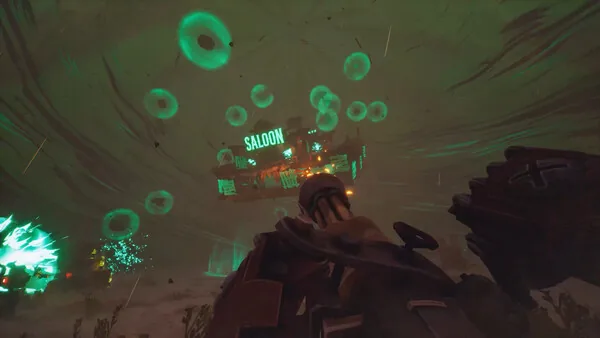 Shared objectives scale with player count: don't divide objectives, complete them in parallel.
Boss Encounters in Co-op
The biggest difference between solo and co-op boss fights isn't damage speed. It's post-boss wave management. When the boss dies, an infinite enemy wave starts immediately. In solo, you make a decision: extract now or risk more loot. In co-op, you can split the team.
Before the boss triggers:
- Clear the full map first, same as solo
- Designate one player as the extractor and one as the rear guard before engaging
- The extractor moves toward the extraction point the moment the boss dies
- The rear guard holds the spawn point, buying time for any remaining loot collection
- The burst dealer and turret handler handle the boss, then the burst dealer assists the rear guard after boss death
Cryptic Train's multi-part fight is much easier in a crew: since the locomotive and each cart hold separate health bars, splitting players across sections clears it faster than everyone focusing one part. Assign the burst dealer to whichever section is closest to breaking rather than spreading damage evenly.
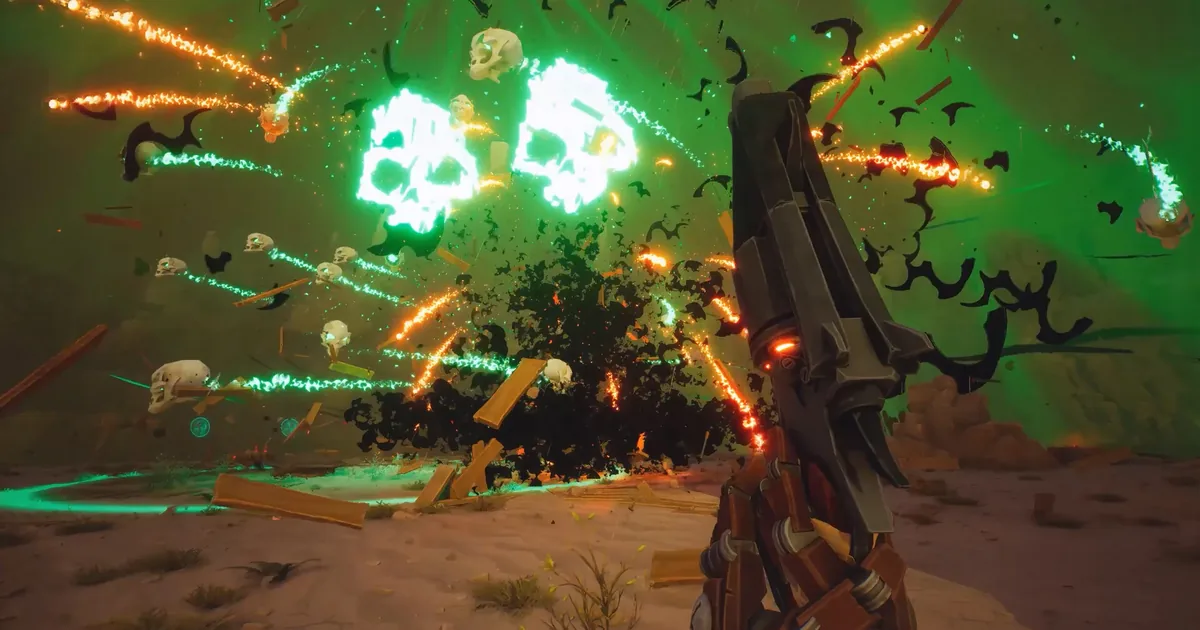
Cryptic Vulture is one of the more coordination-friendly far far west co-op bosses because its two demands split naturally between players: one player focuses down the orbiting skulls while a dedicated burst dealer stays ready for the moment the shield drops and the head becomes vulnerable.

GODEEPER: Full attack breakdowns for every Cryptic boss encounter: Cryptic Train's section-by-section structure, Cryptic Vulture's shield phase, and the post-boss infinite wave structure. Far Far West Boss Guide →
Co-op Tips
Assign roles before queueing, not during. The most common co-op breakdown happens at the boss transition: nobody knows who's handling adds because the group assumed someone else would. One sentence before the session starts ("I'm doing Cactus turrets, you handle the cannon") prevents most of it.
Don't run duplicate schools. Four Pyro builds deal great boss damage and nothing else. Add waves, the infinite post-boss spawn, and crowd-control-dependent fights all become harder. Variety is mechanically stronger, not just stylistically.
Share Joker cards with the group. Joker cards affect individual builds, but some (particularly the ones that spawn healing or resource pickups) benefit the full crew. Coordinate Joker picks the same way you'd coordinate class selection in any looter.
Use the buddy revive. In co-op, downed players stay in the revive window for several seconds. The chain caster or turret handler should be the default revive role: they have the most mobility and the most hands free. The burst dealer should not be the primary reviver; their cooldowns are too valuable for boss windows.
Pre-clear before the last region. In high-difficulty contracts, the final region's infinite wave after the boss is the main run-ender. If you don't have strong add suppression, don't push the boss without at least one Cactus turret player or Electric chain caster primed.
The old Patch 0.1.1.3 friendly-fire and Elite-enemy numbers in this article are no longer a safe current-build reference. The official 0.2.0.20 notes instead list balance changes to Knuckles, Lasso, Dual Revolvers, Banjo, Frost Cube, and Blueprint costs. Keep lanes clear around teammates, but check the live patch notes before building a role around a specific damage cap or spawn chance.
Frequently asked questions
Q: Is Far Far West co-op or single player? A: Both. Far Far West is designed for 1-4 player co-op, while solo play is supported. A crew adds role coverage and more opportunities to combine spell effects, but the official materials do not promise a separate cross-player damage multiplier for every reaction.
Q: Do you need to own Far Far West to play co-op with a friend? A: Steam Remote Play Together may allow a friend to join through the host's session, depending on the current Steam setup. Check the invite options in the live build and expect connection quality to affect input delay.
Q: Does difficulty scale in Far Far West co-op? A: Treat larger crews as more demanding even when the game gives you extra role coverage. Enemy density and contract pressure can change with player count, while revives, role splitting, and spell combos help a coordinated team compensate. Check the current mission difficulty before assuming a fixed scaling value.
Q: Can you play Far Far West co-op with randoms? A: Use the current Open or invite option if it is available in the lobby. Random crews are less coordinated, so communicate the damage, support, and extraction roles before the bounty rather than relying on a specific spell recipe.
Q: Are there co-op exclusive rewards in Far Far West? A: The Steam page and checked patch notes do not establish a co-op-only reward table. The practical co-op advantage is efficiency: more hands for objectives, safer revives, and better coverage during the extraction wave. Check later patch notes if the reward rules change.
Related Reading
- Far Far West Character Guide: All Characters and Builds
- Far Far West Advanced Strategy Guide
- Blood West Scavengers DLC: Is the Roguelite Worth $5?: a nearby co-op and roguelite comparison.
- Far Far West Weapon Leveling: How to Level Up Fast: Far Far West weapon leveling explained: XP comes from damage dealt, not kills. Fastest routes
- Far Far West Jokers Tier List: All 94 Cards Ranked: Far Far West Jokers tier list: 94 cards across 6 rarity tiers, confirmed count. The
- Far Far West Fire Spells: All 5 Pyro Spells & Combos: the older Pyro line and its patch-sensitive combo examples.
- Far Far West Best Weapons: Tier List and Loadout Picks: weapon choices that pair with different crew roles.
- Far Far West Builds Guide: All 3 Archetypes (2026): builds, spell combinations, Joker picks, and difficulty advice.
- Best Early Access Games Worth Buying Right Now: May 2026: a broader Early Access comparison.
- Far Far West Early Access: 250k Sales and What to Expect: the wider hub for maps, weapons, and progression.
References
- Far Far West on Steam: official Early Access page with co-op feature listing and current price
- Far Far West official announcements: Frostburn and Patch 0.2.0.20 notes
- Far Far West developer Q&A: developer explanation of spell combos and cooperation
- Far Far West spells wiki: current school and spell reference, checked against the Frostburn update
- Far Far West Beginner Guide: co-op lobby setup and session joining details
Was this guide helpful?
About the author

Indie & JRPG Critic
Indie game evangelist and lifelong JRPG fan covering small studios since 2017. Mumbai-born, London-based. Writes the way she talks.
- 7 years indie games coverage
- JRPG and visual novel specialist
- Narrative design focus
Keep reading



Disclaimer
This article is published for informational and entertainment purposes. It does not constitute professional financial, legal, or technical advice. Game performance, online services, patch schedules, and store listings change. Verify critical details (pricing, system requirements, regional availability) with publishers and storefronts before you buy. Affiliate links, where present, help support our editorial work and are labelled in our affiliate disclosure.
Comments
Loading comments…