
GuideFar Far West
Far Far West Fire Spells: All 5 Pyro Spells & Combos
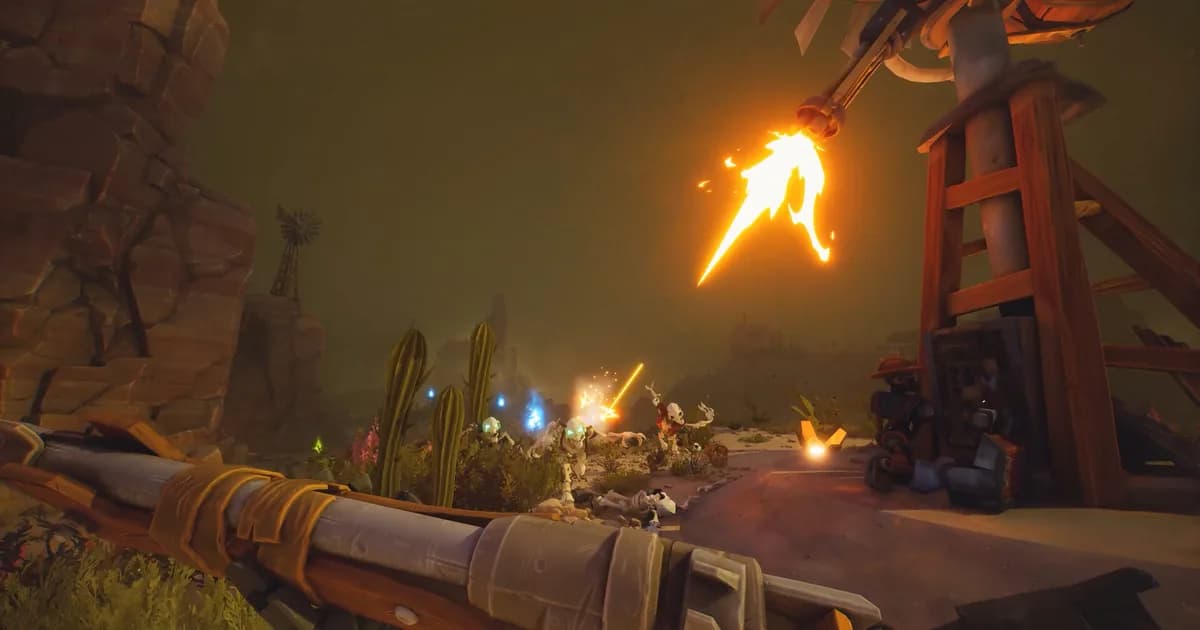
This Far Far West Fire spells guide covers all five spells in the Pyro school, from the level-1 Fireball to the level-35 Finger Guns, and the combos that make Fire the most important damage trigger in the game. Fire is not a standalone loadout, it is the spark that detonates Acid setups, and used right it produces fire tornadoes and chain explosions that no single spell matches. This guide breaks down each Fire spell, the order-dependent Surcharge combo, and the cross-school reactions.
Sponsored

About the game
Far Far West
Evil Raptor · Fireshine Games
Updated 2026-10-02: The live spell reference now lists Finger Guns at an 80-second cooldown and the related crosslink as part of a six-school, 30-spell guide.
TL;DR: The Fire school (Pyro) has five spells: Fireball (lvl 1, explodes and leaves burning ground), Firebeam (lvl 4, scorching beam, ignites Acid surfaces into fire tornadoes), Surcharge (lvl 12, wide burn that detonates ablaze enemies), Wisp (lvl 20, burn summon that jumps on kill), and Finger Guns (lvl 35, replaces your weapon with explosive fire bullets). Fire is the burst-damage school and the primary trigger for Acid setups. Key combos: Firebeam on an Acid surface makes a traveling fire tornado, and Fireball-then-Surcharge (in that order) detonates burning enemies. Run one or two Fire spells as your damage trigger, not a full Fire loadout.
BESTPRICE: Want Far Far West? These stores list it: Buy on Eneba (NA key) → Buy on Green Man Gaming → Buy on Humble Bundle → Buy on Gameseal →
Far Far West Fire spells: quick answer
The Pyro school has five spells: Fireball, Firebeam, Surcharge, Wisp, and Finger Guns. Fireball starts the burn, Surcharge detonates already-burning enemies, and Firebeam turns Acid surfaces into traveling fire tornadoes. The strongest loadout usually pairs one Fire trigger with an Acid setup.
Sponsored

Current status: October 2026
Frostburn's official balance notes reduced Fireball from 20 to 15 seconds, Firebeam from 80 to 60, and Surcharge from 60 to 50. Wisp's listed duration also fell from 25 to 18 seconds. Use those current values rather than the older cooldowns still shown on some wiki pages.
Far Far West Fire spells: the damage trigger
Far Far West runs on setup-and-trigger combos, and the Fire school is the game's premier trigger. Fire spells deal burst damage and leave burning ground, and Fire is the primary damage trigger for Acid setups. That dual role, strong on its own, devastating against an Acid surface, is what makes it a cornerstone of nearly every high-damage build.
The school has five spells, unlocked at levels 1, 4, 12, 20, and 35, and the design intent is clear: you rarely run all five. Instead you bring one or two Fire spells as the spark for your combos, pairing them with a setup school. Understanding which Fire spell triggers what, and in what order, is the difference between a fizzled cast and a screen-clearing tornado. This guide covers all five and the reactions that matter.
Key takeaways
- The Fire school (Pyro) has five spells, unlocked at levels 1, 4, 12, 20, 35.
- Fireball (lvl 1, 15s): explodes and leaves burning ground, your reliable opener.
- Firebeam (lvl 4, 60s): scorching beam; ignites Acid surfaces into fire tornadoes.
- Surcharge (lvl 12, 50s): wide burn that detonates enemies already ablaze.
- Wisp (lvl 20, 100s): a burn summon that jumps between targets on kill.
- Finger Guns (lvl 35, 80s): replaces your weapon with explosive fire bullets.
- Fire is the trigger school: run one or two Fire spells, not a full Fire loadout.
Step-by-Step: build a Fire trigger combo
- Equip one Fire spell and one Acid setup spell instead of filling all slots with Fire.
- Lay down an Acid puddle, Bubble, or Geyser where enemies will pass.
- Cast Firebeam into the Acid surface to create a traveling fire tornado.
- For a Fire-only burst, cast Fireball first and Surcharge second so the detonation has burning targets.
The five Fire spells
Here is the full Fire school, in unlock order.
Fireball (level 1, 15-second cooldown) is your foundation: a fireball that explodes and leaves burning ground. The short cooldown makes it your reliable, spammable ignition source, and it is the spell that sets enemies ablaze for the rest of your combos.
Firebeam (level 4, 60-second cooldown) is a giant fire beam that scorches everything in range. It is the school's main combo tool, and its Acid interaction (below) is one of the best in the game.
Surcharge (level 12, 50-second cooldown) burns all enemies in a wide zone and, crucially, detonates enemies who are already ablaze. It is a payoff spell, not an opener, its value depends on enemies already being on fire.
Wisp (level 20, 100-second cooldown) summons a Wisp that deals extra burn and jumps between targets on kill, giving you spreading damage that chains through a group.
Finger Guns (level 35, 80-second cooldown) is the endgame burst spell: it replaces your weapon with fiery fingers shooting explosive bullets, the school's highest single-cast burst ceiling.
GODEEPER: Fire is one of six schools, and the cross-school reactions are where the real damage lives. Far Far West Spells Guide: All Schools & Combos →
The order-dependent Surcharge combo
The most important Fire-internal combo is the one that punishes casting order. Surcharge detonates enemies who are already ablaze, so you cast Fireball first, then Surcharge, not the other way around.
The logic: Fireball sets the burning ground and ignites enemies, then Surcharge's wide-zone burn detonates everything already on fire for bonus damage. Reverse the order and Surcharge lands on enemies who are not yet ablaze, so its detonation has nothing to trigger and you lose most of the combo's payoff.
This is the kind of detail that separates a player who "uses Fire spells" from one who plays the school. The cooldowns reinforce it: Fireball's 15 seconds means you can keep enemies ignited, while Surcharge's 50 seconds means each detonation needs to count. Open with fire, then blow it up.
Fire is the trigger school. Cast Fireball first to set enemies ablaze, then Surcharge to detonate them, the order is the whole combo, and reversing it wastes the detonation.
The Acid combos: fire tornadoes
Fire's biggest payoff comes from outside the school, against Acid surfaces. Firebeam on an Acid surface creates traveling fire tornadoes that deal continuous damage as they move across the field.
This is the forgiving crowd-control combo the game is built around: an Acid setup spell leaves a puddle, Bubble, or Geyser, and Firebeam ignites it into a roaming tornado that handles a group while you reload or reposition. Dropping a fire effect onto an Acid bubble likewise spawns a traveling fire tornado, and Fire damage hitting an Acid puddle causes an instant explosion that burns everything caught in it, with the radius scaling to the size of the Acid surface. Pre-place a large Acid surface at a chokepoint, then trigger it with Fire for the biggest detonation.
The takeaway for loadout building: Fire wants an Acid partner. One Fire trigger plus one Acid setup is a stronger core than two Fire spells alone, because the reaction does far more than either spell by itself. Fire is the match; Acid is the fuel.
Wisp, Finger Guns, and the endgame
The two highest-level Fire spells round out the school for late-game builds. Wisp summons a burn entity that jumps between targets on kill, giving you spreading, self-propagating damage through a wave. Its own cross-school trick: a Wisp hit with Elec damage converts into an Electric Wisp that jumps between targets spreading burn, layering two elements onto one summon.
Finger Guns is the school's ceiling: for a few seconds it replaces your weapon with explosive fire bullets, turning you into a burst cannon. It is the only Fire spell that completely changes how you play for its duration, and with a 120-second cooldown, you save it for a boss damage window or a dangerous wave rather than spending it casually.
Neither is an opener. Both are payoffs you build toward, and both reward the same principle as the rest of the school: Fire is at its best when it is amplifying something, an Acid surface, an Elec conversion, a wave already on fire, rather than acting alone.
Fire's biggest payoff is cross-school: Firebeam ignites an Acid surface into a traveling fire tornado, the game's most forgiving crowd-control combo. Pair one Fire trigger with one Acid setup rather than stacking Fire spells alone.
Building around Fire
The practical rule for loadouts: run one or two Fire spells as your damage trigger, not a full Fire loadout. You equip three spells at a time, and a Fire-heavy three-stack wastes Fire's identity as an amplifier. The strongest setups pair a Fire trigger with a setup school.
For bosses, the recommended setup is Firebeam plus Boing plus Geyser, leaning on Firebeam as the damage trigger against the Acid Geyser surface. For general play, Fireball is your cheap, repeatable ignition, and you slot one setup spell (usually Acid) to trigger off. Surcharge is a strong pickup at level 12 specifically because by then you have reliable ignition to detonate. And once you reach the Portal unlock in the Elec school, throwing a Firebeam through a Portal duplicates it, two beams, two tornadoes, for one cast.
Think of every Fire pick as a question of "what am I igniting?" If the answer is an Acid surface, you are playing Fire correctly. If the answer is "nothing, just the enemies," you are leaving most of the school's damage unused.
GODEEPER: See how Fire's ignition setups hold up against each of the four Cryptic bosses, including the multi-part Cryptic Train fight. Far Far West Boss Guide →
Frequently Asked Questions
What are the Fire spells? Fireball, Firebeam, Surcharge, Wisp, and Finger Guns, unlocked at levels 1, 4, 12, 20, and 35. Fire is the burst and Acid-trigger school.
Best Fire combo? Firebeam on an Acid surface makes a fire tornado; for burst, Fireball then Surcharge (in that order) to detonate ablaze enemies.
Why Fireball before Surcharge? Surcharge detonates enemies already on fire, so Fireball must ignite them first. Reverse the order and the detonation does nothing.
Is Fire good? Yes, it is the primary burst and trigger school. Run one or two Fire spells alongside an Acid setup rather than a full Fire loadout.
How does Firebeam work? A giant scorching beam (lvl 4, 60s) that ignites Acid surfaces into traveling fire tornadoes.
What does Finger Guns do? Replaces your weapon with explosive fire bullets (lvl 35, 80s), the school's highest burst. Save it for boss windows.
Related Reading
The Far Far West Spells Guide covers all six schools and the current documented cross-school combo table.
The Far Far West Builds Guide breaks down the loadouts that use Fire as a damage trigger.
The Far Far West Complete Guide is the hub for every Far Far West system, from spells and builds to bosses.
- Far Far West Voodoo Spells: All 5 & the Healing Rule: Far Far West Voodoo spells: all 5 healing spells from Drain to Doll, the rule that healing only.
- Far Far West Elec Spells: All 5 & the Portal Trick: Far Far West Elec spells: all 5 from Strikes to Thunderstrike, why Portal duplicates any spell thrown through.
- Far Far West Boss Guide: Cryptic Train, Vulture, Saloon & Necromancer: Far far west boss guide: all four Cryptic encounters with attack patterns, weak points, and best spells per boss.
- Far Far West Beginner Guide: Tips for New Cowboys 2026: Far far west beginner guide: elemental combos, the Joker system, best starting weapons, and how.
- Far Far West Boss Guide: All Four Bosses and Strategies: Far far west boss guide: all four Cryptic encounters with attack patterns, weak points, and best spells per boss.
- Far Far West Best Weapons: Tier List and Loadout Picks: Far far west best weapons ranked: Leveredge and Minigun lead, Sheriff Star tops the secondaries.
- Far Far West Co-op Guide: Multiplayer Setup and Team Tips: Far far west co-op guide: party setup for 1-4 players, how spell reactions fire cross-player.
References
- Far Far West on Steam: official store page, updates, and patch notes
- Fireshine Games: the publisher's Far Far West page
- Far Far West spells wiki: current Pyro roster and spell values
- Far Far West official announcements: Frostburn balance notes and current patches
Was this guide helpful?
About the author

Systems & Economy Desk
GameBrief's byline for roguelikes, strategy and simulation. Reads patch notes, wiki tables and Steam stats and puts the numbers on the page.
- Roguelikes, strategy and simulation
- Builds, progression and economy
- Sources listed per article
Keep reading
Far Far West Voodoo Spells: All 5 & the Healing Rule
Guides · 11 min
Far Far West Elec Spells: All 5 & the Portal Trick
Guides · 8 min

Far Far West Strategy Guide: 30 Spells, Loadouts & PvE
Guides · 20 min
Far Far West Complete Guide 2026: Builds, Bosses & Spells
General · 12 min

Far Far West Co-op Guide: Multiplayer Setup and Team Tips
Guides · 9 min

Far Far West Boss Guide: All 4 Bosses and Strategies
Guides · 20 min
Sponsored
Disclaimer
This article is published for informational and entertainment purposes. It does not constitute professional financial, legal, or technical advice. Game performance, online services, patch schedules, and store listings change. Verify critical details (pricing, system requirements, regional availability) with publishers and storefronts before you buy. Affiliate links, where present, help support our editorial work and are labelled in our affiliate disclosure.
Comments
Loading comments…