
GameBrief · Guides
Far Far West Strategy Guide: 25 Spells, Loadouts & PvE

Reviewing
Far Far West
Evil Raptor · Fireshine Games
This far far west strategy guide is for players who've logged 15+ hours and want the mechanics that don't show up in first-session tips. Most players stop at the beginner loadout: fire spell, Leveredge, one Voodoo for sustain. It gets them through Hard. On Very Hard and Nightmare, that baseline costs runs because it leaves CDR, Joker economy, and spell combo uptime on the table.
TL;DR: CDR stacking can hit 66% reduction, dropping Portal to a 3.4-second cooldown. Three loadout archetypes, Storm Chain Gunner, Iron Reaper Melt, Deadeye Spellhand, cover the three main difficulty contexts. Never kill a boss before looting the map; the post-boss infinite wave locks out everything. Glass Cannon + Second Wind is the highest-damage Joker pairing that doesn't get you killed. Pickaxe yields 40 gold per vein; explosives yield 20, don't mine with spells when you need gold.
Far Far West strategy? (quick answer)
Start with a single weapon line, build around one cooldown or damage anchor, and clear every map objective before summoning the boss. For advanced runs, Portal duplication, Mino plus Strikes, and a focused Joker package matter more than carrying three loosely related weapons. The current Early Access build is still balance-sensitive, so treat exact numbers as patch-dependent.
Current status: September 2026
Far Far West remains in Early Access at $19.99 on Steam. The official page currently shows 96% positive from 20,270 English reviews and 89% from 1,704 recent reviews. The latest listed build is 0.2.0.20 from September 7, after the Frostburn update added frost spells and melee weapons; the official Steam Community hub still lists balance and bug-fix work as active.
Far Far West strategy: key takeaways
- CDR Joker stacks are multiplicative: 66% is achievable and drops Mino to a ~3.4-second effective cooldown
- Glass Cannon (+40% damage, -25% HP) is only viable paired with Second Wind (cheat death, 180s cooldown)
- Dual Tornado (Portal + Bubble + Firebeam) spreads two tornadoes across separate packs, it does not double damage on one target: overlapping tornadoes only refresh duration, per community testing
- Post-boss infinite wave is permanent: complete all map objectives before pulling any boss
- Pickaxe mines 40 gold per vein; fire or explosives only yield 20: the difference matters on gold runs
- In co-op, only the first player to reach a dropped Joker claims it: movement investment pays off for Joker acquisition
Overview: what makes Far Far West advanced play different
Far Far West strategy rewards systems thinking more than reaction time. The difference between a Normal clear and a Nightmare clear isn't faster aim: it's build architecture. Joker slot economy, spell cooldown management, and route sequencing separate runs that finish with 80% health from runs that end before the boss.
Three gaps separate intermediate players from advanced ones:
CDR awareness. Most guides mention cooldown reduction once and move on. At 66% CDR, the entire spell rotation changes. Portal drops to roughly 3.4 seconds. Mino becomes a perpetual presence. Firebeam, the bottleneck cooldown in the Dual Tornado sequence, drops from 80 seconds to roughly 27 seconds. That's the difference between casting it once and casting it two or three times across a single boss phase.
Joker economy. The game has 94 Joker cards across six tiers. Players running their first 20 hours tend to pick whatever looks good. Advanced play treats Joker slots like build slots: every card needs to trigger every 5-10 seconds or it's dead weight. A Joker that only activates on specific boss phases is a weaker pick than one that fires on every kill wave. For a full breakdown of where every card lands, see our Far Far West Jokers tier list ranking all 94 cards.
Map sequencing. The post-boss infinite wave is the mechanic most players learn the hard way. Kill the boss too early and the wave spawns before you've touched the Joker cards, secret objectives, and gold veins. There's no recovering from this: the wave doesn't stop, and extraction is your only option. Advanced players run a mini-route that sweeps every side objective before committing to the boss encounter.
Step-by-step: optimal early Far Far West build path
The foundation choices you make at levels 1-20 determine what's available at 35. Here's the sequence that keeps the most doors open:
1. Secure your CDR anchor first (levels 1-12). Before you have Portal, the CDR benefit applies to Mino and Strikes. More Mino placements, more Tesla tower procs. Prioritize CDR Jokers when the Gamba Machine offers them in the first two runs.
2. Lock in your weapon pairing by run 5. The Gamba Machine shows visible odds since Hotfix 3: use that information. Commit to one weapon upgrade line and max it. Spreading levels across three unfinished weapons produces weaker performance than a single maxed line. Quad Cylinder + Revolver for most players; Leveredge + Boomerang for players targeting Nightmare from the start.
3. Slot Portal at level 12 and learn the throw-through-gate muscle memory immediately. Portal has a 10-second cooldown at base. At 50% CDR it's 5 seconds. The mechanical habit (place gate, throw spell through center of gate, not beside it) takes 3-4 runs to internalize. Start at level 12, not 25.
4. Pick your first Legendary Joker carefully. The two strongest options for most builds are Glass Cannon (+40% weapon and melee damage, -25% HP) and Speedster (damage and fire rate scale with velocity). Glass Cannon requires Second Wind in the same loadout: it's not survivable without a cheat-death safety net. Speedster requires mobility investment first, specifically stacked Run and Gun Jokers, before the damage bonus becomes meaningful.
5. Complete secret missions in order: Far West bell first, Canyon medallions second. Bell Shot gives weakspot hits a chance to summon a healing ghost bell, which you shoot for +20 HP. Pick Pick gives hits a chance to afflict enemies with a 10-second flurry of damaging pickaxes. Unlock both before progressing past Very Hard difficulty.
GODEEPER: All 25 spells ranked by school, the complete elemental reaction table, and the Portal duplication mechanic explained in full. Far Far West Spells Guide: Schools, Combos, and Reactions →
Spell combinations and combos
The Far Far West spells guide covers the full reaction table. These are the three combos that matter most at advanced difficulty levels, with specific timing.
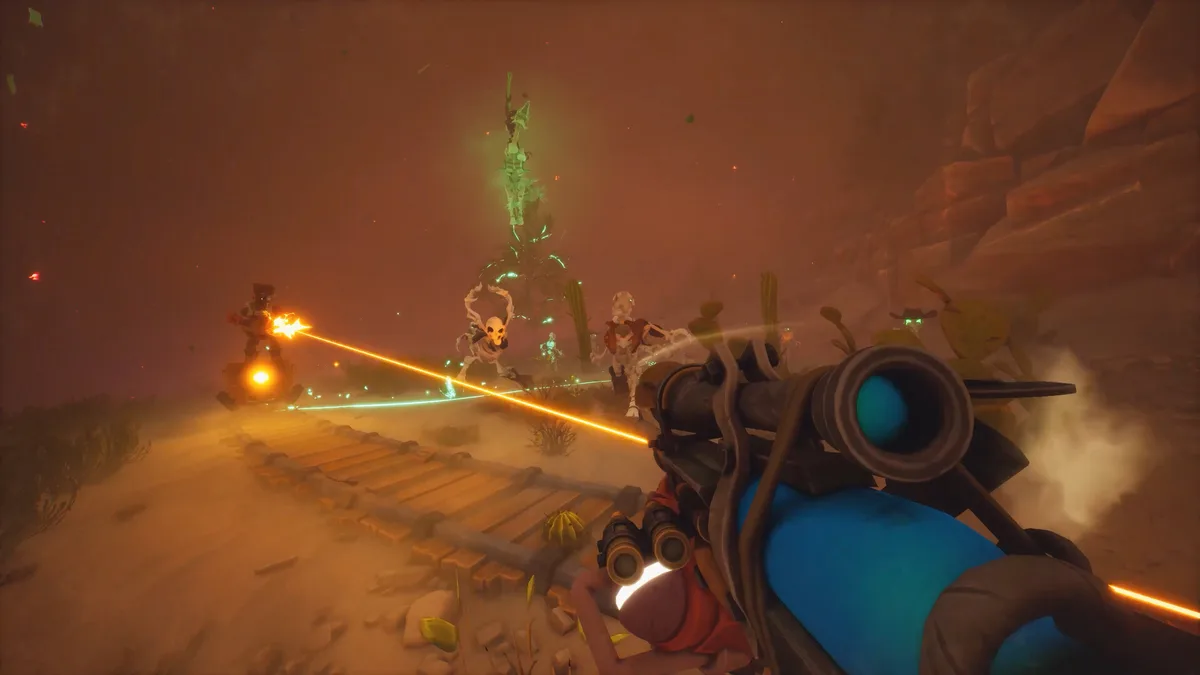 A beam attack cuts through a skeleton ambush near abandoned train tracks, one of the game's Wild-West-but-weirder combat setpieces.
Combo 1: Dual Tornado (Portal + Bubble + Firebeam)
Setup takes about 5 seconds from Portal placement:
- Place Portal between you and the enemy cluster (0.2s cast)
- Throw Bubble directly through the gate center: Elec Portal duplicates the spell, so two acid puddles exit the far gate and land in the cluster simultaneously
- Wait 0.5 seconds for the puddles to settle
- Throw Firebeam through the gate: both puddles ignite on contact, each spawning a roaming fire tornado
Here's the nuance most guides skip: two tornadoes landing on the same pack doesn't mean double damage. Players testing this on r/FarFarWest have consistently found that the game only calculates one tornado's damage per target. A second tornado overlapping the first mostly just refreshes duration and widens the visual area. It doesn't stack DPS on anything already burning. The real payoff of the Portal duplication is coverage, not burst. Two tornadoes let you hit two separate enemy clusters, or cover more ground on a spread pack, from one cast. They don't double the damage on one target. At 50% CDR: Portal is back in 5 seconds, Bubble in 20 seconds, Firebeam in 40 seconds, so the full three-spell cycle resets roughly every 40 seconds regardless of extra CDR investment beyond that. Firebeam's cooldown is the bottleneck, not Portal's or Bubble's.
The positioning constraint: Portal placement must create a line-of-sight gate between you and the cluster (or two separate clusters, if you're splitting the tornadoes). Cramped final boss arenas require deliberate early placement: Portal at the start of the fight, not mid-chaos. Against a single boss, throwing Bubble then Firebeam directly, no Portal, does the same per-target tornado damage for two fewer cooldowns spent. Save the Portal-duplicated cast for waves and adds, where the second tornado lands on a separate cluster instead of stacking uselessly on the first.
Combo 2: Mino Tesla Chain (Mino + Strikes + CDR loop)
Less flashy, more consistent. Mino's base cooldown is 10 seconds; at 66% CDR it's 3.4 seconds. You have a mine active essentially permanently.
Every Strikes cast that contacts a live Mino converts it to a Tesla tower, which arcs lightning at all nearby enemies. With multiple Minos active (achievable at 66% CDR) a single Strikes triggers 2-3 towers simultaneously. The AoE coverage from three Tesla towers handles clustered wave enemies without requiring you to aim at individual targets.
This combo does less burst than Dual Tornado but operates on much shorter cycles. Good for sustained wave management between major boss damage windows.
Combo 3: Wisp Conversion (Wisp + Portal + Elec)
Available at level 20. Wisp (Fire school) maintains persistent burn across multiple enemies. Hit an active Wisp with any Elec damage (including a secondary weapon assigned Electric) and it converts to an Electric Wisp that spreads burn on every hit and jumps between targets on kill.
Through Portal: Throw Wisp through the gate (two Wisps activate simultaneously. Immediately fire your Electric-assigned secondary through the gate or cast Strikes nearby) both convert to Electric Wisps. Two jump-chain Electric Wisps clear entire waves while you focus the boss.
The combo requires a secondary weapon assigned Electric, or an Elec spell. It's why the weapons guide treats element assignment as a build decision rather than a single named gun: whichever secondary you're running isn't just a weapon, it's a combo activator once you assign it Electric.
Loadout optimization by playstyle
Three Far Far West strategy archetypes cover the full difficulty range.
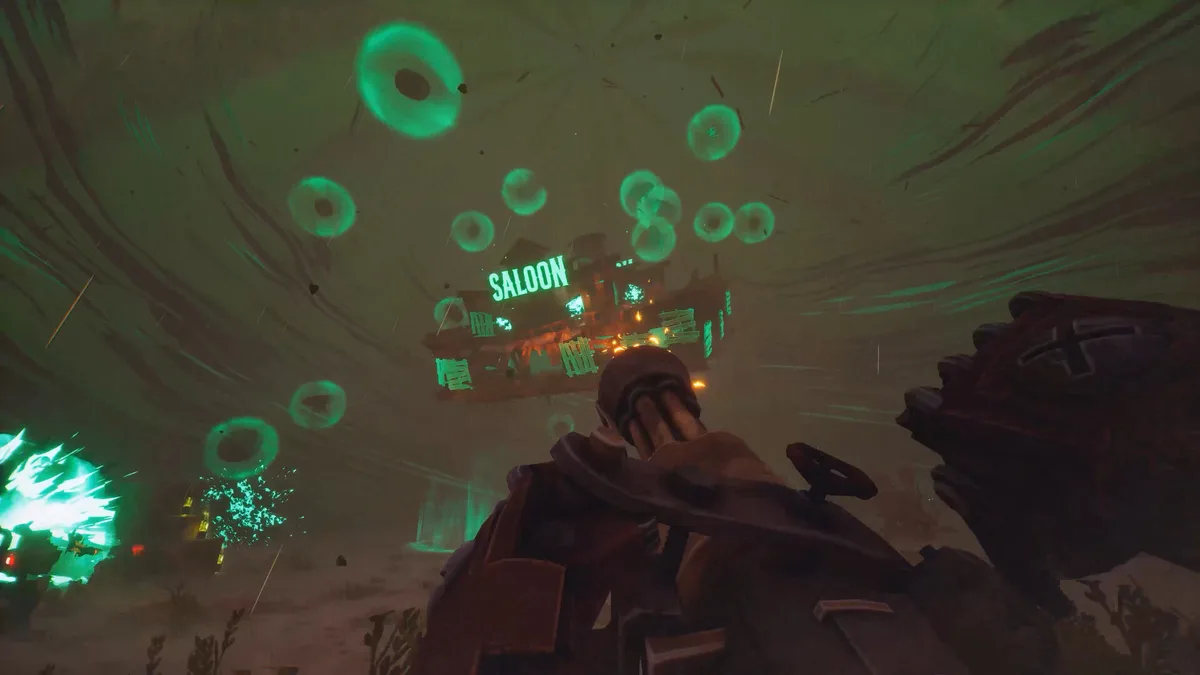 Rings of green light drift through a stormy night sky above the Saloon, one of the atmospheric moments between missions.
Archetype 1: Storm Chain Gunner (Balanced, Hard,Very Hard)
Weapons: Quadcylinder (primary) + Revolver (secondary) Spells: Strikes + Bubble + Drain Key Jokers: Homing Burst, Mark Ace, Soul Siphon
The Storm Chain Gunner is the cleanest all-around loadout for players moving from Hard to Very Hard. Quadcylinder handles wave clear at medium range. Mark Ace marks any enemy the Revolver hits for 5 seconds, and marked targets take +15% more damage from every source. Run it alongside Headbang's +20% weakspot bonus if you have a slot free for both; the two effects stack cleanly. Soul Siphon (2 HP per soul pickup, stackable) handles sustained healing without Voodoo spells: freeing the third spell slot for a damage option instead of Drain.
Stat priority: fire rate and damage first, then CDR for Strikes and Bubble. The Revolver secondary needs Draw Speed investment for the snap-aim weakspot targeting that activates Mark Ace.
The loadout's ceiling is Very Hard. On Nightmare, the boss DPS requirements push you toward a more specialized option.
Archetype 2: Iron Reaper Melt (Boss-Focused, Very Hard,Nightmare)
Weapons: Minigun (primary) + Sheriff Stars (secondary) Spells: Firebeam + Portal + Voodoo (Drain or Ritual depending on solo/co-op) Key Jokers: Frenzied Spin, Second Wind, Glass Cannon
The Iron Reaper is the highest single-phase boss DPS option. Minigun with Frenzied Spin (fires twice as fast when kill counter exceeds 10) plus Glass Cannon (+40% weapon damage) outputs more damage per second during boss vulnerability windows than any other setup: but the Glass Cannon HP penalty means you're at 75% health constantly.
Second Wind is non-negotiable in this loadout. It's the safety valve that makes Glass Cannon viable: one cheat-death per 180 seconds offsets the HP reduction. Without it, one mistimed boss attack during a damage phase ends the run.
The minigun reload window remains the critical weakness. Portal lets you reposition to cover during reload cycles. Pre-cast Portal before each boss vulnerability window so you have an exit point when the reload forces you off the burn.
The Sheriff Stars secondary exists for ammo sustainability: running out of minigun ammo mid-boss phase is the failure mode this loadout needs to avoid.
Archetype 3: Deadeye Spellhand (Solo Nightmare)
Weapons: Leveredge (primary) + Boomerang/Moverang variant (secondary) Spells: Boing + Wallo + Ritual Key Jokers: Eagle Lever, Headbang, Stacked Lever, Soul Siphon
This is the Nightmare solo build. Leveredge is a precision rifle: stat priority is Damage, then Draw Speed, then Fire Rate. Headbang (+20% damage to weakspots) is the damage foundation. Eagle Lever adds +10% damage per consecutive hit without a miss, stacking up to +50%: exactly the kind of bonus a precision build like this one is built to cash in on. Stacked Lever instantly reloads 2 rounds from reserve ammo on every kill, so you keep firing through the intense phases instead of getting caught mid-reload.
Wallo (Cactus school, level 12, 40s cooldown) creates spike walls that slow enemies and funnel them into predictable lanes. That's the targeting assist that makes headshots consistently landable under pressure. Place Wallo before enemies cluster, position Leveredge on the funnel lane, headshot through it.
Ritual (Voodoo, level 20, 100s cooldown) sustains health in Nightmare without requiring Drain's tight positioning requirement. Solo on Nightmare, health packs alone don't cover the damage output: Ritual provides the team healing ring you would otherwise need a co-op partner to supply.
The boss approach for Deadeye Spellhand is a "Throw, Turn, Dash, Jump" cycle: throw Wallo into the boss's advance path, turn to create angle, Boing (15s cooldown) to reposition, fire Leveredge headshots during the repositioning window. Target the Vulture's flying skulls specifically: Leveredge one-shots them at max damage investment, which reduces incoming projectile density more effectively than any AoE option.
GODEEPER: Full boss phase breakdowns, the infinite wave rule, and spell picks by boss type. Far Far West Boss Guide: All Four Bosses and Strategies →
Advanced movement and positioning
Basic movement advice is "keep moving." Advanced Far Far West strategy is structured about where and when you move, not just that you're moving.
Boing as a reposition tool, not an escape. Boing (Elec school, 15s cooldown) repositions you instantly. The advanced use isn't emergency escape: it's pre-emptive angle creation. Cast Boing to a position with line-of-sight through your active Portal before the damage window opens, not after you're already under pressure. Boing out of position reactively wastes the cooldown on survival; Boing into position proactively sets up the next combo.
Wallo's funnel geometry. Three Wallo placements can create a narrow lane that enemies must travel through. The lane needs to be 1.5-2 enemy widths wide: enough to let enemies advance but narrow enough that Leveredge headshots land on clustered targets rather than whiffing on spread formation. In open maps this requires deliberate pre-combat placement. In Nightmare, setting up the funnel before engaging is the difference between efficient headshot chains and scrambling at the edge of the storm.
Storm boundary awareness in solo. Nightmare's storm closes faster than co-op runs. It's easy to build tunnel vision on a combat engagement and drift into the storm's edge while managing waves. Two habits that prevent this: glance at the minimap every 10-15 seconds during sustained fights, and place Portal near the storm boundary early in the fight. If you're about to get pinched, the Portal lets you teleport back toward the center rather than running through storm exposure.
Reload during movement, never stationary. Sniper enemies on Nightmare track still targets accurately. The minigun reload cycle is where most Nightmare deaths happen: players plant to finish the reload and get punished by sniper tracking. Cross-map movement during reload breaks aim lock. It feels wasteful. It's correct.
Tips for endgame and boss fights
The following far far west strategy tips apply primarily to Very Hard and Nightmare, where a single sequencing error costs the run.
Complete the map before pulling the boss. Every boss kill in Far Far West spawns a permanent infinite enemy wave, and there is no looting after the boss dies: extraction is the only option from that point on. Run the full map sweep first: all gold veins (pickaxe only, 40 gold each versus 20 from explosives), all Joker card locations, and all white question mark objectives. On Canyon specifically, complete all four medallions before engaging. Missing the Pick Pick Joker because you triggered the boss early costs you its damaging pickaxe effect until you go back and re-earn it on a future Canyon run.
Apply Bell Shot and Pick Pick before opening damage phases. Bell Shot gives weakspot hits a chance to summon a healing ghost bell, which you shoot for +20 HP. Pick Pick gives hits a chance to afflict enemies with a 10-second flurry of damaging pickaxes. Both need to be active and present in your loadout before the boss phase opens. Equip them in Town before the run, not after.
Time the minigun reload to boss phase transitions. Every boss in Far Far West has a vulnerable window that opens after phase transitions. The minigun's reload cycle averages 3.5 seconds. If you start the reload 4 seconds before the phase transition (which is predictable by audio/visual tells) the reload finishes exactly as the window opens and you enter the burst phase with a full magazine. Doing the reload mid-vulnerability window is the single most costly mistake in boss encounters.
Skip Portal on a solo boss target. A boss only takes one tornado's damage no matter how many land on it, so the extra Portal cooldown is wasted against a single target. Throw Bubble, then Firebeam directly during a boss vulnerability window (no Portal) for the same tornado damage on two fewer cooldowns spent. Save the Portal-duplicated Bubble throw for phases with adds, where the second tornado can land on a separate cluster instead of overlapping the first.
Abandon the boss fight if your Second Wind is on cooldown. Glass Cannon builds without Second Wind available have no margin for error. If Second Wind is on its 180-second cooldown and the boss phase is ongoing, play defensively: extend the fight rather than push for the kill and risk running into the next attack pattern at 75% HP with no safety valve.
Advanced gold farming
The basic loop gets players through Hard. Gold pressure becomes the defining Far Far West strategy constraint on Very Hard and Nightmare, where Saloon upgrade costs scale faster than standard run payouts.
Pickaxe every vein. Gold veins mined with a pickaxe yield approximately 40 gold each. Mined with fire spells or explosives: 20 gold. That's a 50% penalty per vein for using spells. On a full run with 6-8 veins available, the difference is 120-160 gold per mission. Over 10 runs, that's 1,200-1,600 gold left on the table.
Stack Gold Tooth Jokers on dedicated farming runs. Gold Tooth is a Normal-tier Joker with a 10% chance per kill to drop 1 gold nugget, and copies stack additively. Ten copies means a guaranteed nugget on every single kill: a full wave clear turns into a steady gold stream instead of a coin flip. The Canyon Medallion route (all four medallions before the boss) adds the Elder Pickaxe and Pick Pick Joker to that same run, making it the highest single-run payout available.
Route Marauder camps and veins on a single path. Marauder camps are marked on every map and guaranteed to spawn. Plot a route from landing to boss encounter that passes through all reachable veins and camps without backtracking. Backtracking adds 2-3 minutes per run that compound into lost gold over sessions.
Frequently asked questions
Q: What is the best build in Far Far West for Nightmare difficulty? A: Leveredge + Boomerang (Moverang variant) with Eagle Lever, Headbang, and Stacked Lever Jokers. Pair with Boing, Wallo, and Ritual spells. Wallo funnels enemies into predictable headshot lanes; Boing handles repositioning; Ritual handles solo healing at a level health packs can't sustain on Nightmare. Target 66% CDR through Joker stacking so Wallo is nearly permanent.
Q: What is the best spell combo for experienced players? A: A strong dual-target combo is Portal + Bubble + Firebeam: send Bubble through Portal for two puddles, then ignite both with Firebeam. It spreads pressure rather than stacking boss damage, so use Mino + Strikes at 66% CDR or Bubble + Firebeam for one target.
Q: How do you unlock the secret Joker cards? A: Five secret mission Jokers are available: Bell Shot (three Far West bell locations), Pick Pick (Canyon medallions), Cactus Day (Desert cactus match), Shroom Grave (Woodlands mushroom circuit), and Anti-Gravity Falls (Area 41 symbols). Complete Far West first; Bell Shot's healing bell helps later runs.
Q: How many Joker cards should I run? A: High-performing builds typically run 12-16 active Jokers, with distribution favoring damage and speed over niche synergies. Cut any Joker that doesn't trigger every 5-10 seconds: Jokers that only activate on specific boss phases are nearly dead slots compared to on-kill or on-damage effects.
Q: Does Glass Cannon work in solo play? A: Yes, but only paired with Second Wind (Mythic, cheat death at 50 HP, 180s cooldown). Without Second Wind, the -25% HP penalty means one mistake ends you. With it, you have one guaranteed save per 3 minutes. On Nightmare, play conservatively whenever Second Wind is on cooldown: extend the fight rather than push.
Q: What is the fastest way to level from 20 to 35 in Far Far West? A: Prioritize Far West and Canyon missions over other maps: those regions' rewards have the biggest direct combat impact and tend to yield more XP per encounter. Stack Soul-linked experience perks from the Town progression tree if available. Route gold vein sweeps and Marauder camp clears into the same run path to avoid dead time between encounters.
Q: Is Far Far West worth playing solo or does it require co-op? A: Far Far West is viable solo; Deadeye Spellhand is a strong Nightmare option. Solo difficulty is calibrated for one player, but Ritual uses a spell slot that co-op players can devote to damage. The Far Far West co-op guide covers role splitting.
Related Reading
- Far Far West Tips: Gamba Machine, Jokers, and Early Runs: Far Far West tips for beginners: how the Gamba Machine actually works, when to collect Joker cards, and....
- Far Far West Boss Guide: All Four Bosses and Strategies: every boss phase, the spell schools that counter each, and the post-boss wave management that ends most runs.
- Far Far West Spells Guide: All 25 Spells & 5 Schools: the full spell roster this guide's archetypes draw from, school by school.
- Far Far West best weapons guide: weapon roles and Joker pairings for advanced loadouts.
- Far Far West challenges guide: challenge rewards and secret mission routes.
- Far Far West weapon leveling guide: how to spend upgrade points before Nightmare.
- Far Far West maps guide: map routes, objective order, and extraction planning.
- Far Far West Frostburn update: current frost weapons, spells, and balance changes.
- Far Far West fire spells guide: Pyro spells and Fire Tornado setups.
- Far Far West electric spells guide: Elec spells, portals, and mobility tools.
- Far Far West frost spells guide: defensive Frost spells and shield timing.
- Far Far West Voodoo spells guide: healing and sustain options for solo Nightmare.
- Far Far West complete guide hub: the full weapons, spells, bosses, and beginner index.
- Far Far West co-op guide: role splitting and multiplayer loadout planning.
- Far Far West Joker tier list: all Joker rarities and weapon-specific options.
- Far Far West spell guide: every school and the interactions used in this strategy guide.
References
- Far Far West on Steam: official store page, current patch notes, and Early Access roadmap from Evil Raptor
- Far Far West wiki: Jokers: current Joker roster, rarities, slots, and weapon availability
- Far Far West wiki: Spells: current spell schools, unlock levels, cooldowns, and combo options
- Gold Tooth: +10% gold-nugget chance, additive stacking, and trigger conditions
- Bell Shot and Pick Pick: official mechanic and secret-mission reward details
- Far Far West complete guide: weapons, spells, bosses, beginner tips, and all cluster guides
Was this guide helpful?
About the author

Games Critic
Games writer and reluctant optimist who has reviewed over 400 titles across 9 years. Irish, currently in Berlin. Has strong opinions about tutorial design.
- 400+ games reviewed across 9 years
- Platformer and horror specialist
- Narrative design focus
Keep reading



Disclaimer
This article is published for informational and entertainment purposes. It does not constitute professional financial, legal, or technical advice. Game performance, online services, patch schedules, and store listings change. Verify critical details (pricing, system requirements, regional availability) with publishers and storefronts before you buy. Affiliate links, where present, help support our editorial work and are labelled in our affiliate disclosure.
Comments
Loading comments…