
GameBrief · Guides
Winter Burrow Crafting Recipes Guide: Knitting and Cooking
Reviewing
Winter Burrow
Winter Burrow crafting recipes don't hide behind vague flavor text the way most cozy games' do. Open the Knitting or Cooking menu and every card lists exact ingredient counts, a craft-time hourglass, and the precise stat payout, no mystery, no "you'll figure it out."
TL;DR: Winter Burrow's confirmed recipes include Wool Yarn (3 Fur per batch, spun for warm clothes) and Beechnut Biscuit (3 Beechnuts, 1 hour, +15 warmth and +15 fullness). Raw foraged food like Blackberries can be eaten on the spot for a smaller fullness bonus, and an early tutorial popup shows crafting unlocking with two starter furniture recipes tied to a specific Aunty story beat.
Key Takeaways
- Wool Yarn (Knitting) costs 3 Fur per batch and is described as making "the warmest winter clothes"
- Beechnut Biscuit (Cooking) costs 3 Beechnuts, takes 1 hour, and gives +15 warmth plus +15 fullness
- Raw foraged food like Blackberries gives a smaller fullness bonus without needing a station at all
- A "Crafting unlocked!" tutorial screen ties the system's opening to an Aunty dialogue and a workstation prompt
- Burrow storage holds a wide spread of materials, several stacked well past 15 units in a mid-game save
Crafting overview: how Winter Burrow recipes work (quick answer)
Winter Burrow splits crafting across at least two dedicated stations, Knitting and Cooking, each opened from a scroll-style menu with tabs along the top. Select a recipe from the left-hand list and the game shows you everything up front: the item's icon and name, a short description, a "Required items" box with an exact count, and Craft or Craft All buttons. There's no hidden math. If you have the materials, the number turns from red-tinted to available and the Craft button lights up.
That transparency is unusual for the genre. A lot of cozy survival games make you eyeball whether you have "enough" of something. Winter Burrow just tells you: 6 Fur on hand, 3 needed, craft it three times before you're short.
The Knitting station: Wool Yarn and warm clothes
Knitting is where Fur becomes usable clothing, and the chain starts with Wool Yarn. The recipe card describes it plainly: "Soft woollen yarn is spun from tufts of fur to create the warmest winter clothes." The Required items box shows a ratio of 6/3, meaning the recipe needs 3 Fur per craft and the player in that screenshot was holding 6, enough for two batches with one to spare.
The Knitting menu's left-hand list runs at least four items deep, including string-like intermediate materials above Wool Yarn and a finished garment below it, though only Wool Yarn's card was open long enough to read in full. That structure matters for planning: Wool Yarn looks like a midpoint ingredient rather than a finished piece of clothing, something you spin first and then feed into a second recipe for an actual sweater, hat, or coat. The exact downstream recipe wasn't visible in the available screenshots, so treat that second step as confirmed to exist but not yet confirmed in its specific cost.
This ties directly into Winter Burrow's warmth system. Knitted clothing is one of exactly two confirmed ways to push that meter back up, the other being cooked food. If you're still getting a handle on why warmth matters at all before diving into recipes, our Winter Burrow review breaks down how the four-meter HUD (health, hunger, warmth, breath) actually plays out over a real session.
GODEEPER: See how the warmth meter interacts with everything else in a full session, not just the crafting menu. Winter Burrow Review: Cozy Survival With Real Depth →
The Cooking station: Beechnut Biscuit and Blackberries
Cooking is the second confirmed path to warmth, and its clearest example is the Beechnut Biscuit. The recipe card reads: "This aromatic cracker that will keep you warm and full," backed by numbers instead of a vague promise. Craft it and you get +15 warmth (fire icon) and +15 fullness (cheese icon) for a one-hour craft time, plus a shield icon reading 10% that the tooltip doesn't explain further. The Required items box shows a 9/3 ratio, and zooming into that icon confirms it's a beechnut in its spiky husk, not a generic nut placeholder, so the ingredient name matches the item name exactly: 3 Beechnuts per Biscuit.
Not everything needs a station, though. Blackberries can be eaten straight from inventory. Their card lists +5 fullness (cheese icon again) with no warmth bonus at all, since they're raw rather than cooked. There's also an hourglass reading 0.5h next to an unlabeled blue icon and a shield stat reading 2%, both smaller than the Biscuit's equivalents, which tracks with a snack being weaker than a full baked good. What that hourglass measures on a raw item isn't spelled out, since Blackberries aren't crafted so much as picked, but the flavor text does drop a real hint about where this is headed: "With a little willpower, this berry could be saved to make a jam or pie!" That's the game's own wording, not a guess, and it points at a jam or pie recipe that likely unlocks later rather than one available from the start.
The Cooking menu's tab row shows at least four categories beyond the Biscuit's own card, including what looks like a preserves or jam icon among them, which lines up with that Blackberry hint rather than contradicting it.
Step-by-Step: how crafting unlocks and how to read a recipe card
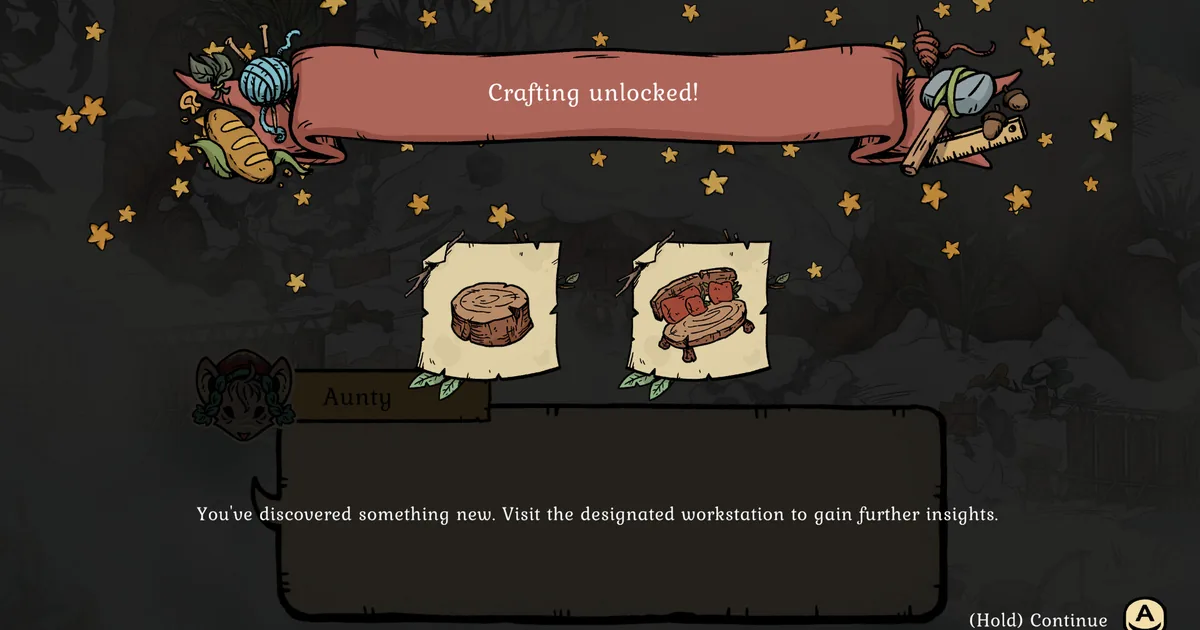
Crafting isn't available from the first minute. A tutorial screen titled "Crafting unlocked!" appears once you hit a specific point in the opening story, framed by knitting needles and yarn on one side and a hammer, ruler, and acorn on the other. Below the banner, two recipe cards get revealed at once: a tree-stump stool and a small wooden table, both burrow furniture rather than food or clothing. Aunty's own dialogue accompanies it directly: "You've discovered something new. Visit the designated workstation to gain further insights."
- Reach the story beat. The unlock is tied to the early "Bring your old burrow back to life" quest chain, specifically after the initial "Get settled in" objective.
- Watch for the popup. It interrupts play with the two revealed recipes shown as blueprint cards, no names printed on them in that screen, just the icons.
- Find the matching workstation. Aunty's line makes clear you need to physically visit a bench or station, not just unlock the ability in a menu.
- Open the recipe list. Each station (Knitting, Cooking, and presumably a build-focused one for furniture) shows its own scrollable list on the left with a detail panel on the right.
- Check the Required items box before committing. Every card checked so far shows an exact ratio (held/needed), so there's never a reason to guess.
That last step is the one worth internalizing early. Winter Burrow never makes you commit resources blind, which is a small thing that saves a lot of backtracking to the forest for one more Fur.
Where to find crafting ingredients in the wild
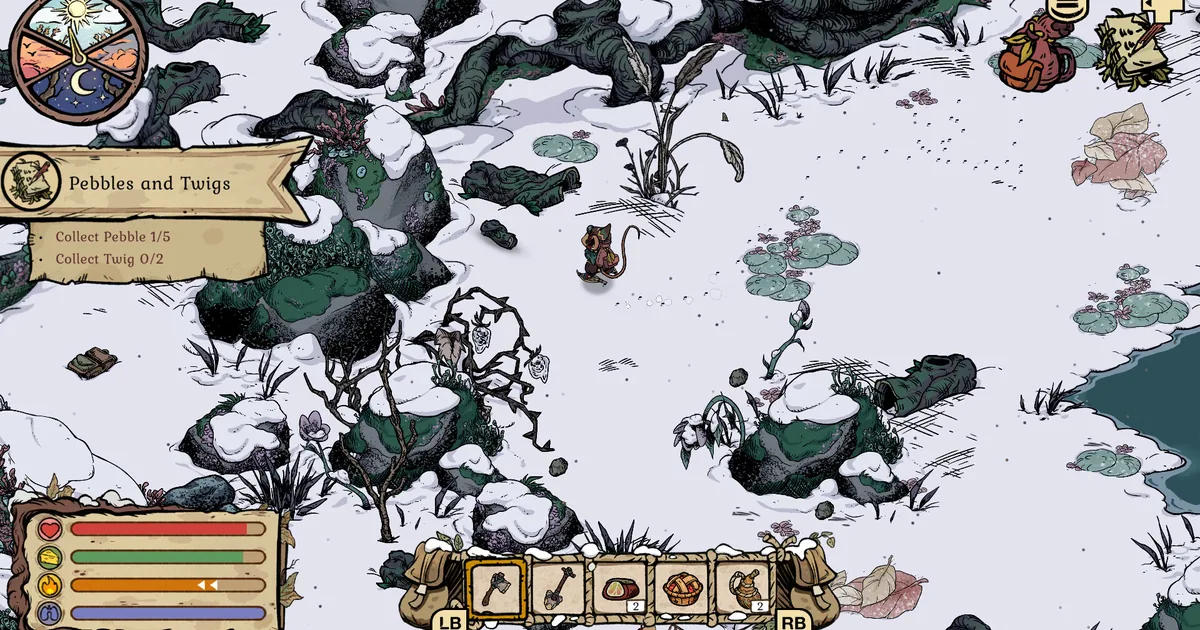
Fur and Beechnuts, the two confirmed core ingredients above, both come from exploring rather than buying or growing. Early gathering quests like "Pebbles and Twigs" (collect Pebble, collect Twig) establish the pattern: you're out in the snow picking up raw materials by hand, tracked with a simple checklist in the corner of the screen. Mushrooms show up constantly in that same loop, some growing in small clusters near tree roots, others standing taller on their own near frozen ponds, and berries cling to bare branches even in the depths of winter.
 Foraging nodes like mushroom clusters and berry branches are how raw cooking ingredients enter your inventory before they ever reach a recipe card.
None of the specific gathering nodes for Fur were visible in the available screenshots, which likely means it drops from wildlife encounters rather than a static node you walk up to and harvest, similar to how a lot of survival games separate "resources you pick" from "resources you get from creatures." Treat that as a reasonable inference rather than a confirmed mechanic, since no screenshot showed the exact Fur source directly.
Everything you gather funnels into Burrow storage, a dedicated screen separate from your carried inventory. One mid-game screenshot showed a 20-slot grid with real stack counts: a bundled herb item at 20, another herb bundle at 16, stone at 12, a rolled bark item at 9, a wrapped food roll at 10, fur at 6, and several other materials sitting between 2 and 6. That spread tells you two things worth planning around: herbs and fibrous materials stack the highest by a wide margin, and the storage screen is clearly built to hold a lot more than your five-slot hotbar ever could.
GODEEPER: If you want a deeper look at how another cozy game handles late-game recipe unlocks and ingredient combos, this breakdown of a similar cooking-focused title is worth reading. Beastro Advanced Recipe Guide: Spicy, Eggs & Late Unlocks →
Tips for managing your crafting queue and burrow storage
Use Craft All, not repeated single crafts. Every recipe card carries a Craft All button next to the single Craft option. If you've got 9 Beechnuts and need 3 per Biscuit, Craft All burns through all three batches in one action instead of three separate menu confirms.
Bank Fur before you commit to a big knitting session. Since Wool Yarn eats 3 Fur per craft and Fur likely comes from wildlife rather than a guaranteed gathering node, stockpiling a buffer before you sit down to knit avoids a mid-session trip back outside.
Don't eat every Blackberry on sight. The game's own flavor text flags a future jam or pie use for saved berries. Eating one on the spot for +5 fullness is fine in a pinch, but if the Cooking menu's tab row really does include a preserves-style category, hoarding a stack before that recipe unlocks is the safer bet.
Check the shield percentage even without a label. Both confirmed food items carry a shield stat, 10% on the Beechnut Biscuit and 2% on the raw Blackberry. Neither tooltip explains what it does, but the pattern (higher on the cooked, more effortful item) suggests it scales with craft investment, so it's worth tracking even while the exact mechanic stays unconfirmed.
Track your storage stack sizes, not just totals. With herb bundles already sitting at 16 and 20 units mid-game, storage pressure is going to come from bulk foraged materials first, not from rare drops. Clearing out excess before a big gathering run keeps you from wasting a trip.
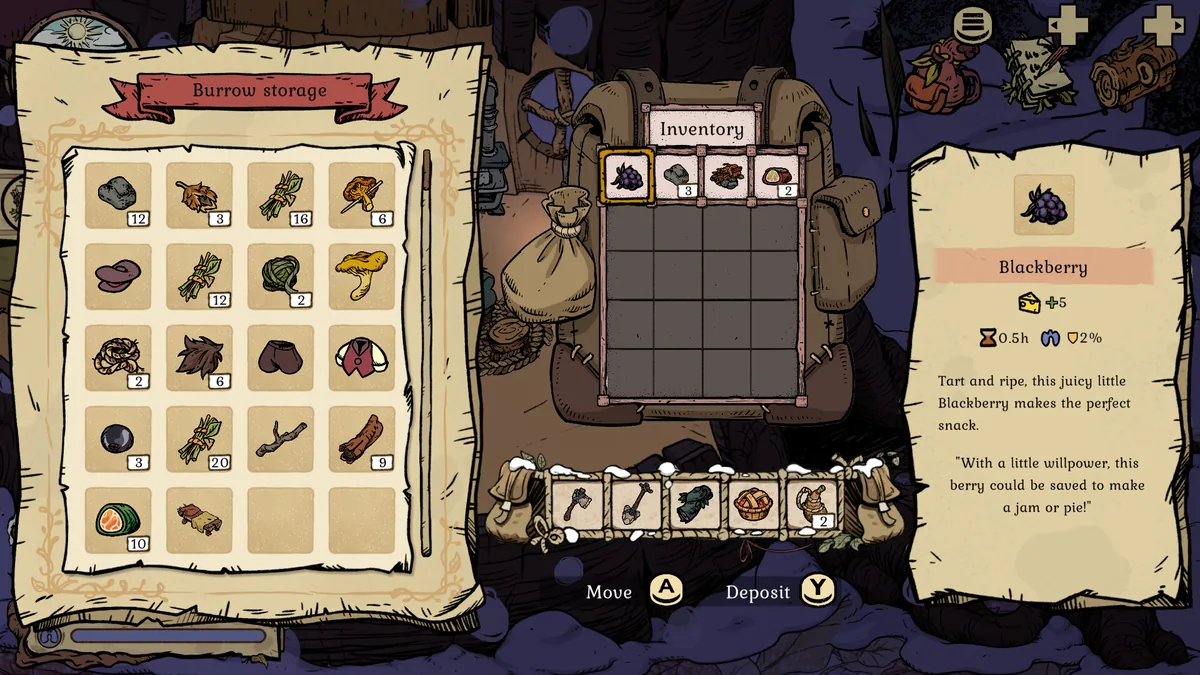 Burrow storage separates long-term stockpiles from your carried backpack, and stack sizes here hint at which materials pile up fastest.
Frequently Asked Questions
What is the first thing you can craft in Winter Burrow? A tutorial popup titled Crafting unlocked reveals two starting recipes tied to burrow furniture, a wood stump stool and a small table, right after an early Aunty dialogue tells you to visit a workstation.
How does the Knitting station work in Winter Burrow? You spend Fur to spin Wool Yarn, described in-game as making the warmest winter clothes. The confirmed recipe needs 3 Fur per batch, shown directly on the recipe card with a Craft and Craft All button.
What does the Beechnut Biscuit recipe actually require? 3 Beechnuts per batch, one hour of craft time, and it returns +15 warmth and +15 fullness. The required-item icon on the recipe card visually matches a beechnut in its husk, not a generic nut.
Can you cook with raw foraged food like Blackberries? Blackberries are eaten raw for +5 fullness without visiting a station. Their tooltip hints at a future use too: With a little willpower, this berry could be saved to make a jam or pie.
Where do you find Fur and Beechnuts to craft with? Both are gathered out in the snow rather than bought or grown. Fur turns up from wildlife encounters and Beechnuts from foraging nodes, the same loop that fills the pebbles-and-twigs early quests.
Is there a storage limit in Winter Burrow? The Burrow storage screen shows a grid of slots, and several resource types were already stacked past 15 to 20 in a mid-game screenshot, suggesting a generous but not unlimited cap per item type.
Does every Winter Burrow recipe show its exact stats before crafting? Yes. Every recipe card checked lists a required-items count, a craft-time hourglass, and output stats like warmth and fullness before you commit, so there's no guessing what a craft will cost or give back.
Related Reading
- Winter Burrow Review: Cozy Survival With Real Depth: The full verdict on Winter Burrow, including how the warmth meter and crafting tie into the missing-Aunt story.
- Beastro Advanced Recipe Guide: Spicy, Eggs & Late Unlocks: Another cozy cooking system broken down recipe by recipe, useful for comparing how two different studios handle ingredient math.
- Beastro Flavor Guide: How All 6 Tastes Work in Combat: A deeper look at stat-driven cooking design in a sibling cozy title.
- Romestead Buildings Guide: All Buildings & Build Order: How a similarly numbers-first survival sim structures its own crafting and build order.
- Valheim Food Buff Guide: Best Foods for Every Biome: For comparing how a longer-running survival game balances cooked food stats against raw ingredients.
- Winter Burrow Complete Guide: Warmth, Crafting, Achievements: The full hub covering crafting alongside warmth management and achievements.
References
Was this guide helpful?
About the author

Indie & JRPG Critic
Indie game evangelist and lifelong JRPG fan covering small studios since 2017. Mumbai-born, London-based. Writes the way she talks.
- 7 years indie games coverage
- JRPG and visual novel specialist
- Narrative design focus
Keep reading

Disclaimer
This article is published for informational and entertainment purposes. It does not constitute professional financial, legal, or technical advice. Game performance, online services, patch schedules, and store listings change. Verify critical details (pricing, system requirements, regional availability) with publishers and storefronts before you buy. Affiliate links, where present, help support our editorial work and are labelled in our affiliate disclosure.
Comments
Loading comments…