
GameBrief · General
Beastro Flavor Guide: How All 6 Tastes Work in Combat

This beastro flavor guide covers the part that takes most players too long to figure out. The cooking loop is obvious. What isn't obvious is that every dish you cook is already deciding how the fight goes tonight. What all six tastes do, how they interact in combat, and why your secondary flavor choice matters more than anything else you'll do in the kitchen.
TL;DR: Beastro has six flavors: Sweet, Salty, Sour, Bitter, Umami, and Spicy. Spicy unlocks after your first region, earlier than most guides assume, which is why some early guides only counted five. Each flavor is a card suit in combat, and the dominant flavor of your last-cooked dish becomes a trump suit that beats any other flavor's card regardless of value. Sour and Umami enhance each other; Bitter balances Umami, reducing its peak output. Start with two complementary flavors, not one or six. Oyshi the Umami Caretaker is the easiest starting point. The goal isn't to counter enemies. It's to build a deck so strong in its own flavor lane that it wins regardless.
Beastro flavor guide: what are the 6 tastes? (quick answer)
The six flavors in Beastro are Sweet, Salty, Sour, Bitter, Umami, and Spicy. They function simultaneously as the game's worldbuilding (the regions Panko's Caretakers explore) and as card suits in combat (the type of card each dish ingredient produces), with the dominant flavor of your last dish acting as a trump suit that beats any other flavor's card regardless of printed value.
Spicy is easy to miss early: it unlocks once you clear the game's first region, earlier than many guides assume, but if you've only played the opening hour or two you've likely only seen five of the six. Once unlocked, Spicy functions as a full flavor category, not just a modifier, though (as covered below) it's the one flavor with no dedicated Caretaker of its own.
Each flavor maps to a color code in the cooking interface:
- Umami is lime-green
- Sweet is pink
- Sour is green
- Bitter is slate gray
- Salty is sky-blue
- Spicy is orange
These colors show up on both the ingredient UI and the combat cards. Once you internalize the color coding, identifying what a dish will produce becomes fast. You don't need to read ingredient names mid-service.
How cooking ingredients become combat cards
The cooking system creates your Caretaker's deck directly. There's no separate card collection screen, no purchasing, no draft. What you cook is what they fight with.
The process: each ingredient carries a flavor. When you cook that ingredient in a dish, it generates one or more cards of that flavor for your Caretaker's combat run that night. Cook five Umami ingredients and your Caretaker walks into the puppet theater with a heavy Umami deck. Cook a mixed plate of Sour and Umami and the deck reflects that balance.
Card quality scales with cooking technique. The cooking mini-games (chopping, tenderizing, and boiling) each have quality thresholds. Landing better execution ratings produces stronger versions of the same card. A "Fantastic" boiling result generates a higher-power Umami card than a basic pass. This is why the cooking station upgrades matter: not just for throughput, but for the card quality ceiling.
Two things the tutorial does a poor job of explaining:
Every Caretaker has preferred flavor combinations. Cook toward those preferences and their spirits improve, which unlocks stronger combat abilities. Oyshi responds best to Umami-heavy meals with Sour mixed in. Kalan wants Bitter-forward dishes. Feed Oyshi a plate of Sweet ingredients and he eats fine but his best cards stay locked. The flavor request system during service is your signal: when a Caretaker sits down, their order tells you what to prioritize.
Monster parts are time-sensitive. When Caretakers return from runs with monster parts, cook them in the next session. Monster parts generate cards with special effects that standard crops can't produce. Holding them for three days while other cooks go by is a common mistake. The right time to use a monster part is the day after you get it.
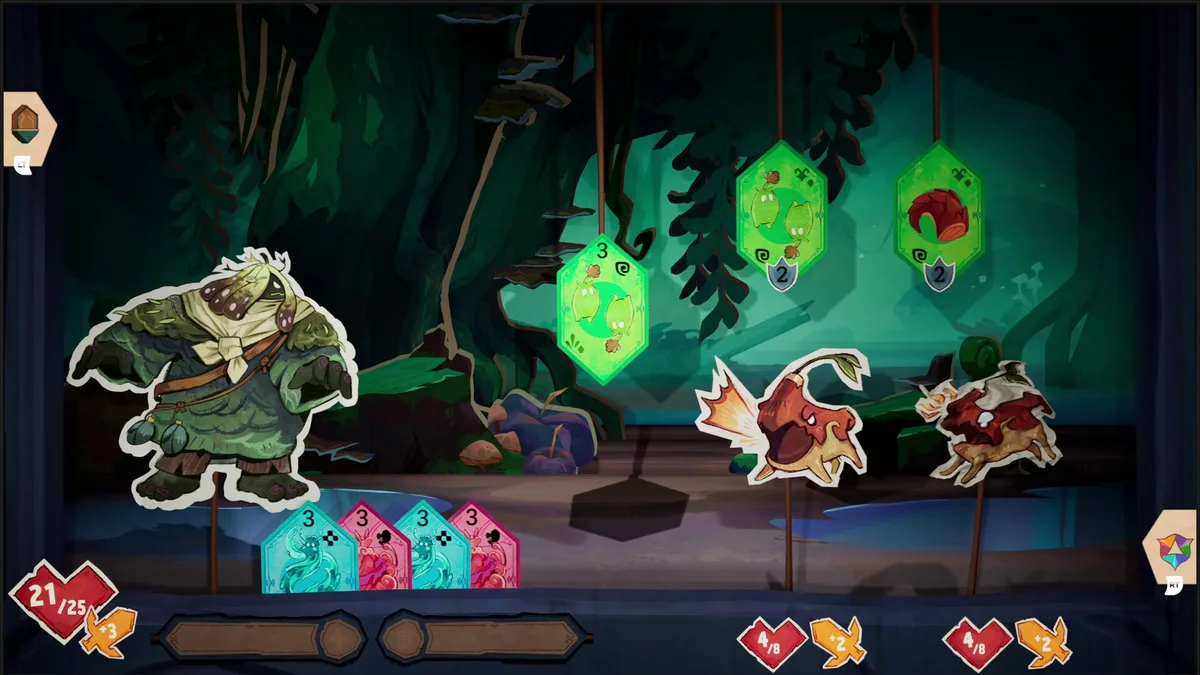 Puppet theater battles display every combatant's health and card values on stage. The flavor icon on each card, not just its printed number, decides which side wins the trick.
GODEEPER: For a full breakdown of which specific cards to build toward in each chapter, the deck building guide covers the strongest card effects by Caretaker type. Beastro Deck Building Guide: Best Cards and Combos →
Enhancement and balance: how flavor pairs interact
This is the part most guides skip, including Into Indie Games. The combat cards don't just compete on raw number values. Specific flavor pairs interact with each other, and the full chart splits into three enhancement pairs and three balance pairs across all six flavors.
Enhancement: Sour cards enhance Umami cards and vice versa. When both are in play in the same encounter, each flavor increases the effective output of the other. This is why Oyshi's Umami deck pairs so naturally with Sour secondary cards, and the combination pushes both above their printed ceilings. The same mutual boost exists between Bitter and Salty, which is why Kalan's Bitter deck synergizes with Salty cards, and between Sweet and Spicy. Enhancement is how you win fights that your raw numbers shouldn't win.
Balance: A balancing flavor reduces the other's effectiveness when played against its lead. Umami and Bitter balance each other, so mixing Bitter into an Oyshi deck weakens its Umami output. Sour and Spicy balance each other. Sweet and Salty balance each other.
The implication for deck building: if you're running Oyshi, mixing in Bitter cards actively weakens your Umami cards' enhancement synergy. Mixing in Sour actively amplifies it. The choice of secondary flavor is not neutral.
Enhancement pairs confirmed:
- Umami ↔ Sour (mutual enhancement)
- Bitter ↔ Salty (mutual enhancement)
- Sweet ↔ Spicy (mutual enhancement)
Balance pairs confirmed:
- Umami ↔ Bitter (each reduces the other's effectiveness)
- Sour ↔ Spicy (each reduces the other's effectiveness)
- Sweet ↔ Salty (each reduces the other's effectiveness)
Spicy has no dedicated Caretaker. It's a genuine sixth flavor category with its own enhancement and balance pairs, just not a playable deck identity of its own the way the other five are.
Caretaker preferences and what happens when you ignore them
Beastro has five playable Caretakers, one for each of the five starting flavors with a dedicated deck (Spicy has no Caretaker of its own, even though it's a real sixth flavor category). Each comes from a flavor region, and their origin defines what they need from your kitchen.
Oyshi (Umami Caretaker) is the starting Caretaker and the most forgiving for new players. His combat style is defense-forward, with high healing, survivable even when tricks don't go your way. Feeding him Umami-heavy meals with Sour mixed in activates his strongest abilities and builds the Umami/Sour enhancement pair that makes his deck competitive in chapter two and beyond. Some players nickname him "the sweet one" based on his personality, which causes confusion; Oyshi is Umami, not Sweet.
Kalan (Bitter Caretaker) is the second unlock, harder to earn. He shows up in the wilds and resists your restaurant initially; you have to figure out his preferred dishes through story progression and experimentation. Kalan's Bitter-forward deck has a different combat rhythm than Oyshi's: fewer sustained healing effects, more burst damage and debuff combos. His enhancement pair is Bitter/Salty, not Sour, and cooking toward Salty ingredients (once Sunna's region opens up) is what makes his deck spike in chapter two.
Sunna (Salty Caretaker) comes from the Crystalline Coast and runs a resource-and-tempo deck built around drawing extra cards and out-tempoing enemies over a long fight rather than winning fast. Sunna's enhancement pair is Bitter, the same bond that boosts Kalan's deck.
Colsi (Sour Caretaker) comes from the Acidic Swamps and specializes in crowd control: forcing monsters to discard their best cards or skip tricks entirely. Colsi's enhancement pair is Umami, which makes Colsi and Oyshi the natural two-Caretaker combo for a Sour/Umami-focused kitchen.
Azur (Sweet Caretaker) comes from the Mogave Desert and runs a swarm deck: rapid buffs and a wide field of low-value, highly synergistic cards that win through volume rather than single big hits. Azur's enhancement pair is Spicy, the one flavor with no dedicated Caretaker.
All five are story unlocks with full combat decks, not restaurant vendors. Salty and Sour aren't background NPCs in Palo Pori: they're Sunna and Colsi, with the same flavor preferences and card system as every other Caretaker. If a Caretaker feels missing partway through a run, it's most often Colsi (Sour), whose unlock some players report landing later than the other four.
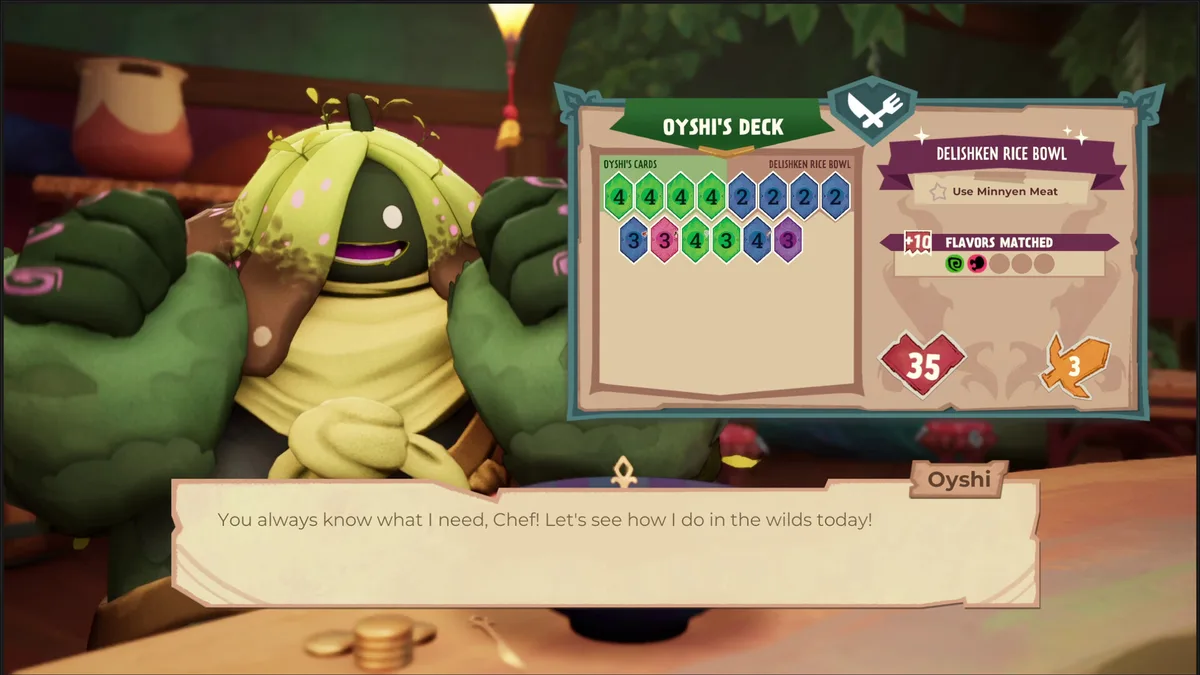 The results screen after cooking for Oyshi: matched flavor cards against the dish you served determine the "Flavors Matched" bonus feeding into that night's puppet theater run.
Practical deck building: how many flavors to use
The deck you build is a byproduct of what you cook. Since you can't curate cards directly, deck building in Beastro is really ingredient selection discipline.
Two complementary flavors is the baseline that holds up through chapters one and two. For Oyshi, that means Umami primary and Sour secondary. The enhancement pair covers both flavors' cards and gives you tools for most encounter types. You're not spreading thin, and you're not brittle to flavor counters.
Mono-flavor decks clear the early hours without trouble. Chapter two is where they break. Enemy encounters start introducing flavor-specific defenses and encounter modifiers that punish decks without response options. A pure Umami deck with no Sour will still work against Umami-neutral enemies, but you lose the enhancement advantage and have nothing when an encounter suppresses your main suit.
Three-flavor decks work once you understand the enhancement chart. Adding a third complementary flavor extends your response options without creating balance liabilities. The risk is diluting your primary enhancement pair if you pick the wrong third.
Spreading across all six flavors is not a strategy. It looks like coverage. What it actually produces is a deck with no coherent enhancement pairs that can't win by overwhelming any single combat track. You're covering everything and winning nothing.
Tips
When your Caretaker makes a flavor request during service, fill it even if it costs you a better dish by raw quality. The request isn't random. It's the game telling you what your deck needs before the next encounter. I've skipped these requests to optimize service flow and regretted it consistently in chapter two fights.
Cooking station upgrades matter more for secondary flavor cards than primary ones. Primary flavors are easy to hit Fantastic ratings on by volume. Secondary flavors come up less often during prep, so a lower-ceiling station caps those cards at mediocre quality. Upgrade toward your secondary flavor station early.
Check the skill tree after your first combat run, not your third. Several cooking upgrades are available earlier than players expect and compound across every session. The game doesn't surface them aggressively.
Foraged ingredients provide Sour and Umami that farming doesn't produce in chapter one. Even a short forage run on days when your garden is full keeps flavor variety healthy and stops the deck from drifting entirely into whatever your farm produces most.
GODEEPER: The tips guide covers caretaker food preferences and how the cooking station upgrades change card output quality. Beastro Tips: Cooking, Caretakers, and What the Game Doesn't Tell You →
Related Reading
- Beastro: Cozy Deckbuilder Launches on Game Pass and Steam: release overview with platform details and what's included at launch.
- Beastro Tips: Cooking, Caretakers, and What the Game Doesn't Tell You: expanded tips covering the daily cycle, fishing timing, and caretaker unlock order.
- Beastro Deck Building Guide: Best Cards and Combos: specific card recommendations by Caretaker and which effects are worth building around.
- Beastro Review: Cozy Deckbuilder on Game Pass: full verdict on whether the game holds up across all chapters and whether it's worth playing through Game Pass.
Frequently Asked Questions
What are the 6 flavors in Beastro? Sweet, Salty, Sour, Bitter, Umami, and Spicy. Each acts as both a card suit in combat and a flavor region in the world. Spicy unlocks after your first region, earlier than most guides assume, which is why some guides only counted five.
How does cooking affect combat in Beastro? Every ingredient in your dish produces a corresponding flavor card for your Caretaker. Cook Umami ingredients and the deck has more Umami cards. Cook a mixed dish and the deck reflects that. The dominant flavor of your last-cooked dish also becomes a trump suit for the fight, beating any other flavor's card regardless of value. Cooking quality affects card strength too: better execution ratings at the cooking stations produce higher-power versions of the same cards.
What caretaker should I start with? Oyshi, the Umami Caretaker. His deck is defense-forward with good healing, which means early mistakes are survivable while you learn the trick-taking system. Pair his dishes toward Umami and Sour for the enhancement synergy.
What does enhancement mean in Beastro combat? Sour and Umami enhance each other: when both are in the same deck, each flavor's cards perform above their printed values. Enhancement is how you win encounters that raw numbers shouldn't win. Building your deck to activate an enhancement pair is the core mid-game skill.
How many flavor types should my deck have? Two for the first two chapters: one primary flavor matching your Caretaker's preference, one secondary that forms an enhancement pair with the primary. Mono-flavor decks break in chapter two against flavor-specific enemy modifiers. Spreading across all six flavors produces a deck that does nothing well.
Is Beastro on Game Pass? Yes. Beastro launched day-one on Xbox Game Pass and PC Game Pass on June 11, 2026. It's included with any active Game Pass Ultimate or PC Game Pass subscription.
References
- Beastro on Steam: store page, platform list, and feature set
- Beastro Launch Day Coverage, Xbox Wire: official Game Pass launch announcement with Timberline Studio design notes
- Beastro PS5 Announcement, PlayStation Blog: flavor system design overview from Timberline
- Beastro Wiki: Flavor Profiles: full enhancement and balance chart for all six flavor types
- Beastro Wiki: All Caretakers: roster confirmation for all five Caretakers and their flavor origins
Was this guide helpful?
About the author

Senior Critic & Analyst
Former game data analyst turned critic with 11 years covering indie and mid-tier games. Based in Austin. Runs spreadsheets on games most people just play.
- 11 years games criticism
- Former game economy analyst
- Roguelike and strategy specialist
Keep reading




Disclaimer
This article is published for informational and entertainment purposes. It does not constitute professional financial, legal, or technical advice. Game performance, online services, patch schedules, and store listings change. Verify critical details (pricing, system requirements, regional availability) with publishers and storefronts before you buy. Affiliate links, where present, help support our editorial work and are labelled in our affiliate disclosure.
Comments
Loading comments…