
GuideBeastro
Beastro Advanced Recipe Guide: Spicy, Eggs & Late Unlocks

This Beastro advanced recipe guide covers the parts of the cooking system that become important after the first region. Most launch references focused on five flavor categories, but current sources document six, including Spicy as a late-game ingredient flavor without a dedicated Caretaker.
Updated 2026-10-05: Steam currently lists Beastro at $19.99 with Very Positive across 648 all-language reviews, 600 positive and 48 negative; the recipe audit also corrected the documented Spicy pairing and egg and ingredient names.
If you've read the Beastro flavor guide and the Beastro deck building guide and still feel like your late-game kitchen is hitting a wall, this is the guide for that wall.
TL;DR: Spicy is the 6th flavor, unlocked after clearing the first region and represented by late-game ingredients rather than a dedicated Caretaker. Public achievement lists confirm Spicy sources from monster drops, fishing, and Delishken treats. Sweet and Spicy are the documented enhancement pair, while Umami and Sour form a separate pair. Today's Special now gives +25 appeal according to official patch 1.0.5 notes.
Beastro advanced recipe guide: what most guides miss (quick answer)
There are six flavors in Beastro, not five. The sixth, Spicy, is a late-game ingredient flavor that the current public reference places after clearing the first region. It has no dedicated Caretaker and functions as an effect modifier rather than a full Caretaker trump suit. The exact card text for every Spicy ingredient is not documented in the sources checked here.
The other gap is the Delishken treat roster. Public achievement lists identify named egg variants across the flavor categories, but the current public reference does not publish complete combat text for every treat. Check each in-game tooltip before building around it instead of assuming the name describes the full effect.
Key takeaways
- Spicy is the 6th flavor category, available after clearing the first region; current sources do not publish one named region route for every Spicy source
- Delishken treats have named flavor-linked variants; the public lists confirm ten names, but use in-game tooltips for exact effects
- Fenpire Fang is explicitly tied to the Fenpire rescue; Spinewt Greens are listed as a garden ingredient, and no current source checked here documents Flamato's unlock
- Seeds from the market let you farm Bitter, Salty, Sour, Sweet ingredients without repeated hunting
- Today's Special highlights one dish per day for a restaurant appeal bonus
- Documented enhancement pairs are Sweet and Spicy, plus Umami and Sour; do not treat Sour as Spicy's enhancement partner
The 6th flavor: Spicy and what it unlocks
Spicy is the sixth flavor type, has no dedicated Caretaker, and is documented as a late-game ingredient flavor. The public achievement guide for the Spicy Connoisseur achievement confirms six named sources across monster drops, fishing, and Delishken treats. The current public flavor reference does not document a market seed for Spicy.
The confirmed named Spicy sources are:
- Flamadon Tentacles (monster drop; the r/Beastro ingredient list places it in Mogave Desert / Capasin Ruins)
- Langoferno Claw (monster drop; listed for Crystalline Coast / Capasin Ruins)
- Tortano Scale (monster drop; listed for Crystalline Coast / Capasin Ruins)
Other confirmed Spicy sources are:
- Shrimp (Fishing)
- String Jelly (Fishing)
- Power Up Egg (Delishken treat)
For how Spicy cards behave once they reach a fight, see the Beastro flavor guide and the boss guide.
These sources give you multiple ways to use Spicy once it is available. The exact combat text and relative power of each ingredient should be read from the card tooltip because the public references do not document every Spicy card value.
Spicy is an effect modifier rather than a complete trump suit. For a documented enhancement build, pair it with Sweet. Umami and Sour are a different enhancement pair, so do not describe a Spicy, Sour, and Umami stack as one confirmed three-flavor bonus.
GODEEPER: For the foundational flavor-card relationship and how to build around it from chapter one, the Beastro deck building guide covers mono vs. mixed builds and the Mise en Place grid mechanics. Beastro Deck Building Guide: Best Cards and Combos 2026 →
The Palo Pori garden is one confirmed source of ingredients and seeds used to build later Caretaker meals.
Delishken eggs: the wildcard ingredients
Delishken animals in Palo Pori produce the egg and meat ingredients used in Caretaker meals. The named egg treats below are recorded by flavor in the public achievement lists; they are not a substitute for checking the current card tooltip.
The public achievement ingredient lists confirm ten named Delishken egg variants across the flavor categories:
| Egg | Confirmed public record |
|---|---|
| Attack Up Egg | Umami Delishken treat |
| High Power Egg | Umami Delishken treat |
| Shield Egg | Umami Delishken treat |
| Healthy Egg | Umami Delishken treat; achievement guide documents its healing card use |
| Rotten Egg | Umami Delishken treat |
| Weak Egg | Bitter Delishken treat |
| Slow Egg | Salty Delishken treat |
| Poison Egg | Sour Delishken treat |
| Evasion Egg | Sweet Delishken treat |
| Power Up Egg | Spicy Delishken treat |
The key thing to understand about the egg list is that the names identify ingredient variants, not a complete substitute for the in-game card text. The sources checked here confirm the names and flavor records, but do not publish every combat value. Read the current tooltip before committing a treat to a primary flavor build.
For practical use:
- Healthy Egg is the only treat in this list whose healing use is independently described by the achievement guide checked for this audit
- Use the in-game tooltip to compare Shield, Attack Up, Evasion, Poison, Slow, Weak, High Power, and Power Up before choosing a final deck
- Treat Rotten Egg as undocumented for exact value rather than assuming it is filler from its name alone
Quest-locked ingredients: which quests are worth it
The current sources support two useful unlock notes, but not a universal priority ranking:
Spinewt Greens (Bitter tier): The Bitter achievement guide lists these as a garden ingredient. Beastro also has a Friendly Foraging achievement for rescuing the Spinewts, but the source checked here does not say the greens are that achievement's reward.
Fenpire Fang (Sweet tier): The Sweet achievement guide says this appears while exploring Palo Pori once the Fenpires move to town after their quest. Sweet's documented enhancement pair is Spicy, but the public source does not establish a universal power ranking for the ingredient.
I could not trace Flamato to a current ingredient or achievement source during this audit, so it is not part of the confirmed unlock list. Track the named ingredient record in game rather than assuming every rescue reward is a cooking ingredient.
Seeds and gardening: what you can grow
Some ingredients can be purchased as seeds from the market and grown at home rather than hunted per-run:
Bitter seeds from market:
- Bloomshroom
- Caboggi
- Moon Bean
- Pinesquash
Salty seeds from market:
- Sea Palm
- Amatato (available from Mystery seeds rather than standard market)
Sour seeds from market:
- Sour Sunrise
- Tangeriners
Sweet seeds from market:
- Cranbearry
- Oven Mitt Cactus
Seeds give you a reliable supply of those ingredients without requiring repeated hunting trips to the regions. For consistent flavors in your daily kitchen, the seed/garden system is more reliable than hunting. The tradeoff is that seeds take in-game days to produce and can't give you higher-tier region ingredients.
For practical deck building, prioritize seeds for your primary flavor once you know your Caretaker's preference. Farming Moon Bean (Bitter) or Cranbearry (Sweet) while collecting confirmed late-game Spicy sources gives you a stable base with a high-ceiling secondary.
GODEEPER: For the flavor pairing theory that explains why certain combinations hit harder than others, the Beastro flavor guide covers the Sour-Umami cross-enhancement and what it means for deck design. Beastro Flavor Guide: How All 6 Tastes Work in Combat →
Today's Special: how the appeal bonus works
The official v1.0.5 patch notes confirm that Today's Special gives +25 appeal correctly. The current public restaurant reference also documents Appeal as the stat that controls regular patron volume. The sources checked here do not document the article's earlier claim that Today's Special itself unlocks harder bonus encounters with better ingredient drops.
How it works in practice:
- The game marks a Today's Special dish type for the restaurant day
- Serving it should grant the documented +25 Appeal bonus on the current patch
- Appeal affects the restaurant's patron and income loop; use the current in-game UI for any additional unlock thresholds
Players reported a bug shortly after launch where the Today's Special appeal bonus wasn't registering correctly at high restaurant appeal. Timberline's official patch 1.0.5 confirms this is fixed: "Today's Special will now give +25 appeal correctly." If you're on 1.0.5 or later, the appeal bonus works as described below.
For practical use: match Today's Special with a dish you can serve accurately, then verify the resulting Appeal increase in the restaurant UI. Do not assume the bonus changes a Caretaker's combat deck unless the in-game recipe screen shows that effect.
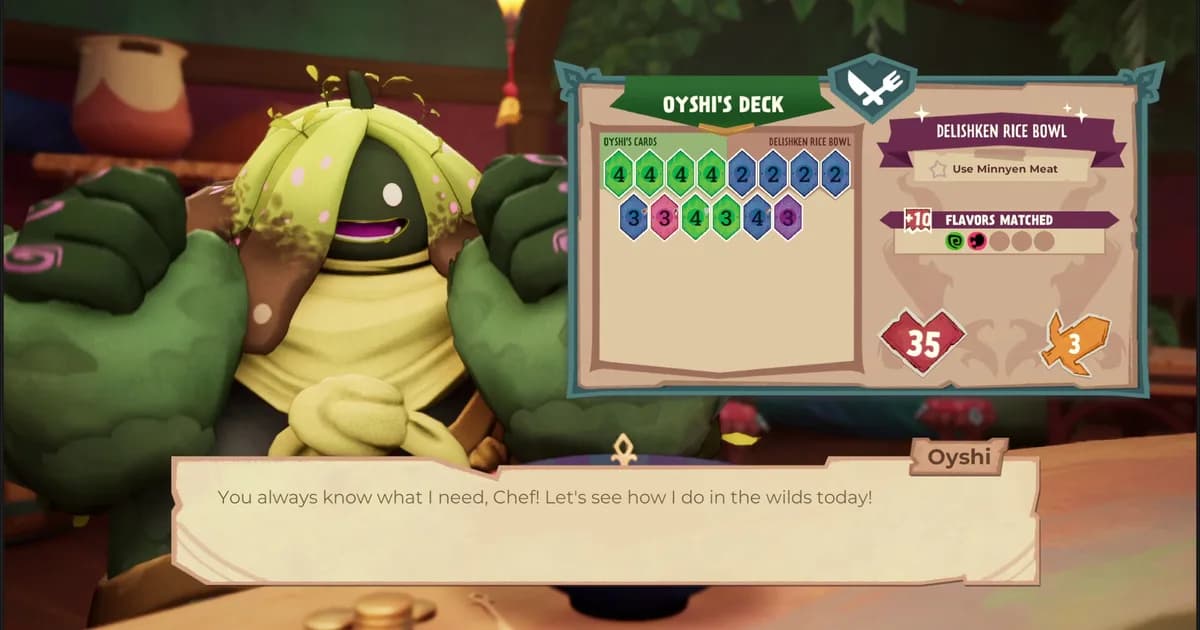
The puppet-theatre combat stage is where the cooked meal becomes a Caretaker card hand, with flavor symbols and card values visible against the monsters.
Step-by-Step: late-game kitchen optimization
Step 1: Reach the late-game Spicy sources. The current flavor reference places Spicy after clearing the first region, while achievement guides document monster drops, fishing, and Delishken treats as sources. If you also want the boss side of the late game, the Beastro boss guide covers the seven achievement-confirmed bosses and the order supported by current unlock data.
Step 2: Complete the Fenpire rescue and check the garden. Verify that Fenpire Fang appears after the Fenpires move to town, then check the garden record for Spinewt Greens. The sources checked here do not establish Spinewt Greens as a direct rescue reward.
Step 3: Establish a seed garden for your primary flavor. Pick 2-3 seed types matching your Caretaker's primary and plant them in rotation. This gives you a reliable supply without requiring daily hunting.
Step 4: Read the Delishken treat tooltips. Compare the egg variants against what your current build is missing. Healthy Egg has documented healing use in the achievement guide; use the game's current card text for Shield, Attack Up, and the other named variants.
Step 5: Match Today's Special to your deck's strongest day. Don't cook off-flavor just to fill Today's Special if your primary flavor is stronger. The appeal bonus from matching is worth more than the hit from diluting your deck.
Step 6: Add Spicy coverage once a confirmed source is accessible. Start with Shrimp or String Jelly from fishing, or Power Up Egg from Delishken treats, then test the card tooltip. Add Flamadon Tentacles, Langoferno Claw, or Tortano Scale when their source becomes available and compare the resulting deck to your Caretaker's documented enhancement pair.
Tips: advanced recipe mistakes
Ignoring Spicy because it's not listed in early guides: Several launch guides listed Beastro as having five flavors. It has six. Spicy is a late-game ingredient flavor with no dedicated Caretaker, and it participates in the documented Sweet enhancement pair.
Using Rotten Egg intentionally: There is almost no situation where Rotten Egg is a better choice than any other egg type. It exists for completeness. If you see yourself cooking with it regularly, it's a symptom of running out of better ingredients, not a deck strategy.
Assuming every quest reward is a cooking ingredient: The sources explicitly tie Fenpire Fang to the Fenpire rescue, while they list Spinewt Greens as a garden ingredient. I could not trace Flamato's current unlock, so check the in-game ingredient record before planning around it.
Overloading eggs: Egg treats have named variants across the flavor categories, but the sources checked here do not establish a universal two-egg limit or a universal best count. Compare the current tooltip with the Caretaker's primary flavor before giving up core ingredient slots.
Not tracking Caretaker preferences after chapter transitions: The Caretakers sometimes shift their preferred secondary flavor as the story progresses. Check what they're requesting before setting your seed garden for a new chapter.
Related Reading
- Beastro Deck Building Guide: Best Cards and Combos 2026: covers the Mise en Place grid mechanics and mono vs. mixed build theory that underlies every advanced kitchen decision
- Beastro Flavor Guide: How All 6 Tastes Work in Combat: covers the cross-flavor enhancement and balance pairs and all five Caretaker preferences, the foundation for how flavor synergy works in combat
- Beastro Tips: 9 Things to Know Before You Start Cooking: early-game tips covering the Dust economy and first-chapter kitchen setup before the advanced ingredients are available
- Beastro Complete Guide: Flavors, Decks, Caretakers 2026: the hub that links every Beastro guide, from flavors and Caretakers to bosses and release details
- Beastro Boss Guide: All 7 Bosses and Unlock Order (2026): the seven bosses in the order players defeat them, useful for judging when a late-game kitchen setup has to hold up
- Beastro Review: A Cozy Deckbuilder Worth Your Time: our 8.0/10 verdict on the cooking-to-combat loop these advanced recipes build on
- Beastro Release Date: Cooking Deckbuilder Hits June 11: launch date, platforms and Game Pass availability for newcomers
Frequently Asked Questions
How many flavors are in Beastro? Six. Bitter, Salty, Sour, Sweet, Umami, and Spicy. Several launch guides listed five. Spicy is a late-game ingredient flavor with no dedicated Caretaker. Public achievement lists confirm monster, fishing, and Delishken treat sources.
What do the Delishken eggs do in Beastro? The public achievement ingredient lists confirm ten named variants: five Umami treats (Attack Up, High Power, Shield, Healthy, and Rotten), plus Weak, Slow, Poison, Evasion, and Power Up treats for Bitter, Salty, Sour, Sweet, and Spicy. Read the current in-game tooltip for exact combat text; Healthy Egg is documented as a healing card.
How do you unlock Spicy ingredients? Public achievement guides list Flamadon Tentacles, Langoferno Claw, and Tortano Scale as monster drops, plus Shrimp and String Jelly from fishing and Power Up Egg from a Delishken treat. The community r/Beastro ingredient list places the three drops in Mogave Desert and Crystalline Coast, around Capasin Ruins. Check the ingredient tooltip for the current route.
What are the quest-linked ingredients in Beastro? Fenpire Fang is the only ingredient in this guide's confirmed list that the checked achievement guide explicitly links to a rescue, saying it appears once the Fenpires move to town. Spinewt Greens are listed as a garden ingredient. I could not trace Flamato's current unlock.
What does Today's Special do in Beastro? It is tied to a restaurant appeal bonus. Official patch 1.0.5 says Today's Special now gives +25 appeal correctly. The public restaurant reference ties Appeal to regular patron volume; it does not document additional combat encounters as a direct Today's Special effect.
Is Spicy better than other flavors in Beastro? Not universally. Spicy has no dedicated Caretaker and is documented as an effect modifier. Sweet and Spicy are the confirmed enhancement pair, while Umami and Sour are a separate pair. Choose based on the Caretaker and the current card tooltips.
Can I grow Spicy ingredients from seeds? The current public sources do not document a market Spicy seed. Confirmed sources include monster drops (Flamadon Tentacles, Langoferno Claw, and Tortano Scale), fishing (Shrimp and String Jelly), and Delishken treats (Power Up Egg).
References
- Beastro on Steam: official store page, current $19.99 price, Very Positive label, and June 11, 2026 release
- Beastro official site: official game overview and platform links
- Beastro Steam announcements: official v1.0.5 Today's Special fix and current v1.0.6 patch notes
- Beastro Wiki flavor profiles: six flavors, Spicy's post-first-region availability, and enhancement pairs
- Beastro Wiki regions: six named areas and the four-chapter progression reference
- Beastro Wiki ingredients: current ingredient names and documented sources
- Spicy Connoisseur achievement guide: named Spicy ingredient source list
- Beastro achievements list: flavor ingredient and quest achievement names
- r/Beastro Ingredient List: community-compiled ingredient roster by flavor category (June 19, 2026)
- r/Beastro Today's Special bug report: community thread on the appeal bonus miscalculation, fixed in official patch 1.0.5
Was this guide helpful?
About the author

Indie & JRPG Critic
Indie game evangelist and lifelong JRPG fan covering small studios since 2017. Mumbai-born, London-based. Writes the way she talks.
- 7 years indie games coverage
- JRPG and visual novel specialist
- Narrative design focus
Keep reading

Beastro Deck Building Guide: Best Cards and Combos 2026
General · 10 min

Beastro Review: A Cozy Deckbuilder Worth Your Time
General · 9 min
Beastro Tips: 9 Things to Know Before You Start Cooking
General · 13 min

Beastro Complete Guide: Flavors, Decks, Caretakers 2026
General · 14 min

Beastro Flavor Guide: 6 Tastes, Cooking & Combat Tips
General · 9 min

Beastro Release Date: Cooking Deckbuilder Hits June 11
General · 4 min
Game deals · affiliate links

Disclaimer
This article is published for informational and entertainment purposes. It does not constitute professional financial, legal, or technical advice. Game performance, online services, patch schedules, and store listings change. Verify critical details (pricing, system requirements, regional availability) with publishers and storefronts before you buy. Affiliate links, where present, help support our editorial work and are labelled in our affiliate disclosure.
Comments
Loading comments…