
Guide33 Immortals
33 Immortals Builds Guide: Weapon Themes and Perk Trees
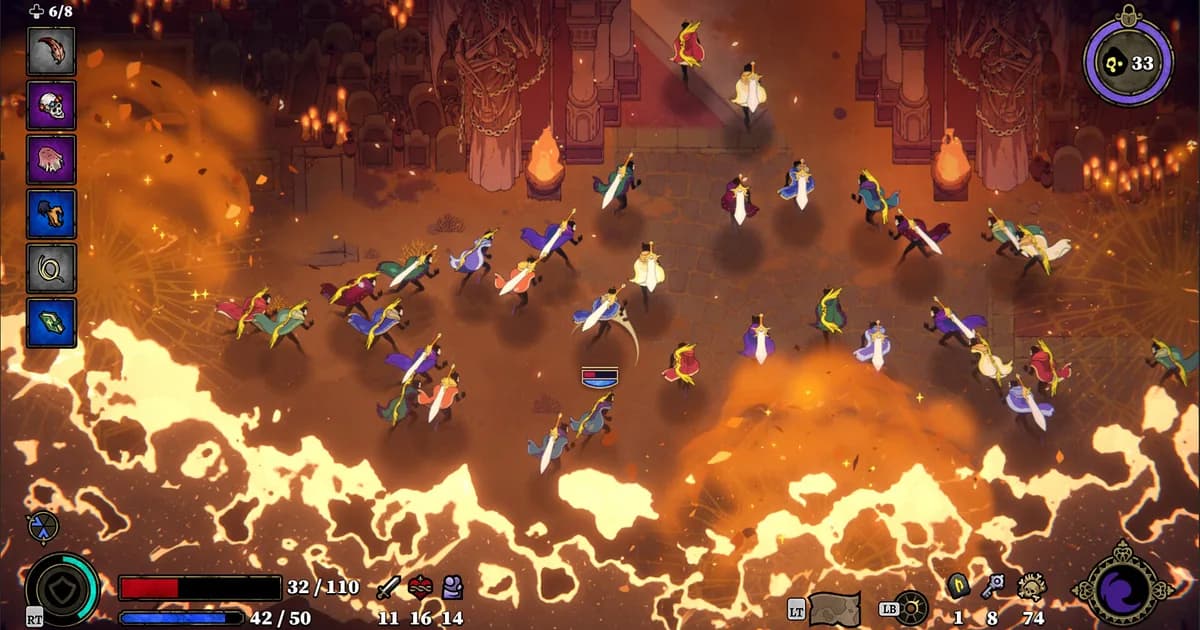
This 33 Immortals builds guide explains a system that's different from most action-RPGs. There's no class selection, no stat allocation at the start of a run, and no loadout you build outside of the encounter. Your build emerges from what you pick up during a run, shaped by the weapon theme you commit to from the first encounter.
Updated 2026-10-05: Steam currently lists 33 Immortals at $8.93, 40% off its $14.89 list price; the latest official Steam patch is 1.1.1, and the current Relic and Co-Strike rules no longer use the old Marked or crit-meter wording.
This guide breaks down what each of the 8 weapons actually does, how the relic Path system works alongside them, what the perk tree ranks actually cost, and how to approach building for the run's three-realm structure when the player count drops from 33 to 11.
TL;DR: Builds in 33 Immortals are defined by one of 8 weapon kits, 6 Relic Paths, and permanent Dark Woods perks. Dust is spent at Dust Shrines during a run; Eternal Shards and Paragons fund permanent perk ranks. Co-Strike's current gauge provides a damage bonus. Plan effects for Paradiso's 11 players, not only Inferno's 33.
33 Immortals builds guide: how the system works (quick answer)
33 Immortals doesn't have classes. Your build identity comes from three decisions made across a run and the Dark Woods: which of the 8 weapons you've committed to, which relics you've accumulated from the 6 Relic Paths (Honor, Malice, Unity, Vainglory, Revenge, Mercy), and which permanent perks you've equipped and upgraded.
The relic system is what creates build coherence, and it's separate from your weapon choice. Each Path pushes a different effect: Honor raises your Inner Fire for more damage dealt and less taken, Malice enables Critical Hits, Unity generates Co-op power orbs, Vainglory fires homing missiles, Revenge triggers damage blasts, and Mercy generates healing orbs. Boost Relics only show up once you own a relic from that Path, and Duo Relics mix two Paths together for a new effect once you have one from each. Commit to 1-2 Paths that suit your weapon and filter drops toward them; spreading across all 6 typically underperforms.
The permanent perk tree sits alongside that run loop. Dust drops from defeated enemies, fills the Dust Vial, and is spent at Dust Shrines to raise Attack, Vitality, or Empathy during the current Journey. Perks are upgraded with Eternal Shards in the Dark Woods, with Paragons required for ranks IV and V. Do not treat Dust as the currency for permanent perk ranks.
33 Immortals builds current status: October 2026
The live Steam appreviews snapshot is Mostly Positive with 1,717 positive and 667 negative reviews, 2,384 total. Steam currently lists $8.93, 40% off its $14.89 list price. Thunder Lotus's official 1.1 update added Fate, changed Weapon Feat I/II unlocks, and globally buffed Sword of Justice, Staff of Sloth, and Scepter of Charity by 30%. The weapon roster and relic-path advice below should be read against that 1.1 balance context. The latest Steam hotfix is 1.1.1 from September 9. Sources: 33 Immortals on Steam, the official 1.1 update notes, and the official Hotfix 1.1.1.
If you are still learning the run loop, pair this build breakdown with the 33 Immortals beginner guide; the progression guide covers what persists between runs, while the co-op guide covers the coordination that makes the Dust economy work. The complete hub ties those systems together.
Key takeaways
- 8 weapons total, each with a distinct playstyle (Scepter of Charity is the newest, added with Paradiso at 1.0)
- Relics come from 6 Paths (Honor, Malice, Unity, Vainglory, Revenge, Mercy), separate from weapon choice
- Permanent perk ranks II-III use Eternal Shards; ranks IV-V also need Paragons
- Co-Strike's current gauge provides a damage bonus rather than increasing Critical Hit chance
- Player count narrows from 33 in Inferno to 11 in Paradiso: plan perk tree for 11, not 33
- Paragons are the scarce limiter: spend them on 1-2 high-impact perks per run
The 8 weapons: what each one actually plays like
Each weapon in 33 Immortals has its own kit, and the roster spans beginner-friendly to execution-heavy:
Bow of Hope is the safest starting pick. Its Guiding Light ability recalls fired arrows, refilling ammo while stunning and damaging anything caught in the recall path. Good for learning boss tells from range before committing to melee weapons.
Sword of Justice is the closest thing to a tank. Guard blocks incoming damage, including AoE and projectiles, and the Gavel Bash counterattack makes you briefly invulnerable. You're not tanky because of raw stats; you're tanky because the kit lets you avoid damage outright.
Daggers of Greed reward hit-and-run play. Basic attacks build a Greed meter that dumps into a Takedown lunge, scaling damage and stun with how much Greed you've stacked. Mistiming the lunge is punishing, which is why it sits in B-tier on most community rankings despite a high ceiling.
Glaive of Temperance is a technical mid-range pick with two hitboxes: hitting the tip does far more damage than hitting close. A Temperance meter powers its strikes, and dropping below half cuts damage significantly until Backstep restores it.
Crossbows of Pride reward precise rapid-fire attacks and target focus. The old Brand and Marked description is not current: the official 1.0 notes removed Marked as a status effect, so use the current weapon and combat text for its resource loop.
Staff of Sloth is the support pick: slows and splash damage that lock down groups of enemies for the whole team, best played near allies rather than at the front.
Hooks of Gluttony is a mobile, aggressive tank. The Hook pulls you toward enemies for bonus damage, Parry prevents incoming hits and triggers Gluttonous stacks, and the whole kit rewards players comfortable standing in danger windows.
Scepter of Charity is the newest weapon, added with the Paradiso realm at 1.0. It's a mid-to-long-range specialist that inflicts Blind, causing enemies to flee, take more damage, and take damage over time for 4 seconds. It's recent enough that the community hasn't settled on a tier placement yet.
The key thing to understand: no single weapon is universally best. The encounter design rewards different kits at different points in the three-realm progression, which is why knowing how the realms work shapes which weapon you lean into. The achievements guide is useful when a build goal overlaps with a completion target.
GODEEPER: For how Inferno, Purgatorio, and Paradiso differ and what the 1.0 launch added to each realm, the 33 Immortals complete guide breaks down the new final boss and what changed since Early Access. 33 Immortals Complete Guide: Realms, Builds, and Co-op Tips →
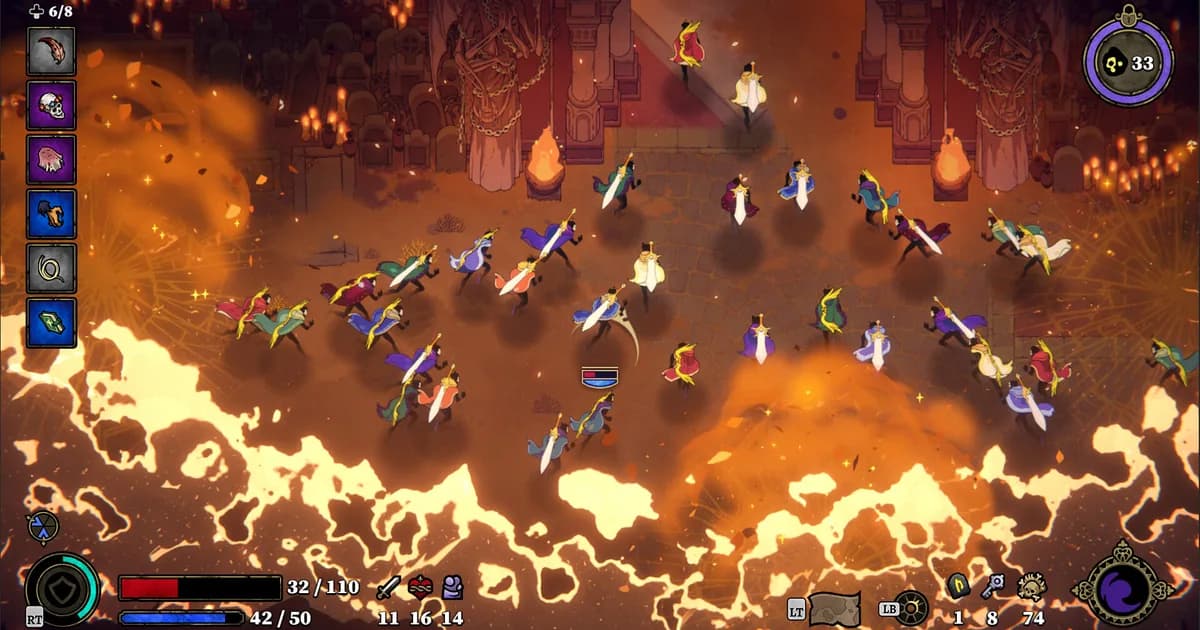
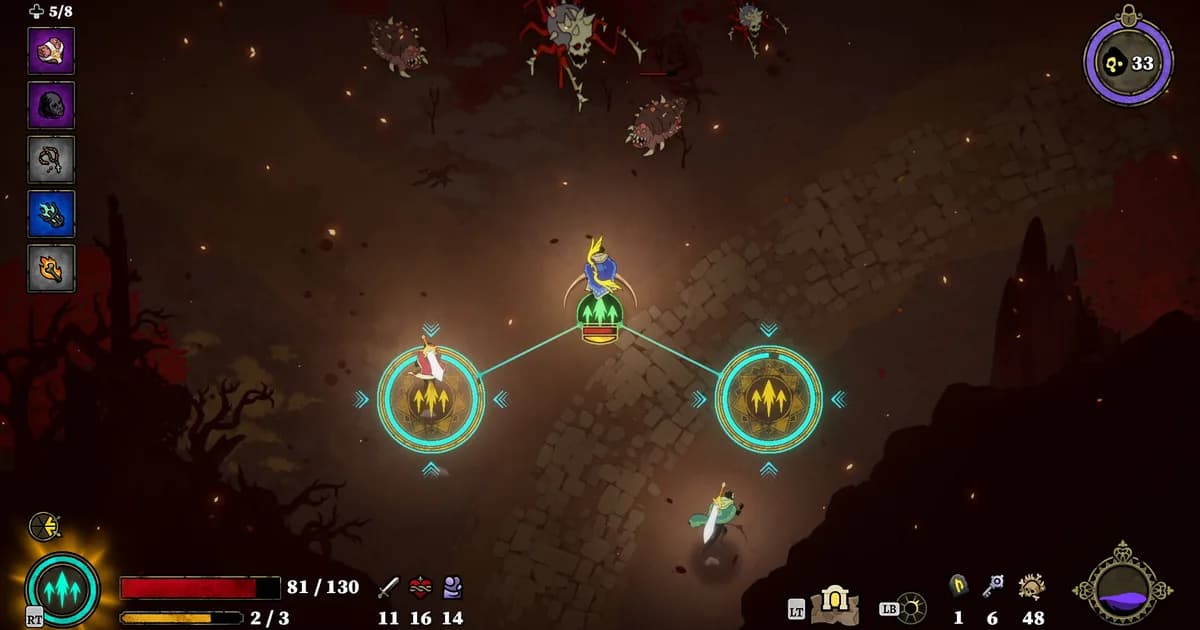
This combat view shows the weapon and relic loadout in the left HUD, not a perk screen.
Perk ranks and Paragon costs: what actually gates your build
Every immortal has a permanent perk tree in the Dark Woods that upgrades through five ranks. The cost structure is what most guides don't explain clearly:
Ranks II-III: Purchased with Eternal Shards in the Dark Woods. During a Journey, Dust drops from enemies and is spent at Dust Shrines for temporary characteristic increases; it does not buy permanent perk ranks.
Ranks IV-V: Require Paragons alongside Eternal Shards. Paragons are rare persistent currency found in the Beyond and used in the Dark Woods, so commit them to one or two priority perks rather than assuming a typical run guarantees a rank V upgrade.
This scarcity creates the key build decision: which perks get rank IV-V investment? The answer determines what your build actually does in Paradiso when those upgrades start mattering most.
Practical guidance:
- Identify your build's most impactful perk (the one that most directly amplifies your theme's damage or survivability) and commit your first Paragons there
- Don't spread Paragons to cover defensive gaps or secondary perks until your primary perk is at IV or V
- The rank IV passive on theme-core perks often triggers new interactions that don't exist at rank III
Co-Strike and Dust generation: the build economy
Co-Strike is the cooperative mechanic that rewards synchronized attacks with a damage-bonus gauge. Dust is a separate run resource: enemies drop it, it fills the Dust Vial, and Dust Shrines convert it into temporary Attack, Vitality, or Empathy.
In Inferno, coordinating Co-Strike is easier because you're running with 33 players. By Paradiso, you're down to 11, and coordinating is both more important and more achievable.
What this means for builds: the permanent Renewal of Dust perk improves the separate Dust economy, while Co-Strike is still valuable for its current damage bonus and team coordination. Do not promise a fixed Dust multiplier for synchronized attacks when the official notes do not document one.
Weapons with a built-in resource meter, like the Greed meter on Daggers of Greed or the Temperance meter on the Glaive, reward deliberate timing. Coordinated Co-Strikes help the group focus damage, but Dust Shrine choices and permanent perk upgrades remain separate systems.
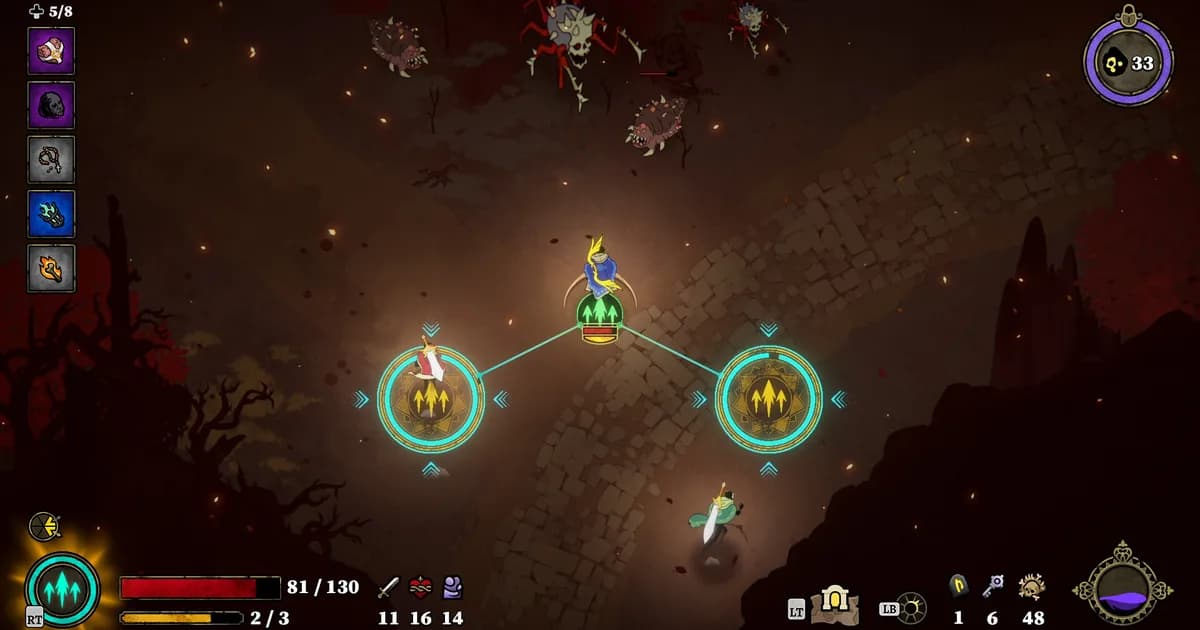
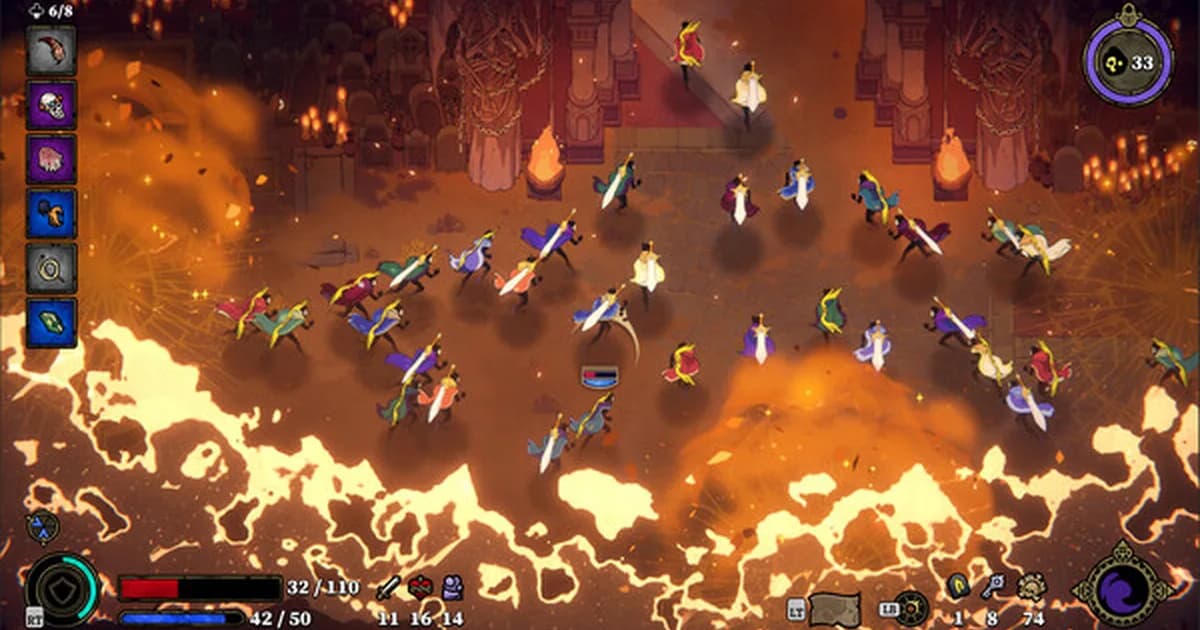
The visible wheel is the coordination menu, separate from the Co-Strike gauge.
Step-by-Step: building for a full three-realm run
Step 1: Choose a weapon theme at the first weapon drop. Don't switch themes mid-run unless your current weapon becomes unavailable. Relics accumulate toward your chosen theme, and switching resets that advantage.
Step 2: Use Dust Shrines during Inferno. Raise the characteristic that supports your weapon and keep participating in Co-Strikes for the current damage bonus. Permanent perk ranks are upgraded between runs in the Dark Woods.
Step 3: Identify Paragon sources in Inferno. The hardest Inferno encounters drop Paragons more reliably. Engage those encounters rather than routing around them if you need rank IV access.
Step 4: Make your first Paragon investment before Purgatorio ends. Rank IV perks unlock conditional interactions that change how your build functions in Paradiso. Having rank IV active by the Paradiso threshold is the goal.
Step 5: Adjust relic selection for Paradiso's 11-player context. Unity-Path relics generate Co-op power orbs from your actions, and their value scales with how many nearby players you can trigger them around. With 11 players instead of 33, those triggers fire less often. Filter your relic picks toward unconditional effects (Honor, Malice) by Paradiso if you were leaning on Unity.
Step 6: Communicate with your remaining group about role distribution. At 11 players in Paradiso, build overlap (two people committed to the same theme) creates redundancy. A diverse theme spread across 11 players is more resilient than 11 players running the same theme.
GODEEPER: For specific co-op role coordination and how to communicate build roles to a group mid-run, the 33 Immortals co-op guide covers the role distribution approach and how to call your build theme at the start of a run. 33 Immortals Co-op Multiplayer Guide: How 33 Players Work Together →
Tips: common build mistakes
Spreading Paragons across 4-5 perks: You get better returns from one fully-upgraded rank V perk than from five perks at rank III. Paragons are too scarce for broad investment.
Ignoring Co-Strike because you're playing solo-style: Even in a 33-player game, synchronized attacks are a team-damage opportunity. Players who ignore the current Co-Strike gauge lose that damage bonus and make group coordination harder; do not frame the penalty as an undocumented Dust multiplier.
Switching weapon themes mid-run: Unless your current weapon drops out of availability, stick to your chosen theme. Relic accumulation toward your theme compounds. Switching mid-run resets that compound and leaves you with a split relic set that doesn't trigger either theme's bonuses reliably.
For a broader verdict on whether the co-op loop is worth the coordination, see the 33 Immortals review. Players planning a completionist run can also use the 33 Immortals achievements guide to route realm-specific goals without abandoning their build theme.
Building for Inferno's player count: Perks that scale with nearby player count perform well in Inferno's 33-player chaos and poorly in Paradiso's 11-player structure. If a perk's effectiveness depends on having many players nearby, evaluate it as a Paradiso build tool, not an Inferno tool.
Not reading relic tags: Relic drops happen fast in 33-player encounters. The theme tag on each relic is the most important information for your build decision. Skipping the tag and grabbing relics by perceived strength often leads to off-theme accumulation that dilutes your build identity.
Related Reading
- 33 Immortals Beginner Guide: 9 Tips for Your First Runs: 33 Immortals beginner guide: Co-Strike, Dust perks, and 9 tips for surviving Inferno. What Thunder
- 33 Immortals Review: Co-op Roguelite Worth Playing 2026: 33 Immortals review: current Steam listing is $8.93 at 40% off its $14.89 list price. Thunder Lotus puts 33 players in Dante's
- 33 Immortals Progression and Unlocks Guide 2026: what carries over between runs, how persistent unlocks work, and how the metagame progression complements the per-run perk system
- 33 Immortals Achievements Guide: How to Get All 33: all 33 achievements by category, including which ones need multiple runs or specific realms to unlock
- 33 Immortals Complete Guide: Realms, Builds, and Co-op Tips: the full hub tying builds, realms, and co-op mechanics together in one reference.
Frequently Asked Questions
What are the weapon themes in 33 Immortals? 33 Immortals has 8 weapons, each with its own kit and playstyle, from the beginner-friendly Bow of Hope to the newest addition, Scepter of Charity, added at 1.0. Relics are separate from weapon choice and come from 6 Paths (Honor, Malice, Unity, Vainglory, Revenge, Mercy). Your build identity comes from your weapon plus which relic Paths you commit to.
How do perk ranks work? Five ranks per permanent perk (I-V). Ranks II-III use Eternal Shards in the Dark Woods, while ranks IV-V also require Paragons. Dust from encounters is spent at Dust Shrines during a Journey, not on permanent perk ranks.
What does Co-Strike do for builds? Co-Strike provides a current damage bonus when synchronized. Builds with Greed or Gluttony themes can still benefit from coordinated timing, but do not treat the mechanic as a documented Dust multiplier.
How do the three realms affect build planning? Player count narrows from 33 in Inferno to 11 in Paradiso. Perks that scale with player count are stronger in Inferno, weaker in Paradiso. Plan rank IV-V investments for Paradiso context.
Is there a best theme for beginners? The Bow of Hope is the most forgiving starting weapon: ranged, safe, and built to teach you boss patterns before you commit to melee. The Sword of Justice is a close second if you'd rather learn timing through its Guard block and invulnerable counter. Weapons like the Staff of Sloth and Hooks of Gluttony ask for more group-awareness and positioning, so save those for after your first few runs.
Can builds carry over between runs in 33 Immortals? Dust Shrine choices, Relics, weapon upgrades, and Co-op Powers are per-run. Permanent perks, weapon unlocks, Feats, and other Dark Woods progression carry over, subject to the optional Fate reset added in Update 1.1. See the progression guide for what persists.
What's the hard cap on perk ranks? Rank V is the maximum. Paragons are the binding constraint: you need enough to hit rank IV and V on your priority perks. The scarcity is intentional and creates meaningful build decisions.
References
- 33 Immortals on Steam: official store page with feature details and available on Game Pass
- r/33Immortals community: active community discussion on build themes, Paragon strategies, and Co-Strike coordination
- 33 Immortals official site: Thunder Lotus Games' developer page with game overview and update announcements
Was this guide helpful?
About the author

Senior Critic & Analyst
Former game data analyst turned critic with 11 years covering indie and mid-tier games. Based in Austin. Runs spreadsheets on games most people just play.
- 11 years games criticism
- Former game economy analyst
- Roguelike and strategy specialist
Keep reading
33 Immortals Progression Guide: Best Unlock Order 2026
General · 15 min
33 Immortals Achievements Guide: How to Get All 33
General · 11 min
33 Immortals Review: Co-op Roguelite Worth Playing 2026
General · 7 min
33 Immortals Co-op Guide: 8 Tips for Better Team Play
Guides · 8 min
33 Immortals Beginner Guide: 9 Tips for Your First Runs
Guides · 14 min
33 Immortals Complete Guide: Realms, Builds, and Co-op Tips
General · 14 min
Game deals · affiliate links

Disclaimer
This article is published for informational and entertainment purposes. It does not constitute professional financial, legal, or technical advice. Game performance, online services, patch schedules, and store listings change. Verify critical details (pricing, system requirements, regional availability) with publishers and storefronts before you buy. Affiliate links, where present, help support our editorial work and are labelled in our affiliate disclosure.
Comments
Loading comments…