
GameBrief · General
Legionbound Battle Mode Guide: Endurance Runs 2026

Reviewing
LegionBound
Spicy Garlic Games
Legionbound Battle Mode strips the game down to its core question: how long can your hero roster hold before the enemy scaling overtakes you? No Endbringer bearing down on you, no routing decisions across maps, no building placement eating into wave prep time. Just your heroes, the waves, and however far you can push the wave count.
TL;DR: Legionbound Battle Mode is an endurance sandbox: wave count is the practical score, with no Adventure Mode route or Endbringer decision. Use waves 10, 20, and 30 as build-review checkpoints, not guaranteed stat spikes. The four-class Tax Collector loop is the cleanest first synergy experiment; Warrior-group chains offer more room for a longer run. Combat habits transfer to Adventure Mode, but the modes' run state is separate.
Legionbound Battle Mode: quick answer
Battle Mode is the clean endurance sandbox: recruit heroes, position them, build synergy pairs, and see how far the run goes without Adventure Mode's map route or Endbringer decision. Start with the four-class Tax Collector loop when you want a compact synergy test; move into Warrior-group chains when the run offers the right recruits. Wave 10, 20, and 30 are useful checkpoints for reviewing your build, not guaranteed universal difficulty jumps.
LegionBound status: September 2026
Steam currently lists LegionBound at $9.99 with 676 all-language reviews labeled "Very Positive." The latest official Patch 1.12 fixes a targeting crash, lingering-zone hangs, and item-disable states that could become stuck. Patch 1.115 also addresses high-wave crashes and heroes generating at the wrong level, while Patch 1.11 reworks Boss Idols without pausing the run. Those notes make high-wave stability a current concern, but they do not change the verified launch-loop roster documented in the LegionBound synergy guide.
That simplicity is why Battle Mode deserves attention on its own terms, not just as a warmup for Adventure Mode. It has its own optimal builds, its own scaling checkpoints, and its own leaderboard. Players who spend real time here learn things that Adventure Mode simply doesn't teach.
Key takeaways
- Battle Mode is pure endurance: wave count is your score, no Endbringer, no map routing
- Waves 10, 20, and 30 are useful build-review checkpoints, not published universal stat jumps
- Tax Collector full loop (4 classes) is the easiest synergy build to complete in Battle Mode
- Warrior-group dual chains give longer runs more adaptation room than a compact loop
- Spell timing and row positioning matter as much here as class selection
- Combat habits transfer to Adventure Mode, but run state and mode-specific decisions remain separate
What Battle Mode is (and what it isn't)
The combat layer is identical in both modes: recruit heroes between waves, position them in rows, cast spells during combat, buy items from the shop. The difference is everything around it. In Adventure Mode, you're also routing between maps, placing structures, watching the Endbringer timer, and carrying decisions across multiple battle sequences. In Battle Mode, none of that exists. Every decision collapses into one question: which heroes am I putting on the field and in what order?
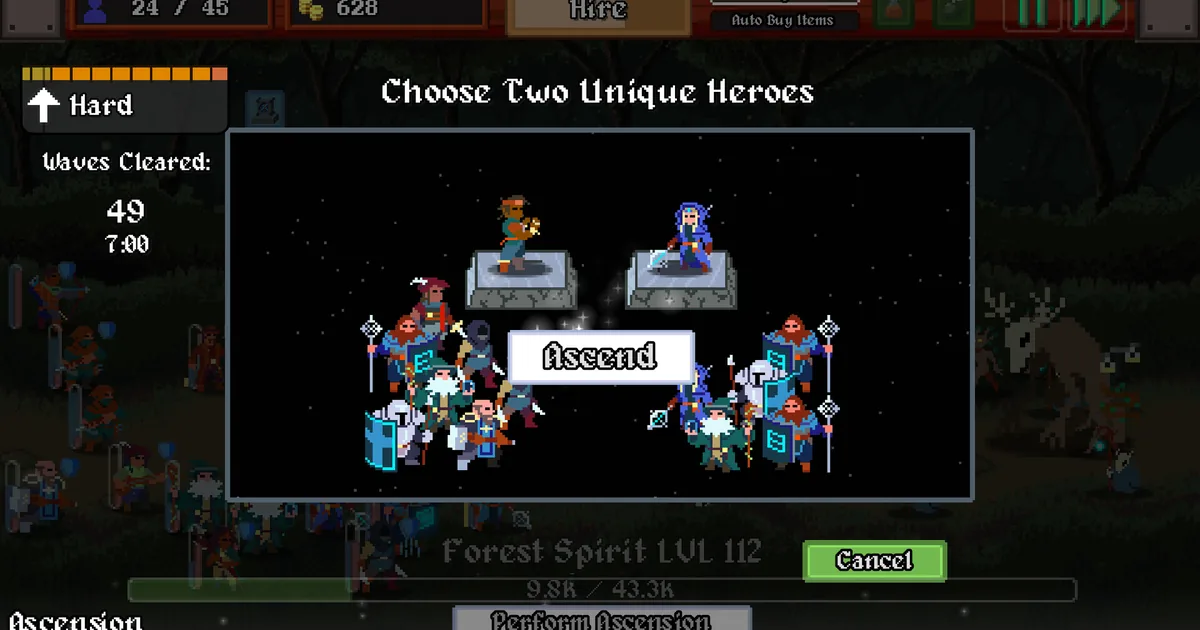
Because you're not managing buildings or routing anxiety, you can actually watch what's happening in the synergy chain and see how the enemy scaling reads against your current build. Most players who learn Ascension timing here (when to trigger a merge, and which class to merge first) carry that intuition cleanly into Adventure Mode. The reverse isn't reliable. Going straight to Adventure Mode and then trying to apply what you learned back to Battle Mode produces weaker results, because the two modes don't give you the same feedback loop.
Battle Mode also gives you more freedom in your recruiting sequence. Adventure Mode often forces your hand based on what's available at a given map node. Here the hero pool is freer, which makes this the better place to deliberately test a synergy chain you haven't built before. Want to run the full Tax Collector loop for the first time? Battle Mode lets you chase it without an Endbringer scaling against you while you're still figuring out the class trigger order.
How Battle Mode scaling works
Enemy pressure in Battle Mode rises as the run continues, but the public patch notes do not provide a fixed multiplier table. Use waves 10, 20, and 30 as review points from the current guide's play pattern, not as hard-coded thresholds that every run must obey.
Wave 10 is a useful first review point. If the party still has no active synergy or Ascension, use the next shop and recruit choices to stabilize rather than assuming a fixed health jump. Base-class heroes can still survive different runs depending on items and rolls, so the guide's checkpoint is a planning tool, not a stat claim.
Wave 20 is a second review point. Check whether the front row has a real defensive plan, whether at least one synergy chain is active, and whether an Ascension is helping rather than consuming a needed prerequisite. A completed Tax Collector loop is one route; it is not the only possible answer.
Wave 30 is a late-run review point where flat-stat recruiting becomes less reliable. Tier-2 Ascensions and synergy items can help, but the official patch notes do not establish a universal loadout requirement or guarantee a leaderboard result. Build around the options your run actually offers.
Treat each threshold as a decision point, not a deadline. The correct first Ascension timing depends on the shop, your current prerequisites, and whether merging removes a class needed for another synergy. The Ascension guide explains that distinction in more detail.
GODEEPER: The full three-loop breakdown (which classes sit where in each circular synergy chain and what each synergy subclass does) is in the class reference guide. LegionBound Synergy Guide: All 42 Classes →
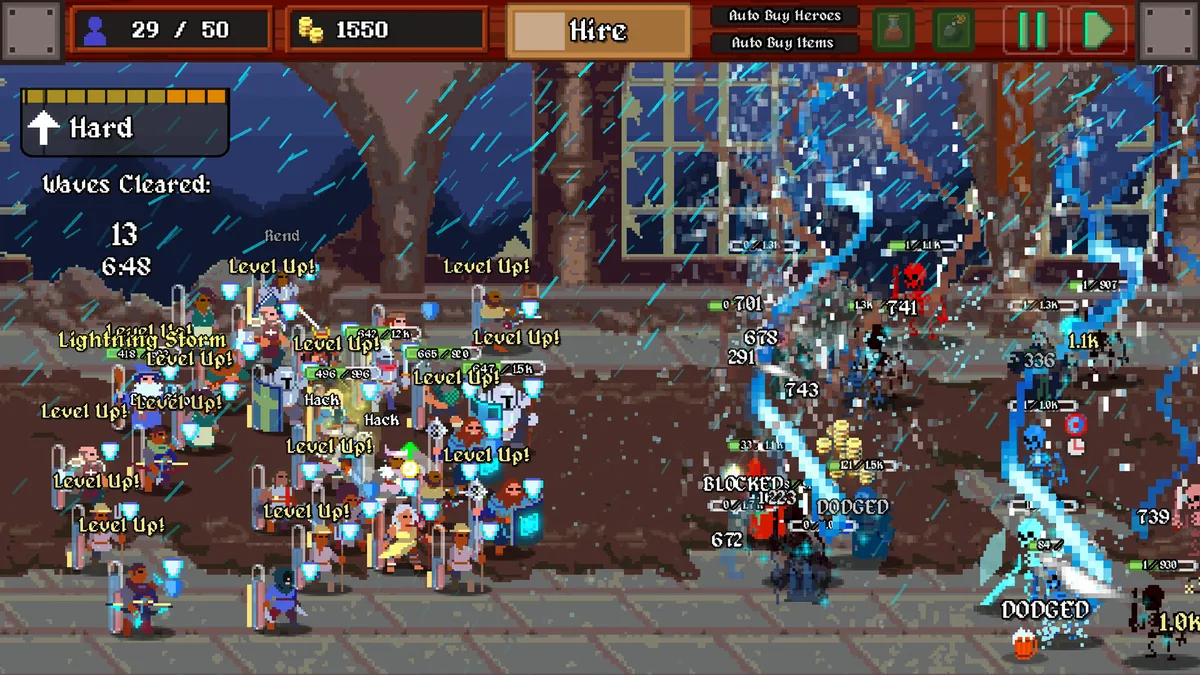 Wave 20 is a useful review point in Battle Mode: check whether the front row, synergy prerequisites, and item plan still match the run you rolled.
Legionbound Battle Mode: best builds for endurance runs
Tax Collector full loop: the compact synergy test
The Tax Collector group has four classes: Tax Collector, Barbarian, Brawler, and Mercenary. None of the five starter classes belong to this group, so you're recruiting your way in from scratch. That's the only real cost: the payoff is that a complete Tax Collector loop activates all four synergy subclasses simultaneously: Strongarm, Berserker, Boxer, and Bounty Hunter.
Four subclasses across four heroes, all active at once, is something that takes significantly more party investment to achieve in either of the larger loops. In Battle Mode specifically, the Tax Collector loop is easier to test because you're not also managing map routing. Whether you complete it early depends on the recruiting offers in that run.
Do not treat the loop as having a fixed wave ceiling. If the run offers Ascensions and items that support it, deepen the loop; if the offers do not appear, use the four-class progress as a learning route and pivot rather than forcing a promised wave number.
Warrior-group dual chain: the long-run build
Once you understand how subchains work inside the Warrior group's 14-class loop, Battle Mode's longer endurance runs open up. The advanced builds guide covers this in depth, but the short version for Battle Mode: run the damage chain (Warrior → Sorcerer → Witch) and the sustain chain (Knight → Smith → Guardian) simultaneously.
Seven party slots for seven active synergy subclasses: Spellblade, Warlock, Hexer on the damage side; Stalwart, Armorer, Bulwark on the sustain side. The front row runs your Knight chain absorbing damage while the Warrior chain's casters stack output behind them.
This build takes more recruiting luck than the Tax Collector loop because none of the Knight-chain classes are starters. Build the damage or sustain side that the shop actually offers, then reassess before spending a slot on a disconnected hero. A tier-2 Ascension can help a long run, but no official source establishes a required class, wave, or leaderboard threshold.
A practical note on sequencing: if you draw Warrior and Sorcerer early and start building the damage chain, do not divert into Knight-chain recruiting until the first chain is actually active and your front row is stable. The correct switch point depends on the next offers, not a fixed wave deadline.
Anchor-plus-satellite: the efficient middle option
If neither full loop is clicking because of bad recruiting luck, the anchor-plus-satellite structure still gives you two active secondary synergy subclasses on top of your primary chain. Run 6-8 heroes deep in the Warrior group, then add 2 adjacent Tax Collector heroes (Barbarian + Tax Collector, for example) as satellites. Barbarian triggers Berserker with Tax Collector present. Two party slots, two subclasses, zero disruption to the main chain.
This isn't as clean as the dual chain, but it's more forgiving with bad draws. Battle Mode's recruiting pool gives you options: this structure lets you adapt without abandoning synergy discipline.
GODEEPER: Stat priority by Ascension tier, subchain values inside the loops, and exactly when to switch from HP items to damage multipliers: all covered in the late-game guide. LegionBound Advanced Builds: Late-Game Class Chains →
Row positioning in Battle Mode
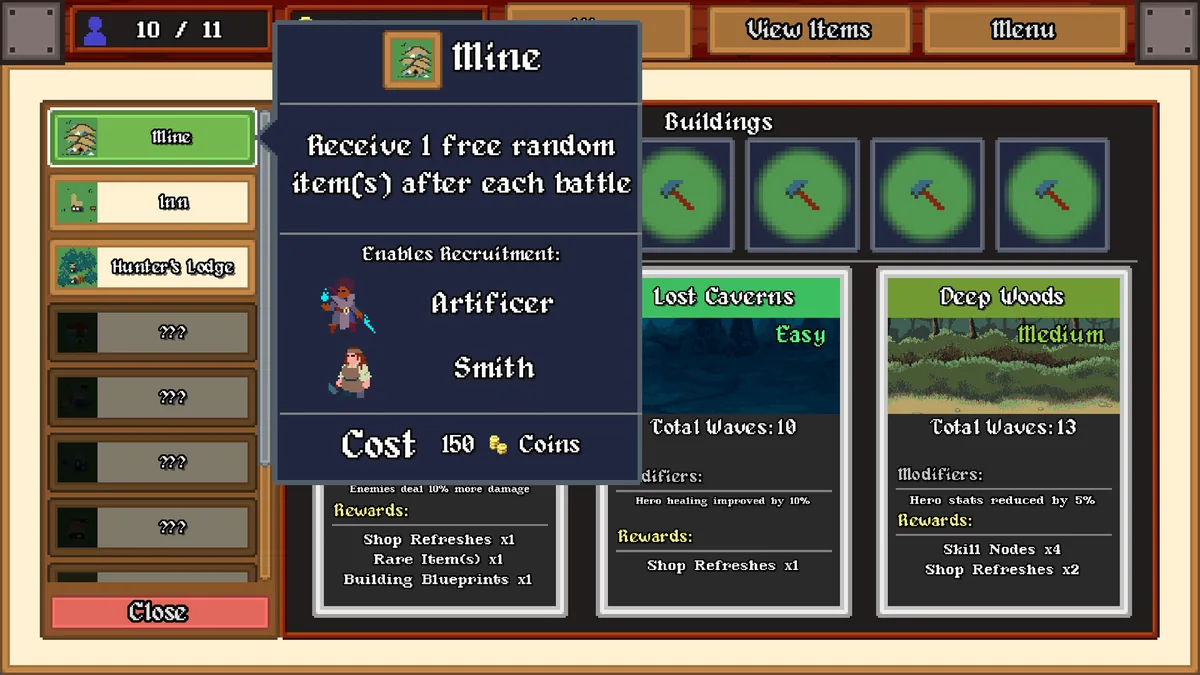 Front row is your damage sponge: if a caster ends up there after a death, replacing them is your next-wave priority.
Row positioning matters more in Battle Mode than its simplicity suggests. The basic rule from the tips guide (highest HP in front row) holds here, but Battle Mode's extended wave counts create situations where that rule needs updating mid-run.
When an Ascended hero has died and your front row suddenly has a caster that you placed there to fill the gap, replace them as fast as your next wave's recruiting allows. Front-row casters are a temporary measure, not a build state. Leaving a Witch or Sorcerer in front row while the run's pressure rises usually costs you more than spending the next recruit on a proper defensive anchor.
The swap protocol: if a front-row hero dies mid-wave, the row behind it absorbs that combat. After the wave resolves, immediately check who's in the front row and what their HP pool is. If the answer is "a class that belongs in the back row," recruiting a replacement takes priority over items that wave.
Step-by-step
1. Pick an anchor chain when the shop gives you enough information. Decide whether the Tax Collector loop or a Warrior-group chain fits the first offers. Do not reject a useful defensive recruit merely to satisfy an arbitrary wave deadline.
2. Separate Ascension from synergy prerequisites. An Ascension can strengthen a hero, but the class guide warns that an Ascended hero does not replace the base prerequisite for another synergy. Merge when the offer improves the current formation without deleting the class another chain still needs.
3. Verify synergy subclasses in the hero detail. Confirm the class displays its subclass name (Spellblade, Berserker, Stalwart) rather than its base class name. If a hero still shows its base name, the trigger is missing or the current roster does not meet it. Fix the gap only if the next recruit supports the overall formation.
4. Review the formation before a difficult wave. For the Tax Collector loop, check whether all four classes and their triggers are present. For the Warrior dual chain, decide whether the damage side or the sustain side is currently more complete. A missing synergy position is a reason to pivot, not proof that the run has a predetermined endpoint.
5. Check subclass status after roster changes. A class reverting to its base name means the current trigger is no longer active. Check after deaths, merges, and recruit swaps instead of waiting for a fixed five-wave interval.
What Battle Mode teaches that Adventure Mode doesn't
Players who skip Battle Mode and go straight to Adventure Mode tend to hit a specific wall: their synergy chains work fine in isolation but fall apart when map routing forces a non-ideal recruiting sequence. Having built chains in Battle Mode first means you've already internalized what the chain requires: so when Adventure Mode hands you a bad option, you can read the situation and adapt instead of just taking whoever's available.
Spell timing is the clearest example of a skill Battle Mode develops that Adventure Mode doesn't. With no routing overhead eating your attention, you can actually watch your spells relative to wave composition. Spending a group heal when two heroes are lightly damaged is a habit that quietly costs you. Holding it 3 seconds to catch four heroes below half HP extends runs meaningfully. Adventure Mode's cognitive load makes this easy to miss. Battle Mode gives you the space to actually see it.
The modes teach overlapping combat decisions, but do not assume every reward or progression value is identical. Check the current in-game results screen after a run; the official patch feed has changed high-wave progression and coin behavior before. Battle Mode is still a useful low-routing environment for practicing the class system.
Legionbound Battle Mode leaderboard strategy
The visible Battle Mode result is wave count. The official patch notes do not publish an additional scoring formula for party size, class diversity, or time, so do not build around a hidden multiplier that has not been documented.
If you care about a high result, prioritize a build that survives rather than one that only clears early waves quickly. The Tax Collector loop is a clean experiment; the Warrior-group dual chain is a flexible experiment. Neither is a guaranteed leaderboard formula.
Two habits that separate the longer runs: check your synergy subclass status every five waves (a class displaying its base name instead of its subclass name means synergy broke somewhere: catching it early is recoverable, catching it fifteen waves later usually isn't), and hold AoE damage spells for enemy clustering rather than casting the moment they're off cooldown. An AoE that hits six enemies two seconds after it's ready beats the same spell hitting two enemies the instant it fires.
Frequently asked questions
What is Battle Mode in Legionbound? Battle Mode is Legionbound's endurance format: survive escalating enemy waves for as long as possible. No Endbringer, no map routing. Your score is your wave count.
How does difficulty scale in Battle Mode? There are useful review points around waves 10, 20, and 30, but the public patch notes do not establish fixed health or damage spikes there. Builds can diverge because of recruit offers, items, synergy state, and Ascension choices.
Which build survives longest in Battle Mode? The Warrior-group dual chain gives a longer run more room to adapt when the right classes and items appear. The Tax Collector full loop is easier to understand because it has four classes. Neither has an official guaranteed wave ceiling or leaderboard result.
Is Battle Mode good for beginners? Yes. It removes Adventure Mode's extra complexity (Endbringer, map routing, building placement) so you can focus on learning class synergies, Ascension timing, and row positioning: all of which transfer directly to Adventure Mode.
Does the skill tree advance in Battle Mode? Check the current results screen after each run. Battle Mode is a good place to practice and may award progression, but the official patch notes do not establish that every mode reward is permanently identical across versions.
What's the first synergy build to try in Battle Mode? Tax Collector loop: Tax Collector, Barbarian, Brawler, Mercenary. None are starters, so you recruit into them. But four classes completing a full loop and activating all four synergy subclasses simultaneously is the cleanest introduction to what synergy-active party composition actually feels like.
What carries over to Adventure Mode? Synergy-chain construction, Ascension judgment, row positioning, and spell timing are the useful transferable habits. Battle Mode's run state, route, and leaderboard context do not automatically become an Adventure Mode run.
Related Reading
- LegionBound Adventure Mode Guide: the campaign format with map routing and the Endbringer.
- LegionBound Synergy Guide: All 42 Classes & Groups: the full launch-loop system behind the class choices here.
- LegionBound Advanced Builds: late-game class chains for longer endurance runs.
- LegionBound Tips for Beginners: a beginner route into Ascension timing and the first synergy chain.
- LegionBound Warrior Group: All 14 Classes & Synergies: the largest documented loop and its circular subclass chain.
- LegionBound Barkeep Group: All 11 Classes & Synergies: the mid-size loop and its Rogue-Duelist-Gunslinger path.
- LegionBound Tier List 2026: Ranking All 30 Classes: editorial class rankings for the launch roster.
- LegionBound Ascension Chain: Timing, Risk, Recovery 2026: risk and recovery when the run offers a merge.
- LegionBound Ascension Guide: How to Merge Heroes (2026): the separate Ascension layer and its prerequisites.
- LegionBound Endbringer Guide: When to Fight and How to Win: the Adventure Mode final-boss layer.
References
- Legionbound on Steam: official store page, Very Positive reviews, $9.99 USD
- LegionBound official announcements: Patch 1.12, high-wave stability fixes, and Boss Idol changes.
- Spicy Garlic Games on Steam: developer page
- LegionBound Synergy Guide: All 42 Classes & Groups
- LegionBound Advanced Builds: Late-Game Class Chains
- LegionBound Tips: Best Builds & Synergies for Beginners
- LegionBound Launch Overview: April 2026
- LegionBound complete guide hub: all classes, synergies, ascension, and battle/adventure mode guides
Was this guide helpful?
About the author

Games Critic
Games writer and reluctant optimist who has reviewed over 400 titles across 9 years. Irish, currently in Berlin. Has strong opinions about tutorial design.
- 400+ games reviewed across 9 years
- Platformer and horror specialist
- Narrative design focus
Keep reading


Disclaimer
This article is published for informational and entertainment purposes. It does not constitute professional financial, legal, or technical advice. Game performance, online services, patch schedules, and store listings change. Verify critical details (pricing, system requirements, regional availability) with publishers and storefronts before you buy. Affiliate links, where present, help support our editorial work and are labelled in our affiliate disclosure.
Comments
Loading comments…