
GameBrief · General
Wax Heads Review: Record Store Sim That Gets Music Right
Wax Heads review: Patattie Games' record store sim has 80+ hand-drawn albums, an original soundtrack, and Overwhelmingly Positive Steam reviews on PC.

Reviewing
Wax Heads
Patattie Games · Curve Games
Score
Reviewed build: 1.0
Pros
- 80+ hand-drawn albums with individual liner notes, cover art, and fictional band backstories
- 29 soundtrack tracks, with most of the score composed specifically for fictional acts
- No time pressure: the store waits while you research, which changes everything
- Character writing rewards attention without demanding it
Cons
- First hour has real puzzle opacity before the research tools click into place
- Premise self-selects: record store culture needs to mean something to you
Verdict
A debut from a small studio that knows exactly what it's about: and sticks the landing.
My Wax Heads review starts at the same place most players do: uncertain what the record recommendation mechanic actually asks of you. A customer walks in looking for "something warm, like music you'd play while it rains," and you're standing behind the counter of a fictional vinyl shop with an inventory of 80+ albums from bands that don't exist. The question is how you're supposed to figure out which one they want.
Wax Heads answers that question well, and the answer is the reason this game works.
Current status: September 2026
As of September 17, 2026, Wax Heads is available on Steam for Windows and Linux at $14.99. The current Steam snapshot is Overwhelmingly Positive at 97% across 594 reviews, and the store lists 28 achievements plus a demo. Patch 1.0.5 is the latest official patch reference linked below. Prices and review totals can change.
Wax Heads review: Key Takeaways
- Launched May 5, 2026 on PC (Steam, Windows and Linux) for $14.99 list price: the original 15% launch-week discount ended, but Steam has run further discounts since, so check current pricing before buying
- 80+ hand-drawn albums and a 29-track soundtrack led by composer Gina Loughlin
- Recommendation puzzles solved through in-game research, not memorization
- Overwhelmingly Positive on Steam: 97% positive from 594 reviews in the September 2026 snapshot
Wax Heads review: the pitch
Wax Heads puts you behind the counter at Repeater Records, a struggling vinyl shop with a tight community of regulars and a lot of opinions. You work shifts, match records to customer requests, and learn the store's ecosystem of fictional bands, genres, and repeat visitors who are not shy about their taste. The game launched May 5, 2026 on PC via Steam for Windows and Linux, priced at $14.99. It is a debut from Patattie Games, published by Curve Games.
According to developer interviews, the studio is led by Murray Somerwolff, who spent years in the DIY music underground before making games. That background shows in the inventory. The fictional bands have real aesthetic identities: specific sounds, specific decades, reasons they mattered to specific people. Wax Heads is a game about a record store made by someone who has opinions about record stores.
If you've been tracking music-themed indie releases this year, Mixtape from Annapurna Interactive lands May 7 and covers adjacent territory, centering mixtape nostalgia and memory rather than store management.
Wax Heads Gameplay: Working the Counter
Each shift presents customers with requests. A regular wants something "melancholy but not slow." Another specifically asks for a debut album from a band that broke up after one record. You don't memorize answers. You research them.
The game gives you a Phonogram social media feed (think: the store's internal music community), in-store magazines, album liner notes, and your own running conversation history with regulars. Cross-referencing these sources against a customer's description is the core puzzle. Get it right and you earn a RAD! rating. Miss the mark and you get MEH or SAD, neither of which damages the store but both of which sting a little.
The mechanic that matters most: there is no time limit. Customers wait while you browse. You can spend three minutes reading the fictional press clippings stapled to a Krautrock album's inner sleeve before responding. Most store management games build pressure through queues. Wax Heads removes it entirely, which makes the recommendation puzzle feel like reading rather than racing.
The learning curve exists, and it's concentrated in the first hour. Early on, the tools feel scattered: you're not sure which resource answers which type of question. The game doesn't walk you through it clearly. By the third customer interaction you'll have pieced it together, but that initial opacity is the most friction the game generates. After it clears, each shift flows better than the last.
The structure follows a weekly schedule. Each chapter advances the store's narrative: staff tensions, the neighborhood changing around the shop, a slow question about what a place like this is even for in 2026. The narrative is light, but it's consistent and doesn't overstay.
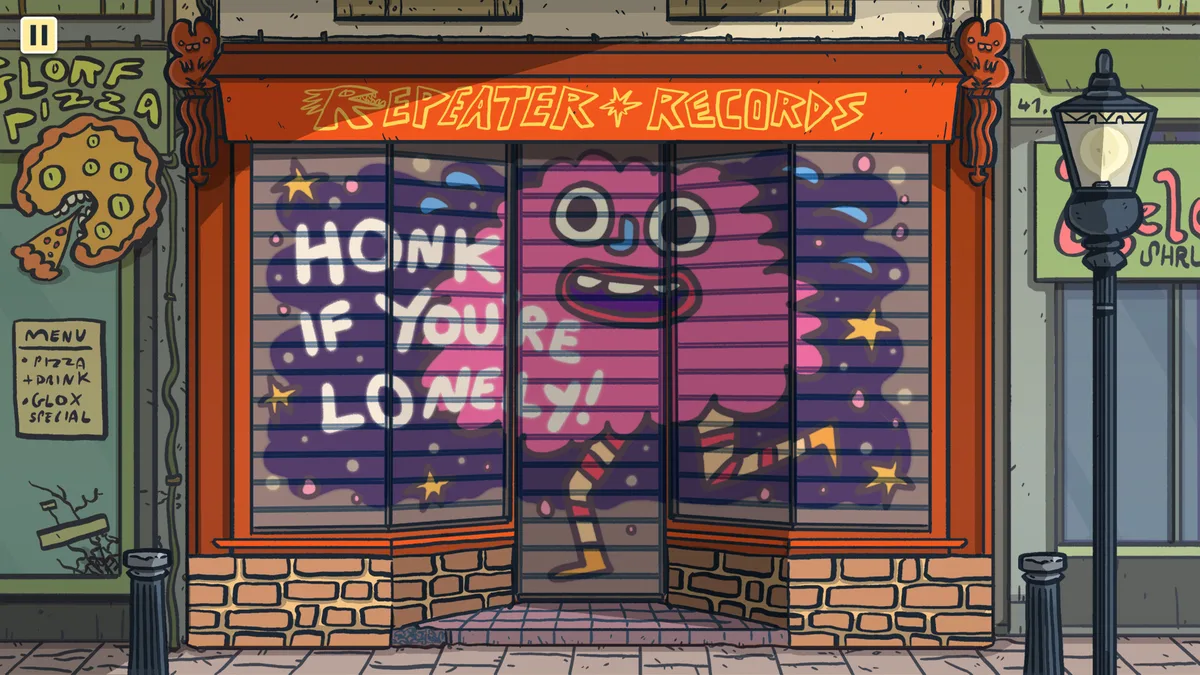 Caption: The shop's shutter art sets the tone before you ever step behind the counter.
GODEEPER: For another 2026 creative sandbox where the entire game is hands-on research into a niche subject (illuminated manuscripts instead of vinyl) the Scriptorium review covers the same design instinct applied to medieval art. Scriptorium Review →
What Patattie Games got right
The music is real. The official soundtrack listing has 29 tracks, with 25 credited to Gina Loughlin and four guest tracks. They are not placeholder audio: the songs are written around specific fictional band identities. When a customer asks for "something that sounds like it was recorded in a basement in 1993," you're not just picking a tag. You're listening for something particular.
The 80+ hand-drawn album designs each have individual cover art, fictional liner notes, and invented press history. Spending five minutes reading the sleeve of an album by a band that doesn't exist is not something Wax Heads forces. It just makes it available, and available is enough.
Polygon described the game as "a vibey record shop sim that simply oozes aura." That tracks. The visual tone isn't chasing a look: it's a place that has accumulated one, with handwritten staff picks and a layout that suggests years of decisions rather than a single design pass.
The character work is consistent throughout. Each repeat visitor has a taste profile and a backstory that develops across shifts. None of them are stock types. Wax Heads is one of the few management sims where knowing a customer's history changes how you play, less because the game requires it and more because you've started to care about getting it right.
For reference on how another recent store sim handled a similar niche of genre: inKONBINI launched in late April and takes the slice-of-life angle from the convenience store side. Same cozy-management category, completely different texture.
 Caption: Each fictional album gets its own cover art on the turntable screen, part of the 80+ entries the game asks you to sit with.
Where it stumbles
The first-hour puzzle opacity is the sharpest edge. Wax Heads gives you the tools you need but doesn't sequence them. You're handed a magazine, a social feed, and an album wall without a clear signal for which one to reach for when. Most players piece it together quickly, but the opening could use one more pointed tutorial moment.
The premise also self-selects hard. If record stores don't register as meaningful spaces (if vinyl culture lands as someone else's thing) the game's emotional register may not connect. This isn't a flaw in the writing. It's a narrowness of subject that the game doesn't try to overcome, and it shouldn't have to. But players without any attachment to the setting may find the puzzle mechanic alone can't carry it.
Cozy games that handled the accessibility question differently include Forage Wizard, which launched the same week and uses a much flatter onboarding curve. Different design priority, different result.
GODEEPER: For a 2026 indie that makes its subject (denpa music and online obsession) the entire texture of the game, the Yunyun Syndrome review is the music-as-premise comparison that lands closest to Wax Heads. Yunyun Syndrome Review →
Verdict
Wax Heads is one of the cleaner indie launches of 2026. An Overwhelmingly Positive score from 594 reviews at 97% isn't a guarantee of staying power, but it signals something real: the game delivered on its premise for nearly everyone who tried it. For a debut release from a small studio, that matters.
The record store simulation genre is thin. Wax Heads found a mechanic that works, built 80+ albums of content around it, and added an original soundtrack that's genuinely composed rather than filler. The character writing holds up across the full runtime. At its $14.99 list price, or less whenever Steam is running a sale, it doesn't ask for much.
The rating here is 8.5 rather than higher because the first-hour opacity is real and the premise will leave some players cold. But for the audience this is made for (anyone who knows what it feels like to flip through a record bin and find something unexpected) Wax Heads is exactly what it promises.
Rating: 8.5 / 10
Related Reading
- Wax Heads Guide: How to Match Customers and Find Records: Wax heads guide to matching customers with records: 80+ albums, 60+ NPCs, Phonogram tips, and the Dialogue Tracker....
- Wax Heads Tips: Research, Records, and RAD! Ratings: Wax Heads tips: how to use Phonogram and liner notes before customers arrive, match their mood to the....
- Raccoons to Riches Review: The Shop Sim Done Right: Another non-combat shop sim built entirely around reading customers, this time running a raccoon-owned item store instead of a record counter.
- Best Indie Games Under $20 in 2026: other affordable indie releases to compare with Wax Heads' $14.99 list price
- People of Note Review: another character-focused indie where close attention to small details matters
References
- Wax Heads on Steam: current PC price, review snapshot, demo, and achievements
- Wax Heads official launch trailer: Curve Games video
- Wax Heads soundtrack on Steam: official track listing and composer credits
- Wax Heads Patch 1.0.5: official update notes
- Curve Games: Publisher page
Frequently Asked Questions
How long is Wax Heads? Most playthroughs run four to six hours depending on how much time you spend reading album lore and replaying customer recommendations. It's designed to feel complete at that length, not padded.
Is Wax Heads available on consoles? No console versions are listed as of launch. Wax Heads is on PC via Steam (Windows and Linux). No Xbox, PlayStation, or Switch versions have been announced.
How do the record recommendations work? Customers describe what they want in general terms: mood, era, energy level. You research the answer using in-game tools: a Phonogram social media feed, in-store magazines, album liner notes, and your conversation history. Correct matches earn a RAD! rating. Mismatches earn MEH or SAD.
Is Wax Heads worth buying? At its $14.99 list price, yes, if the record store premise appeals to you. The current Steam snapshot is Overwhelmingly Positive at 97% across 594 reviews, suggesting strong satisfaction among players who went in with the right expectations.
Does Wax Heads have replay value? The narrative is largely linear with no branching endings. Replay value comes from tracking down every album in the catalog and completing all customer storyline arcs. It's designed for one thorough playthrough, not repeated runs.
Who made Wax Heads? Wax Heads is a debut release from Patattie Games, published by Curve Games. Its Steam soundtrack listing has 29 tracks, with Gina Loughlin credited for most of the score and guest contributors on the remaining tracks.
About the author

Games Critic
Games writer and reluctant optimist who has reviewed over 400 titles across 9 years. Irish, currently in Berlin. Has strong opinions about tutorial design.
- 400+ games reviewed across 9 years
- Platformer and horror specialist
- Narrative design focus
Keep reading




Disclaimer
This article is published for informational and entertainment purposes. It does not constitute professional financial, legal, or technical advice. Game performance, online services, patch schedules, and store listings change. Verify critical details (pricing, system requirements, regional availability) with publishers and storefronts before you buy. Affiliate links, where present, help support our editorial work and are labelled in our affiliate disclosure.
Comments
Loading comments…