
ReviewScriptorium: Master of Manuscripts
Scriptorium Review: Medieval Art Without the Monastery
Scriptorium review: Yaza Games' medieval manuscript sim is Overwhelmingly Positive on Steam, with 1,000+ hand-drawn assets. Who it suits, who should pass.
This Scriptorium review can be summed up quickly: a strong recommend for creative players, a pass for anyone who needs a challenge. Yaza Games built a medieval manuscript simulator with genuine period craft behind it, and that care shows in every one of the 1,000+ hand-drawn assets.
Sponsored

About the game
Scriptorium: Master of Manuscripts
Yaza Games · Mythwright
Reception
- Steam user reviews, all languages
- Overwhelmingly Positive
- 97% positive of 1,157 reviews
- Checked on Steam
Pros
- Over 1000 hand-drawn medieval art assets with genuine period accuracy and humor
- No timers and no pressure mechanics make it a genuine creative sandbox
- Story Mode commissions provide structure without restricting creative freedom
Cons
- Windows-only at this audit, with no announced Mac or Linux release
- Players who need progression systems or scoring may find it directionless
Verdict
A focused, handcrafted creative tool wrapped in medieval charm. Overwhelmingly Positive on Steam through confidence in what it is and refusal to be more
Updated September 29, 2026: Steam's current snapshot is 97% positive from 1,058 reviews at the $14.99 list price. The August 6 Wholesome Update added custom sketch templates and new drawable content, so this verdict now reflects that post-launch build.
Sponsored

Scriptorium Review: Key Takeaways
- $14.99 list price on Steam at this audit: check Steam for current pricing, since sales rotate
- Developer: Yaza Games (Poland), published by Mythwright
- 6 to 12 hours in Story Mode; Sandbox Mode is open-ended
- Steam: Overwhelmingly Positive across all languages
- Latest official update: the August 6 Wholesome Update added custom sketch templates and new drawable content
BESTPRICE: Want Scriptorium: Master of Manuscripts? These stores list it: Buy on Humble Bundle → Buy on Loaded → Buy on Kinguin →
Overview
Scriptorium: Master of Manuscripts is a medieval manuscript creation sim from Yaza Games, a small Polish indie studio published by Mythwright. It launched on April 16, 2026, and Steam players rate it Overwhelmingly Positive: it remains among the highest-rated indie releases of its launch year.
You play a scriptorium worker composing illuminated manuscripts using a drag-and-drop interface and a library of over 1,000 hand-drawn medieval art assets. Story Mode hands you commissions from patrons while a royal court drama plays out between them. Sandbox Mode drops the narrative entirely and lets you build whatever you want. There's a demo available on Steam if you'd rather try before buying, which is a nice touch for a game that's inherently difficult to pitch in a trailer.
If you've played other simulation games in the cozy category (like the management sim covered in our Sintopia review) the general rhythm will be familiar. But where Sintopia layers systems on top of each other, Scriptorium strips them away. No combat or resource optimization. Story Mode still gives you commissions and workshop progression, while Sandbox is just composition.
"Scriptorium is a true passion project, built by real artists and enthusiasts of medieval period with zero AI assistance.": Yaza Games
That claim holds up visually. Borders, illustrated creatures, ornate capital letters: they all carry the slight inconsistency of actual hand-drawn linework. The game ships with 54 Steam achievements and supports seven languages, which signals confidence that the audience extends beyond the English-speaking cozy-game crowd.
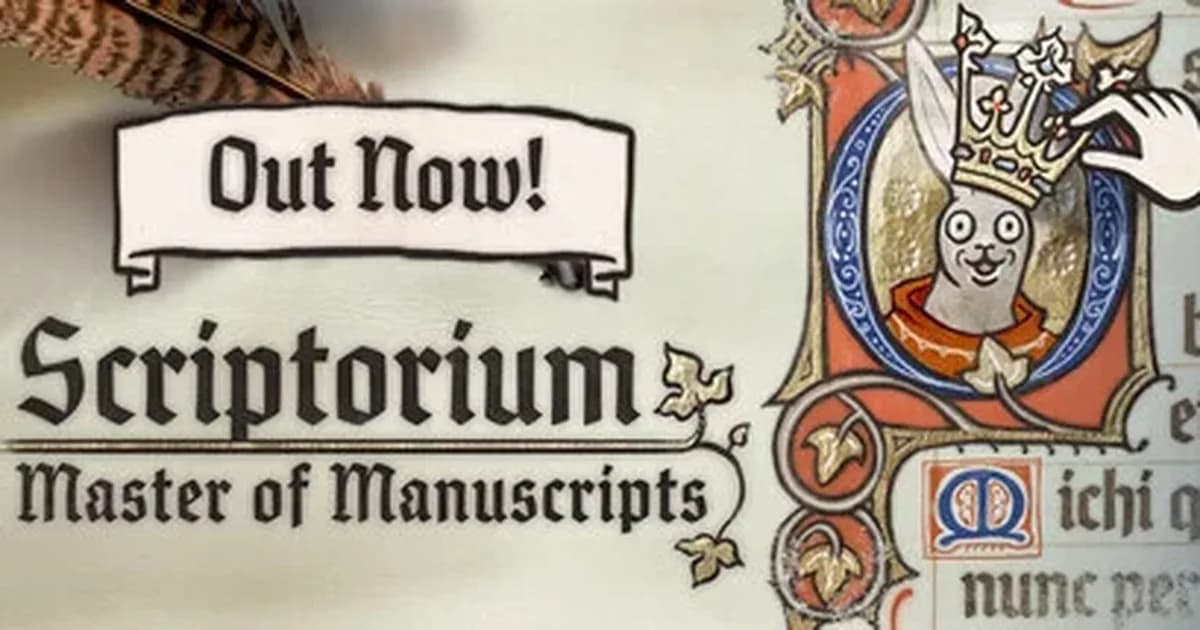
Promotional key art for Scriptorium: Master of Manuscripts. The composition tools described above come from actual play, not this marketing image.
GODEEPER: For another 2026 indie where research and discovery are the gameplay (this time in a vinyl record store with 80+ hand-drawn albums and original music) the Wax Heads review covers very similar design instincts. Wax Heads Review →
Gameplay
The core loop is composition. Drag ornamental borders, illustrated characters, decorated initials, and text blocks onto parchment. Resize, rotate, layer, done. There are no timers and no failure state, and the commission check is forgiving: one player says you can fill a request "by just dumping body parts haphazardly onto the page" and "will get a perfect score" (Steam review).
Does that bother you? That's the entire Scriptorium review in one question. If you need a system pushing you toward optimization, this game will feel aimless. If you want a sketchbook that happens to be set in 1150 AD, it's nearly perfect.
Story Mode provides guardrails. Commissions arrive with subject requirements: illustrate a saint's life, decorate a royal charter, reproduce a bestiary page. The court drama between patrons gives context and occasionally changes which clients show up. The narrative isn't trying to be profound. It provides rhythm to what could otherwise be unstructured creative toolbox time. (And it does that well.)
The asset library is where Yaza Games' art background becomes obvious. Medieval humor runs through the collection: marginalia creatures doing absurd things, "cartoon bottoms," monks engaged in activities monks probably shouldn't be doing. Everything is presented in a style inspired by actual medieval manuscripts: playful and reverent without contradiction. For another game that leans into historical flavor with a light touch, our Masters of Albion analysis takes a different approach to the same instinct.
Text tools deserve separate mention. Multiple ornate medieval fonts ship with the game, and text resizes, colors, and layers like any other element. The illuminated capitals (decorated initial letters that define the medieval manuscript aesthetic) are among the library's strongest assets. Building an entire composition around a single ornamental letter is how real scribes worked, and Scriptorium gets that right.
Yaza's zero-AI stance matters more here than in most games. Manuscript illustration depends on specific artistic decisions: letter spacing, color relationships, visual weight across a page. AI-generated asset packs tend toward a sameness that contradicts the handmade quality real manuscripts are known for. Yaza's artists avoided that problem, and the variety across 1,000+ assets reflects it.
Workshop customization adds a light meta-layer: furnish your space, choose lighting, adopt a pet that wanders between desks. You can set candles around the workspace and adjust the ambient glow while you compose. None of it has mechanical effect. That's consistent with a game that refuses to gamify what should be a creative process.
The layer system is worth dwelling on. Elements stack in a genuine z-order, so you can tuck illustrated borders behind text blocks or overlap creatures with decorative initials in ways that match period-accurate composition. Zooming in reveals hand-drawn linework detail that holds up at high resolution: useful if you're actually printing any of this. The game never restricts layer count or canvas size, which means the practical ceiling on complexity is your own patience.
There are some friction points. Selecting overlapping elements can be fiddly when two assets share the same visual space and the selection box hitches between them. The undo history is limited enough that rapid experimentation occasionally requires rebuilding rather than reversing. Neither is session-ruining, but both surface during longer compositions.
The August 6 Wholesome Update adds a practical layer to that loop: Sandbox now lets you save custom sketch templates and reuse them, alongside new drawable elements. It does not change the low-pressure premise, but it gives repeat creators a reason to return.
The community output has been striking. Soon after launch, players posted a Hades fan-art scene and D&D session recreations using nothing but the medieval toolkit. Yaza Games' first Reddit art challenge made that use case explicit by asking players to recreate famous works. When a tool inspires that kind of creative lateral thinking, the design is working correctly.
The official launch trailer, not a community recreation: Scriptorium's own marketing leans on the same illuminated-manuscript look that players have been recreating since launch.
Export lets you save finished manuscripts as PNGs for printing or social sharing. That practical output is part of the game's value: the same toolkit works for print-ready pages, fan art, and tabletop handouts. Yaza Games ran a Reddit AMA shortly after launch where they discussed their art pipeline and design decisions. The care visible across different manuscript traditions (Romanesque versus Gothic ornamentation, insular versus continental layout conventions) confirms the team did their homework.
GODEEPER: For a cozy, zero-pressure alternative that launched the same month (automation and alchemy instead of manuscripts, but the same "no timers, no fail states" design philosophy) the Forage Wizard launch covers what $6.99 buys in 2026. Forage Wizard Launch →
Scriptorium Review: Verdict
Scriptorium occupies a category of one. There isn't another game doing medieval manuscript illustration as primary gameplay with hand-drawn assets from a team that clearly studied the source material, and Steam players rate it Overwhelmingly Positive. The fans mostly describe a creative tool: one artist says "i use it as a program for design with a nice game/story mode feature added on" (Steam review), and another advises "Just skip story mode and go crazy in sandbox," noting that export without background and saving custom pieces have since been added (Steam review).
The negative reviews say the same thing from the other side: it "just felt like a virtual sticker book rather than a game," and the commissions started to feel "like a chore" (Steam review). Others want item labels and search across a sketch shop of more than 2,500 items (Steam review) and a wider scaling range plus a "group" feature (Steam review).
Who it suits: creative players who want a medieval sticker-book sandbox with historical detail and no pressure, people making art for tabletop games or gifts, and anyone who wants a quiet palate cleanser between louder games. The $14.99 list price is fair for that player.
Who should wait: players who need goals, failure states or a challenge (commissions accept almost anything), and anyone who will be frustrated by the asset browser until search and grouping arrive. Discounts have come and gone since launch, so a sale is a sensible entry if you are unsure. For more narrative substance in the relaxed category, our Tides of Tomorrow review covers an alternative, and our Skull Horde review is the contrast if you want mechanical pressure.
If Scriptorium's low-pressure creative sandbox appeals to you, our best indie games under $20 roundup has more picks at a similar price point and pace. TetherGeist's review and Mixtape's launch coverage are both worth a look too, for readers drawn to Scriptorium's atmospheric, unhurried tone. And if you want something with real stakes underneath a similarly crafts-focused loop, Beastro's boss guide covers a cooking-deckbuilder hybrid that adds combat to a comparable creative premise.
Frequently Asked Questions
How long is Scriptorium: Master of Manuscripts? Story Mode runs 6 to 12 hours depending on how much time you spend on each commission. Some players finish faster by treating commissions as quick exercises; others spend an hour per page. Sandbox Mode has no endpoint and can run indefinitely.
Is Scriptorium available on Mac or Linux? No Mac or Linux release is announced as of September 29, 2026. Yaza Games says it is not ruling out other systems, but has not committed to them.
Can you export your manuscripts? Yes. Finished works save as PNG files optimized for both high-resolution printing and social media sharing.
Is there a time limit on commissions in Scriptorium? No. There are no timers and no failure conditions, and players say the commission check is very forgiving. Everything moves at your pace, and commissions can be revisited after completion.
Was AI used to create Scriptorium's art? No. Yaza Games explicitly stated it was "built by real artists and enthusiasts of medieval period with zero AI assistance." All 1,000+ assets are hand-drawn.
How many art assets does Scriptorium include? Over 1,000 hand-drawn medieval art assets spanning ornamental borders, illustrated characters, decorated initial letters, marginalia creatures, and text elements across multiple ornate fonts.
Related Reading
- ReStory Review: Is the Mid-2000s Tokyo Repair Sim Worth It?: another low-pressure creative sandbox worth reading if Scriptorium's unhurried pace is what drew you in.
References
- Scriptorium: Master of Manuscripts on Steam: Overwhelmingly Positive (97%, 1,058 reviews in the September 29 audit snapshot), 54 achievements, seven supported languages
- Scriptorium Wholesome Update: August 6 update adding custom sketch templates and new drawable content
- Yaza Games: official developer page with the current game description and platform list
- Yaza Games on X: official studio social and launch updates
- Yaza Games AMA on r/Games: developer Q&A covering art process and zero-AI development philosophy
- Official Scriptorium launch trailer: trailer used in the review
- Scriptorium on Loaded (sponsored): often discounted below Steam's $14.99 list price, same key. Check current price before buying, since Steam's own discounts rotate.
About the author

Action & Design Desk
GameBrief's byline for platformers, horror and action games. Dry, short paragraphs, strong opinions about tutorials and boss design.
- Action, platformers and horror
- Tutorials, onboarding, boss design
- Sources listed per article
Keep reading

Moomintroll Winter's Warmth Review: Soft and Quiet
General · 9 min
Kristala Review: PS5 and PC Feline Souls-Like With Caveats
General · 10 min

Tides of Tomorrow Review: Story-Link Changes Everything
General · 10 min
Skull Horde Review: Fast Dungeon Auto-Battler Worth Buying
General · 7 min
Vampire Crawlers Review: poncle's Deckbuilder Delivers
General · 8 min
inKONBINI Game: What It Is and Is It Worth Buying?
Features · 7 min
Sponsored
Disclaimer
This article is published for informational and entertainment purposes. It does not constitute professional financial, legal, or technical advice. Game performance, online services, patch schedules, and store listings change. Verify critical details (pricing, system requirements, regional availability) with publishers and storefronts before you buy. Affiliate links, where present, help support our editorial work and are labelled in our affiliate disclosure.
Comments
Loading comments…