
ReviewSintopia
Sintopia Review: Hell's Management Loop Still Works
Sintopia review: a darkly comic Hell-management sim with a two-layer economy. Bullfrog fans should buy; players who hate micromanagement should wait.
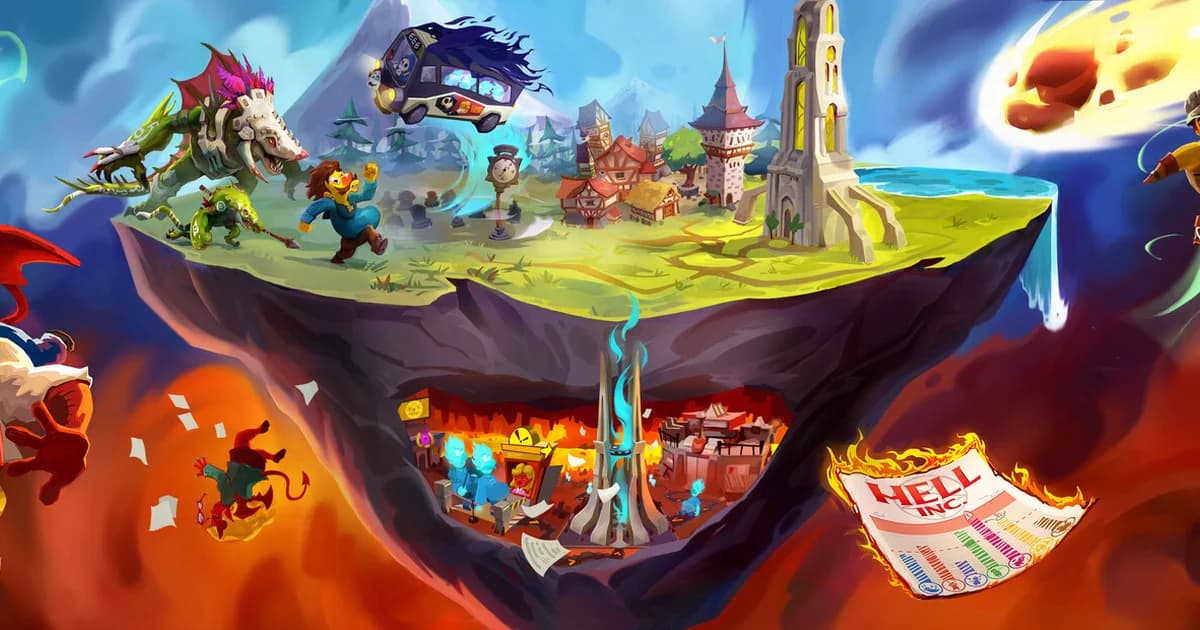
Sintopia review, short version: Bullfrog fans should buy it; anyone who hates micromanaging traffic should not. Every decision has to survive a trip through two economies: you manage Hell's paperwork, queues, buildings, and automation, then reach into the Overworld to push the population toward the outcomes that keep those systems supplied. Steam players rate it Very Positive. The negative reviews, many from people who liked the idea, describe tedium, lag in big setups and an Overworld that turns into babysitting.
Sponsored

About the game
Sintopia
Piraknights Games · Team17
Reception
Pros
- The Hell and Overworld loops feed one another instead of feeling like two unrelated modes.
- Automation gives the management layer a satisfying long-term shape.
- The dark comedy is consistent enough to give the bureaucracy a distinct voice.
Cons
- Several systems communicate their feedback poorly before the economy clicks.
- Sandbox has less goal scaffolding after the campaign.
Verdict
Sintopia suits Bullfrog-era management fans who enjoy untangling soul bottlenecks; players who dislike micromanagement or want a long campaign should wait for a sale.
Updated 2026-10-15: dropped the old score; the verdict now draws on Steam reviews, and the price section reflects the current 30% sale.
TL;DR: Sintopia is a single-player Hell-management sim with a second god-game layer above it. The dual loop is clever and funny, but some feedback is opaque until the economy clicks, and the campaign is compact. It's $27.29 on sale right now against a $34.99 list price, a better ask for management fans who want a focused campaign rather than an endless sandbox.
BESTPRICE: Want Sintopia? These stores list it: Buy on Eneba → Buy on Green Man Gaming → Buy on Humble Bundle → Buy on Kinguin →
Current status: October 2026 (quick answer)
Steam lists Sintopia at $27.29, 30% off its $34.99 US list price, and players rate it Very Positive (the Reception box has the live figures and the Metacritic score). The game is single-player, has Steam achievements and cloud support, and was released on April 16, 2026 by Piraknights Games and Team17.
The most meaningful recent context is the July 27 Imployee Retention Update, still the latest on the official feed. It added a Souls Gate facility in the Logistics folder for steering soul traffic, plus smarter cultist activity, balance changes, cosmetic props, and upscaling support. That is a quality and tuning update, not a new campaign chapter.
Sponsored

Key takeaways
- The Hell side is a queue, staffing, construction, and automation problem.
- The Overworld side is a god-game layer where spells and manipulation shape the inputs Hell needs.
- Souls are the bridge, so ignoring either side eventually starves the other.
- The game is strongest when a messy chain suddenly becomes a stable production loop.
- The interface sometimes explains what changed less clearly than it should.
- Steam players rate it Very Positive; one long-play reviewer counts 8 story missions in the campaign.
Sintopia review: the dual loop
The first few hours teach you to look at Hell as a factory with personality. Souls arrive, workers process them, facilities convert them into useful outputs, and new buildings expand the number of ways you can turn a bottleneck into throughput. It is recognizable management design, but the setting gives every normal decision a sharper comic edge. A staffing shortage becomes a bureaucratic crisis in a place that is supposedly built around punishment.
The Overworld prevents that factory from becoming self-contained. You can use divine tools to influence the population, alter conditions, and steer the flow of souls. The correct question is rarely “Which building is strongest?” It is “Which side of the loop is currently limiting the other?” Build more Hell capacity while the Overworld is not producing enough input and you have an expensive empty facility. Manipulate the population without enough processing capacity and the queue becomes your new problem. That diagnosis-first approach also separates Sintopia from the more purely automated loop in our All Hail the Orb review.
That relationship is Sintopia's best idea. It rewards players who diagnose a system rather than simply buying the next building in the menu.
Hell is at its best when queues, workers, and construction decisions finally form one readable production chain.
Where the management design lands
The Hell layer is satisfying because automation arrives as an answer to friction. Early on, you watch individual tasks and wonder why a queue is not moving. Later, you are arranging facilities, staff, and priorities so that the queue moves without constant intervention. That change of scale feels earned: the game lets you see the manual problem before handing you the system that solves it.
The tradeoff is communication. Sintopia often gives you enough information to solve a bottleneck, but not always in the place you first look. A production building can appear idle because the input is missing, the worker is assigned elsewhere, or a prerequisite is hidden behind another panel. The result is not difficulty in the strategy sense. It is a short period of confusion while you learn which dashboard actually owns the answer.
That friction is tolerable because the economy is legible once it is running. It becomes frustrating when the game asks you to make a major investment before explaining the feedback loop. A stronger onboarding layer would make Sintopia easier to recommend to players who like the idea of management sims but do not already speak their language.
The Overworld and the comedy
The Overworld side gives the game its personality. You are not simply zoning houses and watching numbers rise. You are manipulating the population with a set of divine interventions, then observing how those changes affect the soul economy below. The spells work best when treated as economic tools with comic presentation, not as a separate action game.
The writing is not a hit every time, but the premise gives it a reliable target: bureaucracy, performance metrics, and the idea that an afterlife can be managed with enough forms. Hell's office language and the Overworld's bright presentation make a good contrast. The joke gets stronger when the system underneath it has a real consequence, such as a funny intervention creating a useful resource flow.
The Overworld is not just a visual change of scene. Its interventions are how the upper layer feeds the Hell economy.
Recent updates and current value
The July Imployee Retention Update matters because it addresses the kind of friction that affects a management game after launch: worker behavior, balance, presentation, and performance support. It does not erase the learning curve, but it makes the current build a better reference point than the first-week version.
At the current US list price of $34.99, Sintopia sits in the awkward middle ground between a small indie sim and a larger management release. Its value comes from focus. The campaign is compact, the two-layer loop has a clear identity, and the game knows it is about running a system rather than building an infinite city. If you need hundreds of hours of sandbox depth, the price is harder to defend. If you want a contained management story with a strong premise, wait for a sale or accept that you are paying for a focused management story.
Verdict: who Sintopia suits
Sintopia works more often than it confuses, and when the loop works it has a satisfying rhythm: influence the Overworld, process the consequences in Hell, automate the worst bottleneck, then expand the system until a new bottleneck appears.
Steam's fans place it exactly: "It's basically Black & White + (LucasArts) Afterlife (Hell-only) + quasi-factory game + Dungeon Keeper's campaign structure," and "If you like '90 unique Bullfrog management games, you will love this one" (Steam review). Another says "This looks like a city builder but it's more of a circuit builder" (Steam review). A 36-hour fan loved the humour and easter eggs, with one negative: "there are only 8 story missions" (Steam review).
The negative reviews are mostly people who liked the idea. One says the logic gates "have a tendency to brake, leaving your souls just standing there" by the fourth campaign and advises waiting for updates (Steam review). Another calls the gameplay "fantastic" but says it is "super laggy once have more than 30+ buildings operating" (Steam review). A third felt like it was "babysitting a civilization that was constantly on the verge of death" in the Overworld (Steam review). The first two were written in launch week, before the July update added new soul-routing tools and performance work.
Who it suits: Black & White, Dungeon Keeper and Afterlife fans, players who enjoy diagnosing production chains, and anyone who wants a compact, funny campaign rather than an endless city builder. The sale price makes the short campaign easier to accept.
Who should wait: players who dislike micromanaging one-way roads and stats, anyone with a modest PC who plans large Hell layouts, and players who want a long campaign at full price.
Frequently asked questions
Is Sintopia a god game or a management sim?
Both. Hell is the management simulation, while the Overworld gives you god-game interventions. Souls connect the two layers.
How long is the Sintopia campaign?
It is a compact campaign whose length varies with difficulty and how much time you spend tuning the economy. Sandbox and Challenge modes add play after the story, but this is not positioned as an endless city builder.
Does Sintopia have co-op?
No co-op is listed on the official Steam feature list. It is a single-player management game.
Does Sintopia support controllers?
The current store feature list does not confirm controller support. Its management UI is designed primarily for mouse and keyboard, so check the current store page if controller input is essential.
What changed in the recent update?
The July 27 Imployee Retention Update lists smarter cultist activity, balance work, cosmetic props, and upscaling support. Check the official announcement for the full patch list.
Is Sintopia worth it at $34.99?
For management fans, yes, and it is $27.29 on sale right now. It is a weaker fit if you want a long campaign or an open-ended sandbox with no campaign structure.
Related Reading
- All Hail the Orb Review: another compact automation game with a very different tone.
- Fatekeeper Early Access Review: a second short Early Access comparison.
- Combolands: a roguelike city-builder for players who like management with a twist.
- Tainted Grail Review: a larger single-player RPG contrast.
- BeastLink Early Access Review: a multiplayer Early Access comparison.
- Away From Life Early Access Analysis: another evolving Early Access case.
- Windrose coverage: a different survival and Early Access comparison.
- LegionBound launch coverage: an autobattler with a more run-focused loop.
- Subnautica 2 Complete Guide Hub: a larger exploration comparison.
References
- Sintopia on Steam: current price, review snapshot, features, and game loop.
- Sintopia official announcements: the July 27 Imployee Retention Update and later patch notes.
- Sintopia official launch trailer (Team17): the trailer embedded above.
About the author

Action & Design Desk
GameBrief's byline for platformers, horror and action games. Dry, short paragraphs, strong opinions about tutorials and boss design.
- Action, platformers and horror
- Tutorials, onboarding, boss design
- Sources listed per article
Keep reading

Above the Snow Review: Alpine Resort Drama Holds Up
General · 10 min
Steam Next Fest October 2026: Dates, Times and 15 Demos
Features · 7 min
Risk of Rain 2 Mithrix Guide: All 4 Phases and Escape
General · 10 min
Risk of Rain 2 Interactables: Shrines, Printers, Scrappers
General · 10 min
Do Steam Next Fest Demos Expire? What Valve's Rules Say
General · 6 min
Risk of Rain 2 Eclipse Guide: All 8 Modifiers Explained
General · 10 min
Sponsored
Disclaimer
This article is published for informational and entertainment purposes. It does not constitute professional financial, legal, or technical advice. Game performance, online services, patch schedules, and store listings change. Verify critical details (pricing, system requirements, regional availability) with publishers and storefronts before you buy. Affiliate links, where present, help support our editorial work and are labelled in our affiliate disclosure.
Comments
Loading comments…