
ReviewYunyun Syndrome!? Rhythm Psychosis
Yunyun Syndrome Review: Infectious Denpa Horror in 2026
Yunyun Syndrome review: a denpa rhythm game wrapped around a dark visual novel. Great song list, forgiving charts, and an English script rewritten in 1.2.0.
Yunyun Syndrome review, short version: buy it if you love denpa songs or early 2000s otaku culture; wait if you want hard charts or were put off by the launch translation. The rhythm game is easy, the song list is the draw, and the story under it is darker than the pastel colors suggest. Steam players rate it Very Positive, and the biggest complaint since April, the English script, got a full revision on October 1.
Sponsored

About the game
Yunyun Syndrome!? Rhythm Psychosis
Alliance Arts, WHO YOU · Alliance Arts
Reception
Pros
- Over 30 denpa songs, mostly licensed classics plus originals, with five more added free in October
- Fully voiced, with Nanahira as Qtie and Haruko Momoi as Yunyun
- Forgiving four-lane charts that rhythm newcomers say they can finish
- Steady support since launch: song-speed and offset options in 1.1.0, a full English text revision in 1.2.0
Cons
- The launch English localization drew the most upvoted negative reviews on the page; the rewrite is recent
- Rhythm veterans call the charts too easy outside the hardest difficulty
- Players who chase every ending say the base song list gets repetitive
- Several players find the story thin or badly paced
Verdict
Yunyun Syndrome suits denpa and early 2000s otaku culture fans and rhythm newcomers who want a story; rhythm veterans after hard charts and players who read only English and were burned by the launch script should wait for more feedback on the 1.2.0 rewrite.
Updated 2026-10-15: rebuilt from Steam reviews and the developers' patch notes. We added the Reception box, the localization story, the 1.2.0 and 1.3.0 updates and the KOTOKO song pack, corrected controller support (Steam lists partial support), and removed completion times and claims about the late story that came from no source. An earlier update removed the old score; nobody on staff played Yunyun Syndrome for this review.
Sponsored

Yunyun Syndrome review: quick answer
Worth it for denpa fans and rhythm beginners who want a story with their songs. Rhythm veterans and English-only readers who care about faithful translation should read the current reviews first.
BESTPRICE: Want Yunyun Syndrome!? Rhythm Psychosis? These stores list it: Buy on Eneba → Buy on Kinguin →
Key Takeaways
- Rhythm adventure by Alliance Arts and WHO YOU (Fuyuki Hayashi), released April 23, 2026, published by Alliance Arts.
- You play Qtie (voiced by Nanahira), a hikikomori whose obsession with Yunyun (voiced by Haruko Momoi), a character who talks to her through the monitor, spills out into anonymous posts that "destroy the world."
- Over 30 denpa songs at launch and multiple endings; Ver. 1.3.0 added five songs free, and a ten-track Extra Song Pack feat. KOTOKO is a separate DLC.
- 49 Steam achievements, 15 interface languages, full audio in Japanese, partial controller support.
- The developers announced 100,000 copies sold on June 19.
What kind of game is this
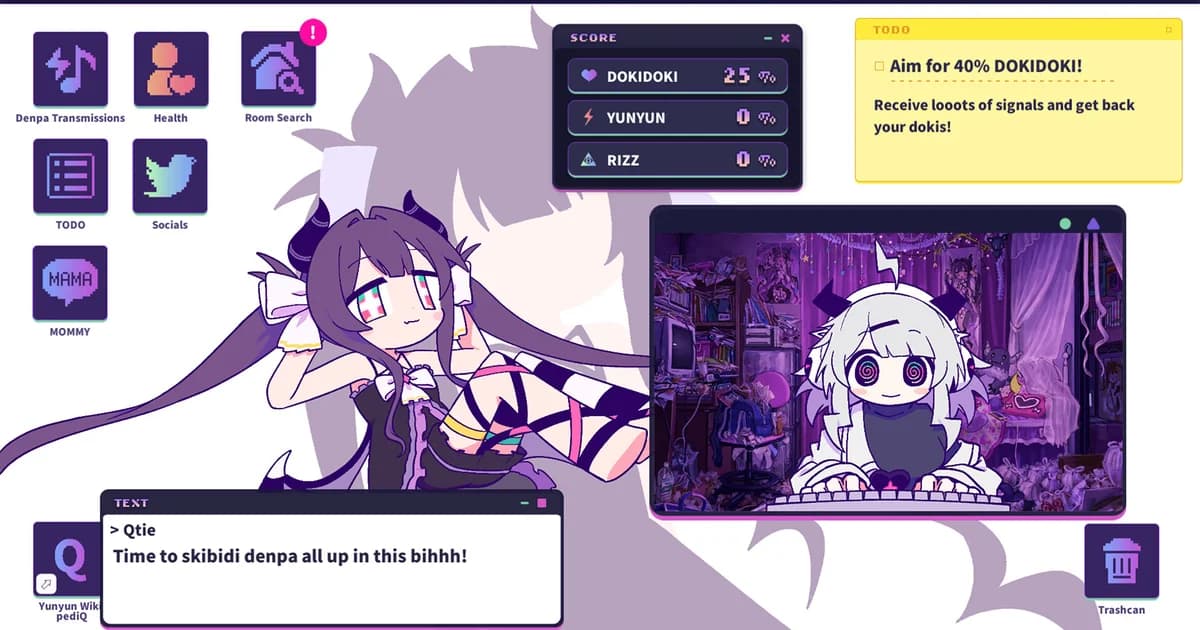
Steam calls it "a rhythm-adventure game where you play as a hikikomori (shut-in) girl who's high on denpa songs." The premise is a question the store page asks outright: "Does a happy ending exist for a degenerate otaku?" Qtie's goal, if you can call it that, is to "anonymously post online and infect the whole world with Yunyun-brain."
The rhythm stages are four-lane charts, and players say they also drive the story. One calls the progression "very well done by encouraging you actually PLAY the beat maps in order to unlock new and interesting endings" (Steam review). The same player lists content warnings worth knowing before you buy, from "abuse, suicide, psychosis" to an "EXTREME FLASH WARNING."
Qtie and Yunyun: the store page frames Yunyun as "most likely" a figment of Qtie's imagination.
The songs are the reason to buy
Denpa (電波, roughly "radio waves") is a Japanese music subculture of deliberately strange, sticky songs; Wikipedia's denpa article covers the history. The Steam page says "All playable songs in this game are denpa songs," and the list leans on licensed classics: INTERNET OVERDOSE, INTERNET YAMERO, PETTAN PETTAN TSURUPETTAN, Cirno's Perfect Math Class, Miko Miko Nurse and Sakuranbo Kiss among them, alongside originals such as YUNYUN HARDCORE.
Players who grew up with that music respond to it most. "The song list's actually top tier lots of famous creators, plus tracks from musedash n touhou project, total banger lineup," says one (Steam review). Another "screamed when I saw that Miko Miko Nurse was a playable song" (Steam review). Players who don't know the scene are cooler: one Not Recommended review says "I only recognised like 4 songs" (Steam review).
Rhythm difficulty: easy by design
The charts are forgiving, and reviews agree on that whether they like it or not. "The rhythm parts r too easy for rhythm game vets, n the plot's a bit messy," says one player (Steam review); a 49-hour player calls the rhythm game "fun albeit forgiving to a fault" but says "the harder difficulty will be enough for tryhards like me to sink their teeth into" (Steam review). For newcomers that is the appeal: a player who had never played rhythm games calls it "simple, but super fun" and points to tools that skip rhythm parts for players who only want the story (Steam review).
Patch 1.1.0 in June added in-play note speed changes, per-song audio offset, separate story and rhythm volume, and a judgment distribution display, which covers most of the basic options rhythm players ask for.
The launch trailer leans into the "infected" visual language: spiral eyes and glitch lines.
The English localization story
At launch, the English script was the story. The most upvoted review on the page, with thousands of helpful votes, is Not Recommended and opens: "The English translation is awful" (Steam review). Negative reviews accused the localization of swapping period-appropriate otaku references for modern slang and invented lines.
The developers responded quickly. Within days, one of the top positive reviews noted "The game's localization is being fixed after a lot of backlash" (Steam review), but in May a player still called it "Probably the single worst localization I've ever seen in my life" even after the first fixes (Steam review). Ver. 1.2.0 on October 1 "Revised the English text throughout the game." Early reactions are better: "the English localization is quite good," writes a player who checked it against the Japanese audio (Steam review), while another says it improved "little bit, it's enough for understand the plot" (Steam review). The game also supports 14 other languages if you'd rather avoid English entirely.
Story and endings
The store page leaves the story's central question open, and players split on whether it delivers. A 49-hour player says "the story is pretty shallow" and that the conspiracy endings are "very repetitious" (Steam review); a newcomer calls the plot "not very well paced" (Steam review). Others find it moving: one player found it "truly tugs at the heartstrings in a way you wouldn't expect" (Steam review).
Replay value depends on the song list. An 18-hour player says the base game "doesn't have nearly enough tracks at base to make getting all the endings not repetitive" (Steam review). Ver. 1.3.0 added five songs for everyone, and the paid KOTOKO pack adds ten.
GODEEPER: Wax Heads is another 2026 game about fan obsession with music: vinyl collecting and the social world around it, wrapped in a short management-game format. Wax Heads Review →
Verdict
Yunyun Syndrome is a fan's game, and it says so on the box. One long review sums up who it's for: "You will like this game if you" enjoy "denpa music, Nanahira, Momoi Haruko, Kotoko, Touhou songs," have an interest in "early JP internet culture," and "Are a casual to intermediate rhythm game player. Hardcore vets might find this game too easy/uninteresting" (Steam review). Another long-time fan puts it more bluntly: "This game's target audience is very VERY niche" (Steam review).
Who it suits: denpa and Touhou fans, anyone nostalgic for 2000s Japanese internet culture, rhythm newcomers who want a story to pull them through, and players who don't mind dark themes under a cute surface.
Who should wait: rhythm veterans after hard charts, players who need a tightly paced story, and English-only readers who were put off at launch and want more reviews of the 1.2.0 rewrite before buying. If you're unsure, the current Steam reviews under "Most Recent" now reflect the revised text.
For another 2026 indie with a strong aesthetic identity, our MOUSE: P.I. For Hire review is a useful contrast, and the Tales of Seikyu review covers a different kind of anime-styled release.
Frequently Asked Questions
What is denpa music in Yunyun Syndrome? Denpa is a Japanese music subculture of intentionally strange, extremely catchy songs. The Steam page says all playable songs in the game are denpa songs, and the list mixes original tracks with licensed classics such as INTERNET OVERDOSE, PETTAN PETTAN TSURUPETTAN and Sakuranbo Kiss.
Does Yunyun Syndrome have multiple endings? Yes. The Steam page lists multiple endings, and players say you unlock them by playing the rhythm stages. Completionists note that some endings require replaying songs many times.
How long is Yunyun Syndrome to complete? The developer has not given a completion time. One player wrote their review after finishing the story mode at about seven hours, and a player who 100 percented it logged about 13 hours.
Is there controller support for Yunyun Syndrome? Partial. Steam lists partial controller support with DualShock and DualSense controllers. Patch 1.1.0 also added more areas you can control with the keyboard alone.
Is the English translation of Yunyun Syndrome fixed? It has been revised. The developers patched the worst lines within days of launch, and Ver. 1.2.0 on October 1 revised the English text throughout the game. Early October reviews call it good enough to follow the plot; the game also supports 14 other languages.
Who developed Yunyun Syndrome!? Rhythm Psychosis? Alliance Arts and WHO YOU (Fuyuki Hayashi) developed it, and Alliance Arts published it. It launched on Steam on April 23, 2026.
Related Reading
- Dead as Disco Review: Beat Kune Do Is the Real Deal: another 2026 rhythm-focused indie review, built around timing and a sharply defined music identity.
- Mina the Hollower Review: Yacht Club's Gothic New World: a gothic action-adventure review for a different kind of exploration-first genre blend.
- Luna Abyss Review: Bullet Hell in First-Person Horror: first-person horror with a strong mechanical hook and a very different kind of pressure.
- Best Indie Games Under $20 in 2026: a wider low-price shortlist for players comparing small releases.
- Best Roguelike Games in 2026: broader recommendations for replayable systems-driven games.
- Die in the Dungeon Review: Dice-Building With Brains: another compact indie review where a distinctive input system drives the whole game.
- Sintopia Review: a different systems-heavy indie review for readers comparing unusual genre blends.
References
- Yunyun Syndrome!? Rhythm Psychosis on Steam: store page with the developer description, song list, features, languages and user reviews.
- Yunyun Syndrome!? Rhythm Psychosis official announcements: patch notes for Ver. 1.1.0, 1.2.0 and 1.3.0, and the 100,000 copies announcement.
- Extra Song Pack feat. KOTOKO on Steam: the ten-track song DLC released October 8.
- Yunyun Syndrome!? Rhythm Psychosis on Metacritic: critic reviews.
- Alliance Arts official game page: official premise, songs and endings.
- Denpa song (Wikipedia): background on the denpa music subculture.
About the author

Indie & JRPG Desk
GameBrief's byline for indie, JRPG, visual novel and cozy games. Warm, direct, and willing to say which one to buy.
- Indie, JRPG and visual novels
- Early access and survival
- Sources listed per article
Keep reading
Static Dread: The Submarine Launch: What We Know So Far
General · 13 min
Dungeon Inn 1.0 Is Out: 12 Chapters and Who Should Buy It
General · 8 min
Steam Next Fest October 2026: Dates, Times and 15 Demos
Features · 7 min
Risk of Rain 2 Mithrix Guide: All 4 Phases and Escape
General · 10 min
Risk of Rain 2 Interactables: Shrines, Printers, Scrappers
General · 10 min
Do Steam Next Fest Demos Expire? What Valve's Rules Say
General · 6 min
Sponsored
Disclaimer
This article is published for informational and entertainment purposes. It does not constitute professional financial, legal, or technical advice. Game performance, online services, patch schedules, and store listings change. Verify critical details (pricing, system requirements, regional availability) with publishers and storefronts before you buy. Affiliate links, where present, help support our editorial work and are labelled in our affiliate disclosure.
Comments
Loading comments…