
GameBrief · General
Alabaster Dawn Early Access: CrossCode Fans Need to Know
Alabaster Dawn Early Access is live: Radical Fish cuts CrossCode's puzzle-dungeon density, adds map tools, and is preparing the Trial of Cryo update.

Alabaster Dawn Early Access opened May 7, 2026, and for anyone who played CrossCode (all 60-plus hours of it) the question that's been hanging since Radical Fish Games announced this game is whether Radical Fish could build something equally good without the puzzle dungeons that derailed a measurable portion of the playerbase.
Based on confirmed details and developer statements, the answer is a deliberate redesign, not an accident of scope.
TL;DR: Alabaster Dawn entered Early Access on May 7, 2026 on Steam. The initial build contains roughly 10 hours through mid-Chapter 2, while the next major update, Trial of Cryo (0.2.0), is targeted for late September to October. It's a deliberate departure from CrossCode, not a sequel.
The initial build is live, and Radical Fish's latest official roadmap update puts Trial of Cryo (0.2.0) next: Scala Moor maps, puzzles, encounters, new weapons, and a new dungeon are mostly complete, while boss fights and some swamp content remain in development. Treat the late-September-to-October window as a target, not a guaranteed release date.
What is Alabaster Dawn? (quick answer)
Alabaster Dawn is an action RPG from Radical Fish Games (CrossCode) that entered Early Access on May 7, 2026. The initial build delivers roughly 10 hours through mid-Chapter 2, with the full game targeting seven chapters and around 40 hours total. It's a deliberate redesign of CrossCode's formula: shorter, less puzzle-dense dungeons, a self-service world map for getting unstuck, and combat drawing from Devil May Cry and Kingdom Hearts.
- Alabaster Dawn Early Access opened May 7, 2026 on Steam
- Radical Fish Games, the studio behind CrossCode
- ~10 hours at launch through mid-Chapter 2, plus an optional roguelite side story
- 7 chapters planned, ~40 hours total, at least 2 years in Early Access
- Combat draws from Devil May Cry and Kingdom Hearts, not just CrossCode's element system
- 4 elements, 8 weapons, 2 slottable per element, each with its own skill tree
- World map hint tools (player-placed reminders, objective markers, fast travel) built in from the start: CrossCode had nothing like it
- Steam Deck Verified
Alabaster Dawn overview
Alabaster Dawn is an action RPG set on Tiran Sol, a world that went dark when a force called Nyx turned it into a wasteland and caused the gods to vanish. You play as Juno, the Outcast Chosen, who wakes up after the collapse and is tasked with restoring civilization.
That framing gives the game its central mechanical loop: exploring ruined regions, fighting enemies in puzzle-heavy areas, rebuilding settlements that unlock new zones and story chapters. Radical Fish calls it a world-building structure. The towns you restore aren't cosmetic: they gate the next chapter's content.
Alabaster Dawn early access at launch covers the prologue and story through the middle of Chapter 2, estimated at roughly 10 hours. An optional roguelite side story runs parallel to the main campaign, available from day one for players who finish the main EA content before the next update ships.
The full game is planned at seven chapters with a target of around 40 hours total. Radical Fish expects Early Access to last at least two years. Save file compatibility will be maintained across all updates: stated explicitly, not assumed.
What CrossCode got right: and what didn't
CrossCode launched in 2018 after a five-year development cycle. Its combat and traversal are still cited as some of the tightest movement in any 2D action RPG of that era. Concurrent player peaks on Steam averaged well above what most players would expect from an indie title with that development timeline. The game built a devoted following.
The dungeons, though. CrossCode's dungeons are long, dense, and built around puzzle sequences that players either find satisfying or find exhausting: with very little middle ground. The Rhombus Mines, the fourth dungeon, became an informal checkpoint. Players who cleared it tended to finish the game. Players who hit it and stopped tended not to return.
Radical Fish has addressed this directly. Lead Programmer Felix Klein stated: "Dungeons will be shorter, but not super short either, and they will also be somewhat less puzzle-heavy." It's a measured answer: not gutting the puzzles, just reducing the density that turned CrossCode's dungeon sections into multi-hour gauntlets.
The self-service tools also target this failure mode specifically. Alabaster Dawn pairs Juno with companions in dungeon spaces, including Filia, and gives players a world map where they can place their own reminders, mark objectives, and fast travel between landmarks and checkpoints whenever they're stuck. Early preview coverage described Cabbage, Juno's phantom water-pig sidekick, as a source of puzzle clues, but the released Early Access build doesn't bear that out: players who've spent time with the launch build report Cabbage comments on the story and the world rather than dispensing directional hints. Radical Fish's actual hint architecture, built in from the start, lives on the map screen, not in a companion's dialogue.
CrossCode's dungeon problem was addressed by community guides and external wikis. The self-placed reminders and fast travel on Alabaster Dawn's world map are the version that's built into the game itself.
GODEEPER: CrossCode still holds up as a benchmark for 2D action RPG mechanics: Kristala is the closest recent EA action-RPG comparison for what the format can do at the $20 price point. Kristala Review →
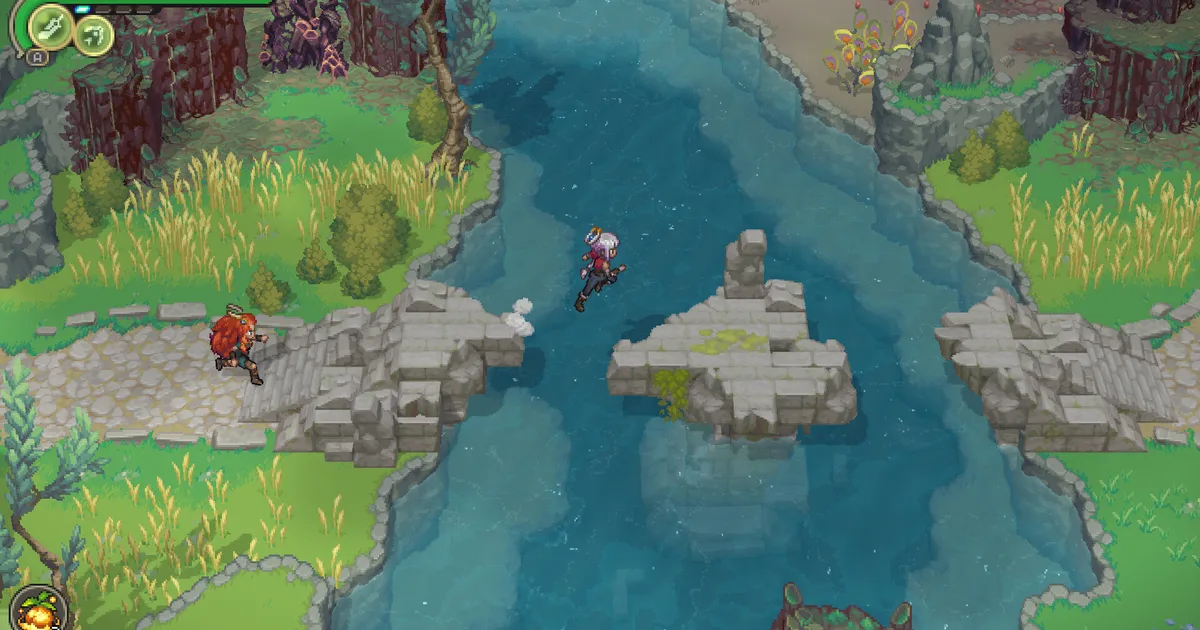
Traversal across broken terrain like this is a core part of Alabaster Dawn's movement, closer to CrossCode's platforming-heavy exploration than a straight top-down RPG.
What Alabaster Dawn includes at early access launch
The May 7 launch build is roughly 25% of the planned full game by chapter count: two chapters of seven. Radical Fish has been precise about the 10-hour estimate, which is more specific than most Early Access developers commit to ahead of launch.
The optional roguelite side story is there for players who finish the main narrative sections before the next update ships. Its mechanics and connection to the main world weren't detailed ahead of launch: adding it at all is the more telling signal, since it means Radical Fish planned for the gap between content updates rather than leaving players with nothing.
The current Steam list price is $24.99, and Radical Fish says the price may increase as content is added. Players who buy in Early Access are buying into the lowest-price period for the complete game, but the exact final price is not fixed.
GODEEPER: Far Far West launched in similar Early Access conditions this spring: different genre, same kind of small-team ambition. Worth knowing how that one landed before committing to another EA. Far Far West Early Access →
Combat system: four elements, eight weapons
Alabaster Dawn's weapons system gives players four elements to work with, eight total weapons across those elements, and two weapons slottable per element at any time. Each weapon carries its own skill tree and upgrade path. The team has cited Devil May Cry, Kingdom Hearts, and CrossCode's combat as the direct inspirations: a combination that suggests mobility, timing, and weapon-switching rather than stamina gating or roll punishing.
CrossCode's element system had a skill ceiling that rewarded players who learned to switch quickly in combat. Alabaster Dawn expands that into a dedicated weapon specialization structure: instead of swapping between four elements contextually, you equip specific weapons within elements and build toward their individual trees.
The settlement-rebuilding mechanic ties into progression. As you restore towns across Tiran Sol, you unlock access to new regions and story paths. This is the same basic loop structure as CrossCode (world exploration gates more world) but expanded into a full civilization-recovery system.
Alabaster Dawn is also Steam Deck Verified, confirmed by Valve ahead of launch. CrossCode ran well on Steam Deck through community patches; Alabaster Dawn has official certification from day one.
Settlements like this one are the visible payoff of the civilization-recovery loop: restoring a town unlocks the region around it rather than just cosmetic changes.
The dungeon problem: why it matters for early access
CrossCode's puzzle design remains divisive not because the puzzles were bad but because they were relentless. Three-hour dungeons with no clear checkpoint for hint-seeking players pushed a portion of the audience out at specific content gates. Radical Fish is aware of the specific moment: and is designing so Alabaster Dawn doesn't reproduce it.
"Shorter but not super short, less puzzle-heavy but not puzzle-absent" is a precise description of what fixing this looks like. Klein's framing suggests Radical Fish is targeting accessibility without gutting depth: the same approach they took when rebuilding CrossCode's traversal mechanics, which were also significantly revised during that game's Early Access run.
The self-service world map is the most concrete signal that this redesign is structural. A hint system players can lean on entirely at their own pace, without needing a character to dispense a clue, means Radical Fish wants players to use it without stigma. That's a design philosophy call, not a feature bolt-on.
The INDUSTRIA 2 launch analysis is a reasonable comparison point: a debut EA build from an indie studio with an ambitious scope and a specific narrative structure to protect.
Related Reading
- Alabaster Dawn Review: CrossCode's Shadow, Its Own Light: Full review of the 1.0 release: how the dungeon redesign holds up and whether the weapon system delivers on its promise.
- Alabaster Dawn Complete Guide: Weapons, Builds, Dungeons: Alabaster Dawn complete guide hub: 8 weapons, 3 build paths, dungeon exploration, new player tips.
- Best Early Access Games Worth Buying Right Now: May 2026: Roundup of the strongest early access launches of May 2026, with Alabaster Dawn placed among the top-tier picks.
- Kristala Review: PS5 and PC Feline Souls-Like With Caveats: The closest recent action-RPG comparison point for Alabaster Dawn's Early Access ambitions: a souls-like built around clan selection and melee depth.
- Alabaster Dawn Skill Tree: Best Builds and Tips 2026: Alabaster Dawn skill tree guide for all 8 weapons and 4 elements.
References
- Alabaster Dawn on Steam: official store page, Early Access plan, developer FAQ on content scope
- Alabaster Dawn Steam announcements: official Trial of Cryo roadmap and 0.2.0 development update
- Radical Fish Games official site: developer blog with Early Access announcement and post-launch update schedule
- Alabaster Dawn Early Access confirmed May 7: Gematsu
- Steam Deck Verified ahead of launch: RPG Site
- CrossCode dungeon redesign details: PowerUpGaming
Frequently Asked Questions
When did Alabaster Dawn Early Access launch? Alabaster Dawn entered Early Access on May 7, 2026, exclusively on Steam. No console or Epic Games Store release has been announced for the Early Access period.
How much content does Alabaster Dawn have in Early Access? The initial build covers story through mid-Chapter 2: approximately 10 hours. An optional roguelite side story runs alongside the main campaign, while the full game targets seven chapters and roughly 40 hours.
Who made Alabaster Dawn? Radical Fish Games, the German indie studio behind CrossCode. The game was previously known as Project Terra and has been in active development since at least 2023.
How is Alabaster Dawn different from CrossCode? The most direct change is dungeon design: shorter, less puzzle-dense, with a self-service world map (reminders, objective markers, fast travel) built into the architecture. CrossCode had no hint system. Combat is also redesigned: drawing from Devil May Cry and Kingdom Hearts rather than CrossCode's pure element-swapping model.
Is Alabaster Dawn on Steam Deck? Yes. Alabaster Dawn is Steam Deck Verified.
What is coming in Alabaster Dawn's next update? Trial of Cryo (0.2.0) is targeted for late September to October 2026. The latest official update says its Scala Moor maps, puzzles, and encounters are mostly complete, while boss fights and some swamp content were still being developed.
How long will Alabaster Dawn be in Early Access? Radical Fish Games expects at least two years of Early Access. The full game targets seven chapters and approximately 40 hours. Save compatibility will be maintained across all updates.
About the author

Senior Critic & Analyst
Former game data analyst turned critic with 11 years covering indie and mid-tier games. Based in Austin. Runs spreadsheets on games most people just play.
- 11 years games criticism
- Former game economy analyst
- Roguelike and strategy specialist
Keep reading

Disclaimer
This article is published for informational and entertainment purposes. It does not constitute professional financial, legal, or technical advice. Game performance, online services, patch schedules, and store listings change. Verify critical details (pricing, system requirements, regional availability) with publishers and storefronts before you buy. Affiliate links, where present, help support our editorial work and are labelled in our affiliate disclosure.
Comments
Loading comments…