
GameBrief · Guides
Die in the Dungeon Dice Tier List 2026: Best Dice Ranked

This Die in the Dungeon dice tier list ranks the effects that most change a run, then explains the mechanics that determine whether a good-looking die is actually useful. The most important correction is terminology: the game separates dice types, properties, and quality tiers. Treating every label as a separate die type makes old tier lists difficult to trust.
TL;DR: Grow and Mirror are the strongest general-purpose effects in this editorial ranking, with Terrain, Area, and Boost close behind. Mirror does not simply copy an adjacent die: its target distance depends on the original value. Grow gains value during a fight and resets between fights. Use the list as a decision framework, not as an official scorecard.
Current status: September 2026 (quick answer)
The current Steam snapshot used for this audit listed Die in the Dungeon at $14.99 in the United States, with 93% positive from 1,958 English reviews and 90% positive from 88 recent reviews. The game is a full release. Official 1.0 notes describe four playable Dice Knights, character progression, D8 difficulty, a secret quest, a true ending, a new character, parry, a codex, and a final boss.
The latest official post-launch notes checked for this refresh include version 5.1 changes to map visuals and bridge tile types, followed by a hotfix for Regen, bridges, and controller behavior. The tier advice below is therefore written for the current full-release ruleset and avoids old claims about exact floor thresholds or a mandatory Endless floor.
Die in the Dungeon dice tier list: how to read it
This is an editorial ranking of useful named effects, not an official menu supplied by the developer. The placement assumes a run that wants reliable value across many fights. A narrow effect can move up when the enemy board makes its condition especially valuable.
There are three separate questions when judging a die:
- What type or property does it have?
- What quality tier and face values does it roll?
- Does the current character and board let you use the effect often enough?
The current mechanics reference describes universal types such as Attack, Block, Heal, and Boost, alongside player-specific types such as Mirror, Terrain, and Dual. It also documents properties including Heavy, Eternal, Glass, Hollow, Bonded, Grow, Area, Pierce, and Bomb. Basic, Silver, and Gold are quality tiers that describe the die's number range. Do not compare a Basic Grow die and a Gold Attack die as if the label alone decides the outcome.
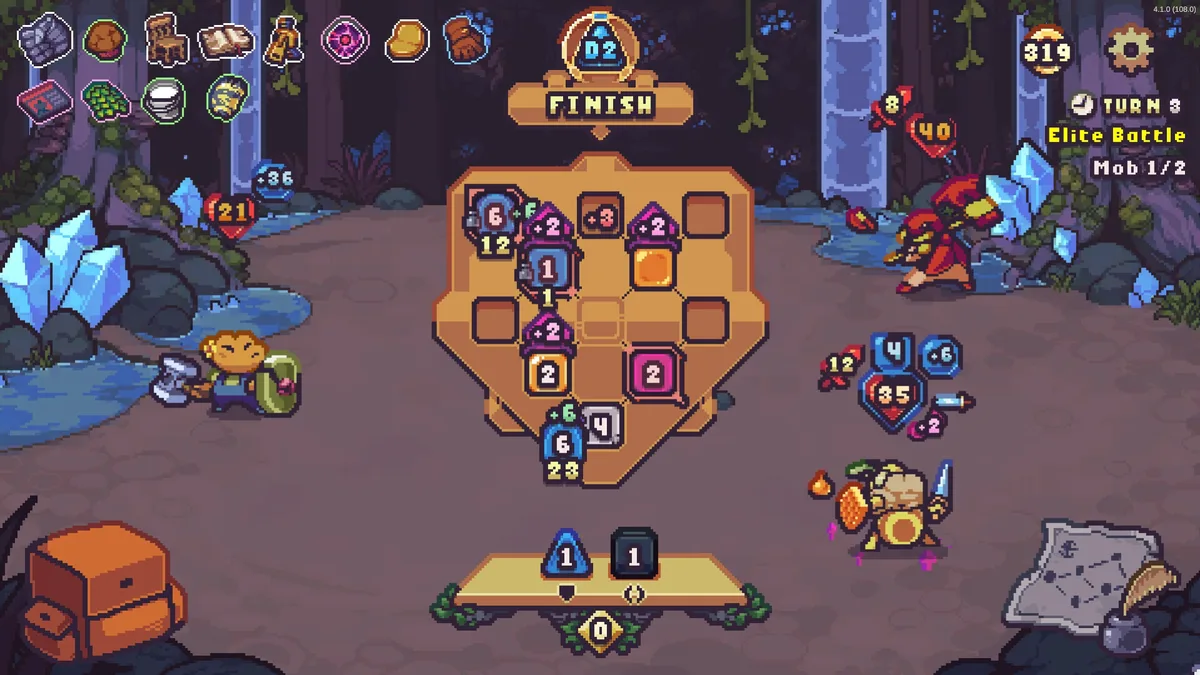 Grow and Mirror can complement one another, but placement and range still decide whether the turn works.
S tier: Grow and Mirror
Grow is S tier for long fights. The current reference describes Grow gaining value when it is used during a fight and resetting its accumulated growth in a new fight. That makes it a setup effect, not an instant burst button. Use it early when the encounter is long enough to repay the turns spent building it.
Grow is strongest when the rest of the board can protect it or amplify its output. A short fight can end before the growth matters, and a bad draw can leave the die unused. That is why its S tier is about ceiling and repeatable value, not a promise that every Grow roll is better than every Gold die.
Mirror is S tier when you understand its range. Mirror copies the type and value of a die at a distance equal to the original die's value. It is not a simple adjacent copy. A die showing four points can look for a target at range four, while an incompatible arrangement can produce no useful copy. Read the targeting preview and plan the original die's value before you place Mirror.
Mirror rewards a board with one clearly valuable target. Copying a strong Grow, a high Boost, or a useful attack property can create a large turn. Copying a weak die merely repeats a weak result. The effect is powerful because it multiplies a decision you already made, not because it automatically doubles the nearest number.
A tier: Terrain, Area, and Boost
Terrain is A tier for planned turns. When played, it gives the area where it lands a bonus based on its value. That bonus decays by one each turn. Put it where your next high-value dice can use the area, then spend the bonus before it disappears. Terrain falls when the board forces you to move away or when the fight ends before the setup matters.
Area is A tier in multi-enemy fights. An Area attack can hit all enemies in the affected attack pattern. Its value depends on the board. Against one enemy it may resemble an ordinary attack, while a crowded board makes the same value much more efficient. This is a contextual A tier, not a universal replacement for single-target damage.
Boost is A tier as an enabler. Boost adds value to other dice within its effect range, so it is only as good as the dice it reaches. A high Boost beside an empty or low-value board is a poor turn. A carefully arranged Boost supporting Grow, Mirror, or an attack property can be stronger than another flat damage roll.
The three A-tier effects share a requirement: plan one turn ahead. They are not bad because they need setup. They are bad only when the run never has enough board control to use that setup.
B tier: Bomb, Pierce, and Block
Bomb is B tier for burst and board pressure. The current reference describes Bomb as an altar property that stays on the board and can explode randomly. It can create a strong swing against a group, but the timing is less controlled than a direct attack. Treat it as a way to convert a dangerous board into a future payoff, not as guaranteed immediate damage.
Pierce is B tier with a clear target. Pierce bypasses Block, so its value rises when the opponent's defense is the reason a normal attack fails. Against a target without meaningful Block, a more general scaling effect can be better. Keep Pierce when the current enemy board makes its condition common, and do not judge it only by face value.
Block is a practical B-tier foundation. It prevents damage and buys turns for Grow or Terrain to mature. It is less exciting than a scaling effect, but a run that dies before its damage engine activates gets no benefit from a perfect offensive tier list. Move Block upward in a defensive character or a fight where survival is the limiting resource.
C tier and context picks
Eternal is a context pick that often falls into C tier in a damage-focused list. The current reference describes it remaining until the fight ends, with low normal values that need other effects such as Boost or Mirror to become impressive. That persistence can be useful, but it is not the same as carrying an endlessly growing die between fights.
Heal is not a bad effect. It is difficult to rank it against damage without knowing the character, relics, and current health. In a fragile run, Heal can be more valuable than an A-tier setup effect that never gets a chance to fire. The same caveat applies to Glass, Hollow, Heavy, and Bonded properties. Their value depends on the offered number, the character, and the board.
The practical rule is to treat C tier as “replace when the run offers a better answer,” not “never take.” A contextual Pierce that solves the current armored enemy is better than a theoretical S-tier Grow that cannot be played before the fight ends.
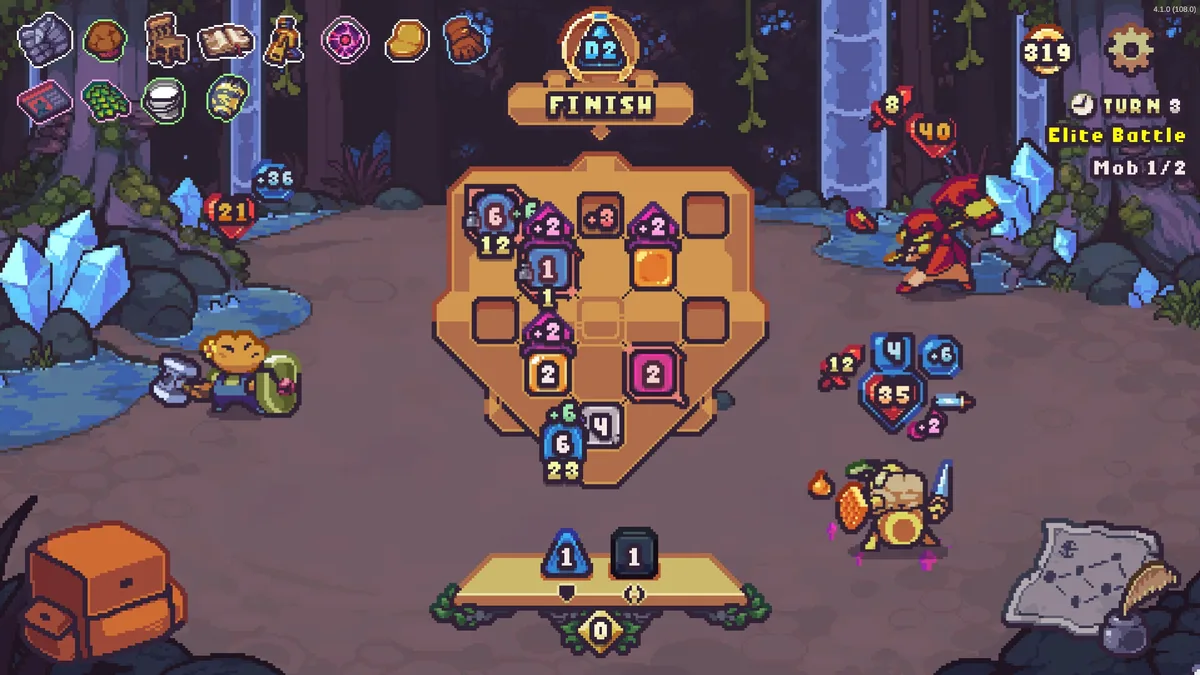 Quality tier matters, but a better number does not erase a poor effect or an unusable board position.
Step-by-step: build around the best effects
1. Identify the bottleneck: Decide whether the run is losing to damage, defense, healing, range, or a specific enemy property.
2. Take a general engine: Grow, Mirror, Terrain, or Boost is valuable when the character and board can use it repeatedly.
3. Check the range: Preview Mirror, Boost, Terrain, and Area before committing a die to the board. The intended target is part of the effect.
4. Keep a contextual answer: Hold Pierce for Block-heavy enemies, Area for crowded boards, and Block or Heal when survival is the actual limit.
5. Upgrade the weakest slot: Replace low-value Basic dice when the offered alternative improves the run's bottleneck, not simply because its tier color is higher.
6. Re-rank after the character changes: A property that is mediocre for one Dice Knight can become central when a relic or starting kit changes its board access.
Common tier-list mistakes
The first mistake is treating a label as a full mechanical description. “Mirror adjacent” is wrong because its target distance depends on the original value. “Eternal carries its growth forever” is also wrong because the effect persists through a fight, not necessarily through the run.
The second mistake is copying floor thresholds as if they were universal. Enemy boards, characters, relics, and the current full-release balance all affect when a die stops working. This article removes old claims that Mirror is mandatory beyond one exact floor or that every flat die falls off at a fixed number.
The third mistake is ranking a die without its condition. Area is better against several enemies, Pierce is better against Block, and Block is better when a run cannot survive a hit. Use the tier list to narrow the choice, then read the board.
For character-specific starting kits, use the Die in the Dungeon character guide. For broader run planning, the best build guide and relic guide add the context a universal list cannot provide. The Die in the Dungeon tips guide is the better companion when you need run context rather than a ranking.
Frequently asked questions
What are the best effects in Die in the Dungeon?
Grow and Mirror are the strongest general-purpose effects in this editorial list. Terrain, Area, and Boost are close behind when the board lets you set them up.
Is Mirror adjacent?
No. Its target distance depends on the original die's value. Read the board preview and do not assume the nearest die is copied.
Does Grow keep its value between fights?
No. Its accumulated growth resets in a new fight. Use it repeatedly during the current encounter when the fight is long enough to reward the setup.
What is the difference between a type and a property?
Types describe effects such as Attack, Block, Heal, Boost, Mirror, and Terrain. Properties include Grow, Area, Pierce, Bomb, Eternal, and other modifiers. Quality tiers describe the number range.
When is Pierce worth taking?
Take it when Block is the reason the current enemies are surviving. Against unarmored or low-defense enemies, a broader scaling effect may be better.
Are these official tiers?
No. They are editorial recommendations that should be re-evaluated for the current character, relics, board, and enemy pattern.
Related Reading
- Die in the Dungeon Character Guide: starting kits and Dice Knight context.
- Die in the Dungeon Best Build Guide: build engines around scaling effects.
- Die in the Dungeon Relics Guide: relic interactions with dice.
- Die in the Dungeon Tips Guide: early-run choices.
- Die in the Dungeon Floor Guide: encounter planning without fixed tier claims.
- Die in the Dungeon Achievement Guide: full-release completion goals.
- Die in the Dungeon Complete Guide: the full article hub.
References
- Die in the Dungeon on Steam: full-release status, price, review snapshot, and 1.0 scope.
- Die in the Dungeon official announcements: 1.0, 5.1, and hotfix notes.
- Die in the Dungeon mechanics reference: current type, property, tier, and effect documentation.
Was this guide helpful?
About the author

Senior Critic & Analyst
Former game data analyst turned critic with 11 years covering indie and mid-tier games. Based in Austin. Runs spreadsheets on games most people just play.
- 11 years games criticism
- Former game economy analyst
- Roguelike and strategy specialist
Keep reading

Disclaimer
This article is published for informational and entertainment purposes. It does not constitute professional financial, legal, or technical advice. Game performance, online services, patch schedules, and store listings change. Verify critical details (pricing, system requirements, regional availability) with publishers and storefronts before you buy. Affiliate links, where present, help support our editorial work and are labelled in our affiliate disclosure.
Comments
Loading comments…