
GameBrief · Guides
Die in the Dungeon Best Build: Attack, Poison, and Reroll

Reviewing
Die in the Dungeon
ATICO
The die in the dungeon best build question has a clear answer at each experience level: poison for runs 1-3, attack for the ceiling you're pushing toward, reroll chains once you understand what relics are actually doing. The game doesn't explain any of this directly: it just gets harder around floor 5 until the build logic clicks.
TL;DR: Push your primary die toward 4-5 matching attack faces. Take relics that trigger on each attack. Poison builds don't need positioning and are forgiving for learning. Reroll faces are probability management, not wasted slots. Don't mix build paths before floor 5.
Key takeaways
- Attack concentration (4-5 attack faces + scaling relics) is the highest-ceiling build in the current 1.0 state
- Poison DoT ignores board positioning: the best starting path while learning the spatial layer
- Reroll faces function as probability management: they skip unfavorable results toward your trigger faces
- Die concentration beats spread; a die doing one thing well outperforms a die doing three things poorly
- Character selection matters: the four frog warriors have different starting dice that suit different build paths
Die in the dungeon best build: the core logic
Die in the Dungeon's relic system rewards concentration. A relic that triggers on each attack hit scales linearly with how many attack faces your die has. One attack face triggers it once per roll on average. Five attack faces triggers it five times. Two relics stacked on attack faces means ten triggers per roll. The math compounds fast.
The mistake most players make in their first five runs: picking relics they like the look of without calculating how many faces currently support them. A relic that extends poison duration is neutral if you have one poison face. It's a scaling engine if you have four.
The same logic applies to every face type. This is why die face rerolling matters less than face concentration, and why split builds underperform until the late game when specific dice (unlocked through achievements) give you enough faces across two types to support two relic stacks simultaneously.
Step-by-step: building the attack concentration path
The attack build is the highest ceiling in the current 1.0 state. Here's the setup:
-
Die shape: 4-5 attack faces on your primary die, with one reroll face. The reroll cycles past non-attack results on bad rolls rather than locking you into poison or parry damage you didn't build for.
-
Relic priority: attack-trigger relics first. The relics that fire on each individual attack face hit are what make this build scale. Secondary: relics that add dice or increase rolls per turn. A modifier relic that buffs attack hits gets stronger with every additional die you add.
-
Floor progression: floors 1-3 with a lightly built die. Floor 3-4 is where you start spending rerolls to push toward 4-5 attack faces. By floor 5, the build should be running with at least two attack-trigger relics.
-
Boss floors: enter with effect potions, not healing potions saved from trash encounters. An effect potion that temporarily doubles your attack trigger rate on a loaded attack die is considerably more damage than anything your healing potions provide.
The attack build stalls before floor 5 when players reroll too early (disrupting a starting die before relic direction is confirmed) or take mixed relics they don't have the face count to support.
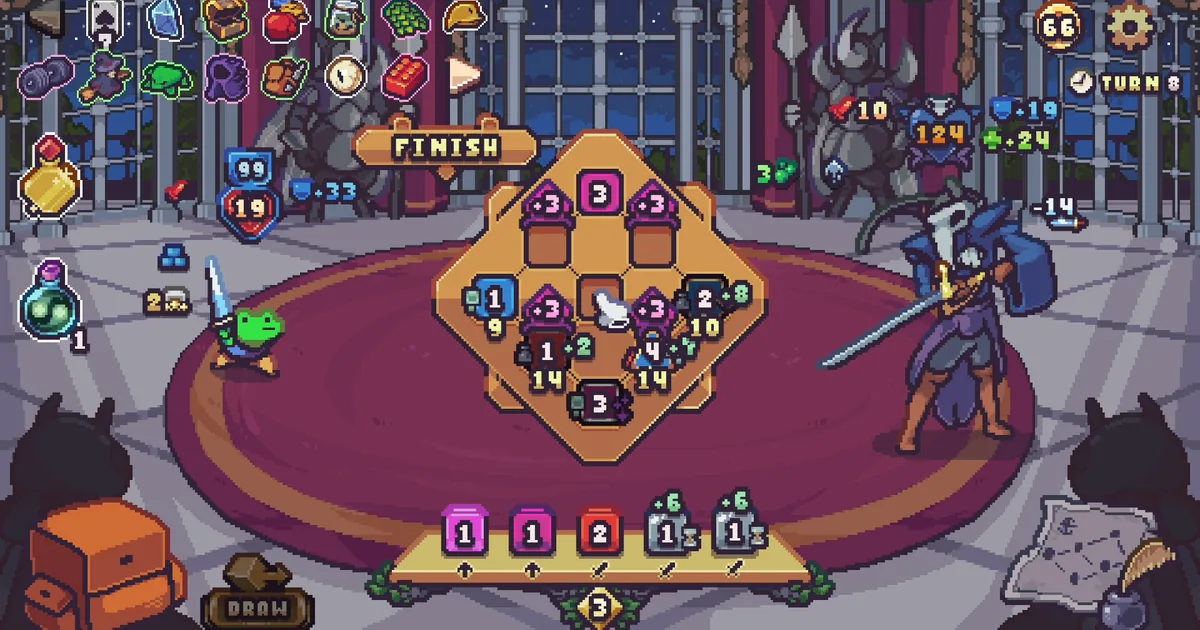
 Each battle win offers one new die for your deck. Reading the face values shown on cards like these before picking is how you steer toward a concentrated build instead of a random spread.
Die in the dungeon best build for beginners: poison
Poison is the most forgiving die in the dungeon best build for players still developing board intuition. Here's why it works as a starting path:
Poison deals damage on subsequent turns, not on the current roll. That means it doesn't require positioning: if you're flanked on floor 5 and forced into a defensive tile, your poison ticks regardless. Your attack build needs to be rolling and hitting. Your poison build is burning the enemy whether you're flanked or not.
The setup:
Die shape: 3-4 poison faces as the primary, one reroll, one attack or parry face depending on what your character starts with.
Relic priority: duration extenders first (more ticks per application), then DoT amplifiers (each tick deals more). Avoid relics that reward burst attack: they don't pair with poison and dilute your relic slots.
Against high-HP boss phases, poison builds deal consistent damage where attack builds front-load per roll. Poison is more reliable when the fight stretches into phase two and your attack build has fewer opportunities to cycle all five faces.
The downside: poison doesn't scale as hard as an attack build at equivalent relic investment. At floor 8-10, an attack build with four relics outdamages an equivalently developed poison build. Poison is the better starting point; attack is the ceiling you're playing toward.
Die in the dungeon best build: reroll chains
Reroll builds are the hardest to execute and pay off in the late game. The core mechanism:
Reroll faces cycle your die result, which means a reroll face in a build with relics that trigger on specific face results functions as an additional trigger: it lets you skip past bad results toward the faces that fire your relics. Two reroll faces with three attack-trigger relics means you're effectively getting additional attack triggers by cycling away from non-attack outcomes.
The advanced version of this is a "chain" setup: relics that trigger on reroll results themselves, so each reroll face fires a relic and then pushes toward the attack trigger faces. This requires specific relic combinations that don't reliably appear until mid-game.
Reroll builds are not a starting path. Run them after you've unlocked permanent dice from achievements: several of the 31 achievement-unlocked dice have unusually high reroll face counts that make chains possible earlier in a run.
GODEEPER: Achievement unlocks determine which dice are available across all runs. Die in the Dungeon Achievements: All 59 and Dice Unlocks →
Character selection by build path
Matching your character to the die in the dungeon best build you're targeting saves early rerolls. The four frog warriors each start with a different die configuration. Picking the wrong one doesn't lock you out of a build, but it costs rerolls.
The character with the highest attack face count in their starting die is the obvious choice for attack concentration builds. They enter floor 1 with a die already leaning toward the shape you're building to: no wasted rerolls early.
The character with poison-heavy starting faces is the cleaner path for poison builds, but it's not required. Any character can run poison by spending rerolls to reshape early. The poison-affinity character just gets there without spending early reroll resources.
Reroll-heavy starting characters are the worst choice for first runs. Their starting die configuration relies on chain mechanics that require specific relics to function: without the right relic support, high reroll face count just means you're cycling randomly. Run them after you understand what relics the chains require.
None of the four characters are locked to one build path. The starting die creates friction in the wrong direction, not a hard wall.
Tips for all three build paths
These apply regardless of which die in the dungeon best build direction you're pursuing.
A tight two-die setup outperforms a five-die spread. More dice means more rolls and more synergy surface, but only if the additional dice support your relic direction. Two dice with five matching faces each and stacked relics beats five dice split across three face types.
The board matters more for attack builds than poison. Attack builds need clean rolls to cycle through all five attack faces. Being flanked splits your defense and interrupts your roll rhythm. Poison builds can afford to take bad positional trades because the DoT continues whether or not you're in a strong tile.
Don't take relics that add dice until your primary die has 3+ matching faces of your target type. More dice before your primary die is shaped just means more random faces. Shape first, scale second.
Healing potions are most valuable on boss floors, not trash encounters that can be survived by spending one bad roll. Effect potions that boost your primary face type for one fight are strongest on boss floors where the fight is long enough for the buff to fire multiple times.
GODEEPER: Full game coverage including characters, mechanics, and the relic system explained. Die in the Dungeon Guide: All Tips, Builds & Characters →
 The relic icons running along the top of the screen are what turn a concentrated die shape into real damage. Each one triggers off a specific face type rolled during the turn.
Frequently asked questions
What is the die in the dungeon best build overall? Attack concentration has the highest ceiling: push your primary die to 4-5 attack faces and take relics that trigger per attack hit. Poison is the most forgiving starting build. Both work. Reroll chains are an advanced option requiring specific relic setups.
Which character for attack builds? The character with the most attack faces in their starting die. They begin closer to the shape you're building toward.
How many faces before taking modifier relics? At least 3 matching faces on your primary die before taking relics that modify that face type. 4 is better. Adding modifier relics before you have enough faces to support them is wasted relic investment.
Can you mix attack and poison? Possible but not recommended before floor 5. The relic investment required to support two face types equally is more than the game typically provides in the first half of a run. Mixed builds work with specific achievement-unlocked dice that have unusual face distributions.
When do reroll builds become viable? After you've unlocked permanent dice from achievements and understand which relics are needed to chain. For most players, that means run 5+, not run 1-2.
What's the fastest path to a functioning attack build? Take your first relic to match your starting die's strongest face type. Spend rerolls after floor 3 to push toward 4 attack faces. By floor 5, prioritize attack-trigger relics over any others. Don't branch until both relics and die shape are committed.
How important is the board for builds? More important for attack than for poison. Attack builds need uninterrupted roll cycles to fire all attack faces. Poison builds can absorb bad tiles because DoT continues regardless of where you're standing.
Related Reading
- Die in the Dungeon Relics Guide: All 142 relics across 5 trigger categories with guidance on reading any relic against your current dice.
- Die in the Dungeon Dice Tier List: S to D ranking of all dice types with scaling and Endless mode viability analysis.
- Die in the Dungeon Achievement Guide: All achievements with unlock conditions, including the dice and characters locked behind them.
- Die in the Dungeon Complete Guide: Hub covering all Die in the Dungeon systems for new and returning players.
- Die in the Dungeon Floor Guide: Floors 1 to 6 Breakdown: Die in the dungeon floor guide: what each floor demands, how floor 5 kills most.
- Die in the Dungeon Relic Tier List: Best Picks & Synergies: Die in the Dungeon relic tier list: all 142 relics ranked, the categories to prioritize.
- Die in the Dungeon Characters: Which to Pick First: Die in the dungeon characters guide: 4 frog warriors with distinct starting dice.
- Die in the Dungeon Review: Dice-Building With Brains: Die in the dungeon review: 31 dice, 142 relics, 4 frog warriors, and the 1.0.
References
- Die in the Dungeon on Steam: store page, patch notes, and community build discussions
- ATICO on Steam: developer page
- Die in the Dungeon tips guide: positioning and relic priority basics
- Die in the Dungeon achievement guide: unlock new dice to enable advanced builds
Was this guide helpful?
About the author

Senior Critic & Analyst
Former game data analyst turned critic with 11 years covering indie and mid-tier games. Based in Austin. Runs spreadsheets on games most people just play.
- 11 years games criticism
- Former game economy analyst
- Roguelike and strategy specialist
Keep reading




Disclaimer
This article is published for informational and entertainment purposes. It does not constitute professional financial, legal, or technical advice. Game performance, online services, patch schedules, and store listings change. Verify critical details (pricing, system requirements, regional availability) with publishers and storefronts before you buy. Affiliate links, where present, help support our editorial work and are labelled in our affiliate disclosure.
Comments
Loading comments…