
GameBrief · Guides
Die in the Dungeon Floor Guide: Floors 1 to 6 Breakdown

Reviewing
Die in the Dungeon
ATICO
This die in the dungeon floor guide starts with the floor that kills most runs: Floor 5. Not because it's unfair, but because it checks whether you absorbed what floors 1 through 4 were teaching. All three of the game's systems become mandatory at once: dice face composition, relic synergy, board positioning. Runs that skipped any one of them find out here.
The guide covers what each floor actually demands, what ATICO designed each stage to teach, and what needs to be in place before each transition. Floor knowledge doesn't mean memorizing enemy layouts. It means reading what the game wants from you before the floor asks for it.
TL;DR: Don't reroll before floor 3. Lock in a build direction on floor 3. Floor 4 stress-tests it. Floor 5 requires board positioning and two matching relics or most runs end. Boss floor: stay off the center tiles, bring a healing potion.
Key takeaways
- Six floors total: 5 dungeon floors plus a boss floor
- Floors 1 and 2 are calibration zones; use them to observe, not customize
- Floor 3 unlocks die customization fully: commit to a face type here
- Floor 4 is a diagnostic: did floor 3 work?
- Floor 5 makes board positioning mandatory, not optional
- Boss floor: the cleave hits the center two tiles: start the fight off-center
How the floor structure works
ATICO designed escalating revelation, not escalating difficulty. Each floor introduces one more system the game expects you to handle before the next stage. Players who read this correctly use each floor to prepare for what follows. Players who don't are caught by floor 5: not because floor 5 is unfair, but because they skipped the preparation floors 1 through 4 provided.
The result is that floor 5 acts as a filter. It lets through players who have three things in place: a committed face type on their dice, two or more relics that trigger on the same type, and the board positioning habit. Runs missing any one of those end here most of the time.
Floors 1 and 2: the calibration zone
Enemy HP is low. Attack patterns are single-vector. Your starting die is intentionally over-tuned for this range. You won't be challenged here unless something goes significantly wrong.
 Floor 1 combat is designed to be read, not survived. Enemies attack from one direction. This is the one stretch of a run where you can watch your dice results without pressure and start building a picture of your face type distribution.
Use them to observe, not to customize.
Watch which face types you land most frequently across multiple rolls. Note which relic categories appear in the floor 1 shop: they signal what the floor pool is weighted toward. Those two observations together tell you your floor 3 direction before you arrive there.
Do not reroll dice here. The starting die handles floors 1 and 2. Rerolling before you have a relic in hand and a direction committed means reshaping toward a build target you haven't confirmed. You'll burn reroll resources on a guess and arrive at floor 3 worse off than you started.
Floor 3: the decision floor
Floor 3 is the most consequential floor in the game. Die customization unlocks fully. The first meaningful relic choice lands. Everything you observed on floors 1 and 2 is now useful.
Floor 3 has two jobs: lock in a face type and start reshaping dice toward it.
Pick one direction (attack, poison, or reroll. The character you started with has a natural lean (the attack-focused character pushes toward attack from floor 1), but floor 3 is where the formal commitment happens regardless of starting character. Floating between options is the most common build mistake in the game. Runs that arrive at floor 5 with dice split evenly across three face types and two relics on different triggers have no compounding) and floor 5 requires compounding to clear.
Once the direction is committed and a relic is in hand, start reshaping dice. Swap face types you don't need into the ones your relic rewards. The reroll system exists for this exact moment: not earlier when you were guessing, and not much later when the cost of pivoting outweighs what you'd gain.
If the relic you picked on floor 1 or 2 isn't firing consistently by floor 3, this is the last clean pivot window: swap face direction, start rerolling toward a new target. After floor 3, pivoting costs more time and reroll resources than committing to what you have.
GODEEPER: How to read your starting die's face type distribution and match it to your first relic pick by character. Die in the Dungeon Character Guide →
Floor 4: the stress test
Floor 4 is not a difficulty wall. It's a diagnostic. Enemies arrive in larger groups with mixed attack types. The floor is asking one question: did your floor 3 decision work?
If your relic-to-die alignment is correct, you'll clear floor 4 with resources to spare. The build is doing what it should: relics firing on qualified turns, damage output keeping up with incoming hits, HP exits looking healthy.
If your build is split, the damage shortfall shows here. Fights take longer than expected. You exit rooms with less HP than the hits warranted. Two relics on different triggers, or dice spread across four face types with no majority: the shortfall that was marginal on floors 1 through 3 becomes visible at floor 4 enemy counts.
 Floor 4 enemy groups test whether your relic fires often enough to matter. If three enemies are hitting you from two angles and your trigger fires once in three turns, the build needs focus: not more relics on a different trigger.
Floor 4 is also the last window for an aggressive reroll course correction. If you notice the problem here, you can still push toward a tighter face distribution before floor 5. After floor 5 starts, that option is effectively gone. Take note of what the floor 4 shop offers and decide: is there a broad-condition relic that helps bridge the gap while you tighten the dice, or do you reroll hard and commit?
Floor 5: the wall
Floor 5 is where the game stops holding back. Flanking enemies, multi-phase fight structures, and elite variants that require specific counter-types rather than raw damage. All three systems are checked simultaneously.
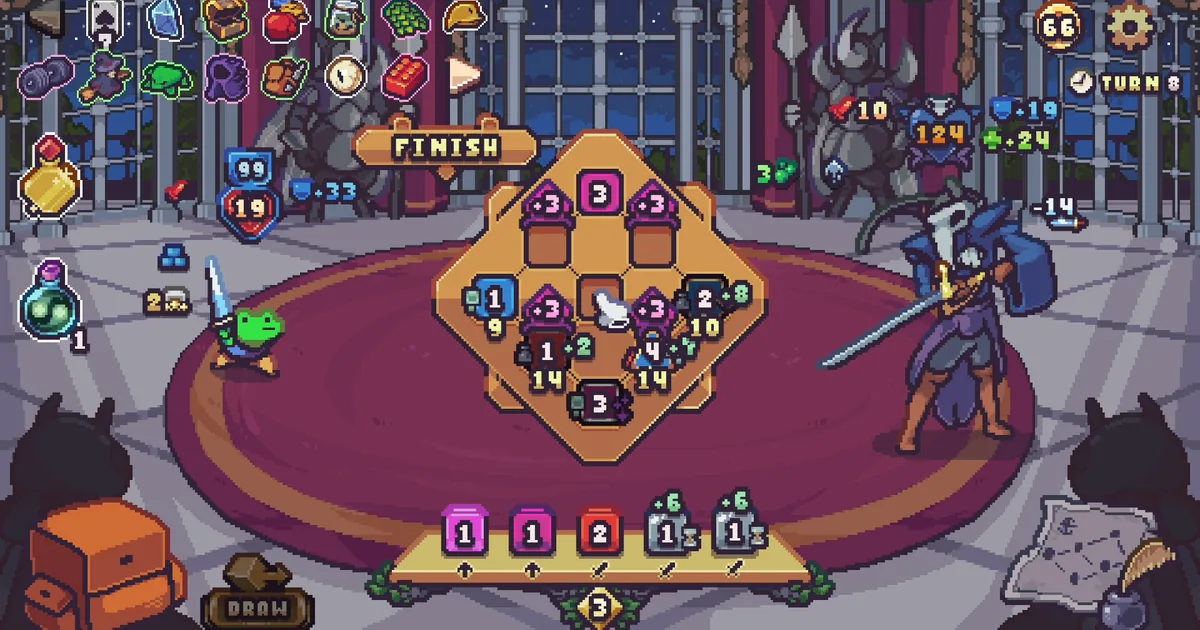
Board positioning stops being optional here. On floors 1 through 4, moving before rolling was good practice the game rewarded. Floor 5 just requires it. Enemy movement is telegraphed one turn in advance: you can see where each enemy will be before your roll. Moving first uses that information: pick the tile that cuts off flanking, forces attacks to one vector, and takes the ranged enemy out of effective range.
Players who haven't built this habit hit floor 5 and make the same mistake every time. Roll first, then try to move. By then the telegraph is wasted. Attacks land from two directions. Parry splits. The run ends on a fight that wasn't unfair: just unread.
Two matching relics is the floor 5 minimum. Runs that cleared floors 3 and 4 on one relic start falling behind here. Floor 5 enemies hit hard enough and have enough HP that a single trigger firing twice per fight doesn't generate enough advantage to clear consistently. Two relics on the same trigger, both firing on qualifying turns: that's the compounding floor 5 is checking for.
Watch out for elite variants too. Some floor 5 encounters have enemies that resist raw face-type damage or require a parry interrupt to break specific attacks. Having a few parry faces on an attack-committed build isn't wasted: you won't build around them, but they'll interrupt the specific patterns elites use.
Floor 5: Positioning specifics
Flanking is the mechanic most guides skip past. Here's how it actually works:
Two enemies are flanking when they're positioned such that each one attacks from a different side of the board. When both connect in the same turn, you're managing two simultaneous damage sources. If your parry capacity is one face per turn, one of those hits lands unmitigated.
Pre-position before you roll. Move to the tile where only one enemy can reach you on their next move. The other has to spend a turn repositioning. On that turn, only one attack vector is live: you roll freely.
Reading enemy movement is what makes this work. Each enemy shows its next move one turn before it happens. Watch which tiles they'll reach next turn. Pick the tile that breaks the flanking geometry before it completes: not after both enemies have already arrived.
GODEEPER: Full framework for reading relic trigger types against your current dice composition and deciding which relics to take on floors 3 through 5. Die in the Dungeon Relics Guide →
Boss floor: the payoff
The boss floor rewards what floors 1 through 5 built. The fight runs long (longer than any dungeon floor fight) which means per-turn compounding relics pull significantly ahead of cooldown-gated ones. A three-relic build with matching triggers on a concentrated face-type die outputs more damage across a long boss fight than any single strong relic effect.
Before your first roll, move off the center tiles. The boss has a cleave attack that hits both center tiles of the board at once. Standing on either of them when the fight starts means absorbing full cleave damage on turn 1. Pick a corner or edge tile. The boss's other attacks are telegraphed one turn ahead: the cleave is the one pattern worth pre-positioning against before it fires, not reacting to after.
Hold your healing potion for this floor specifically. Boss fights run long enough that a bad sequence of turns can drop HP into critical range fast. If you carried a healing potion through floors 3 and 4, this is the floor it was for. Don't burn it the first time you take a hard hit: wait until HP drops below your comfort threshold, then use it to stabilize before the next turn.
Effect potions compound best here. A one-turn dice buff that doubles your attack trigger rate on a turn when two or three matching relics are active generates a damage spike that trash floors can't reward: those fights end too fast. Save effect potions for the boss floor unless you're at full HP and have backup healing available.
What to have in place before each floor
| Before floor | Have ready | Why |
|---|---|---|
| Floor 3 | Observed dominant face type, seen floor 1-2 relic shop | Direction comes from this data |
| Floor 4 | One committed relic direction, dice starting to favor target face | Floor 4 tests whether this is real |
| Floor 5 | Two relics on same trigger, 3+ target faces per roll, positioning habit | All three checked at once |
| Boss floor | Three relics ideal, healing potion, effect potion if available | Long fight, high per-turn value |
If you reach floor 5 without two matching relics, the options are: take the floor 5 shop relic that matches your trigger direction before engaging, or accept that this run is likely ending at floor 5. The difference between one relic and two is not marginal at this floor: it's the line between runs that clear and runs that don't.
Frequently asked questions
How many floors does Die in the Dungeon have? Six: five dungeon floors and a boss floor. Floors 1 and 2 are calibration zones, floor 3 is the build decision, floor 4 stress-tests it, floor 5 is the difficulty inflection, and the boss floor is the run payoff.
Why do most runs die at floor 5? Floor 5 checks dice composition, relic compounding, and board positioning simultaneously. Floors 1 through 4 let players skip one or two of those systems and still clear. Floor 5 doesn't. Runs missing any of the three usually end here.
When is the right time to reroll dice? Floor 3, after you have a relic in hand and a direction committed. Not before: your starting die handles floors 1 and 2 without customization.
Does the character you pick affect which floor is hardest? The floor difficulty sequence is the same for all four characters. What changes is which face type you're naturally pushed toward from floor 1, which changes which relic categories are immediately useful. The attack-focused character can start compounding from floor 1. Poison and reroll-heavy characters need more setup before their relics fire consistently.
Is there anything missable before the boss floor? Healing potions are the main resource to conserve. Effect potions are worth more on the boss floor than anywhere else in the run. Beyond that, the relic and dice slots you fill on floors 3 through 5 are permanent for the run: every floor shop visit is a meaningful decision.
References
- Die in the Dungeon on Steam: official store page, patch notes, achievements
- ATICO developer page: full developer catalog
- Die in the Dungeon complete guide: hub for all GameBrief Die in the Dungeon content
- Die in the Dungeon relics guide: all 5 relic trigger categories and evaluation framework
- Die in the Dungeon character guide: all 4 characters and starting die configurations
- Die in the Dungeon tips guide: board positioning and build basics
Related Reading
- Die in the Dungeon Best Build Guide: the dice-and-relic builds that carry runs through the Floor 5 wall.
- Die in the Dungeon Relic Tier List: which relics to prioritize before each floor transition.
- Die in the Dungeon Dice Tier List: the dice faces that matter most as floors escalate.
- Die in the Dungeon Character Guide: pick a starting loadout suited to the floors ahead.
- Die in the Dungeon Achievements: All 59 and Dice Unlocks: Die in the dungeon achievements unlock 31 unique dice that persist across runs.
- Die in the Dungeon Review: Dice-Building With Brains: Die in the dungeon review: 31 dice, 142 relics, 4 frog warriors, and the 1.0.
Was this guide helpful?
About the author

Games Critic
Games writer and reluctant optimist who has reviewed over 400 titles across 9 years. Irish, currently in Berlin. Has strong opinions about tutorial design.
- 400+ games reviewed across 9 years
- Platformer and horror specialist
- Narrative design focus
Keep reading



Disclaimer
This article is published for informational and entertainment purposes. It does not constitute professional financial, legal, or technical advice. Game performance, online services, patch schedules, and store listings change. Verify critical details (pricing, system requirements, regional availability) with publishers and storefronts before you buy. Affiliate links, where present, help support our editorial work and are labelled in our affiliate disclosure.
Comments
Loading comments…