
GameBrief · Guides
Gambonanza vs Balatro: Which Roguelike Is Worth It?
Gambonanza vs Balatro compared on mechanics, replayability, and price: chess spatial puzzles vs poker hand-building. Which wins for your playstyle in 2026.

Gambonanza vs Balatro: the community made this comparison within hours of Gambonanza's May 1, 2026 launch, and the "Chess Balatro" label that stuck isn't wrong. Both games stack escalating rule modifiers onto a simple base system until the run either clicks into something brilliant or collapses. It's a fair comparison and worth taking seriously.
But the label does hide a real difference. Balatro is a scoring engine. You build a hand, score it, and the jokers modify that score. Gambonanza is a spatial puzzle. You position pieces, capture enemies, and the Crumble Mode counter punishes you for wasting moves. Both share the same underlying architecture: stack your modifier set until it produces something powerful, and ride it to victory or collapse. The moment-to-moment skill required is completely different.
TL;DR: Gambonanza vs Balatro isn't really "which is better": it's "which fits your playstyle." Balatro for hand-building, scoring optimization, and 100+ hours of documented replayability. Gambonanza for spatial reasoning, board pressure, and a shorter but intense run format. Both list at $14.99 on Steam. If you've already put 50+ hours into Balatro and want something that pushes different muscles, Gambonanza is the obvious next step.
Gambonanza vs Balatro: which is better? (quick answer)
Choose Balatro for the gentler learning curve, scoring depth, and long-established replayability. Choose Gambonanza if you want spatial board pressure, a shorter run, and a newer meta that is still changing.
Current status: September 2026
Gambonanza is now $14.99 on Steam and sits at Mostly Positive across 702 all-language reviews. The official patch feed lists 1.5.2b on September 10, following 1.5.1 and the 1.5.0 update that made the game Steam Deck Verified. The game launched on PC and mobile, so the old PC-only framing is no longer accurate; no console release is announced.
Key Takeaways
- Both games stack escalating rule modifiers, but Balatro optimizes scoring while Gambonanza manages board position
- Gambonanza's Crumble Mode creates urgency that Balatro has no equivalent for
- Balatro has significantly more documented replayability (longer track record, more run variety)
- Gambonanza has a steeper early learning curve: one positioning mistake can end a run
- Chess knowledge helps with Gambonanza but chess strategy doesn't transfer directly
- Balatro is available on more platforms (PC, mobile, console); Gambonanza is on PC and mobile with no console version announced
- Both list at $14.99 on Steam at the September 17 audit; Gambonanza launched with a 35% discount through May 15
The core mechanic difference
Balatro starts with a standard deck and builds toward poker hands. The joker cards you pick modify how those hands score: a joker that triples the value of pairs turns pair-heavy draws into scoring machines. Your decisions are: which jokers to take, which cards to add or remove from the deck, and which hand to play each round.
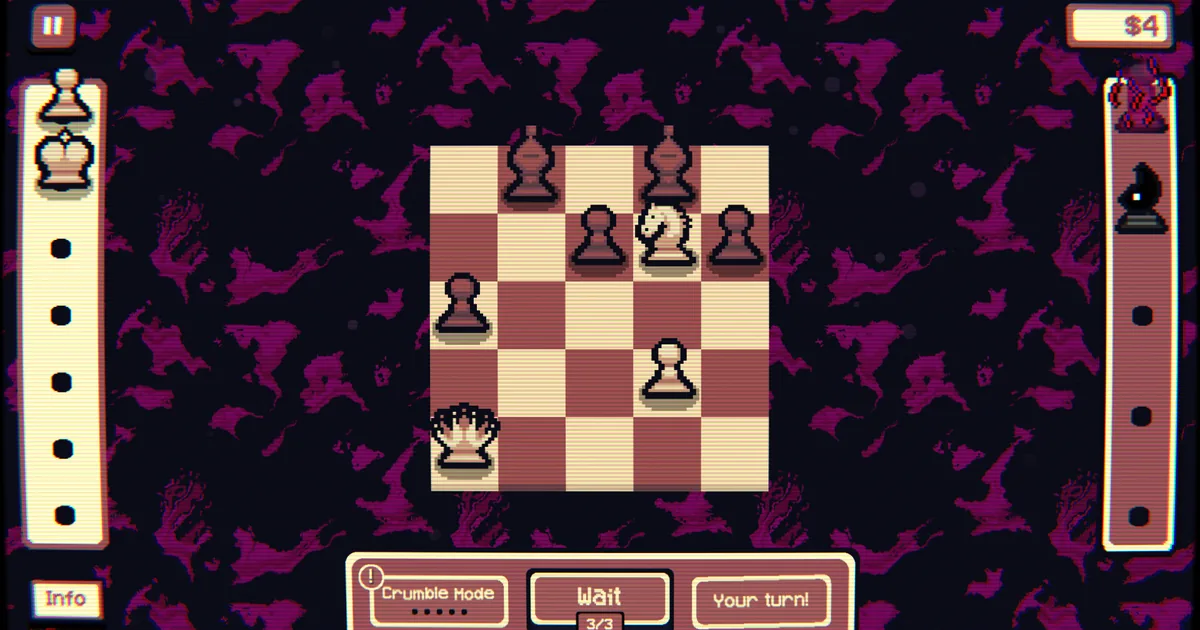
Gambonanza starts with standard chess pieces on a small board. The Gambits you pick modify what pieces do on capture, deployment, or tile interaction. Your decisions are: which pieces to position where, when to hold pieces in the reserve off-board, and whether your current board state is generating enough captures to keep the Crumble Mode counter from hitting 3/3.
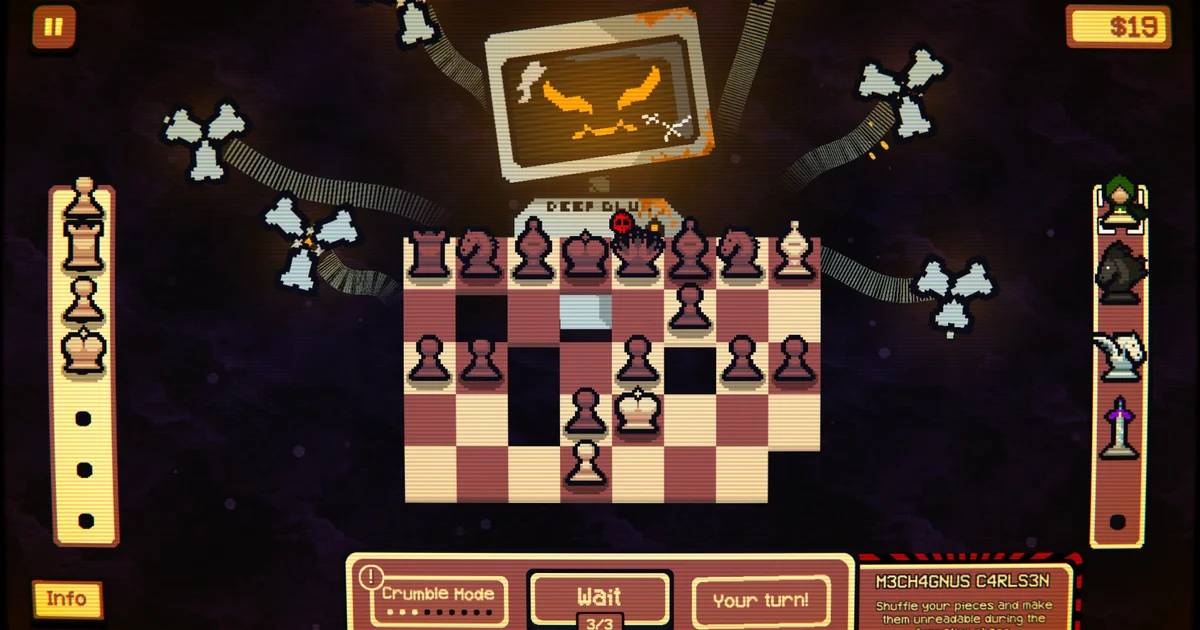
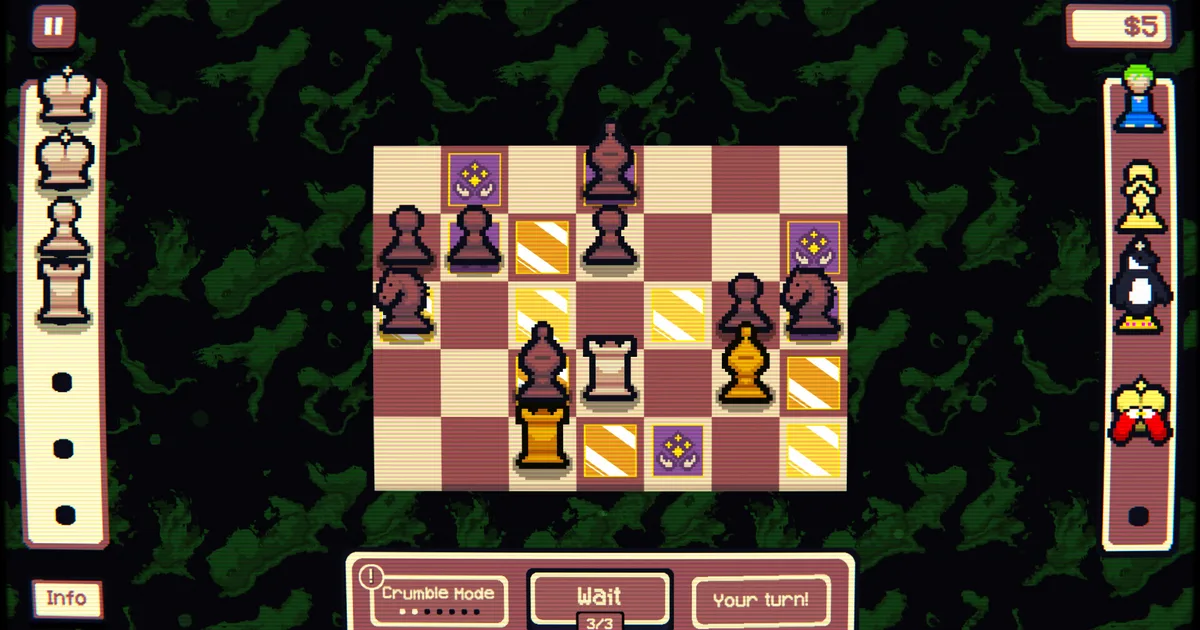
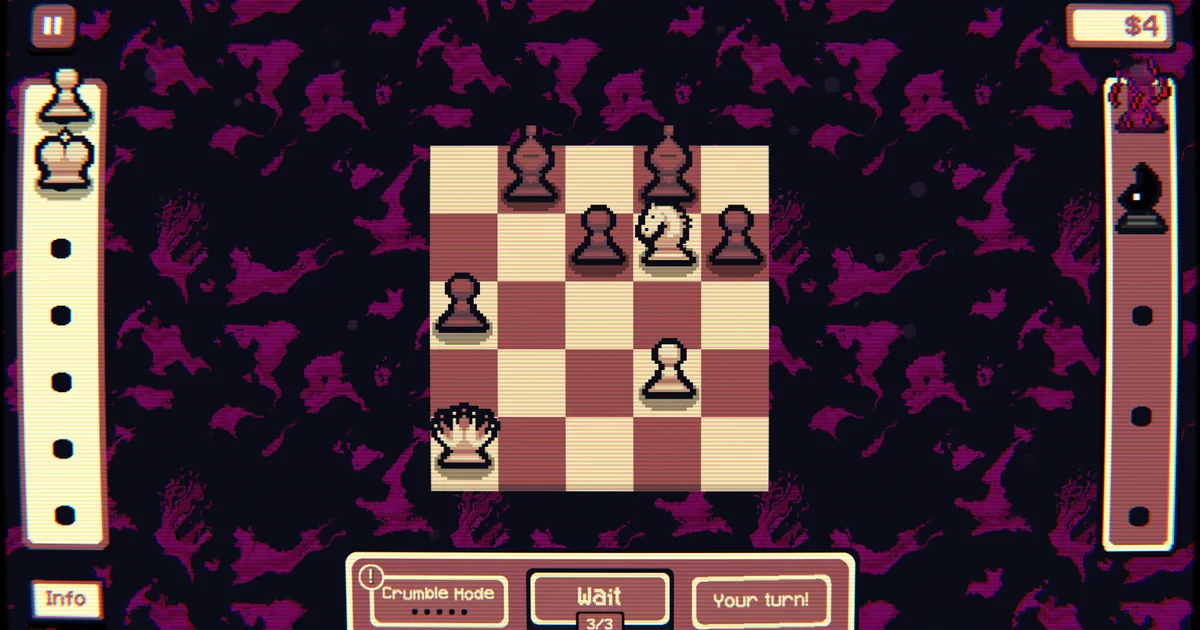
The Crumble Mode counter is the biggest mechanical difference between the two games. Every move that doesn't result in a capture adds one. At 3/3, the board degrades: outer tiles crumble, shrinking the play area. This creates urgency that Balatro's hand-scoring doesn't have. In Balatro, a slow round just means lower score; you can stall and recover. In Gambonanza, stalling physically destroys your playing field.
Learning curve and accessibility
Balatro is more accessible to new players. The hand-ranking system (pair, two pair, full house) is familiar to anyone who's played poker or seen the terms. The joker descriptions are direct about what they do. An early run failing in Balatro usually teaches you something specific: you leaned too hard into one hand type, or bought jokers that conflicted.
GODEEPER: Before comparing, understand what Gambonanza's early runs actually teach. Gambonanza Tips & Tricks: How to Win Your First Run →
Gambonanza has a harder first session. Three things confuse new players early:
First, the win condition. You don't win by capturing the king. You win by capturing every enemy piece on the board. Chess instincts about protecting your king and working toward check are completely irrelevant: worse, they actively mislead you into ignoring pieces you should be targeting.
Second, the reserve. Chess doesn't have an off-board reserve. Gambonanza does. Pieces in the reserve aren't making captures, which feeds the Crumble Mode counter. Holding too many pieces off-board starves you of captures without understanding why.
Third, Crumble Mode itself. The counter in the top corner doesn't announce what it is. First-run players often don't connect the board degradation to their move count until the second or third run.
By run three or four, the mechanics click. But the first two runs in Gambonanza are harder than Balatro's first two runs, full stop.
Build depth and run variety
Balatro's run variety comes from the joker pool (150 jokers), the deck composition, and how different joker combinations interact. High-stakes runs evolve into highly specific deck archetypes (flush builds, pair builds, four-of-a-kind builds) each with their own optimal joker list. The community has mapped most of them in depth after more than two years.
Gambonanza's run variety comes from its documented Gambits (Thunder's, Chemist's, Falling Crown's, Valkyrie's, and others) and which Gambit sequence your shop offers across a run. Our tier list of every Gambit ranks the full set if you want the deep version of this comparison. The community is still mapping interactions at this point, so the "solved" runs don't exist yet in the way they do for Balatro. That's genuinely exciting: Gambonanza right now is what Balatro was in its early days.
The weakness in Gambonanza's variety is the stage boards. They're authored, not procedurally generated. Players report replaying identical board configurations after ten hours of playtime. This is the main reason Gambonanza's replayability ceiling currently sits below Balatro's. You eventually memorize the board layout before the run starts. Our boss guide covering all stages documents exactly which boards and bosses repeat.
Balatro doesn't have this issue. The deck composition and blind structure provide enough variation that even well-understood archetypes feel different run to run.
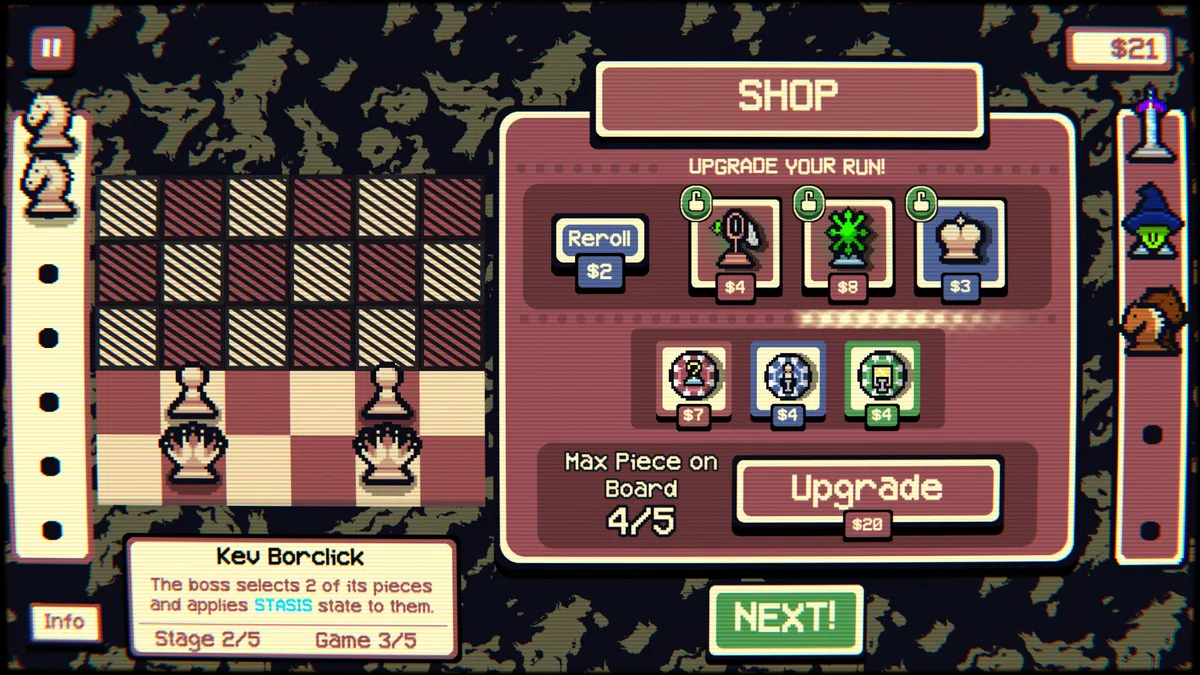 The shop screen between games: boss modifiers like Kev Borclick's STASIS are previewed before you spend.
Run length and pacing
A Gambonanza run takes 20-40 minutes. Five stages, one boss per stage, shop in between. The run ends when you've captured all enemies in all five stages, or when you've lost enough pieces that capturing becomes impossible.
A Balatro run takes 20-60 minutes depending on stake level and deck archetype. The structure is similar (rounds, escalating ante, a final boss blind) but the pace in Balatro is faster per decision. You play a hand, score it, move on. In Gambonanza, a single board state can take several minutes of piece positioning before you make a capture.
Both are session-friendly for 30-minute blocks. The key difference: Gambonanza runs feel more deliberate and heavier. A wrong positioning decision costs pieces that don't come back. Balatro runs are more forgiving of individual hand decisions because you have multiple hands per round and rounds reset between antes.
If you want a roguelike you can pick up for one quick run before dinner, both work. If you want to think deeply on every move, Gambonanza rewards that more.
Price comparison
Both games list at $14.99 on Steam at this audit. Gambonanza launched with a 35% discount that ran through May 15, so that window has closed and the two games are now similarly priced. Check Steam for current prices before buying; occasional sales bring both into the under-$10 range.
Balatro is available on PC (Steam/Epic), Switch, PS4, PS5, Xbox, and mobile. Gambonanza launched on PC and mobile, with no console versions announced. If you primarily play on console, Balatro is the only option; mobile players can choose either game.
Balatro also benefits from 18 months of community run documentation (specific decks, optimal high-stake builds) all of which extends the longevity significantly. Gambonanza's community is still comparatively young and still finding its footing.
GODEEPER: For the full breakdown of what Gambonanza is, who it's for, and whether the gambit system lives up to the Chess Balatro comparison: Gambonanza Review: Chess Balatro or Something Better? →
Which one fits you
Gambonanza is the right pick if you've already put significant hours into Balatro and want something that demands spatial reasoning instead of pure scoring math. It's also the better pick if you want a community meta that hasn't been fully mapped out: the early-discovery phase of a new roguelike is genuinely exciting, and that window doesn't last. If you don't mind a harder first few runs and a higher per-mistake cost, it's absolutely worth it, and our best builds guide is a good starting point once you're in.
Balatro is the right pick if you're new to roguelikes and want a gentler entry point. The hand-ranking system clicks faster than Gambonanza's board mechanics, the failure states are more readable, and the replayability is documented out to 100+ hours across different stake levels. It's also the obvious choice if you play on console; both games are available on mobile. Read our full Gambonanza review for more on where it currently falls short of that.
Both, if you play this genre regularly. The spatial puzzle feel in Gambonanza and the scoring engine in Balatro aren't really competing for the same thing. At $14.99 each on Steam, there's no reason to choose on price alone.
Gambonanza vs Balatro: summary comparison
| Factor | Gambonanza | Balatro |
|---|---|---|
| Core mechanic | Spatial board capture | Poker hand scoring |
| Learning curve | Steeper (3-4 runs to click) | Gentler (1-2 runs) |
| Run length | 20-40 min | 20-60 min |
| Gambit/Joker pool | Documented Gambits, growing | 150 Jokers |
| Replayability | Strong, still mapping | Very strong, 18+ months of data |
| Stage variety | Community reports of authored board repetition | Procedural blind structure |
| Platforms | PC, mobile | PC, console, mobile |
| Price (full) | $14.99 | $14.99 |
| Age of community | Newer, still mapping the meta | More than 2 years |
Frequently Asked Questions
Q: Is Gambonanza similar to Balatro? A: In architecture, yes: both stack rule modifiers onto a simple base system. In moment-to-moment play, not especially. Gambonanza requires active spatial positioning; Balatro is pure scoring optimization. Players who enjoy one often enjoy the other, but the skill sets don't fully transfer.
Q: Which is harder? A: Gambonanza has a steeper early curve. Crumble Mode pressure and reserve timing require spatial reasoning that Balatro doesn't. One positioning mistake in Gambonanza can lose pieces permanently. Balatro's difficulty comes from stake scaling over many hours, not single-decision consequences.
Q: Can you play Gambonanza without knowing chess? A: Yes. You need to know how each piece moves, but not chess strategy. Checkmate concepts are completely irrelevant: the win condition is capturing all enemy pieces, not the king alone.
Q: Which should I buy first? A: Balatro if you're new to roguelikes. Gambonanza if you've already put significant hours into Balatro and want spatial challenge. They're not really competing for the same use case.
Q: Does Gambonanza have more content than Balatro? A: Balatro has more fully mapped content after 18 months of community development. Gambonanza's Collection system (200 items across six categories) is comparable in scope, but the community is still early in discovering interactions compared to Balatro's much longer track record.
Related Reading
- Gambonanza Complete Guide 2026: Hub for all Gambonanza guides: builds, tier lists, gambit pieces, tips, and vs-Balatro comparison.
- Gambonanza Boss Guide: All 8 Bosses and How to Beat Them: Gambonanza boss guide: 8 confirmed stage bosses, what each modifier actually does, and how to spend the shop prep window.
References
- Gambonanza on Steam: store page, current price and review score snapshot.
- Gambonanza official announcements: updates 1.5.0 through 1.5.2b, including Steam Deck Verified status.
- Gambonanza launch trailer: official trailer linked in the developer's Steam launch announcement.
- Balatro on Steam: store page for comparison pricing and platform availability
- Gambonanza Review: Chess Balatro or Something Better?: full analysis of the gambit system and replayability
- Gambonanza Tips Guide: reserve timing, Crumble Mode, and first-run mistakes
- Gambonanza Tier List: Best Gambits & Pieces: full S-to-B tier breakdown for every documented Gambit
- Balatro on Loaded (sponsored): $9.99 vs Steam's $11.99, same key
About the author

Critical game theorist with a background in film criticism. Writing for print and digital outlets since 2015. Specialises in genre analysis and design heritage.
- Background in film criticism
- 10 years games coverage
- Genre theory and design history specialist
Keep reading

Disclaimer
This article is published for informational and entertainment purposes. It does not constitute professional financial, legal, or technical advice. Game performance, online services, patch schedules, and store listings change. Verify critical details (pricing, system requirements, regional availability) with publishers and storefronts before you buy. Affiliate links, where present, help support our editorial work and are labelled in our affiliate disclosure.
Comments
Loading comments…