
GameBrief · Guides
Subnautica 2 Biomes Guide: All 13 Current Zones (2026)

Reviewing
Subnautica 2
Unknown Worlds Entertainment · Unknown Worlds Entertainment
This Subnautica 2 biomes guide maps 13 named zones spread across the region labels used by the official wiki, including current depth ranges, resources, and Leviathan placements that aren't well documented in one place.
TL;DR: 13 named zones across the current map labels: Coral Gardens (8 zones, 0-266m), Scorpius and its Intermediary Basin (0-250m), Karakorum Ruins (3 zones, 0-750m), and the Void (0-3,100m, out of bounds). The Collector Leviathan patrols the Intermediary Basin and Karakorum Metal Farms. The Shiver Leviathan guards the Void. The stationary Great Jaw sits in the Dolerite Spires. Start in the Shallows, work through Coral Gardens, then push into Karakorum Ruins once your hull sections are upgraded.
Subnautica 2 biomes: quick answer
The current official biome wiki lists 13 named zones: eight in Coral Gardens, three in Karakorum Ruins, one in Scorpius called Intermediary Basin, and the Void. Great Trench and Xanadu are listed as potential future biomes, not current explorable zones. Older launch coverage may call Intermediary Basin "Sparse Plains"; use the current name when matching the in-game map and wiki.
Subnautica 2 status: Early Access 1.2 and the current map
Early Access 1.2, the Buddy System update, added proximity chat, player revives, emotes, player trading, two character options, and many fixes. The September 1 hotfix then improved Collector Leviathan pathing and corrected save, base, and localization issues. Unknown Worlds' roadmap still describes the next large drop as an expansion of the world, biomes, creatures, resources, tools, vehicles, and story, but gives no firm date. The 13-zone roster below is therefore a current-build snapshot, not a final map count.
Subnautica 2 biomes: key takeaways
- 13 named zones confirmed by the current official wiki: Coral Gardens, Scorpius, Karakorum Ruins, and the Void
- Coral Gardens is the starting region and contains 8 of the 13 biomes, including the Shallows where your Lifepod sits
- The Collector Leviathan patrols two zones: Intermediary Basin and Karakorum Metal Farms
- The Shiver Leviathan guards the Void, the out-of-bounds zone beyond the Early Access boundary
- The Great Jaw, a stationary ambush creature, sits in the Dolerite Spires
- Depth ranges span 0m (Shallows, Intermediary Basin, several Coral Gardens biomes) to roughly 3,100m in the Void
- Great Trench and Xanadu are listed as potential future biomes and aren't accessible in the current build
How Subnautica 2 biomes work
Subnautica 2 structures its world around the region labels used by the current wiki rather than one continuous descent. Coral Gardens wraps around your starting Lifepod and contains most of the early-game biomes. Scorpius sits beyond Coral Gardens and contains the single Intermediary Basin zone built around the Collector Leviathan's territory. Karakorum Ruins is the mid-to-late game region, built around ancient alien architecture and story content. The Void is not a region you explore, it's the boundary that marks the edge of the current Early Access map.
Within each region, individual biomes still vary a lot by depth and resource type. The deeper you go, the more your equipment needs to catch up, and the harder it gets to scan creatures safely. Skipping a biome isn't just an exploration gap, since biome-specific fauna feeds the DNA modification system covered in the creature evasion guide.
The recommended approach mirrors how the regions are laid out: treat Coral Gardens as your research base, Intermediary Basin as an early Leviathan-avoidance lesson, and Karakorum Ruins as the mid-game push once you have the hull sections and Biomods to handle it.
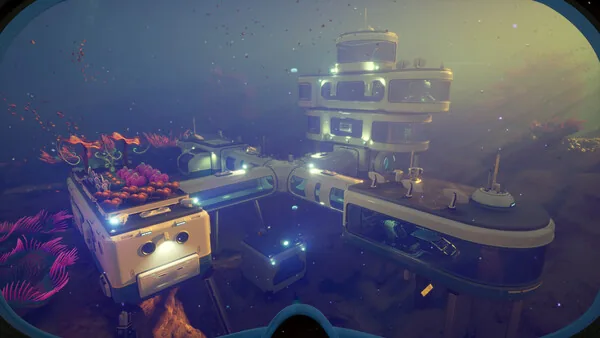 Resource density varies a lot by biome. The Shallows and Intermediary Basin cover most early-game crafting needs without specialized gear.
Biome reference table
| Biome | Region | Depth Range | Notable Feature |
|---|---|---|---|
| Shallows | Coral Gardens | 0-224m | Starting biome; Lifepod, Welcome Center |
| Dolerite Spires | Coral Gardens | 0-128m | Home to the stationary Great Jaw |
| Graveyard | Coral Gardens | 0-266m | Tailings Village, Tadpole Pens; salvage-heavy |
| Lead Zone | Coral Gardens | 34-65m | Best reliable Lead source |
| Necrolei Hills | Coral Gardens | 0-100m | Necrolei Kelp and jelly-type fauna |
| North Raceway | Coral Gardens | 0m+ | Open shallow terrain |
| Plateaus | Coral Gardens | 23-119m | Camp One, Old Habitat outposts |
| South Raceway | Coral Gardens | 0-85m | Coral Crab habitat |
| Intermediary Basin | Scorpius | 0-250m | Collector Leviathan territory |
| Karakorum Metal Farms | Karakorum Ruins | 0-500m | Second Collector Leviathan territory |
| Overgrown Ruins | Karakorum Ruins | 0-600m | Axum Observatory; story-critical |
| Root Canyon | Karakorum Ruins | 364-750m | Deepest explorable biome |
| Void | Other | 0-3,100m | Shiver Leviathan; Early Access boundary |
Great Trench and Xanadu appear on the developer's own biome map as "potential future biomes" and are not part of the current Early Access build.
The Shallows: your starting biome
The Shallows is where you land, literally. Your Lifepod, the Welcome Center, and your first Colonist Bunker are all here, and the biome runs a manageable 0-224m. It's the calmest zone in the game: no Leviathan-class predator patrols it, and the resource list (Coral Shavings, Fibrous Pulp, Quartz, Copper, Titanium) covers your entire first crafting queue.
Base placement: build your first base within a couple hundred meters of the Lifepod, not right on top of it. The Fabrication Module comes first; without it, the rest of your inventory chain doesn't function. Add storage containers before depth-rated hull sections, since storage saturation stops early resource runs faster than depth does.
First session checklist:
- Collect Titanium, Copper, and Quartz from the Shallows seafloor
- Build the Fabrication Module, storage containers, and basic power
- Craft the Seaglide or grab a Wakemaker for faster swimming
- Scan the passive fauna around the Lifepod for early DNA data
- Push toward Intermediary Basin or the Dolerite Spires once your base is stable
GODEEPER: Creature behavior and threat notes across every biome, including how to read a Leviathan's aggro range before you commit to a scan. Subnautica 2 Creature Guide →
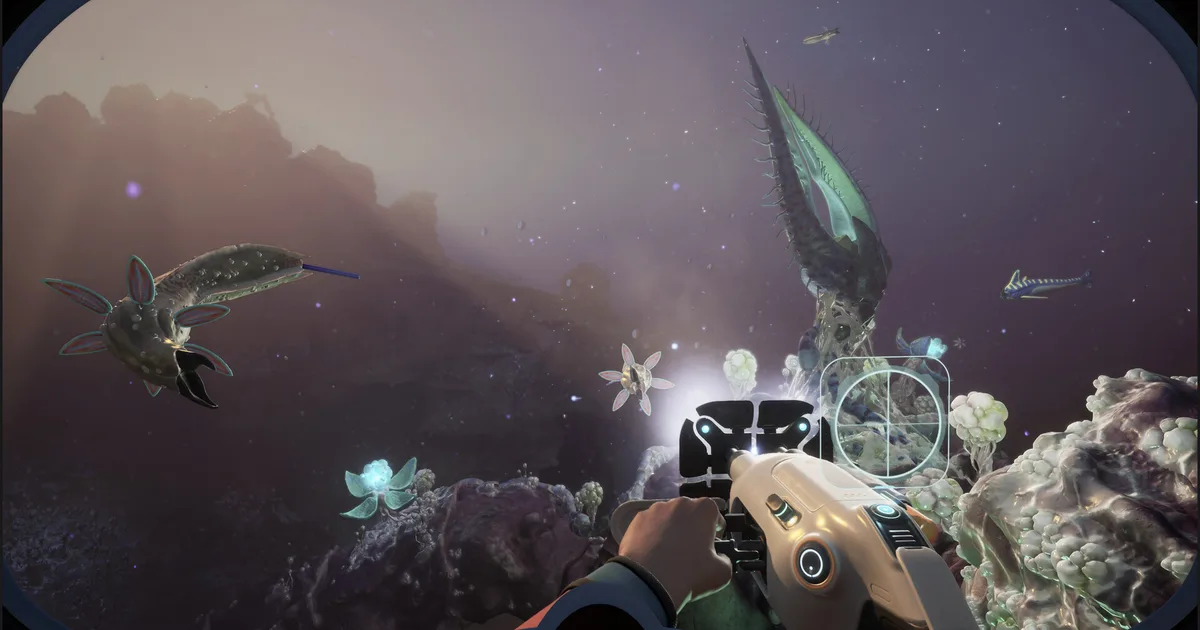
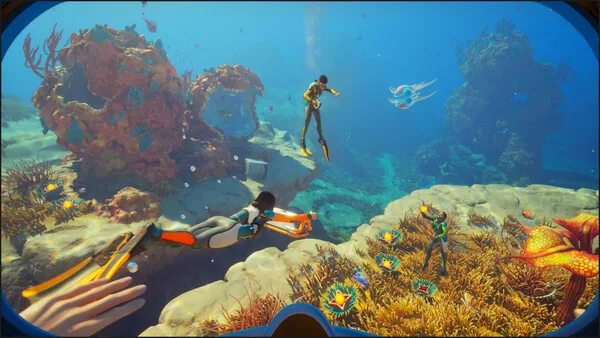 Karakorum Ruins biomes unlock the game's most efficient resource loops, but they demand hull upgrades and a Void-avoidance plan first.
Intermediary Basin: the Collector Leviathan's territory
Intermediary Basin sits beyond Coral Gardens and runs 0-250m. Older launch maps may call it Sparse Plains, but the current official wiki uses Intermediary Basin. It's an open, relatively barren transitional biome, and it's the first place most players run into the Collector Leviathan, an aggressive four-tentacled predator with a learnable patrol route.
The Collector is fully unkillable, so the skill here is reading its patrol rather than fighting it. Scanning it from outside aggro range unlocks one of the better early-game DNA modifications. The full breakdown of its patrol pattern, scan window, and escape routes is in the dedicated Collector Leviathan guide.
Dolerite Spires: home of the Great Jaw
Dolerite Spires sits in the south-west corner of the Coral Gardens region, 0-128m deep. It's an easy biome to explore in general, but it hosts one specific hazard worth knowing before you go in: the Great Jaw, an enormous stationary ambush creature that works like a giant Venus flytrap. It doesn't hunt, it waits, and it's only dangerous if you trip its tendrils. The Great Jaw guide covers the full trigger mechanics and the loot inside it.
The rest of Coral Gardens: Graveyard, Lead Zone, Necrolei Hills, and the Raceways
Coral Gardens has six more named zones worth knowing at a glance beyond the Shallows and Dolerite Spires:
- Graveyard (0-266m): salvage-dense, built around the Tailings Village and Tadpole Pens. A good mid-early stop for scrap and Deepwing Egg Clumps.
- Lead Zone (34-65m): small and specific, this is the most reliable place to find Lead ore in the current build.
- Necrolei Hills (0-100m): named for the Necrolei Kelp that grows here, along with jelly-type fauna not found in the shallower biomes.
- Plateaus (23-119m): home to Camp One, Old Habitat outposts, and a mix of early resource nodes.
- North Raceway and South Raceway (North depth currently unspecified; South 0-85m): open, low-threat terrain with standard Copper, Quartz, Salt, and Titanium deposits.
None of these host a Leviathan-class creature, which makes them good low-risk stops while you build up hull sections for the deeper regions.
Karakorum Ruins: Metal Farms, Overgrown Ruins, and Root Canyon
Karakorum Ruins is the mid-to-late game region, and it's where the story content concentrates. Three biomes make it up:
Karakorum Metal Farms (0-500m) is the second zone the Collector Leviathan patrols, alongside its Intermediary Basin territory. It's also rich in Atacamite and Celestine.
Overgrown Ruins (0-600m) holds the Axum Observatory and the Rosetta Stone, the current story endpoint in Early Access. Reaching and repairing the Observatory concludes the current narrative arc, so this is not a biome to skip if you care about the story so far.
Root Canyon (364-750m) is the deepest biome you can actually explore in the current build, home to the Therapy Room and Stairway to Heaven wrecks. It requires solid depth-rated hull sections before you push in.
GODEEPER: Your base setup determines how deep you can operate and how long you can stay before a hull failure. Get the Fabrication Module and hull sections right before pushing into Karakorum Ruins. Subnautica 2 Base Building Guide →
The Void: the Early Access boundary, not a biome to explore
The Void is not a content biome, it's the edge of the current map. Depth here runs down to roughly 3,100m, but the number that actually matters is the Early Access boundary itself: cross it, and a Shiver Leviathan spawns, a massive female carrying three fast males that can destroy a Tadpole in one clamp. Retreat back inside the boundary and it breaks off immediately.
Treat the Void as a wall, not a zone. Players who go looking for undiscovered content past the map edge find an unkillable pack hunter and nothing else. The full survival breakdown, including the one safe scan window, is in the Shiver Leviathan guide.
Step-by-Step: recommended exploration order
Based on the region layout and equipment requirements, this sequence minimizes unnecessary deaths and maximizes research value per hour spent:
- Shallows (0-224m): first few hours. Build your Fabrication Module and storage. Scan the passive fauna around the Lifepod.
- Dolerite Spires and the rest of Coral Gardens (0-266m): scan the Great Jaw from outside its tendril range, gather Lead in the Lead Zone, and top off resources before pushing east.
- Intermediary Basin (0-250m): scout the Collector Leviathan's patrol from a distance before attempting a scan.
- Karakorum Metal Farms (0-500m): build depth-rated hull sections first. Watch for the second Collector territory.
- Overgrown Ruins (0-600m): the story-relevant push. Repair the Observatory once your gear supports 600m.
- Root Canyon (364-750m): the deepest region worth exploring, once your hull sections handle the pressure.
- Void boundary: avoid unless you specifically want the Shiver Leviathan's databank entry, and go in with Camouflage unlocked.
Tips
Scan everything you can reach safely. The DNA modification system is tied to creature scanning data, not story progression, so players who skip scanning in early biomes arrive at later regions with thinner build options than they should have.
Treat a Leviathan's detection cue as a timer, not an alarm. Both the Collector and the Shiver give you a window to react before they close the distance. Retreating immediately is almost always the right call.
Stage secondary bases between regions. A small base at the edge of Karakorum Ruins cuts down the logistics of operating at 500-750m compared to running everything from your Shallows base.
In co-op, designate someone to handle the Overgrown Ruins scanning pass. It benefits from focused attention rather than being squeezed between shared objectives.
For timing expectations across the whole build, the Subnautica 2 how long to beat guide breaks down runtime by playstyle. The early access tips guide covers the equipment progression that unlocks access to the deeper regions.
Frequently asked questions
How many biomes are in Subnautica 2 Early Access? 13 named zones: Coral Gardens (8), Scorpius's Intermediary Basin (1), Karakorum Ruins (3), and the Void (1). Great Trench and Xanadu are listed as potential future biomes but aren't in the current build.
What biome should I go to first? The Shallows, since that's where you spawn. From there, work through the rest of Coral Gardens before pushing into Intermediary Basin or south into Karakorum Ruins.
Where is the Collector Leviathan? It patrols two zones: Intermediary Basin and Karakorum Metal Farms. Both territories are avoidable if you know the patrol boundary.
Can you kill Leviathans in Subnautica 2? No. The Collector, the Shiver, and the Deepwing Brooder are all unkillable by design. They function as environmental hazards and boundary markers, not boss fights.
What is the Void? The out-of-bounds zone at the edge of the current Early Access map, patrolled by the Shiver Leviathan. It's not meant to be explored, it marks where the playable content currently ends.
Is the Overgrown Ruins story-relevant? Yes. It holds the Axum Observatory and Rosetta Stone, the current story endpoint in Early Access. Skipping it means missing the context building toward whatever comes next.
Related Reading
- Subnautica 2 Creature Guide: full behavior notes and scanning strategy for the fauna in each biome.
- Subnautica 2 Base Building Guide: hull section progression and depth-rated construction for deeper biomes.
- Subnautica 2 Complete Guide Hub: survival, biomes, base building, DNA mods, and all cluster guides.
- Subnautica 2 Leviathan Guide: Avoid, Scan, Survive: Subnautica 2 leviathan encounters: patrol patterns, safe scanning range, and how to escape when aggro fires.
- Subnautica 2 Resources: Biome Farming Guide for Early Access: Subnautica 2 resources: fractional harvests, biome rarity, and the scan-first fabrication pipeline most players get.
- Subnautica 2 Base Building Advanced Guide: Power and Depth: Subnautica 2 base building advanced tactics: power management, hull pressure thresholds, multi-base networks, and deep-sea.
- Subnautica 2 Vehicles: Only the Tadpole in Early Access: Subnautica 2 vehicles: only the Tadpole is in the Early Access build.
References
- Subnautica 2 on Steam: current Early Access store page, price, and features.
- Subnautica 2 Wiki: Biomes: official biome list, current region labels, and depth ranges.
- Subnautica 2 official announcements: Buddy System update and September hotfix notes.
- Unknown Worlds Early Access roadmap: official roadmap for future world and biome expansion.
- Subnautica 2 developer vlog: official Unknown Worlds video.
Was this guide helpful?
About the author

Senior Critic & Analyst
Former game data analyst turned critic with 11 years covering indie and mid-tier games. Based in Austin. Runs spreadsheets on games most people just play.
- 11 years games criticism
- Former game economy analyst
- Roguelike and strategy specialist
Keep reading

Disclaimer
This article is published for informational and entertainment purposes. It does not constitute professional financial, legal, or technical advice. Game performance, online services, patch schedules, and store listings change. Verify critical details (pricing, system requirements, regional availability) with publishers and storefronts before you buy. Affiliate links, where present, help support our editorial work and are labelled in our affiliate disclosure.
Comments
Loading comments…