
GameBrief · General
TetherGeist Review: Precision Platforming Worth the Pain
TetherGeist review: O. & Co. Games' debut precision platformer uses a spiritual tether to craft movement puzzles that click like nothing else in 2026.

Reviewing
TetherGeist
O. & Co. Games · Out of Space Games
Score
Reviewed build: 1.0
Pros
- Seven Azae abilities introduce genuinely distinct movement logic, not just speed boosts
- Disability representation is woven into the mechanics, not bolted onto the story
- Frequent checkpoints and instant retries make brutal difficulty feel earned rather than cruel
- BIG Festival finalist for Best Game, Best Art, Best Sound, and Best Impact: all deserved
Cons
- Narrative occasionally flattens: some NPC interactions repeat emotional beats
- Mushroom-power Azae demands near-perfect angle reads with little room to recover
Verdict
TetherGeist is a precision platformer with a genuinely original movement system and the most thoughtful disability narrative in the genre since Celeste: just expect to fail a lot before the mechanics click.
TetherGeist review: O. & Co. Games' debut precision platformer, out May 7, 2026 on Steam and Switch.
TetherGeist review: Key Takeaways
- TetherGeist is a combat-free precision platformer built entirely around Astral Projection: a tether mechanic connecting Mae to her axolotl spirit, Bao
- Seven distinct Azae items change how the spirit interacts with each environment, forcing you to relearn movement logic in every region
- Mae has a motor disability and chronic illness; the game ties this directly to the mechanics, not just the story
- BIG Festival finalist in four categories: Best Game, Best Art, Best Sound, Best Impact
- Frequent checkpoints and instant retries keep the difficulty steep but not sadistic
The tethergeist review most critics have written focuses on one question: is this the next Celeste? That's the wrong frame. O. & Co. Games' debut title shares Celeste's commitment to movement-as-metaphor and its willingness to make you fail hundreds of times. But TetherGeist's Azae system asks something different of the player: not reflexes, but geometric reasoning. That's a harder sell, and a more interesting one.
Current status: September 2026
TetherGeist launched on May 7, 2026 for Steam and Nintendo Switch, with Nintendo listing Switch 2 compatibility. The Steam snapshot checked on September 17, 2026 was about 97% positive across 299 reviews. The official news hub's latest listed patch, v1.0.8 from May 22, improved blue-pipe input, increased vine contrast, fixed dialogue issues, and marked the game Steam Deck Verified. Those are the current platform and patch anchors for this review.
The review below keeps its difficulty and narrative judgments as editorial judgments. It does not present the old Azae movement examples, completion estimate, or lack of an assist mode as an official technical specification.
TetherGeist review: Overview
TetherGeist follows Mae, a young villager with a motor disability and chronic illness, preparing for a once-in-a-lifetime religious pilgrimage. Her companion is Bao, an axolotl spirit bound to her through Astral Projection: a tether ability that extends Mae's spirit outward like a grappling hook. This is the game's single mechanical throughline. There's no combat, no upgrade tree, no inventory to manage. You move through the world by projecting Bao into it.
The game was funded on Kickstarter, with the campaign page recording 500 backers and $21,445 pledged. The review discusses the campaign's character-development claims as historical context. O. & Co. Games is a debut studio, and TetherGeist was named a finalist in four categories at the BIG Festival before launch. The demo's 98% from 74 reviews was a pre-launch snapshot, not a current score.
The full game largely meets them, with one persistent friction point.
Gameplay: the tether mechanic
The Astral Projection system is the reason to play TetherGeist. Mae can extend Bao outward into the level and then interact with what Bao touches: depending on which Azae item she's currently carrying. There are seven different Azae across the game's chapters, and they don't function as simple power upgrades. Each one changes the fundamental logic of how you interact with the environment.
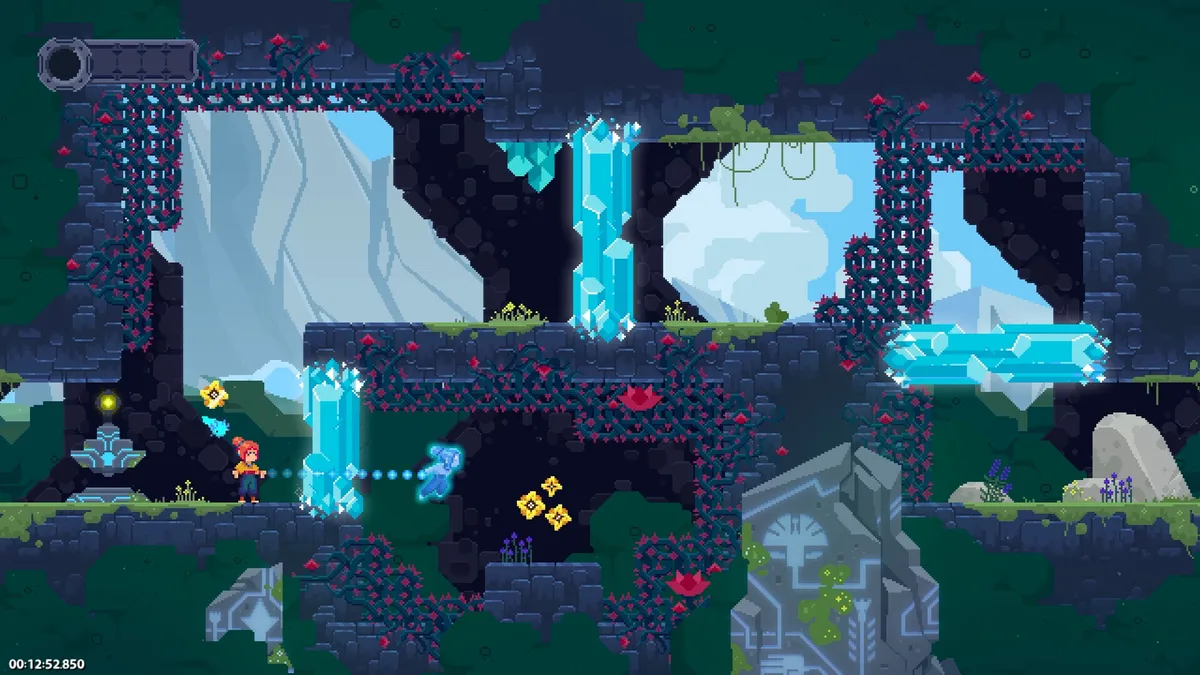 The tether mid-pull in a spiked corridor: the entire game's movement language comes down to this moment.
The review's hands-on examples make the first Azae feel like a short projection and the later examples feel more geometry-driven. The official store confirms seven distinct Azae, but it does not publish a complete movement table, so these descriptions are observations from play rather than universal technical documentation.
The mushroom-focused example is the review's hardest ask. In my playthrough, the approach angle left little room for correction, and the checkpoint loop made repeated attempts manageable. That is a difficulty judgment from the review, not a claim that every player or every Azae behaves identically.
What keeps the system from collapsing into frustration is the level structure. Each screen is bite-sized (rarely more than thirty seconds of movement) and checkpoints appear frequently within levels, not just between them. Instant retries mean a failed attempt costs you seconds, not minutes. This is the same design choice Celeste made, and it's the right one. Failure is information, not punishment.
Each region asks the player to reapply the Azae in a different space. The review estimates a 6 to 10 hour first playthrough, but that is not an official runtime promise and will vary with retries and exploration.
The official store describes seven different Azae, while this review focuses on how their movement logic felt in play. The ball and mushroom examples are useful for understanding the review's difficulty complaint, but they are not a complete ability roster or a substitute for the current in-game descriptions.
GODEEPER: The review's 6 to 10 hour estimate puts TetherGeist in the same value conversation as other compact indies. Best Roguelike Games 2026: 6 Picks Under $15 →
Difficulty and accessibility
TetherGeist is genuinely hard. This is not a game that softens its challenges for narrative reasons, even though its protagonist lives with a motor disability. That choice is deliberate, and worth noting.
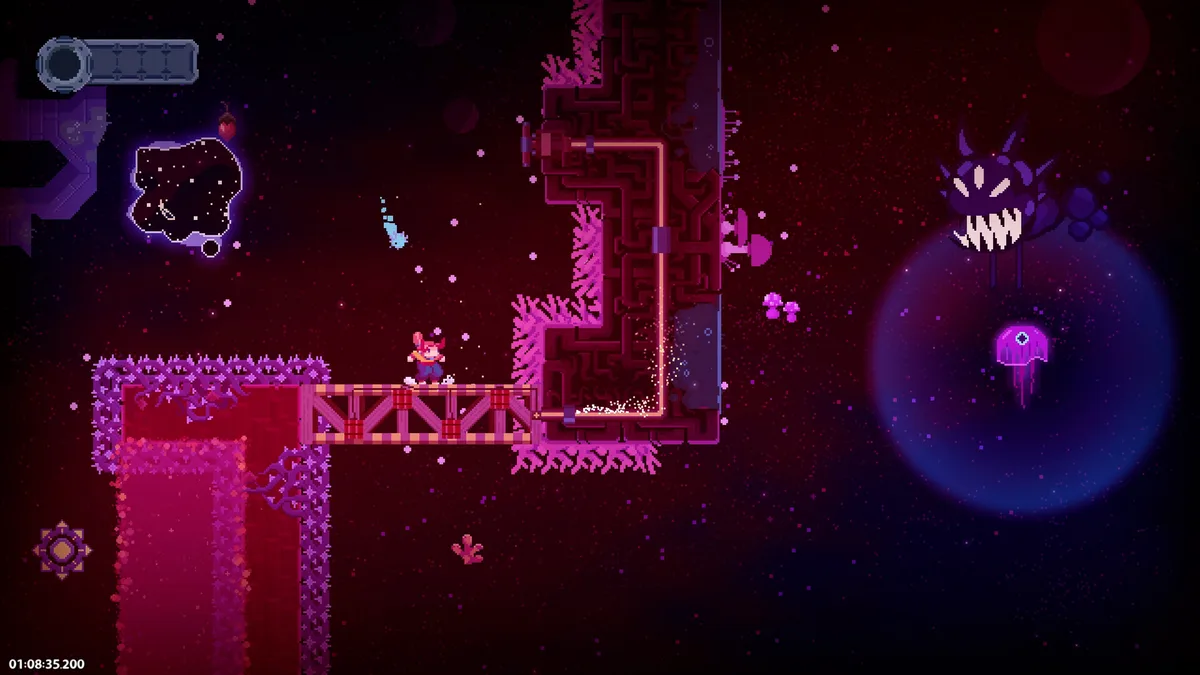 TetherGeist's later biomes pair the platforming with genuine hazards, not just gaps to clear.
Mae's disability shapes her story but doesn't limit what the player can do. The Astral Projection system (the tether) is framed as the way Mae moves through a world her body makes difficult. This isn't a metaphor that collapses under scrutiny. The act of controlling Bao remotely while Mae's physical form stays planted is the game, mechanically. The narrative and the mechanics point at the same thing.
The NPC cast reflects similar attention. Foyal wrestles with faith. Other characters carry class anxieties, cultural identities, diverse backgrounds. These aren't token inclusions. The writing is specific enough to feel like it came from real conversations, which tracks: the Kickstarter campaign involved backers in character development.
For accessibility mechanics specifically, the verified tools are frequent checkpoints, quick retries, and subtitles. I did not find an official source confirming an assist mode equivalent to Celeste's, so this review treats the checkpoint design as the main difficulty aid rather than declaring an exhaustive options list.
Nintendo Life called TetherGeist their favourite 2D platformer since Celeste while noting a flat narrative in places and some minor visual bugs. TechRaptor described it in their TetherGeist review as "a challenging precision platformer with a solid narrative" that's "at times a little too difficult" but worth seeing through. That range reflects the game accurately.
Note: Steam pricing is regional and can change. Check the TetherGeist Steam page for the current price in your storefront.
Players coming from combat-heavy platformers should adjust expectations: TetherGeist has no combat loop to fall back on when the movement doesn't click, which makes the precision demands feel heavier emotionally than the moveset itself would suggest.
If you're evaluating indie releases at this price point, our best indie games under $20 guide covers the same price tier TetherGeist is entering.
Verdict
This TetherGeist review comes down to one question: does the Azae system justify the difficulty? Mostly, yes. O. & Co. Games' debut is one of the more ambitious precision platformers in its lane. The Azae system forces repeated relearning across the game, and that is a harder design problem than polishing one movement trick. The mushroom example remains a specific exception in my playthrough because its angle dependency created a few unfair-feeling screens.
The narrative is the more unexpected strength. Disability representation in games usually takes one of two forms: the disability as obstacle to be overcome, or the disability ignored entirely. TetherGeist threads a third path: Mae's condition is real, shapes how NPCs interact with her, and connects directly to the core mechanic. That's not a small achievement for a Kickstarter-funded debut.
The flat narrative patches that Nintendo Life noted are real. Some NPC conversations retread emotional territory that earlier interactions already covered. The visual bugs they mentioned are minor but present.
At its current regional Steam price, TetherGeist is worth the failure for players who enjoy precision platforming. The Azae system makes you think differently about movement design, and Mae's story is worth seeing through. This is a meaningful debut: not flawless, but genuinely adding something to the genre.
If you've been following the wave of story-rich 2D platformers, Alabaster Dawn's early access launch covers another strong 2026 entry worth tracking alongside TetherGeist.
GODEEPER: If TetherGeist's precision difficulty sounds like your thing, Saint of Chains takes the hard-indie vibe into psychological horror FPS territory. Saint of Chains Review: Horror FPS Verdict →
Frequently Asked Questions
Is TetherGeist harder than Celeste? That is an editorial comparison, not a measured scale. TetherGeist feels demanding because each Azae changes movement logic, while frequent checkpoints keep individual failures short. Your experience will depend on whether geometric problem-solving or reflex practice is the harder challenge for you.
What are the seven Azae in TetherGeist? The official store confirms seven Azae abilities introduced across the game. This review discusses projection, geometry, and the mushroom example from hands-on play, but it does not claim to reproduce a complete official roster or exact interaction table.
Does TetherGeist have accessibility options? The official store confirms frequent checkpoints, and the current game provides quick retries and subtitles. I did not find an official source confirming a Celeste-style assist mode, so check the live options menu if that feature is important to you.
What platforms is TetherGeist on? TetherGeist launched May 7, 2026 on Steam (PC) and Nintendo Switch. The Nintendo Switch version is also compatible with Nintendo Switch 2. Both versions launched simultaneously.
Is TetherGeist about disability? Disability is central to the narrative and Mae's Astral Projection premise. The review focuses on how the tether connects story and movement, while individual diagnoses and NPC backstory should be read as the game's narrative context rather than a medical guide.
How long is TetherGeist? The review's 6 to 10 hour figure is an editorial estimate, not a developer promise. Checkpoints, retries, and your familiarity with each Azae can move the total substantially in either direction.
Was TetherGeist successful on Kickstarter? The cited Kickstarter page records $21,445 pledged by 500 backers. The campaign and pre-launch demo figures are historical context, not current review or sales metrics.
Related Reading
- TetherGeist Tips Guide: Crumble Mode, Reserve, and Gambits
- TetherGeist Complete Guide: Azae, Tips and Walkthrough
- Scriptorium Review: another atmospheric narrative indie worth comparing on mechanics and tone.
- Tides of Tomorrow Review: a differently-paced narrative indie release from the same window.
- Skull Horde Review: for readers who want a faster, more combat-focused alternative.
- Mixtape Launch Coverage: another atmospheric indie release worth tracking.
- Away From Life Early Access Analysis: a differently-scoped indie release worth comparing.
References
- TetherGeist on Steam
- TetherGeist: O. & Co. Games Official Site
- TetherGeist Review: TechRaptor
- TetherGeist Review: Nintendo Life
- TetherGeist Launches May 7: MonsterVine
- TetherGeist BIG Festival Finalist Announcement: Steam News
- TetherGeist Steam News: official release and patch history, including v1.0.8
- TetherGeist on Nintendo: Switch release and Switch 2 compatibility listing
- TetherGeist official reveal trailer: O. & Co. Games video checked for the review update
- TetherGeist Kickstarter
About the author

Games Critic
Games writer and reluctant optimist who has reviewed over 400 titles across 9 years. Irish, currently in Berlin. Has strong opinions about tutorial design.
- 400+ games reviewed across 9 years
- Platformer and horror specialist
- Narrative design focus
Keep reading


Disclaimer
This article is published for informational and entertainment purposes. It does not constitute professional financial, legal, or technical advice. Game performance, online services, patch schedules, and store listings change. Verify critical details (pricing, system requirements, regional availability) with publishers and storefronts before you buy. Affiliate links, where present, help support our editorial work and are labelled in our affiliate disclosure.
Comments
Loading comments…