
GameBrief · General
Everything is Crab Game Launches May 8: Full Guide
Everything is crab game launched May 8, 2026 at $9.99: 125+ evolutions, 4 biomes, a carcinization mechanic. Now Mostly Positive on Steam, 7,288 reviews.

Reviewing
Everything is Crab
The Everything is Crab game is a boss-rush roguelite where you evolve a single crab into wildly different forms. Here's what's in the May 8, 2026 launch build.
TL;DR: Everything is Crab launched May 8, 2026 on Steam at $9.99 (Odd Dreams Digital, published by Secret Mode, Steam Deck Verified). It's a boss-rush roguelite with 125+ evolutions that visibly reshape your crab toward archetypes like predator, trickster, or nomad. Four biomes change which evolutions are viable, runs last 20-40 minutes, and an Endless mode unlocks after normal play to remove the timer. Four months post-launch it sits at Mostly Positive on Steam, 7,288 reviews.
Everything Is Crab game: key takeaways
- Everything is Crab launched May 8, 2026 on Steam at $9.99: developed by Odd Dreams Digital, published by Secret Mode
- 125+ evolutions let you build toward archetypes like predator, trickster, nomad, or full crab: and each choice visibly changes your creature's body
- Four distinct biomes with their own AI ecosystems, climate events, and day/night cycle shifts
- Carcinization is a real mechanical choice: stacking crab-form evolutions unlocks synergies that pure hybrid builds can't access
- Meta-progression includes combinable genetics, challenge scenarios (Ice Age, Always Night, Hunted), and an unlockable Endless mode
- Steam Deck Verified at launch; system requirements are modest
Everything Is Crab game: overview
The everything is crab game earns its title more literally than you'd expect. It's built around carcinization: the actual evolutionary biology concept describing why unrelated crustaceans keep independently arriving at crab-like body plans. About five separate times in evolutionary history, something that wasn't a crab became one. The game asks: what if that were a choice?
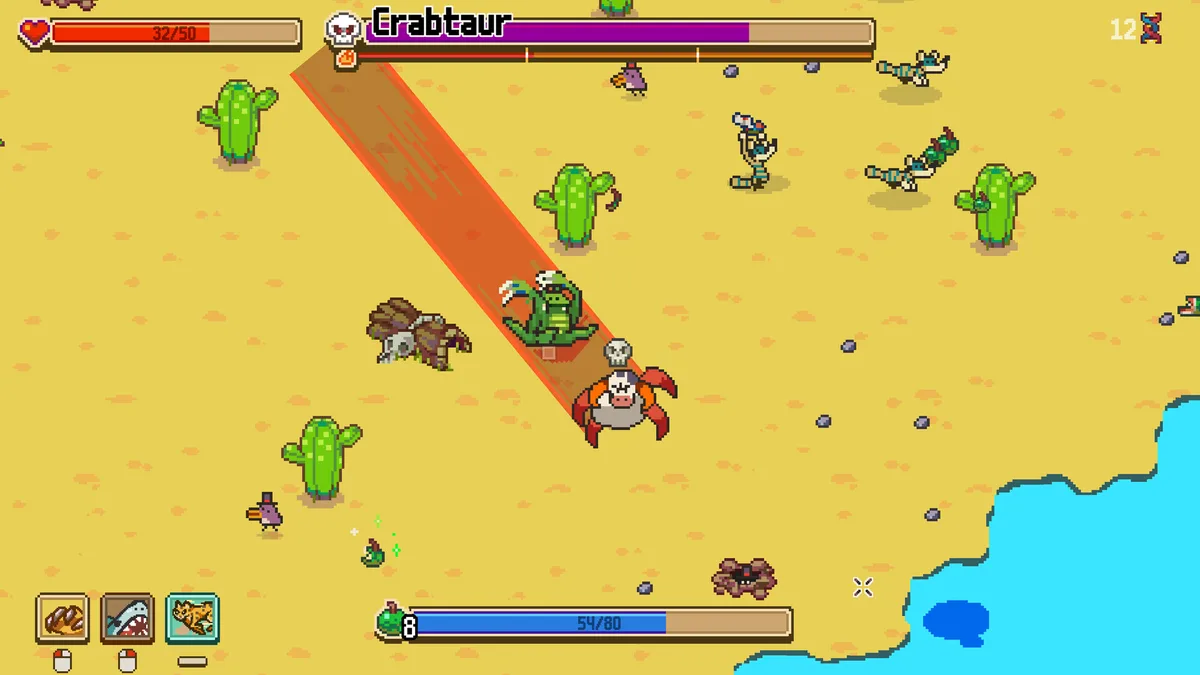 A mid-run boss encounter with the Crabtaur, one of the crab-based bosses that can appear in the desert biome.
Odd Dreams Digital is a small studio based in Malmö, founded in 2024, and Everything is Crab is their debut. They describe themselves (only half-joking on their social accounts) as "not a bunch of crabs in a trenchcoat." Publisher Secret Mode has been backing interesting roguelites for a while now, and this one has been through two public playtests that generated enough word of mouth for PC Gamer to call it "the most interesting roguelike of 2026" before launch.
You start each run as an amorphous blob emerging from the mud. From there, the ecosystem is yours to navigate: hunt other creatures, consume them to gain evolutions, or skip the violence and forage plants instead. Peaceful runs are a real option. So is building a murder machine covered in antlers, beaks, and a pistol shrimp's pincer on one claw. Readers who want a build-commitment roguelite with a much bigger class roster should also see our Gambonanza review, and our Dark Scrolls best builds guide covers a similarly archetype-driven system in a more traditional dungeon-crawler shell.
GODEEPER: Die in the Dungeon's dice-building runs a similar tension between committing to a build early or staying flexible. Die in the Dungeon Review →
What makes Everything is Crab different
Most roguelites give you a build that lives in a menu. You open a screen, pick upgrades, close the screen, go back to fighting. The everything is crab game doesn't do that. Every evolution you take is physically rendered on your creature. Take a beak and you've got a beak. Stack legs and you've got more legs, which affects your actual movement. Grow a pistol shrimp's pincer and your attack animation changes.
That's not cosmetic. It changes hitboxes, movement speed, attack timing, and how other creatures in the ecosystem react to you. A creature that looks like a crab will be treated like one by the AI ecosystem: which has implications for what predators target you.
Here's the mechanic that other coverage mostly glosses over: going "full crab" is an actual build archetype, not just a funny aesthetic. When you stack enough crab-form evolutions (the rounded shell body plan, the sideways scuttle movement, specific pincer types) the game's synergies start rewarding the commitment. Crab-form evolutions interact with each other in ways that mixed hybrid builds don't get. The developers named this after carcinization specifically because the game is asking you to resist or embrace convergent evolution as a strategic decision.
The demo that ran through late 2025 offered 90+ evolutions and eight difficulty settings. The full release ships with 125+ evolutions and specializations. The increase isn't just quantity: the new specializations apparently include more unusual animal adaptations (the store page specifically calls out the pistol shrimp's pincer as an example of the "wilder" tier).
The other living piece of this: the AI ecosystem. Other creatures aren't static. They have their own goals and their own evolution stages. Prey animals will flee, predators will hunt, and creatures at higher evolution stages behave differently than fresh-spawned ones. You can watch a relatively small creature grow into something threatening over a run if you ignore it.
Gameplay and progression
The run structure is built around day/night cycles. You forage, hunt, and evolve during the day. Night changes things: interactions shift as light fades, and some creatures behave differently in darkness. Crab-based boss encounters appear at intervals and require you to read attack patterns and wait for openings before "nipping away at their health bar," as the store copy puts it.
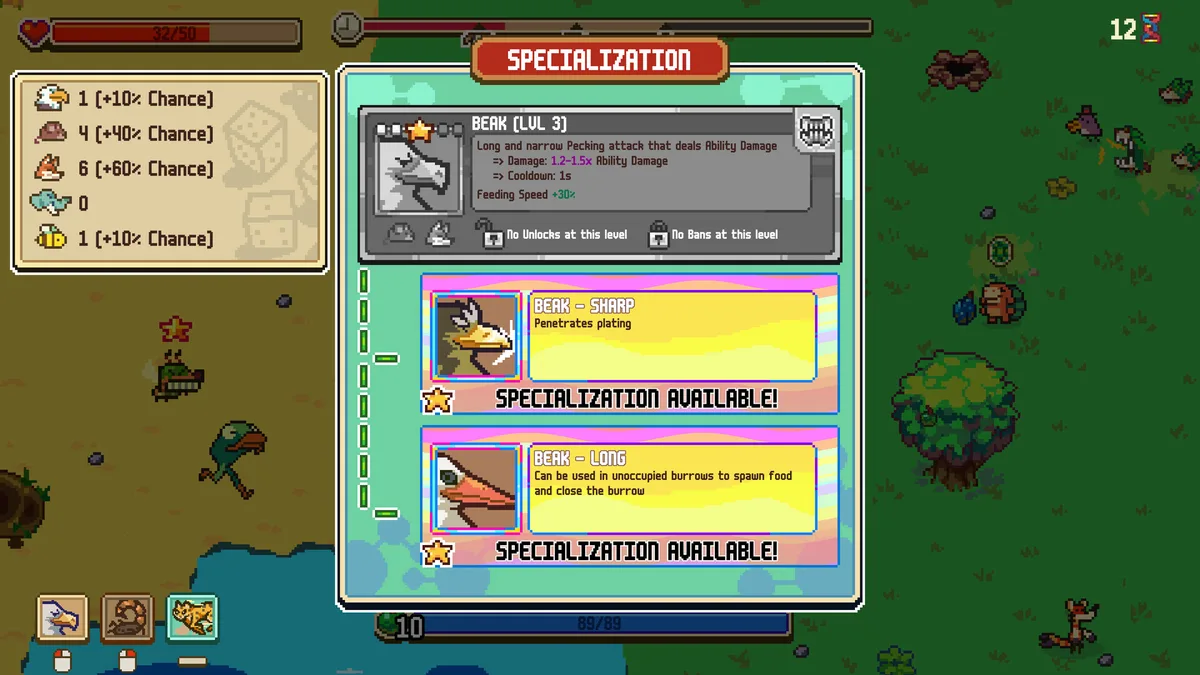 Mid-run specialization choice: picking a Beak variant changes what the evolution does, not just how strong it is.
Four biomes ship at launch: arctic tundra, red rock desert, ocean depths, and at least one temperate environment. Each has its own climate events, points of interest, flora and fauna, and different rules about which evolutions are viable. An evolution that thrives in the desert might be a liability in the ocean depths.
Between runs, meta-progression gives you two main levers. Genetics are starting characters: you can combine multiple genetics to create varied starting loadouts. The Codex tracks your discoveries across runs. Challenge scenarios add modifiers: Ice Age changes the climate conditions, Always Night removes the day/night cycle entirely, and Hunted makes you a primary target for predators from the start. Endless mode, unlockable after you've cleared the standard content, removes the run timer.
The difficulty range is wide. The demo had eight difficulty levels, and the full game extends that. You can tune this from a relatively forgiving survival experience to something that's aggressively punishing: especially on the Hunted challenge where predators prioritize you immediately.
GODEEPER: If you want another roguelite that rewards deep build commitment over safe variety, All Hail the Orb delivers that in a very different package. All Hail the Orb Review →
Why it matters
$9.99 for a Steam roguelite launching Steam Deck Verified in May 2026 is a reasonable proposition. What makes it worth paying attention to beyond the price is the timing and the concept.
The animal evolution angle isn't a thin coat of paint over a standard Vampire Survivors clone. The Loot Level Chill preview called it "a hugely compelling experience" and specifically noted that it moves slower than screen-filling chaos games: the ecosystem interaction is the point, not the spectacle of killing 500 things at once. That's a meaningful design choice. It targets a different mood than most auto-battlers or bullet-hell survivors.
Odd Dreams Digital has one game to their name. This is it. The studio was founded in 2024 by industry veterans, and everything about the pacing of its development (two public playtests, steady iteration, Steam Deck certification on day one) reads like a team that knows what it's doing. The publisher Secret Mode has a track record of backing games that actually finish.
The free demo is still available on Steam. That's a meaningful signal about confidence. You can try a substantial portion of the game before spending anything.
From a market standpoint, the everything is crab game sits in an interesting position. It's not Vampire Survivors (faster, simpler). It's not Slay the Spire (no card layer). It's probably closest to Spore's creature stage crossed with a survival ecosystem sim, wrapped in roguelite runs. That comparison is inexact but it's the reference point most preview outlets reach for. I've played both and the Everything is Crab ecosystem actually behaves more believably than Spore's ever did.
Tips for launch day
Start on a lower difficulty setting. The ecosystem can be overwhelming when you're still learning which evolutions synergize. Eight difficulty levels exist for a reason: use them.
Try a forager run early. It's tempting to immediately hunt everything, but forager builds create a different reading of the ecosystem. You'll learn the biome and creature behavior faster when you're not just charging at things.
Don't ignore the Codex. It tracks your evolution discoveries and meta-progress. Consulting it before picking evolutions mid-run helps you identify what you haven't tried yet: and what you've found works.
Commit to carcinization or resist it deliberately. The worst thing you can do is accidentally drift toward crab-form without synergizing the evolutions. Decide at the start of a run whether you're going full crab or staying hybrid. The carcinization build wants at least five or six crab-form evolutions stacked to see its real advantages.
Night changes the rules. Don't assume what worked during daytime play will carry straight through. Some predators are more active at night; some prey is harder to find. Adjust your feeding strategy before the light drops.
Check challenge scenarios after your first few clears. Hunted especially is a different game: it's built to stress-test how well you understand predator behavior. Ice Age is more forgiving as a modifier, which makes it a good second challenge to try.
Frequently Asked Questions
What is the Everything is Crab game? Everything is Crab: The Animal Evolution Roguelite is an action roguelite by Odd Dreams Digital where you start as an amorphous blob and evolve using 125+ animal-inspired evolutions each run. It launched May 8, 2026 on Steam for $9.99.
How does the evolution system work in Everything is Crab? You gain evolutions by hunting, consuming, or foraging: earning points that let you pick from a pool of mutations each level. Evolutions range from standard traits like extra legs to unusual ones like poisonous saliva or a pistol shrimp's pincer. Each choice visibly alters your creature and changes how it moves and fights.
What is carcinization in Everything is Crab? Carcinization is the real biological phenomenon where non-crab crustaceans independently evolve into crab-like forms. In the game, you can lean into it by stacking crab-form evolutions for a specialized build, or resist it and stay as a stranger hybrid creature. Going full crab is a viable archetype with its own synergies.
Is there meta-progression in Everything is Crab? Yes. You unlock genetics (combinable starting characters with different trait loadouts), an Endless run mode without a timer, challenge scenarios like Ice Age, Always Night, and Hunted, and a Codex that tracks your discoveries across runs.
Is Everything is Crab on Steam Deck? Yes, Steam Deck Verified at launch on May 8, 2026. It runs with cloud saves and achievements, and the minimum specs are modest: AMD Ryzen 5 5600G with 4GB RAM.
What are the biomes in Everything is Crab? The game features four distinct biomes: arctic tundra, red rock desert, ocean depths, and at least one temperate environment. Each has different flora, fauna, climate events, and rules that change which evolutions are viable.
How long is a run in Everything is Crab? Runs are structured around day/night cycles with crab-based boss encounters at intervals. The Endless mode (unlockable after normal play) removes the timer. A standard run appears to take 20-40 minutes depending on your build and difficulty.
References
- Everything is Crab: The Animal Evolution Roguelite on Steam
- Everything is Crab Evolves into a Full Release on 8 May: Secret Mode
- Don't Lose Your Shell in Evolutionary Roguelite Everything is Crab: Secret Mode
- Everything is Crab Preview: Loot Level Chill
- Odd Dreams Digital: Developer Page
For another indie roguelite launching this season, see the Vampire Crawlers Review: poncle's deckbuilder covers very different ground but shares the same commitment to run-to-run build variety.
Related Reading
- Vampire Crawlers Review: poncle's turn-based deckbuilder, another indie roguelite built on run-to-run build variety.
- Rune Dice Tier List: All 8 Classes Ranked: a roguelite where committing to a build archetype decides the run.
- The Spell Brigade Tips: a co-op survivors-like for fans of escalating-power roguelite runs.
- Cursemark Review: another rune-and-build roguelite that rewards committing early over staying flexible.
- Lost Castle 2 Review: a 1.0-launch roguelite worth comparing on how a small studio handles post-launch balance.
- LegionBound Synergy Guide: All 42 Classes: a much larger archetype roster for readers who want the build-variety idea taken further.
- Killer Bean Review: a tighter, mission-structured roguelite for a shorter-session comparison.
About the author

Indie & JRPG Critic
Indie game evangelist and lifelong JRPG fan covering small studios since 2017. Mumbai-born, London-based. Writes the way she talks.
- 7 years indie games coverage
- JRPG and visual novel specialist
- Narrative design focus
Keep reading


Disclaimer
This article is published for informational and entertainment purposes. It does not constitute professional financial, legal, or technical advice. Game performance, online services, patch schedules, and store listings change. Verify critical details (pricing, system requirements, regional availability) with publishers and storefronts before you buy. Affiliate links, where present, help support our editorial work and are labelled in our affiliate disclosure.
Comments
Loading comments…