
GameBrief · Guides
WARDOGS Vehicles Guide: Every Tank, Heli, and Truck
Reviewing
WARDOGS
BULKHEAD · Team17
This WARDOGS vehicles guide exists because almost none of the vehicle numbers floating around online agree with each other, and twenty-plus purchasable vehicles is a lot to get wrong. That's not really anyone's fault: BULKHEAD's economy has already had at least one balance pass since Early Access launched on September 10, and a handful of vehicles were renamed or replaced between the closed beta and Season 1. This guide separates what's actually confirmed, current spawn prices, blueprint unlock costs, and the mechanic almost nobody explains clearly, from numbers that are still floating around from an older build.
TL;DR: WARDOGS vehicles split into ground transport, tanks, artillery, and helicopters, roughly 20 in total. Every vehicle has two separate costs: a one-time blueprint unlock tied to your Driver or Pilot level, and a recurring spawn price you pay each life afterward. The SPH-2 ("Artillery Tank") needs a $500,000 Career-level-90 unlock but only costs about $8,000 per pull once unlocked. Ground vehicles range from the $500 Bobcat to the $6,750 armed Ural Defender; helicopters run from the $6,250 MH-6 up to the $18,000 Havoc.
What vehicles are in WARDOGS? (quick answer)
WARDOGS' current vehicle roster covers four categories: unarmed and armed ground transport (Bobcat, Dune Buggy, Kodiak, Humvee, Ural, and Ural Defender, several with mounted M249 or minigun variants), two tanks (the L2A6 main battle tank and the anti-air Flakpanzer Gepard), the SPH-2 artillery piece, and six helicopters split between transport and gunship roles. Every one of them is a per-life purchase from the same cash economy that funds your weapon loadout.
WARDOGS vehicles status: September 2026
Season 1 is still a moving target for vehicle prices. BULKHEAD's official launch notes moved the SPH-2 artillery unlock to Career level 90, moved the Heavy Tank to Driver level 35, and increased the prices of the Forward Operating Base and Large Hammer. Those notes establish the progression changes, but they do not publish a complete vehicle-price table. The $500,000 SPH-2 unlock and roughly $8,000 spawn price used below are the current values repeated by the WARDOGS Handbook and other community databases, not a promise that a future hotfix cannot change them.
The useful rule is stable even when the economy is not: a blueprint unlock is a one-time progression purchase, while a spawn price is paid again when you pull a vehicle into a life. Read the tables and examples with that distinction in mind, and verify the vendor before spending a large reserve, our WARDOGS FOB guide documents the same kind of Season 1 price movement on the building side.
WARDOGS vehicles: key takeaways
- Roughly 20 vehicles exist across ground transport, tanks, artillery, and helicopters
- Every vehicle has two costs: a one-time blueprint unlock tied to a level, and a recurring per-life spawn price
- Ground transport runs $500 (Bobcat) to $6,750 (armed Ural Defender)
- Helicopters run $6,250 (MH-6) to $18,000 (Havoc), before any blueprint unlock
- The SPH-2 "Artillery Tank" needs a $500,000 unlock at Career level 90, then costs about $8,000 per pull
- Losing a vehicle means paying the spawn price again, unless you reach a Repair Station first
Overview
This guide reflects the vehicle roster as of the September 14, 2026 Season 1 patch, the same balance pass BULKHEAD used to raise several unlock costs and rework helicopter naming, our Week One coverage has the fuller patch timeline if you want the surrounding context. It covers what each vehicle costs, what separates a spawn price from a blueprint unlock, and where the roster still has open questions. It assumes you already understand the Control Zone objective and cash economy; if you don't, our WARDOGS beginner guide covers those basics first. One honest caveat up front: this is a one-week-old Early Access economy, several of the numbers below are the best current community measurements rather than an official patch-notes table, and BULKHEAD has already changed at least two of them once.
Step-by-Step: buying and unlocking a vehicle
1. Check whether the vehicle needs a blueprint unlock first. This is the single most misunderstood part of the vehicle system. Basic ground transport (Bobcat, Dune Buggy, Kodiak, base Humvee, Ural) is available to buy the moment you have the cash. Higher-tier vehicles, armed helicopter variants, the Havoc, the SPH-2, are locked behind a permanent, one-time blueprint purchase tied to your Driver or Pilot track level. You only pay that unlock cost once, ever, on your account. After that, the vehicle behaves like anything else in the shop.
2. Level the right track before you save for an expensive unlock. The armed Little Bird blueprint needs Pilot level 4, the Z20 Lakota needs Pilot 10, the AH-6R needs Pilot 20, and the Havoc tops the list at Pilot 35. The SPH-2 artillery unlock sits on a separate track entirely, Career level 90, not Pilot. Grinding cash for a $500,000 unlock you can't legally purchase yet because you're not leveled is the single most common vehicle mistake in the current build. Check the level requirement before you check your bank balance.
3. Buy the spawn each life from the vehicle vendor. Once a vehicle is unlocked (or if it never needed unlocking), the price you pay is the recurring per-life cost, not the blueprint number. This is where a lot of third-party price lists get confusing, because they mix the two numbers together. A Bobcat is $500 every time. An unlocked SPH-2 is roughly $8,000 every time, a fraction of the $500,000 it took to unlock in the first place.
4. Choose armed variants deliberately, not by default. Several ground vehicles come in a base and an armed configuration: Kodiak (M249) runs about $3,750 against $2,500 base, Humvee (M249) is about $3,750 against $3,000 base, Humvee (Minigun) is about $4,500, and Ural Defender (M249) runs about $6,750. The armed versions cost more per life and die to the same anti-vehicle weapons the base versions do, so they're worth the premium mainly when you're planning to hold a position rather than just ferry a squad across the map.
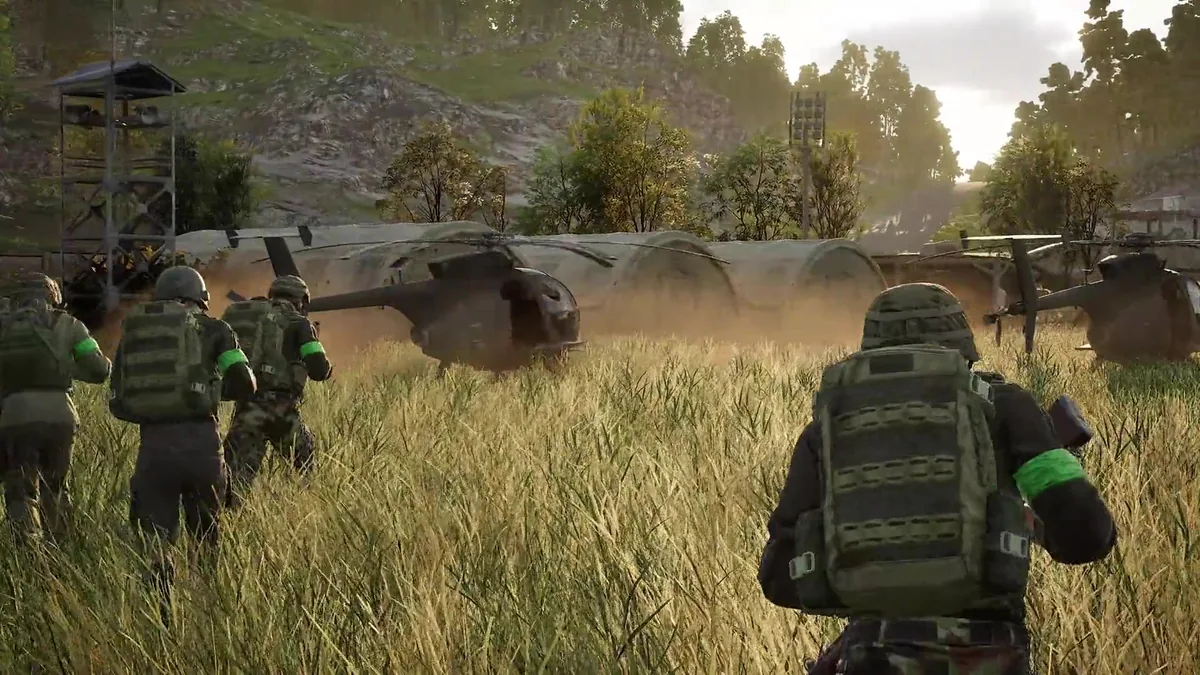 Caption: A squad closing in on a pair of MH-6-style transport helicopters, the cheapest way to move a squad by air before any armed variant or blueprint unlock enters the picture.
5. Match the vehicle to the job, not the price tag. A $14,000 L2A6 main battle tank is overkill for scouting a Hot Zone and underkill for actually holding a Control Zone alone. The anti-air Flakpanzer Gepard, roughly $8,000, exists specifically to answer helicopters, bring it when the enemy team is flying, not as a general-purpose tank substitute. Transport helicopters like the MH-6 (about $6,250) or Z20 Lakota (about $7,400, the vehicle that replaced the older UH-1Y naming in Closed Beta 02) move people and pallets faster than any ground route, while combat helicopters like the AH-6M miniguns (about $7,000) or AH-6R rockets (about $12,500) exist to contest the sky, not to ferry cargo.
GODEEPER: For the actual dollar amounts behind transport runs, pallet delivery, and Hot Zone camping, our WARDOGS money guide has the fastest confirmed ways to fund an expensive vehicle unlock.
6. Get to a Repair Station before you write a vehicle off. A damaged vehicle can be repaired using Mechanical Supplies at a Repair Station instead of abandoning it to pay full spawn price again next life. This only matters if the vehicle survives long enough to limp back, a vehicle that's already destroyed is gone, but a smoking, half-tracked one is worth the detour if a station is close.
Tips
Fuel and resupply matter more than the sticker price. Vehicles in WARDOGS consume fuel during operation and need refueling from jerrycans or a Refuel Station running on Fuel Supplies, the same supply category that powers a FOB's Drill Rig. A $500 Bobcat that runs dry a kilometer from the fight is worse than no vehicle at all; check your fuel gauge before you commit to a long haul.
Don't buy the blueprint unlock the moment you hit the level. Because the unlock is permanent and the level requirement doesn't expire, there's no rush the instant you cross Pilot 35 or Career 90. Save the cash for a match where you'll actually get real use out of it, rather than spending your whole bankroll the second the option appears and starting the next match broke.
An armed Humvee is a target, not just a threat. The RPG and rocket launcher loadouts available to infantry can drop an armed Humvee or Kodiak in one or two hits if the crew doesn't relocate constantly. Treat any armed ground vehicle as something that draws attention the moment it opens fire, staying stationary after your first shots is how expensive vehicles die to a single infantry player.
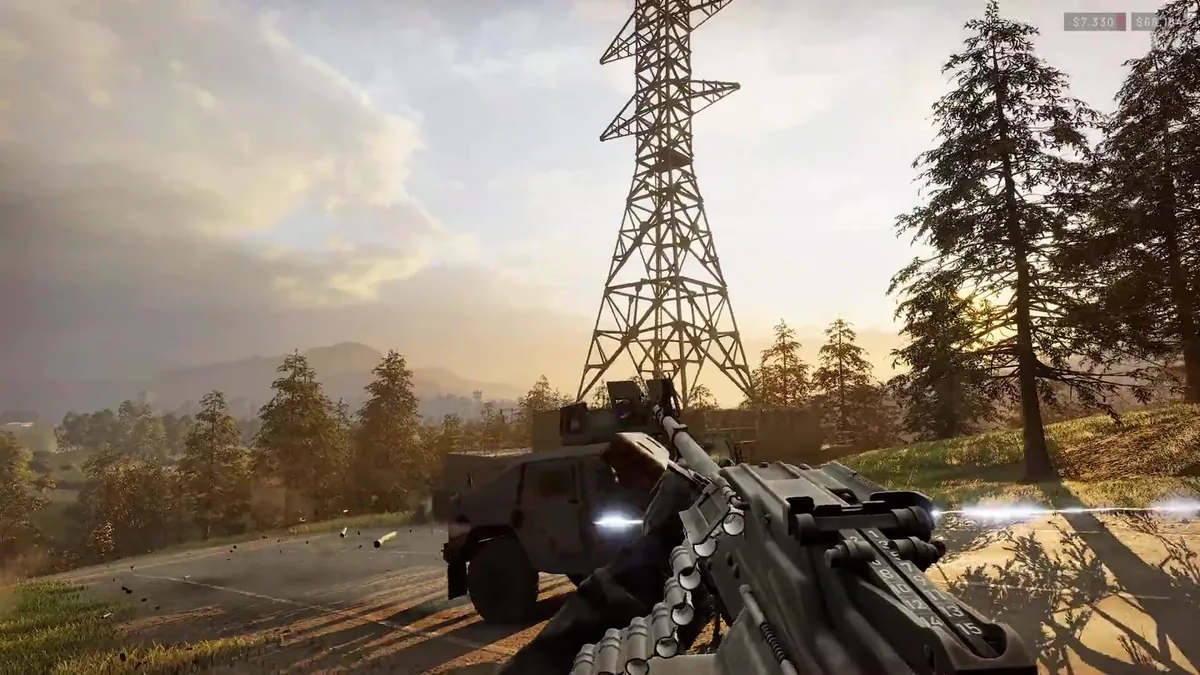 Caption: An armed Humvee under fire beside a power line tower, the exact scenario that makes constant repositioning worth more than raw firepower.
Helicopters reward Pilot-track leveling specifically, not general playtime. Per BULKHEAD's own progression design, only time spent actually flying and fighting in helicopters advances the Pilot track that gates the better airframes, our WARDOGS classes guide breaks down exactly what counts toward each of the six tracks if you're not sure where your XP is currently going.
Common mistakes
Confusing the unlock cost with the spawn price. This is the single biggest source of vehicle sticker shock in WARDOGS right now. Seeing "$500,000" attached to the SPH-2 and assuming that's what it costs every life leads players to write off the vehicle entirely, when the real per-life cost afterward is closer to $8,000, in the same range as a tank. The same blueprint-unlock pattern also gates hammer tiers, our WARDOGS FOB guide covers the Support-side equivalent of this mistake.
Buying an armed variant before you can afford to lose it twice. The extra few hundred to a couple thousand dollars for a minigun or M249 mount adds up fast if you're dying in the vehicle repeatedly while learning a map. Start with the base version until you're consistently surviving with it.
Flying a transport helicopter into contested airspace. MH-6 and Z20 Lakota variants exist for logistics, not dogfighting, they have no offensive armament of their own. Losing one to a Flakpanzer Gepard or an AH-6R because you flew a supply run straight through an active air fight is an avoidable, expensive mistake.
Ignoring the anti-air option when the enemy team is flying. A team that lets enemy helicopters operate unchallenged is giving up transport speed, aerial spotting, and combat helicopter pressure for free. The Flakpanzer Gepard is the direct answer and it's cheaper than either tank alternative, our Iron Nest review covers a much smaller-scale game built entirely around that same fixed-emplacement-versus-vehicle tension, if you want to see the idea taken to its extreme.
BESTPRICE: Haven't picked up WARDOGS yet? A Steam key through Gameseal is often cheaper than the direct Steam price. Get WARDOGS on Gameseal →
Frequently Asked Questions
What vehicles are in WARDOGS? Ground transport (Bobcat through Ural Defender), armed variants with mounted M249s or miniguns, two tanks (L2A6 and the anti-air Flakpanzer Gepard), the SPH-2 artillery, and six helicopters split between transport and combat roles.
How much does the WARDOGS Artillery Tank cost? The SPH-2, the vehicle most players call the Artillery Tank, is currently listed with a one-time $500,000 unlock at Career level 90 and an approximately $8,000 spawn price in community vehicle databases. The Season 1 notes confirm the level move and a price increase, so check the in-game vendor before treating either number as permanent.
Do you keep a vehicle after you buy it in WARDOGS? No. Every vehicle spawn is a per-life purchase, the same as buying a weapon loadout. Losing the vehicle to destruction or abandoning it means paying the spawn price again next time, unless you can get it repaired first.
What is the cheapest vehicle in WARDOGS? The Bobcat, an unarmed light utility vehicle, at roughly $500. It won't survive a direct hit from anything bigger than small-arms fire, but it's the fastest way to get a squad moving early in a match without touching your cash reserve.
How do vehicle unlocks work in WARDOGS? Higher-tier vehicles need a one-time blueprint unlock tied to your Driver or Pilot track level before you can ever buy one, separate from the spawn price you pay each life afterward. The Havoc, for example, needs Pilot level 35 to unlock at all.
Can you repair vehicles in WARDOGS? Yes. A damaged vehicle can be repaired at a Repair Station using Mechanical Supplies instead of abandoning it and paying full price again. This only works if the vehicle survives combat long enough to reach a station.
References
- WARDOGS on Steam: official store page confirming the $10,000 starting economy and vehicle purchasing as a core design pillar.
- WARDOGS official announcements: Season 1 and Patch 0.11 notes, including the SPH-2/Heavy Tank progression changes and later server updates.
- WARDOGS Handbook: Vehicles: current community roster and vehicle price table, used with an explicit caveat because values have changed between builds.
- WARDOGS Wiki: Vehicles: versioned vehicle rows that cross-check the recurring prices and unlock requirements.
- WARDOGS Steam key on Gameseal: often cheaper than the direct Steam price.
- WARDOGS Steam Community discussions: active player discussion of current vehicle pricing given how recently Season 1 changed several numbers.
Related Reading
- WARDOGS Early Access: 100 Players, $10K Cash Start: WARDOGS Early Access launches Sep 10 with a persistent cash economy.
- WARDOGS Beginner Guide: Your First Match: the Control Zone objective and starting-loadout basics this vehicle guide assumes you already know.
- WARDOGS Review: 100-Player Chaos Worth the Rocky Launch: how the combined-arms vehicle sandbox factors into the game's overall Early Access verdict.
- WARDOGS Week One: 428K Players and the Queue Crisis: the Season 1 patch timeline behind several of this guide's price changes.
- Ground Branch 1.0 Launch: Reviews Dip Right Before Full Release: another tactical shooter's approach to vehicle-free, infantry-only combined arms, for comparison.
Was this guide helpful?
About the author

Senior Critic & Analyst
Former game data analyst turned critic with 11 years covering indie and mid-tier games. Based in Austin. Runs spreadsheets on games most people just play.
- 11 years games criticism
- Former game economy analyst
- Roguelike and strategy specialist
Keep reading

Disclaimer
This article is published for informational and entertainment purposes. It does not constitute professional financial, legal, or technical advice. Game performance, online services, patch schedules, and store listings change. Verify critical details (pricing, system requirements, regional availability) with publishers and storefronts before you buy. Affiliate links, where present, help support our editorial work and are labelled in our affiliate disclosure.
Comments
Loading comments…