
GameBrief · General
Saint of Chains Review: 2000s Horror FPS Done Right
Saint of Chains review: MystiveDev's retro psychological horror FPS now has full gamepad support and melee block. Updated post-launch verdict.

Reviewing
Saint of Chains
MystiveDev · MystiveDev
Score
Reviewed build: 1.0
Pros
- 2000s-era retro FPS aesthetic used purposefully, not just nostalgically
- Father-searching-for-family premise gives the horror weight and direction
- Environment shifting between nightmare states keeps the pacing from stagnating
Cons
- The launch build's melee felt underpowered compared to its gun options
- Some puzzle solutions are frustratingly obtuse without signposting
Verdict
Saint of Chains delivers a focused retro horror experience for players who miss when FPS games took risks with psychology.
Key takeaways
- Saint of Chains is a psychological horror FPS with deliberate 2000s-era retro design.
- You play a father searching through shifting nightmare environments for his lost family.
- Combat mixes guns, melee, and puzzle-solving. The launch build's melee was the weakest of the three, though later updates added blocking and stagger.
- Environments actively change between nightmare states, keeping spaces unpredictable.
- Rating: 7.2/10. Recommended for horror FPS players who can tolerate obtuse puzzle design.
This 7.2/10 score is for the 1.0 launch build. Since then, MystiveDev has shipped full gamepad support in Update 1.1.0 and the Flesh & Steel update, which added manual melee blocking, enemy stagger after successful blocks, and map room labels. Steam lists Saint of Chains at $12.99, with 81% of 66 reviews positive in this audit snapshot. Those changes improve the current build, but they do not rewrite what the launch review evaluated.
What Saint of Chains is
Saint of Chains is a psychological horror FPS from MystiveDev, and it came out of Steam Next Fest with quiet but genuine enthusiasm from the small audience that found the demo. That's the right kind of pre-launch signal for a game like this: not viral, not overhyped, just found by the people it was made for.
The premise is direct. You're a father. Your family is gone. The environments you're walking through are nightmares: not metaphor, not stylistic flourish, actual collapsing dream-logic spaces that shift and distort as you move through them. Saint of Chains isn't pretending this is a grounded thriller. It commits to the psychological horror framing completely, which means the aesthetics follow from the concept rather than sitting on top of it.
The 2000s-era retro FPS design is the most immediately striking thing about saint of chains. Pre-HD texture quality, the kind of atmospheric darkness that modern engines render differently, the feel of being inside a game from a specific moment in the genre's history. This isn't purely nostalgia: the visual register is doing actual tonal work. Low-fidelity horror has a specific quality that high-resolution assets can't replicate. MystiveDev clearly understands this.
Saint of Chains post-launch updates: controller support and melee block
The current build is more comfortable to play than the launch version. Update 1.1.0, released June 22, added full gamepad support across gameplay and menus, button remapping, dynamic button icons, slight aim assist, expanded Apartments and Sewers levels, and collectibles throughout the game. The Flesh & Steel update then added manual melee blocking, enemy stagger after a successful block, and room and area labels on the map.
That distinction matters when reading the verdict below. The launch review's criticism of melee describes the 1.0 build, where the option felt underpowered and inconsistent. The later block and stagger systems give close-range play a clearer defensive purpose. If controller support was the reason you skipped Saint of Chains at launch, the official update notes now confirm that the gap is closed. For another short horror review with a different approach to disorientation, compare TetherGeist's review; Mortal Shell 2's review is a useful contrast for players who want more combat weight. Bylina's review and Dark Scrolls' review cover two other small horror-adjacent experiments.
The horror approach
The horror in Saint of Chains comes from disorientation, not shock. Rooms change. Corridors you've walked before lead somewhere different. The nightmare logic isn't consistent in ways that let you map your route. This approach produces unease that persists instead of the brief spike-and-recovery you get from a jump scare.
And it's the kind of horror approach that suits an FPS. You're never safe because you can't trust the space. You know you have a gun. What you don't know is what's around the corner or whether the corner was there a minute ago.
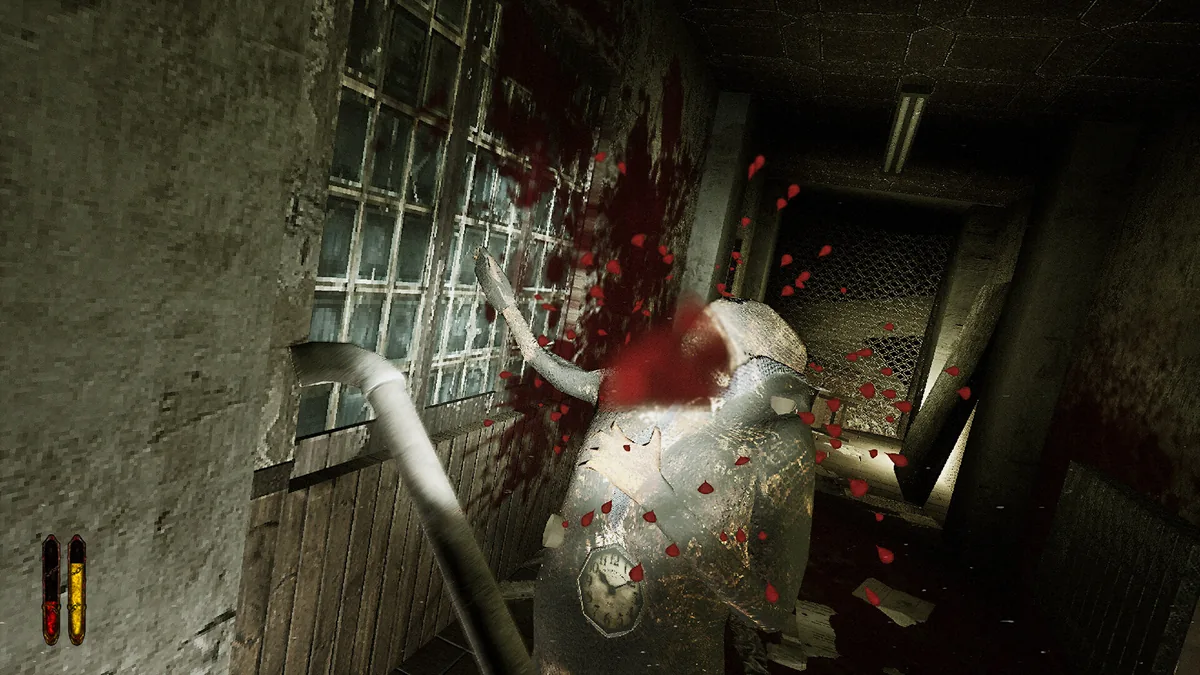 Caption: The nightmare environments in Saint of Chains shift and distort. What looks like a corridor becomes something else. The unreliability is the point.
The father premise is doing more work than it might initially appear. It gives the horror emotional stakes that are legible without being overly explained. You're not an action hero moving through a haunted space. You're someone whose family is missing and who has ended up somewhere that doesn't follow the rules of the world they knew. That reading makes the psychological elements land harder.
For comparison, the atmospheric work in TetherGeist takes a completely different structural approach to building dread, leaning on environmental storytelling without the direct combat of saint of chains. The two games are interesting to think about side by side.
Combat: guns, melee, and puzzle solving
Saint of Chains is an FPS, but calling it just a shooter undersells the structure. You have firearms, you have melee options, and you have puzzles that block your path and require you to stop and think before you can move forward.
The gun combat works. The 2000s-era feel extends to how weapons handle: deliberate, with weight to each shot, in the tradition of the horror-adjacent FPS games of that period. Doom didn't invent this; that era did.
Melee is less convincing. (This is not a small issue in a game where ammo is not guaranteed to be plentiful.) The reach feels inconsistent, and against enemies that move unpredictably through distorted spaces, swinging at close range loses what advantage you'd expect from a melee option. Most players will default to guns and avoid melee unless forced into it. That's a missed opportunity. A horror FPS in collapsing nightmare rooms should be able to make punching through a warped door feel right.
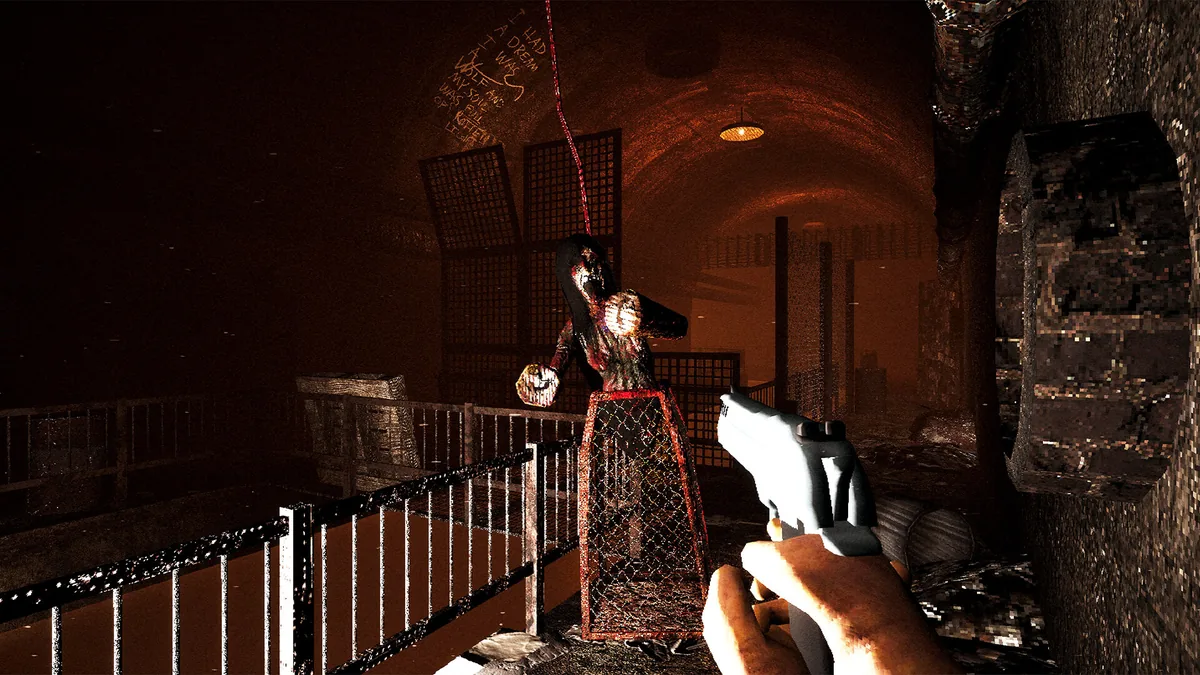 Caption: Gun combat in Saint of Chains handles with the deliberate weight you'd expect from a 2000s-era FPS. The encounters are designed around the space they inhabit.
The puzzles are the other place where saint of chains has a friction problem. Some solutions are genuinely clever, reading the nightmare logic of the space to find a path forward. Others are obtuse without enough environmental signposting to make the intended solution feel discoverable rather than arbitrary. For players willing to stop and think, this is fine. For players who want horror momentum maintained, a puzzle that stops you for 15 minutes on solutions that aren't clearly telegraphed is a pacing disruption.
Melee combat principles differ significantly from what's needed in an FPS like this. The Kristala combat guide demonstrates how good melee timing design should telegraph its windows, something Saint of Chains could learn from.
GODEEPER: For a benchmark on how good melee timing design feels when it's working, the Kristala review covers a parry-based combat system from a 2026 debut studio that shipped it right. Kristala Review: Souls-Like with a Parry Loop →
Who Saint of Chains is for
Saint of Chains is specifically for players who know they want a horror FPS with psychological stakes and are willing to accept rough edges for the right kind of atmosphere. It's not a polished AA production. It's a small game with a clear vision, executed to a standard that serves that vision with occasional gaps.
The retro FPS crowd will feel at home. The 2000s horror game crowd (the people who played F.E.A.R., Condemned, or the earlier Silent Hill games and miss that specific flavor of distorted first-person horror) will find something familiar here at a price that respects their time.
For other recent indie reviews in a similar spirit, Gambonanza is a different genre entirely but represents the same independent risk-taking that makes saint of chains interesting despite its limitations.
Players who need polished melee combat or clearly signposted puzzles will hit friction. That's an honest limitation, not a deal-breaker if you know what you're buying.
Saint of Chains review verdict
Saint of Chains is a 7.2. It does the specific thing it sets out to do, retro psychological horror FPS with shifting environments and a father's grief as its emotional core, with enough conviction that the limitations don't undermine the experience.
MystiveDev has made a game that trusts its own concept. The 2000s aesthetics aren't a failure of resources; they're a deliberate choice that serves the tonal work. The shifting environments keep the spaces from going stale. The premise gives the horror weight.
The launch-build melee felt underpowered and some puzzle solutions needed better signposting. The later block and stagger update gives the current version more defensive texture, but this review keeps its 1.0 score rather than silently regrading the game. Saint of chains knows what it is, and it's confident enough in that to not overexplain or overcorrect. That confidence earns the 7.2.
GODEEPER: If you're scoping other recent indie releases before committing, Bylina is another 2026 debut from a first-time studio doing something distinct with a well-worn genre. Bylina Review: Slavic Souls-Like Verdict →
Frequently Asked Questions
What is Saint of Chains? Saint of Chains is a psychological horror FPS by MystiveDev. You play a father in shifting nightmare environments, using guns, melee, and puzzle-solving to search for the family he lost. It released May 12, 2026 on PC.
Is it scary? The game focuses on sustained psychological dread through distorted, shifting environments rather than jump scares. The atmosphere is consistently disorienting in a way that suits players who find environmental horror more effective than shock moments.
How long is the game? Roughly 5 to 8 hours for most players, depending on puzzle-solving pace and exploration.
Who made it? MystiveDev, a small indie developer. The project has a very specific aesthetic vision built around 2000s-era FPS horror.
Is it on console? PC only. No console ports announced.
Does it have a demo? Yes. A Steam Next Fest demo was available and received positive reception before the full May 12 launch.
Does it have controller support? Yes. Update 1.1.0 added full gamepad support, remapping, dynamic button icons, and support across the menus and gameplay interactions.
References
- Saint of Chains on Steam
- Saint of Chains official Steam announcements: Update 1.1.0 and the Flesh & Steel combat update
- MystiveDev on Steam
About the author

Games Critic
Games writer and reluctant optimist who has reviewed over 400 titles across 9 years. Irish, currently in Berlin. Has strong opinions about tutorial design.
- 400+ games reviewed across 9 years
- Platformer and horror specialist
- Narrative design focus
Keep reading

Disclaimer
This article is published for informational and entertainment purposes. It does not constitute professional financial, legal, or technical advice. Game performance, online services, patch schedules, and store listings change. Verify critical details (pricing, system requirements, regional availability) with publishers and storefronts before you buy. Affiliate links, where present, help support our editorial work and are labelled in our affiliate disclosure.
Comments
Loading comments…